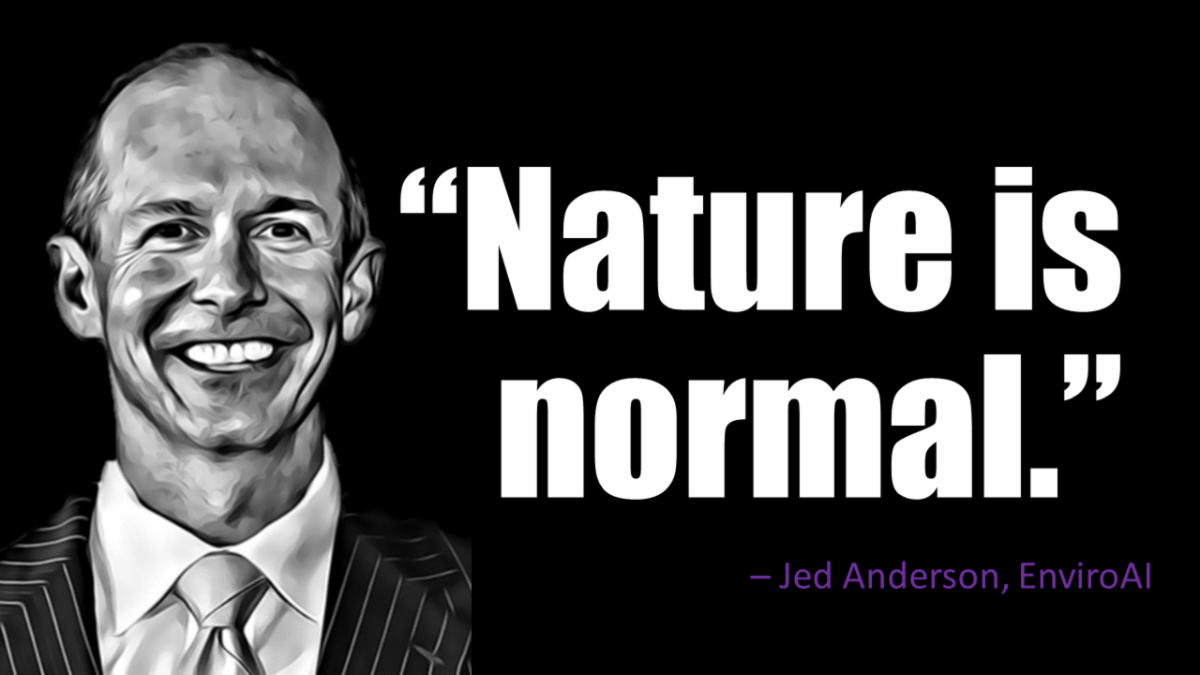
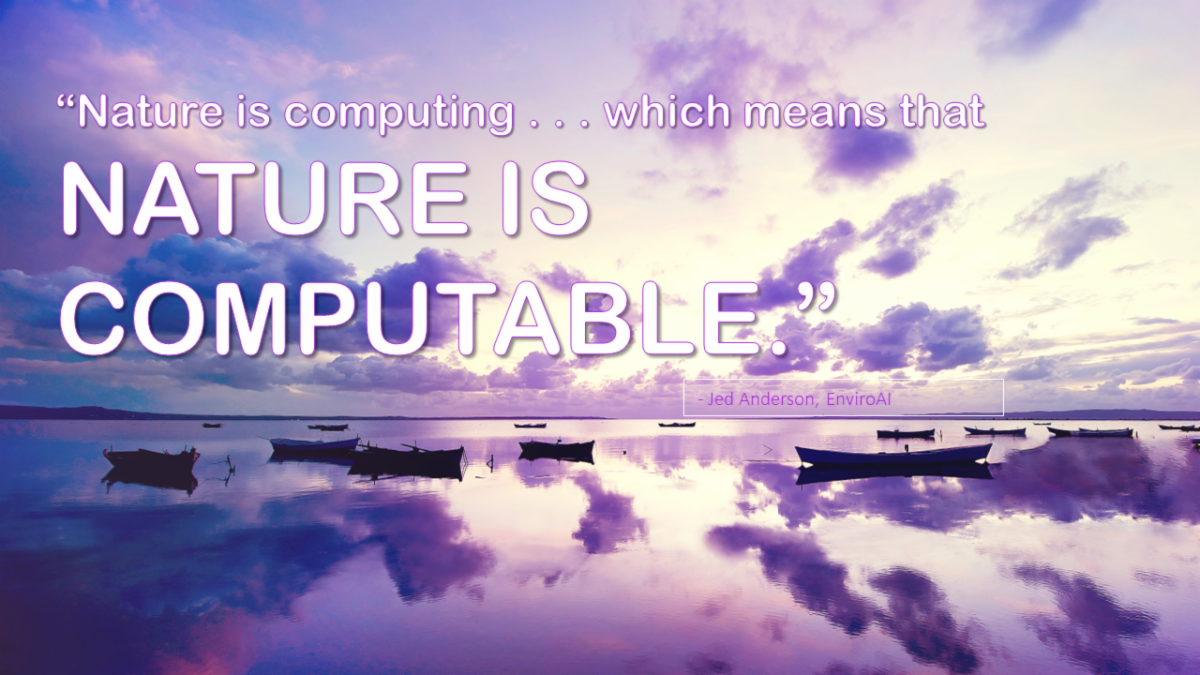
---"Identifying patterns in nature is powerful, but what will really be powerful is identifying the probability of patterns in nature prior to decoherence."
- Jed Anderson, EnviroAI
---“We are all agreed that your theory is crazy. The question which divides us is whether it is crazy enough to be right.”― Niels Bohr
“The visible world is a daily miracle, for those who have eyes and ears.” ― Edith Warton
“The most exciting phrase to hear in science, the one that heralds the most discoveries, is not “Eureka!” (I found it!) but ‘That’s funny…’ Isaac Asimov
"As usual, nature’s imagination far surpasses our own, as we have seen from the other theories which are subtle and deep." — Richard P. Feynman
I
"What if everything is an illusion and nothing exists? In that case, I definitely overpaid for my carpet." --Woody Allen
'The imagination of nature is far, far greater than the imagination of man." - Richard Feynman
"The whole question of imagination in science is often misunderstood by people in other disciplines. ... They overlook the fact that whatever we are allowed to imagine in science must be consistent with everything else we know." — Richard P. Feynman
“In a world where everything is ridiculous, nothing can be ridiculed. You cannot unmask a mask.” - GK Chesterton
“I remember discussions with Bohr which went through many hours till very late at night and ended almost in despair; and when at the end of the discussion I went alone for a walk in the neighboring park I repeated to myself again and again the question: Can nature possibly be so absurd as it seemed to us in these atomic experiments?”
Werner Heisenberg
"At any rate, it seems that the laws of physics present no barrier to reducing the size of computers until bits are the size of atoms, and quantum behavior holds dominant sway." Richard Feynman
"Progress in Science consists in seeing what everyone else has seen, but thinking what no one else has thought." Szent-Gyorgi
"Our imagination is stretched to the utmost, not, as in fiction, to imagine things which are not really there, but just to comprehend those things which are there." Richard Feynman
"The point is no longer that quantum mechanics is an extraordinarily (and for Einstein, unacceptably) peculiar theory, but that the world is an extraordinarily peculiar place." N. David Mermin
"The only 'failure' of quantum theory is its inability to provide a natural framework for our prejudices about the workings of the Universe." Wojciech Zurek
"Everything we call real is made of things that cannot be regarded as real.” --Niels Bohr
---“The fact that we live at the bottom of a deep gravity well, on the surface of a gas covered planet going around a nuclear fireball 90 million miles away and think this to be normal is obviously some indication of how skewed our perspective tends to be.”-- Douglas Adams
"Those who are not shocked when they first come across quantum theory cannot possibly have understood it.” --Niels Bohr
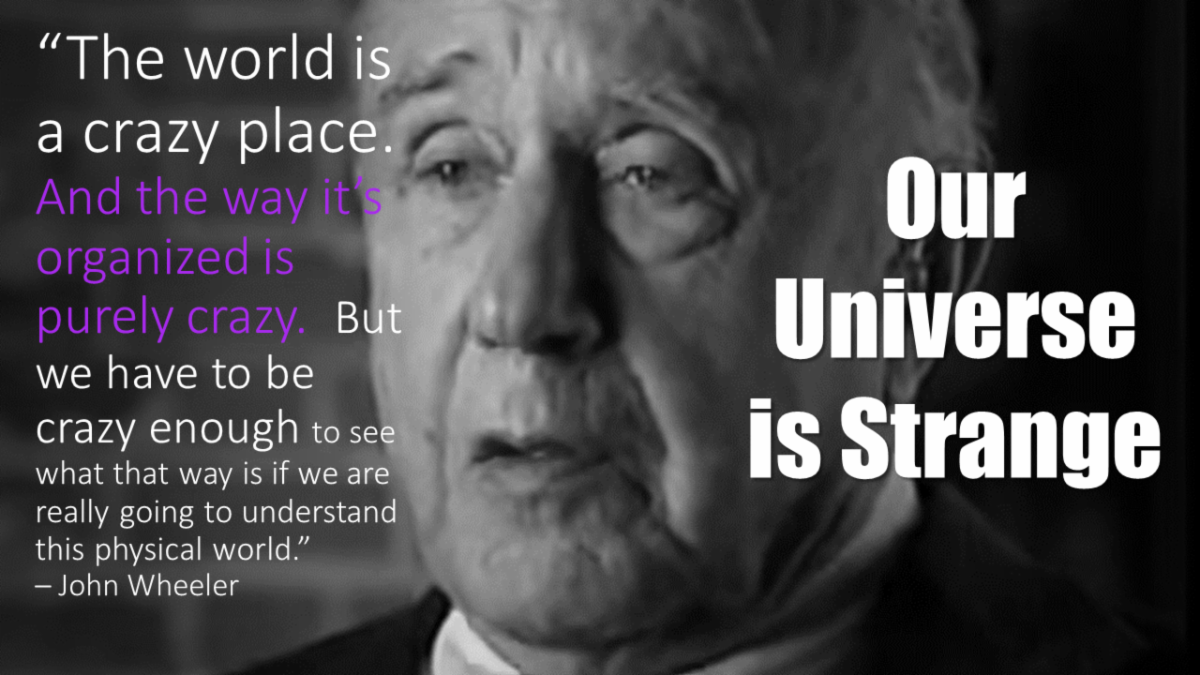
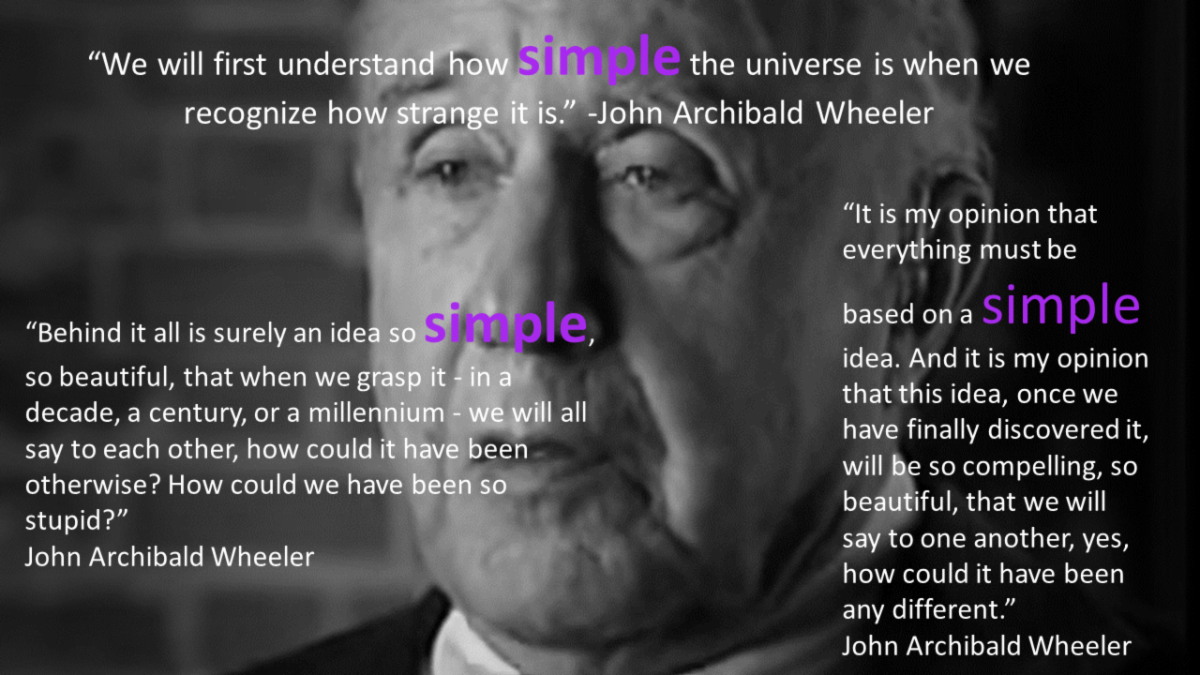
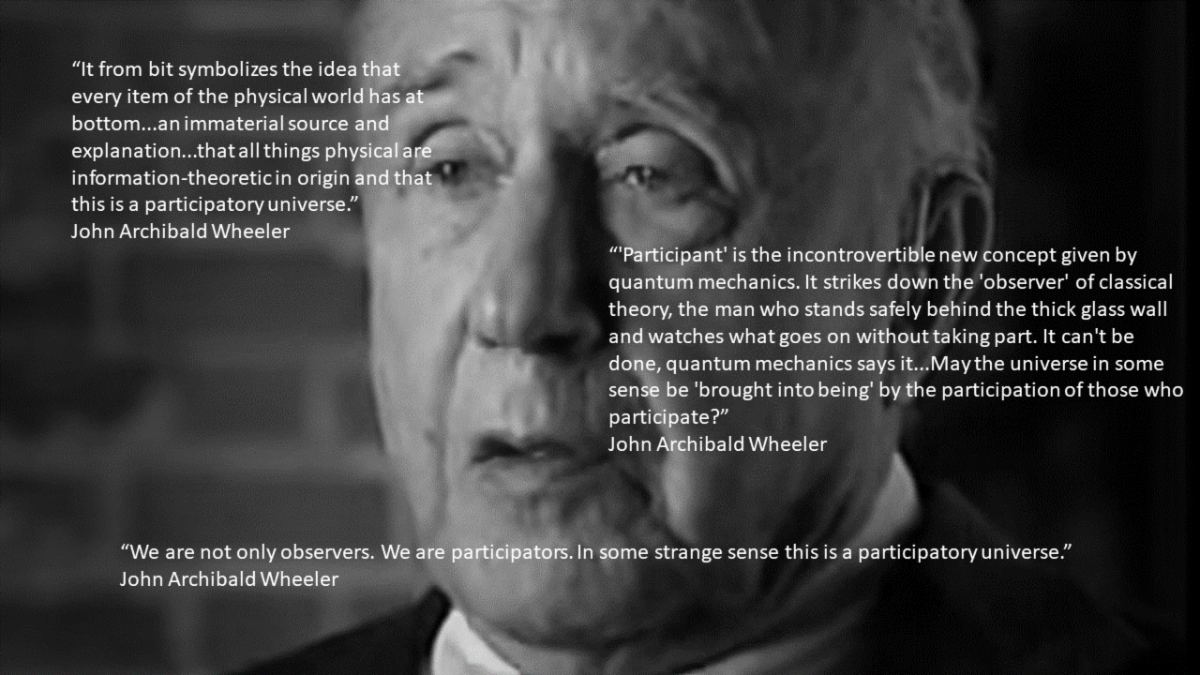
“If you are not completely confused by quantum mechanics, you do not understand it.” --John Wheeler
“I do not like [quantum mechanics], and I am sorry I ever had anything to do with it.” --Erwin Schrödinger
“Quantum mechanics makes absolutely no sense.” --Roger Penrose
“It is safe to say that nobody understands quantum mechanics.”--Richard Feynman
Superpositions have no classical interpretation. They are sui generis, an intrinsically quantum-mechanical construct... N. David Mermin
The nature of the relationships which the superposition principle requires to exist between the states of any system is of a kind that cannot be explained in terms of familiar physical concepts. One cannot in the classical sense piture a system being partly in each of two states and see the equivalence of this to the system being completely in some other state. There is an entirely new idea involved, to which one must get accoustomed and in terms of which one must proceed to build up an exact mathematical theory, without having any detailed classical picture. P. A. M. Dirac
Quantum mechanics is magic. Daniel Greenberger
So long as we can find no better alternative to quantum mechanics we have to accept that it supplies little, if anything, beyond a superlative procedure for making calculations. A. B. Pippard, Eur. J. Phys. 7, 43-48 (1986)
The point is no longer that quantum mechanics is an extraordinarily (and for Einstein, unacceptably) peculiar theory, but that the world is an extraordinarily peculiar place. N. David Mermin
The only 'failure' of quantum theory is its inability to provide a natural framework for our prejudices about the workings of the Universe. Wojciech Zurek
Progress in Science consists in seeing what everyone else has seen, but thinking what no one else has thought. Szent-Gyorgi
Science is basically an artistic endeavor. It has all the freedom of any other imaginative endeavor. The artist and the scientist both live at the edge of mystery, surrounded by it. Both struggle to make order out of chaos. Jacob Bronowski
At any rate, it seems that the laws of physics present no barrier to reducing the size of computers until bits are the size of atoms, and quantum behavior holds dominant sway. Richard Feynman, Foundations of Physics, 16, 530 (1986).
However, once scientists adjusted to quantum jumps, superpositions, and apparent action at a distance, they stopped asking why small things didn't behave like big things, and started wondering why big things didn't act like small things. The general conclusion was that macroscopic systems decohere rapidly, and that this dilution of quantumness is responsible for the apparently 'normal' behaviour. Cummins and Jones Contemporary Physics 41, 387 (2000).
Bohr was inconsistent, unclear, willfully obscure and right. Einstein was consistent, clear, down-to-earth and wrong. John Bell to Graham Farmelo
If one person made it respectable once more for physicists to think about and study the meaning of quantum mechanics, it would be John Bell. Whereas Niels Bohr enveloped the mysteries of quantum mechanics in a web of words as enigmatic and ambiguous as the subject he sought to explain, smothering his readers in a blanket of reassurance that warded off misunderstanding by the indirect expedient of creating a beguiling darkness that set in precisely at the point where one should want more light, and leading more than a few students of physics to conclude - not without, one may suppose, a dim sense of betrayal for how could a loyal apprentice admit the master's thick blandishments to conceal not great wisdom but the implicit acknowledgment of failure? - that his pronouncements had begun to resemble what Thomas Hardy said was the prose of Henry James, that is, a ponderously warm manner of saying nothing in infinite sentences, Bell pursued clarity above all. David Lindley, "Where Does the Weirdness Go?", page 127.
Anybody who's not bothered by Bell's theorem has to have rocks in his head. Distinguished Princeton Physicist to distinguished Cornell Physicist N. David Mermin
I think that a particle must have a separate reality independent of measurements. That is, an electron has spin, location and so forth even when it is not being measured. I like to think the moon is there even if I am not looking at it. Albert Einstein
We now know that the moon is demonstrably not there when nobody looks. N. David Mermin
Sometimes it seems to me that a bond between two atoms has become so real, so tangible, so friendly, that I can almost see it. Then I awake with a little shock, for a chemical bond is not a real thing. It does not exist. No one has ever seen one. No one ever will. It is a figment of our own imagination.... Here is a strange situation. The tangible, the real, the solid, is explained by the intangible, the unreal, the purely mental. Charles A. Coulson
We do not know: we can only guess. And our guesses are guided by a faith in the orderliness of nature and that this orderliness can be comprehended by the human mind. Karl Popper
---"We are perhaps not far removed from the time when we shall be able to submit the bulk of chemical phenomena to calculation." Joseph Louie Gay-Lussac (1888)
"Now we come to the heart of chemistry. If we can understand what holds atoms together as molecules we may also start to understand why, under certain conditions, old arrangements change in favor of new ones. We shall understand structure, and through structure, the mechanism of change." P. W. Atkins Molecular Quantum Mechanics, 1983, p. 250.
We virtually ignore the astonishing range of scientific and practical applications that quantum mechanics undergirds: today an estimated 30 percent of the U.S. gross national product is based on inventions made possible by quantum mecahnics, from semiconductors in computer chips to lasers in compact-disc players, magnetic resonance imaging in hospitals, and much more. Max Tegmark and John Archibald Wheeler Sicnetific American, February 2001
However frustrating to our intuition, a necessary condition for the interference of a quantum "with itself" is that the experiment be such that it is impossible, even in principle, to obtain information on the particular path the quantum has taken. In other words, quantum systems, which left alone, follow the proverbial policy of "don't ask, don't tell!" J.G. Roederer, Information and Its Role in Nature, 2005.
The universe...stands continually open to our gaze, but it cannot be understood unless one first learns to comprehend the language and interpret the characters in which it is written. It is written in the language of mathematics... Galileo Il Saggiatore (1623)
I don't demand that a theory correspond to reality because I don't know what it is. Reality is not a quality you can test with litmus paper. All I'm concerned with is that the theory should predict the results of experiment. Stephen Hawking
Meaning does not reside in the mathematical symbols. It resides in the cloud of thought enveloping these symbols. It is conveyed in words; these assign meaning to the symbols. Marvin Chester, Primer of Quantum Mechanics.
Everything in the future is a wave, everything in the past is a particle. Lawrence Bragg
One of the characteristic features of quantum theory is wave-particle duality, i.e., the ability of matter or light quanta to demonstrate the wave-like property of interference, and yet to appear subsequently in the form of localized particles, even after the interference has taken place. David Bohm (slightly modified by FR)
We may regard the present state of the universe as the effect of its past and the cause of its future. Laplace
In classical physics, the past is assumed to exist as a definite series of events, but according to quantum physics, the past, like the future, is indefinite and exists only as a spectrum of possibilities. Even the universe as a whole has no single past or history. Hawking & Mlodinow, Scientific American, October 2010.
In the quantum world the present does not necessarily have a unique past.
If we want to describe what happens in an atomic event, we have to realize that the word "happens" can only apply to the observation, not to the state of affairs between two observations. Heisenberg (1958)
Quantum mechanics permits the cancellation of possibilities. Nick Herbert, Quantum Reality
How awkward is the human mind in divining the nature of things, when forsaken by the analogy of what we see and touch directly. Ludwig Bolztmann
Whoever endows Y with more meaning than is needed for computing observable phenomena is responsible for the consequences ... N. G. van Kampen
The nanoscopic world is not a miniaturization of the macroscopic world.
...quantum mechanics places the observer in the situation of Plato's prisoner - chained in a cave so he can see only the shadows of objects outside the cave, not the objects themselves. Leibfried, Pfau, Monroe Physics Today, April 1998, page 24.
A quon is any entity, no matter how immense, that exhibits both wave and particle aspects in the peculiar quantum manner. Nick Herbert, Quantum Reality, page 64.
A non-local interaction links up one location with another without crossing space, without decay, and without delay. A non-local event is, in short, unmediated, unmitigated and immediate. Nick Herbert, Quantum Reality, page 214.
Individual quantum-mechanical entities (quons) need have no well-defined state; they may instead be involved in collective, correlated ('entangled') states with other entities, where only the entire superposition carries information. Peter Knight
Quantum mechanics allows us only one incomplete glimpse of a wavefunction, but if systems can be identically prepared over and over, quantum equivalents of shadows and mirrors can provide the full picture. Dietrich Leibfried, Tilman Pfau and Christopher Monroe, Physics Today, April 1998, page 22.The great tragedy of science ... the slaying of a beautiful theory by an ugly fact. T. H. Huxley
The emergence of the classical world, where alternatives do not interfere, from the underlying realm of atomic phenomena, where interference is ubiquitous, is not yet fully understood. Somewhere on the way, coherent quantum superpositions are effectively replaced by incoherent mixtures. Paul Kwiat and Berthold-Georg Englert
Anything you can do in classical physics, we can do better in quantum physics. Daniel Kleppner
Genuine scientific knowledge cannot be certain, nor can it be justified a priori. Instead, it must be conjectured, and then tested by experiment, and this requires it to be expressed in a language appropriate for making precise, empirically testable predictions. That language is mathematics. David Deutsch, Artur Ekert, Rossella Lupacchini
But, much as I venerate the name of Newton, I am not obliged to believe that he was infallible. I see, not with exultation, but with regret, that he was liable to err, and that his authority has, perhaps, sometimes even retarded the progress of science. Thomas Young responding to critics of his wave theory of light.
In a sense, the difference between classical and quantum mechanics can be seen to be due to the fact that classical mechanics took too superficial a view of the world: it dealt with appearances. However, quantum mechanics accepts that appearances are the manifestation of a deeper structure (the wavefunction, the amplitude of the state, not the state itself), and that all calculations must be carried out on this substructure. Peter Atkins , Quanta, 2nd Ed. page 348
The quantum theory was born in 1900, with the twentieth century, and future centuries will list it among our own's most remarkable achievements. Designed to account for the puzzling behavior of matter at the submicroscopic scale of individual atoms, the theory has enjoyed phenomenal success. It has accounted in a quantitative way for atomic phenomena with numerical precision never before achieved in any field of science. N. David Mermin
Time is nature's way of keeping everything from happening at once. John Archibald Wheeler
The important thing in science is not so much to obtain new facts as to discover new ways of thinking about them. Willam Lawrence Bragg
After the first world war I gave a great deal of thought to the theory of quanta. It was then that I had a sudden inspiration. Einstein's wave-particle dualism for light was an absolutely general phenomenon extending to all physical nature. de Broglie
In 1900 Planck discovered the blackbody radiation law without using light-quanta. In 1905 Einstein discovered light-quanta without using Planck's law. A. Pais, "Subtle is the Lord" page 358
The human mind treats a new idea the way the body treats a strange protein -- it rejects it. Peter Medawar
Electrons are characterized by their entire distributions (called wavefunctions or orbitals) rather than by instantaneous positions and velocities: an electron may be considered always to be (with appropriate probability) at all points of its distribution (which does not vary with time). Frank E. Harris, The Encyclopedia of Physics
There is no space-time inside the atom. Heisenberg
From the quantum mechanical perspective, to measure the position of an electron is not to find out where it is but to cause it to be somewhere. Louisa Gilder, The Age of Entanglement
It is usually the fate of a good physical theory that, after its initial success, difficulties or limitations of its applicability become apparent. Eventually it is superseded by a better theory in which some of the difficulties are removed or which has a wider field of application, as the case may be. The history of the quantum theory of radiation, or quantum electrodynamics, is remarkable in showing exactly the opposite trend. W. Heitler
If anything like (classical) mechanics were true then one would never understand the existence of atoms. Evidently there exists another 'quantum mechanics.' Heisenberg to Pauli in 1925
The more progress physical sciences make, the more they tend to enter the domain of mathematics, which is a kind of centre to which they all converge. We may even judge the degree of perfection to which a science has arrived by the facility with which it may be submitted to calculation. Adolphe Quetelet (1828)
The underlying physical laws necessary for the mathematical theory of a large part of physics and the whole of chemistry are thus completely known, and the difficulty lies only in the fact that the exact application of these laws leads to equations much too complicated to be soluble. P. A. M. Dirac (1929)
Quantum chemistry provides an understanding of the stability and structure of matter, its interaction with electromagnetic radiation, and its chemical and physical transformations. F. Rioux
It seemed to me that the foundation of the work of the mathematical physicist is to get the correct equations, that the interpretation of those equations was only of secondary importance. P. A. M. Dirac
If you are receptive and humble mathematics will lead you by the hand. P. A. M. Dirac
The necessity for a departure from classical mechanics is clearly shown by experimental results. In the first place the forces known in classical electrodynamics are inadequate for the explanation of the remarkable stability of atoms and molecules, which is necessary in order that materials may have any definite physical and chemical properties at all. P. A. M. Dirac, The Principles of Quantum Mechanics, 4th Ed., 1958, page 1.
...the main object of physical science is not the provision of pictures, but is the formulation of laws governing phenomena and the application of these laws to the discovery of new phenomena. If a picture exists, so much the better; but whether a picture exists or not is of secondary importance. In the case of atomic phenomena no picture can be expected to exist in the usual sense of the word "picture," by which is meant a model functioning essentially on classical lines. P.A.M. Dirac
In so far as quantum mechanics is correct, chemical questions are problems in applied mathematics. Henry Eyring (1944)
I think there is a moral to this story, namely that it is more important to have beauty in one's equations than to have them fit experiment. It seems that if one is working from the point of view of getting beauty into one's equations, and if one has a really sound insight, one is on a sure line of progress. P. A. M. Dirac (1963)
One could perhaps describe the situation by saying that God is a mathematician of a very high order, and He used very advanced mathematics in constructing the universe. Our feeble attempts at mathematics enable us to understand a bit of the universe, and as we proceed to develop higher and higher mathematics we can hope to understand the universe better. P. A. M. Dirac (1963)
The miracle of the appropriateness of the language of mathematics for the formulation of the laws of physics is a wonderful gift which we neither understand nor deserve. Eugene Wigner (1959)
How can you do both physics and poetry? In physics we try to explain in simple terms something that nobody knew before. In poetry it is the exact opposite. Dirac to Oppenheimer
We have come to the conclusion that what are usually called the advanced parts of quantum mechanics are, in fact, quite simple. The mathematics that is involved is particularly simple, involving algebraic operations and no differential equation or at most only very simple ones. The only problem is that we must jump the gap of no longer being able to describe the behavior in detail of particles in space. Richard Feynman
We choose to examine a phenomenon (the double-slit experiment) that is impossible, absolutely impossible, to explain in any classical way, and which has in it the heart of quantum mechanics. In reality it contains the only mystery.Richard Feynman, The Character of Physical Law.
I will summarize, then, by saying that electrons arrive in lumps, like particles, but the probability of arrival of these lumps is determined as the intensity of waves would be. It is in this sense that the electron behaves sometimes like a particle and sometimes like a wave. It behaves in two different ways at the same time.Richard Feynman, The Character of Physical Law page 138.
We know what goes through the two slits: the wave-function goes through, and then subsequently an electron condenses out of its nebulocity onto the screen behind. N. David Mermin, Boojums All the Way Through page 187.
Any other situation in quantum mechanics, it turns out, can be explained by saying, "You remember the case of the experiment with the two holes? It's the same thing." Richard Feynman, The Character of Physical Law page 130.
Thirty-one years ago, Dick Feynman told me about his 'sum over histories' version of quantum mechanics. "The electron does anything it likes," he said. "It just goes in any direction at any speed, forward or backward in time, however it likes, and then you add up the amplitudes and it gives you the wavefunction." I said to him, "You're crazy." But he isn't. Freeman Dyson (1980)
One cannot understand ... the universality of the laws of nature, the relationship of things, without an understanding of mathematics. There is no other way to do it. Richard Feynman
I want to talk about the possibility that there is to be an exact simulation, that the computer will do exactly the same as nature. I'm not happy with all the analyses that go with just the classical theory, because nature isn't classical, dammit. And if you want to make a simulation of nature, you'd better make it quantum mechanical, and, by golly, it's a wonderful problem because it doesn't look so easy. Richard Feynman
Quantum simulation is a process in which a quantum computer simulates another quantum system. Because of the various types of quantum weirdness, classical computers can simulate quantum systems only in a clunky, inefficient way. But because a quantum computer is itself a quantum system, capable of exhibiting the full repertoire of quantum weirdness, it can efficiently simulate other quantum systems. The resulting simulation can be so accurate that the behavior the computer will be indistinguishable from the behavior of the simulated system itself." (Seth Lloyd, Programming the Universe, p. 149.)
"...the powers of instruction are of very little efficacy except in those happy circumstances in which they are practically superfluous." Feynman's Epilogue, The Feynman Lectures on Physics, Volume 3.
The final truth about a phenomenon resides in the mathematical description of it; so long as there is no imperfection in this, our knowledge of the phenomenon is complete. We go beyond mathematical formulas at our own risk; we may find a model or a picture which helps us understand it, but we have no right to expect this, and our failure to find such a model or picture need not indicate that either our reasoning or our knowledge is at fault. The making of models or pictures to explain mathematical formulas and the phenomena they describe is not a step towards, but a step away from, reality; it is like making a graven image of a spirit. Sir James Jeans
The mathematician's patterns, like the painter's or the poet's, must be beautiful; the ideas, like the colours or the words, must fit together in a harmonious way. Beauty is the first test: there is no permanent place in the world for ugly mathematics. G. H. Hardy
In my paper the fact that XY was not equal to YX was very disagreeable to me. I felt this was the only point of difficulty with the hole scheme. Werner Heisenberg
He [de Broglie] has lifted one corner of the great veil. Einstein
I maintain that the cosmic religious feeling is the strongest and noblest motive for scientific research. Einstein
All these fifty years of conscious brooding have brought me no nearer to the question, 'What are light quanta?' Every Tom, Dick, and Harry thinks he knows it, but he is mistaken. Einstein
But the creative principle resides in mathematics. In a certain sense, therefore, I hold it true that pure thought can grasp reality, as the ancients dreamed. Einstein
One may say the eternal mystery of the world is its comprehensibility. Einstein
Speaking of the scinetific enterprise Max Planck once said, " Experiments are the only means of knowledge at our disposal. The rest is poetry, imagination."
In sum, it can be said that among the important problems, which are so abundant in modern physics, there is hardly one in which Einstein did not take a position in a remarkable fashion. That he might sometimes have overshot the target in his speculations, as for example in his light-quantum hypothesis, should not be counted against him too much. Because without taking risk from time to time is is impossible, even in the most exact natural science, to introduce real innovations. Planck et al. recommending Einstein for membership in the Prussian Academy of Sciences, 1913
I still believe in the possibility of a model of reality, that is to say, of a theory, which represents things themselves and not merely the probability of their occurrence. Einstein
Physics takes its start from everyday experience, which it continues by more subtle means. It remains akin to it, does not transcend it generically; it cannot enter into another realm. Discoveries in physics cannot in themselves - so I believe - have the authority of forcing us to put an end to the habit of picturing the physical world as a reality. Erwin Schrödinger
When two systems, of which we know the states by their respective representatives, enter into temporary physical interaction due to known forces between them, and when after a time of mutual influence the systems separate again, then they can no longer be described in the same way as before, viz. by endowing each of them with a representative of its own. I would not call that one but rather the characteristic trait of quantum mechanics, the one that enforces its entire departure from classical lines of thought. By the interaction the two representatives [the quantum states] have become entangled. Erwin Schrödinger
No language which lends itself to visualizability can describe quantum jumps. Max Born
A new scientific truth does not triumph by convincing its opponents and making them see the light, but rather because its opponents eventually die, and a new generation grows up that is familiar with it. Max Planck (1949)
In conclusion, I would like to emphasize my belief that the era of computing chemists, when hundreds if not thousands of chemists will go to the computing machine instead of the laboratory, for increasingly many facets of chemical information, is already at hand. There is only one obstacle, namely, that someone must pay for the computing time. Robert S. Mulliken (1966)
Today, the situation has been reached where, in many cases, the computational chemist can substitute the computing machine for the test tube. Not that the computational approach to the study of chemistry should be regarded as a rival to the traditional experimental techniques. Often the two approaches are complementary, one approach providing data which are not available from the other, and vice versa. Stephen Wilson (1986)
Numerical simulation is now becoming a trusted partner with experiment. Simulations ... can replace experiments [that] cannot be done because of cost or experimental difficulty. D. A. Dixon (1989)
Something unknown is doing we don't know what. Sir Arthur Eddington
In quantum mechanics there is no such concept as the path of a particle. Landau and Lifshitz
If we ask, for instance, whether the position of the electron remains the same, we must say "no"; if we ask whether the electron's position changes with time, we must say "no"; if we ask whether the electron is at rest, we must say "no"; if we ask whether it is in motion, we must say "no." J. Robert Oppenheimer
This belief in an external world independent of the perceiving subject is the basis of all natural science. Einstein
And since none of the other 'interpretations' of quantum mechanics that we have looked at has brought us any real peace of mind, they simply push the weirdness around, from one place to another, but cannot make it go away - let us stick with the Copenhagen interpretation, which has the virtues of simplicity and necessity. It takes quantum mechanics seriously, takes its weird aspects at face value, and provides an economical, austere, perhaps even antiseptic, account of them. David Lindley, Where Does the Weirdness Go? p. 164
That one body may act upon another at a distance through a vacuum without the mediation of anything else ... is to me so great an absurdity, that I believe no man, who has in philosophical matters a competent faculty for thinking, can ever fall into. Newton
A philosopher once said, "It is necessary for the very existence of science that the same conditions always produce the same results." Well they don't! Richard Feynman
If your model contradicts quantum mechanics, abandon it! Richard Feynman
Quantum mechanics is not just a good idea, it's the Law!
We have always had a great deal of difficulty understanding the world view that quantum mechanics represents. At least I do, because I'm an old enough man that I haven't got to the point that this stuff is obvious to me. Okay, I still get nervous with it ... You know how it always is every new idea, it takes a generation or two until it becomes obvious that there's no real problem. I cannot define the real problem,therefore I suspect that there is no real problem, but I'm not sure there's no real problem. Richard Feynman
In our description of nature the purpose is not to disclose the real essence of the phenomena but only to track down, as far as possible, relations between the manifold aspects of our experience. Niels Bohr
Physics is to be regarded not so much as the study of something given a priori, but rather as the development of methods for ordering and surveying human experience. Niels Bohr
The mathematical predictions of quantum mechanics yield results that are in agreement with experimental findings. That is the reason we use quantum theory. That quantum theory fits experiment is what validates the theory, but why experiment should give such peculiar results is a mystery. This is the shock to which Bohr referred. Marvin Chester with slight modifications.
To our classical sensibilities, the phenomena of quantum mechanics - interference, entanglement, nonlocal correlations, and so forth - seem weird. The various formulations package that weirdness in various ways, but none of them can eliminate it because the weirdness comes from the facts, not the formalism. Daniel Styer, et al. Amer. J. Phys. 70, 297, (2002).
When asked whether the algorithm of quantum mechanics could be considered as somehow mirroring an underlying quantum world, Bohr would answer, "There is no quantum world. There is only an abstract quantum physical description. It is wrong to think that the task of physics is to find out how nature is. Physics concerns what we can say about nature."
In our description of nature the purpose is not to disclose the real essence of the phenomena but only to track down, so far as possible, relations between the manifold aspects of our experience. Niels Bohr
My starting point (for the development of the Bohr model) was not at all the idea that an atom is a small-scale planetary system and as such governed by the laws of astronomy. I never took things as literally as that. My starting point was rather the stability of matter, a pure miracle when considered from the standpoint of classical physics. Niels Bohr
Once at the end of a colloquium I heard Debye saying something like: "Schrödinger, you are not working right now on very important problems...why don't you tell us some time about that thesis of de Broglie, which seems to have attracted some attention?" So in one of the next colloquia, Schrödinger gave a beautifully clear account of how de Broglie associated a wave with a particle, and how he could obtain the quantization rules by demanding that an integer number of waves should be fitted along a stationary orbit. When he had finished, Debye casually remarked that he thought this way of talking was rather childish ... To deal properly with waves, one had to have a wave equation. Felix Bloch (1976)
Observations not only disturb what has to be measured, they produce it... We compel the electron to assume a definite position... We ourselves produce the result of the experiment. Jordan
Quantum mechanics is certainly imposing. But an inner voice tells me that it is not yet the real thing. The theory says a lot, but does not really bring us any closer to the secret of the 'old one.' I, at any rate, am convinced that He is not playing at dice. Einstein
If God has made the world a perfect mechanism, He has at least conceded so much to our imperfect intellect that in order to predict little parts of it, we need not solve innumerable differential equations, but can use dice with fair success. Max Born
It seems hard to look at God's cards. But I cannot for a moment believe that he plays dice and makes use of 'telepathic' means as the current quantum theory alleges He does. Einstein
I cannot believe in the (quantum) theory because it cannot reconciled with the idea that physics should represent a reality in time and space, free from spooky actions at a distance. Einstein
The Heisenberg-Bohr tranquilizing philosophy - or religion? - is so delicately contrived that, for the time being, it provides a gentle pillow for the true believer from which he cannot very easily be aroused. Einstein
The more success the quantum theory has the sillier it looks. Einstein (1912)
There appears to me one grave difficulty in your hypothesis, which I have no doubt you fully realize, namely, how does an electron decide what frequency it is going to vibrate at when it passes from one stationary state to the other? It seems to pre that you would have to assume that the electron knows beforehand where it is going to stop. Ernest Rutherford (1913)
I am a professional theoretical physicist and I would like to make a clean theory. And when I look at quantum mechanics I see a dirty theory. John Bell
We conclude then that no theory of mechanically determined hidden variables can lead to all of the results of the quantum theory. David Bohm, Quantum Theory, 1951, page 623.
But if (a hidden-value theory) is local it will not agree with quantum mechanics, and if it agrees with quantum mechanics it will not be local. This is what the theorem says. John Bell
In principle, quantum chemistry enables us to calculate bond energies, dissociation energies, ionization potentials, electron affinities, frequencies and intensities of spectral transitions, electron densities, spin densities, dipole moments, polarizabilities, equilibriun internuclear distances, force constants, potential barriers for internal rotations, basicity constants, and many other properties of molecules, ions, and atoms without knowledge of empirical data of these systems. It is further possible to treat intermolecular forces and chemical reactions. W. Kutzelnigg
I want to know how God created this world. I am not interested in this or that phenomenon, in the spectrum of this or that element. I want to know his thoughts, the rest are details. Einstein
The essential point in science is not a complicated mathematical fromalism or a ritualized experimentation. Rather the heart of science is a kind of shrewed honesty that springs from really wanting to know what the hell is going on! Saul-Paul Sirag
On a paper submitted by a physicist colleague, Wolfgang Pauli had the following comment: "This isn't right. This isn't even wrong."
It is also a good rule not to put too much confidence in observational results that have been put forward until they are confirmed by theory. Sir Arthur Eddington
When theory and experiment agree, that is the time to be especially suspicious. Niels Bohr
The fact that all past futures have resembled past pasts does not quarantee that all future futures will resemble future pasts. Max Jammer
The classical tradition has been to consider the world to be an association of observable objects (particles, fluids, fields, etc.) moving according to definite laws of force, so that one could form a mental picture in space and time of the whole scheme. This led to a physics whose aim was to make assumptions about the mechanism and forces connecting these observable objects in the simplest possible way. It has become increasingly evident in recent times, however, that nature works on a different plan. Her fundamental laws do not govern the world as it appears in our mental picture in any very direct way, but instead they control a substratum of which we cannot form a mental picture without introducing irrelevancies. P.A.M. Dirac
You surely must understand, Bohr, that the whole idea of quantum jumps necessarily leads to nonsense... If we are going to have to put up with these damn quantum jumps, I am sorry that I ever had anything to do with quantum theory. Schrödinger
If an experiment does not hold out the possibility of causing one to revise one's views, it is hard to see why it should be done at all. P. B. Medawar
The human mind treats a new idea the way the body treats a strange protein -- it rejects it. P. B. Medawar
The distinction between - and the formal separateness of - the creative and the critical components of scientific thinking is shown up by logical disection, but it is far from obvious in practice because the two work in rapid reciprocation of guesswork and checkwork, proposal and disposal, Conjecture and Refutation. Peter Medawar
The formalism of the quantum theory leads to results that agree with experiment with great accuracy and covers an extremely wide range of phenomena. As yet there are no experimental indications of any domain in which it might break down. Nevertheless, there still remain a number of basic questions concerning its fundamental significance which are obscure and confused. Thus for example one of the leading physicists of our time, M. Gell-Mann, has said "Quantum mechanics, that mysterious, confusing discipline, which none of us really understands but which we know how to use." Bohm and Hiley
Quantum mechanics is not itself a theory; rather it is the framework into which all contemporary physical theory must fit. Murray Gell-Mann
This theoretical failure to find a plausible alternative to quantum mechanics... suggests to me that quantum mechanics is the way it is because any small change in quantum mechanics would lead to logical absurdities. If this is true, quantum mechanics may be a permanent part of physics. Indeed, quantum mechanics may survive not merely as an approximation to a deeper truth, in the way that Newton's theory of gravitation survives as an approximation to Einstein's general theory of relativity, but as a precisely valid feature of the final theory. Steven Weinberg
... the more accurate the calculations became, the more the concepts tended to vanish into thin air. R. S. Mulliken, J. Chem. Phys. 43, S2 (1965)
"For calculating molecular properties, quantum chemistry seems to be the obvious tool to use. Calculations that do not use the Schrödinger equation are acceptable only to the extent that they reproduce the results of high level quantum mechanical calculations." (U. Burkert & N.L. Allinger, "Molecular Mechanics", 1982)
The essential difference between classical mechanics and quantum mechanics is that in classical mechanics the kinetic energy and the potential energy are independent (one is determined by momentum, the other by position), whereas in quantum mechanics "T (bar over it) and V(bar over it) are simultaneously determined by the wavefunction," with the kinetic energy proportional to the average square of the gradient of the amplitude function. It is the balance of trying to find a wavefunction leading to both the lowest T(bar over it) and the lowest V(bar over it) that is responsible for the stability of quantum mechanical atoms. Goddard
Finally, it should be emphasized that the phenomenon of the eigenstate is intimately related to the fact that molecules are subject to the laws of quantum mechanics; there are no ground states in classical mechanics or electrostatics. Consequently a physical picture seeking to describe chemical bonding must necessarily incorporate features which distinguish quantum mechanics from classical mechanics and electrostatics... It may be added that the existence of a ground state is intrinsically connected with the fact that the variation integral contains both kinetic and potential energy... Omission of one or the other from consideration cannot, therefore, lead to a full interpretation of binding. Ruedenberg
The chemical bond is a highly complex phenomenon which eludes all attempts at simple description. Werner Kutzelnigg
Because atomic behavior is so unlike ordinary experience, it is very difficult to get used to, and it appears peculiar and mysterious to everyone - both to the novice and to the experienced physicist. Even the experts do not understand it the way they would like to, and it is perfectly reasonable that they should not, because all of direct, human experience and of human intuition applies to large objects. We know how large objects will act, but things on a small scale just do not act that way. So we have to learn about them in a sort of abstract or imaginative fashion and not by connection with our direct experience...We would like to emphasize a very important difference between classical and quantum mechanics. We have been talking about the probability that an electron will arrive in a given circumstance. We have implied that in our experimental arrangement (or even in the best possible one) it would be impossible to predict exactly what would happen. We can only predict the odds! This would mean, if it were true, that physics has given up on the problem of trying to predict exactly what will happen in a definite circumstance. Yes! physics has given up. We do not know how to predict what would happen in a given circumstance, and we believe now that it is impossible - that the only thing that can be predicted is the probability of different events. It must be recognized that this is a retrenchment in our earlier ideal of understanding nature. It may be a backward step, but no one has seen a way to avoid it... So at the present time we must limit ourselves to computing probabilities. We say "at the present time," but we suspect very strongly that it is something that will be with us forever - that it is impossible to beat that puzzle - that this is the way nature really is. Richard P. Feynman, Robert B. Leighton, and Matthew Sands
If a theory is complicated, its wrong. Feynman
At every instant a grain of sand has a definite position and velocity. This is not the case with an electron. Max Born
I have an old belief that a good observer really means a good theorist. Charles Darwin (1860)
About thirty years ago there was much talk that geologists ought only to observe and not theorize; and I well remember someone saying that at this rate a man might as well go into a gravel-pit and count the pebbles and describe the colours. How odd it is that anyone should not see that all observation must be for or against some view if it is to be of any service. Charles Darwin (1861)
Scientific reasoning is an explanatory dialogue that can always be resolved into two voices or episodes of thought, imaginative and critical, which alternate and interact. Peter Medawar
Science is no more a classified inventory of factual information than history is a chronology of dates. Peter Medawar
The process of scientific discovery is cautious and rigorous, not by abstaining from hypotheses, but by rigorously comparing hypotheses with facts, and resolutely rejecting all which the comparison does not confirm. William Whewell
There is a mask of theory over the whole face of nature. William Whewell
The progress of science is strewn, like an ancient desert trail, with the bleached skeletons of discarded theories which once seemed to possess eternal life. A. Koestler
Do not allow yourselves to be misled by the common notion that a hypothesis is untrustworthy merely because it is a hypothesis. T. H. Huxley
Take away number in all things and all things perish. Take calculation from the world and all is enveloped in dark ignorance, nor can he who does not know the way to reckon be distinguished from the rest of the animals. St. Isidore of Seville
Mathematics is the language in which the gods speak to people. Plato
The principles of physics, as far as I can see, do not speak against the possibility of maneuvering things atom by atom. It is not an attempt to violate any laws; it is something in principle that can be done, but has not been done because we are too big. Richard P. Feynman December 29, 1959.
We throw the dice. It is up to the Lord to fix how they fall. Proverbs 16:33