March 16, 2025

Two Action Alerts!

Save SAMHSA

The Substance Abuse and Mental Health Services Administration (SAMHSA) is facing BIG cuts that could drastically impact how the federal government helps our state address mental health and substance use needs. Tell Congress TODAY to stop these cuts to SAMHSA.


In early February, about 10 percent of SAMHSA’s workforce was reportedly cut in efforts to reduce the federal workforce, including nearly a quarter of the 988 Behavioral Health & Crisis Coordinating Office and many regional administrators. Last week, The New York Times reported that possible bigger cuts – 50-70% of SAMHSA staff – could be imminent. SAMHSA is an $8.1 billion agency that largely oversees major mental health, substance use, and suicide prevention programs. NAMI National put out a statement opposing these cuts.


SAMHSA funding is crucial for people with mental illnesses, their healthcare professionals, and their loved ones. Among other things, SAMHSA:

  • Administers the 988 Suicide & Crisis Lifeline and coordinates nationwide action to advance a crisis continuum of care.
  • Administers the Community Mental Health Services Block Grant, which provides critical care and services to 8.5 million people in all states and territories.
  • Administers Project AWARE, which screens children and youth for mental health related concerns in 2023 and refers them for mental health services and treatment.
  • Oversees the Certified Community Behavioral Health Clinic (CCBHC) program, which is transforming mental health and substance use care in 46 states, including Minnesota.
  • Leads harm reduction efforts to reduce overdose deaths.


In short, cuts of this magnitude would be devastating – leaving SAMHSA without staff to administer grants, develop best practices, ensure community input, and more.


NAMI's Child Protection Bill has Committee Hearing

HF 1614, NAMI Minnesota's bill to clarify that neglect under child protection does not include children boarding in an emergency department or in a hospital bed when parents can’t take the child home due to lack of services available, will be heard in the House Children and Families Committee on Wednesday.


If your representative sits on the Children and Families committee, please call or email them to ask them to support the bill. You can find out who represents you here.


Committee Members:


Here is an example of what you can say:


Dear Rep. ____,

I am your constituent at (your address) and I am asking you to support HF 1614. We should not put families in the child protection system when it is the system neglecting the children, not the parents. We need to build the children's mental health system to help families, not blame them. Please support HF 1614.

Senate Votes for Temporary Budget Bill; Federal Government will not Shut Down

Each year, Congress must pass appropriations bills that fund government operations before the start of the new fiscal year on October 1st. Congress failed to do so and is operating the federal government on what’s called a “continuing resolution,” which was to expire at midnight on Friday, March 14.


Unfortunately, Congress still has not passed any spending bills for Fiscal Year (FY) 2025, which runs through September 30, 2025. House Republicans led a mostly-party line vote on Tuesday (March 11), to pass a full-year continuing resolution (CR). A CR keeps the government funded at previous year levels, and it is usually used for a short-term stopgap while Congress finalizes funding bills. It is extremely rare for a full-year CR to occur, and it has never been used for defense programs, only non-defense spending – this year would be a first.  


The House passed a CR that would continue funding through the end of FY 2025 on Sept. 30, 2025 and then the Senate passed it on Friday. The full-year CR would largely keep federal funding at FY 2024 levels, with some cuts. For example, the bill includes $72 million in cuts to SAMHSA, which would impact congressionally-directed projects, or earmarks. Both of Minnesota's senators - Klobuchar and Smith - voted against it. Read more here at NPR


Medicaid Updates

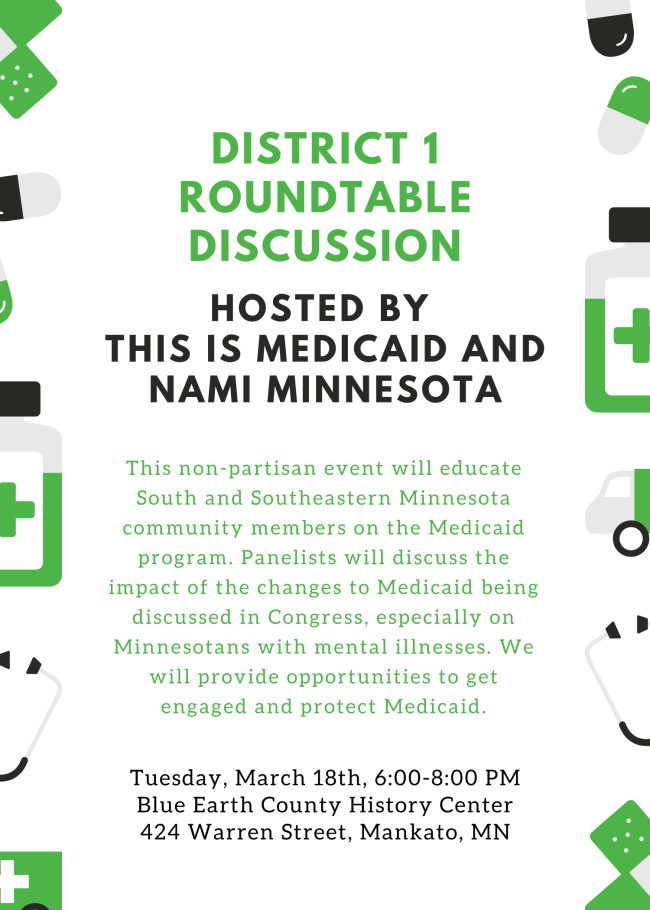
Join Us for a Roundtable Discussion on Medicaid

News from the Capitol

Committee Hearings

Three MHLN Bills

Thursday, the Senate Health and Human Services Committee heard three MHLN bills, bills that NAMI is the lead on. First up was SF 1682, which makes clear that families should not be screened in for child protection when they cannot safely bring children home due to lack of available services. NAMI’s Executive Director, Sue Abderholden, introduced the bill, sharing information from this handout. two parents told their stories. Many thanks to Michelle Woods and Argie Manolis for sharing their personal experiences as parents who have been threatened with child protection cases after exhausting all available avenues to care for their children.


“Shockingly, even with all the begging for help we did, the only discharge advice from the hospital was, ‘If she gets aggressive and hurts someone, call 911 and press charges,’” said Wood describing her daughter who was boarding in the emergency room waiting for a residential placement. Argie Manolis shared her experience working with case managers to find an alternative to juvenile detention where their 15 year-old son is boarding, “So far, between them, they have contacted 102 different options for placement, all of which have turned him down.” Lisa Harrison-Hadley from the Ombudsman Office also testified strongly in support of the bill. Testimony closed with representatives from the Minnesota Hospital Association and the counties sharing some concerns about changing the current process.


Thanks to Chair Wiklund and Senators Abeler, Boldon, and Kupec for their supportive comments during the hearing. “The system is letting them down, and then to have the system come after you and say ‘You’re not a good parent?’ – thank you for bringing this bill forward, we have to fix this now,” said Sen. Kupec. “We set the standards,” said Sen Abeler in support of the bill, “This is the bar we need to establish… this is that safe line.” Sen. Boldon said, “I have no doubt that this is complicated and maybe there’s no easy answers, but this seems like definitely something we should do.” Thanks to Sen. Erin Maye Quade for carrying the bill and her closing comments, “Like Sen. Kupec said, sending the system after you, when the system has already failed you is just wrong.” The bill passed unanimously to the Senate Judiciary Committee.


Next, the committee heard SF 1953, the MHLN’s adult mental health bill authored by Sen. Mann. This bill would increase the rate for protected transport, fund early episode bipolar and psychosis programs, increase education for providers on tardive dyskinesia, extend audio-only telehealth coverage and expand eligibility for case management. NAMI has been working with DHS and Tribes to include PTSD and complex PTSD as qualifying conditions for case management. President Robert Larson of the Lower Sioux Indian Community testified in favor of the bill, “Intergenerational trauma, racial trauma, and unresolved historical grief continues to affect many of our people to this day,” President Larson said, recalling many historical acts of oppression committed against Indigenous people on this land. Thanks also to Anna Solem a nurse from St. Luke’s Hospital who testified in favor of raising protected transport rates. Jewels Lindholm, a Licensed Independent Clinical Social Worker at the M Health Fairview Psychiatry Clinic at the University of Minnesota testified to the impact of First Episode of Psychosis Programs and the hope to truly start one for Early Episode of Bipolar Disorder. Matt Freeman from the Minnesota Association of County Social Service Administrators (MACSSA) testified sharing concerns about counties bearing the cost of expanded case management populations. NAMI does not think the expansion will induce overwhelming costs. The bill passed and was rereferred to the Human Services Committee.


Finally, the committee quickly heard SF 2134 authored by Sen. Mohamed, which replaces the terms “emotional disturbance” and “serious emotional disturbance” with “mental illness” in statute and changes “out of home placement” to “residential treatment” in the Children’s Mental Health Act. Sue Abderholden testified sharing how families confuse the current terms with special education and how the term “out of home placement” holds the connotation of abuse or neglect when in reality, families are voluntarily seeking help for their children. The bill was laid over. 


NAMI's Crisis Bill

Members of the House Human Services Finance and Policy Committee convened on Wednesday morning to hear HF 973 (Backer) prohibiting clients from being charged for mobile crisis intervention services, updating language and increasing funding.


Testimony began with NAMI Minnesota’s Executive Director, Sue Aberholden, explaining the statewide crisis response system has been advocated for over 20 years but funding is needed for crisis teams as they are receiving far less funding than police departments across the state. She continued to echo Rep. Backer's points about the bill ultimately decreasing interactions with police and incarcerations, preventing people from being charged for these services, and increasing 988’s connection with crisis teams to receive appropriate responses.


Eric Sievers from Hiawatha Valley Mental Health Center also testified in support of the bill. Sievers explained the work that they do in five rural counties in Southeastern Minnesota. He revealed that as the rates of suicide continue to rise across Minnesota, there has been a significant increase in calls and assessments in the first 2 months of the year, already equaling a quarter of the assessment numbers completed in 2024.


Rep. Keeler agreed that people should not be charged for mobile crisis services and appreciated the promotion of 988 while encouraging the committee to use their platforms to further promote the use and benefits of 988. The bill was laid over for inclusion in an omnibus bill. Read more here.


Formulary Changes

On Tuesday the Senate Commerce Committee heard SF 1806 authored by Sen. Mann. The bill would require a health plan to continue to cover a medication a person was on at the beginning of the plan year, even if the health plan changes the medication mid-year. NAMI's Sue Abderholden testified in favor of the bill noting how difficult it is to find the right medication to treat mental illnesses and forcing someone to change their medication midway through the plan year was unfair and could be difficult. The bill was spearheaded by the MN Medical Association and doctors testified in support as well.


Protected Transport

Monday, the Senate Human Services Committee heard SF 2125 which raises the rates for Non-Emergency Medical Transport (NEMT), but does not include protected transport. NAMI submitted a letter to the committee asking that protected transport be included in any increases to NEMT rates. Testifiers shared the importance of NEMT especially in rural Minnesota for taking pressure off of already stretched ambulance services. Protected transport can be an important piece in relieving that pressure as people in crisis can use an alternative to ambulance and police transport. The bill was laid over. 


Department of Human Services Budget Forecast

On Tuesday, the House Human Services Finance and Policy Committee heard an overview of the new budget forecast from the Department of Human Services (DHS). The state put out an estimated budget in November, and a revised version in February. The updated budget shows DHS spending 1.9% more than previously thought in fiscal years 24-25 and 26-27. 


DHS Budget Director Elyse Bailey shared that Medical Assistance (MA) makes up 89% of DHS’ budget, with the next-largest expense being the Housing Support program. Changes in the budget estimate were particularly large in Medical Assistance and the Behavioral Health Fund. Increases in both the rates and use of disability waivers are a large piece of the rising MA cost, as is higher than expected fee-for-service payments.


The increase in expected costs in the Behavioral Health Fund is mostly due to an error DHS made in claiming federal reimbursement a few residential substance use disorder programs that were not actually qualified for federal reimbursement from 2015 to 2024. DHS will now have to pay that money ($113 million) back to the federal government using the state’s Behavioral Health Fund.


DHS CFO Dave Greeman also spoke about the significant uncertainty they face in budgeting at the federal level. He said that if the cuts proposed by congress were spread proportionally across all states, that would result in a loss of $1.6 billion dollars to Minnesota in fiscal year 2027. He added we are still receiving annual mental health block grants from SAMHSA, but DHS does not know whether we will continue to receive that funding if there is a government shutdown or if the Trump administration pauses payments again.


Department of Human Services Policy Bill

On Thursday, the House Human Services Finance and Policy Committee heard several bills, including the Department of Human Services’ (DHS) policy bill (HF2115), the future Human Services Committee vehicle bill, and a bill to allow in-home staff to bill for time they spent providing indirect services. 


The DHS policy bill includes many technical updates and putting existing DHS requirements into law, as well as the following provisions:


  • Aligns requirements for who can be a children’s targeted case managers with adult targeted case managers and federal policies
  • Requires children’s mental health case managers to complete functional assessments
  • Codifies the intermediate school district school-linked behavioral health grant program in law and requires evaluation of the program
  • Extends the change in the 48-hour law, which says individuals who are incarcerated and meet the criteria for priority admissions to state-operated treatment programs must be admitted within 48 hours of when a medically appropriate bed is available (rather than when the person who is deemed ineligible to stand trial is commited), to 2027.
  • Moves some of the duties and powers that once belonged to DHS to the new Direct Care and Treatment Department
  • Removes requirement for Commerce Commissioner to publicly post information about prior authorization activity in MA and MNCare
  • Expands the health care bill of rights to apply to clients in withdrawal management, children’s residential substance use disorder (SUD) treatment, and outpatient SUD treatment
  • Adds timeframes to require staff to complete alcohol and drug policy and overdose medication administration training before providing services
  • Expands LADC counselor’s ability to use previously completed comprehensive assessments
  • Adds minimal documentation requirements when guest speakers are used as a part of SUD treatment
  • Reduces Opioid Treatment Programs (OTP) paperwork for client transfers and eases OTP client identification requirements.
  • Allows SUD treatment programs to determine their own system for medication counts
  • Removes redundant orientation and paperwork when a client transfers to another program operated by the same provider
  • Reduces barriers to qualify as a drug counselor for adolescents
  • Exempts SUD treatment programs from needing a childcare license to provide child care for short periods


Opioids and SUD

The members of the House Health Finance and Policy committee convened on Monday to discuss HF1379, which is the “nonopioid directive” bill. Representative Baker described it as a tool for patients who are in recovery that automatically lets their doctors know they do not consent to being given or prescribed opioids. 


Alicia House, Executive Director of the Steve Rummler HOPE Network, testified in support of the bill and described the bill as “a much-needed step towards empowering patients in making informed decisions about their own care, especially those at risk” She went on to say that sometimes patients are prescribed opioids without their full knowledge, which can lead to setbacks in recovery or lead to overdose. This bill hopes to reduce these unintended exposures, which can lead to relapse and overdose risk.


Rep. Carroll questioned the need for a formal nonopioid directive when a patient can just tell the doctor they don’t want any opioids. In response, Rep. Baker shared a personal story describing how his late son, Dan, was still administered opioids after a condescending doctor dismissed their pleas to avoid opioids during a surgical procedure. Baker said this directive removes provider bias, and allows for patients in SUD recovery to have more control over their care. HF 1379 was unanimously referred to the Judicial, Finance, and Civil Law Committee.


Public Safety Council

The House Public Safety Finance and Policy Committee met on Tuesday to hear HF 1257 (Novotny) which would eliminate the legislatively established Public Safety Advisory Council in the Peace Officer Standards and Training Board (POST). NAMI Minnesota serves on this council and wrote a letter asking the committee to oppose this bill. Rep. Novotny first presented the bill to the committee, explaining that although originally the council had a purpose and was established in an environment in ‘’high need of fixing,’’ regarding the 2020 murder of George Floyd, the council has now outlived its purpose and is obsolete. Rep. Novotny completed his introduction by explaining that the POST Board remains and that, ‘’The sky will not fall,’’ with the elimination of the Public Safety Advisory Council as citizens will still have access to the POST board to address concerns. 


The Committee opened up for testimony and former Representative and Chair of the House Public Safety and Finance and Policy Committee, Carlos Mariani, gave testimony opposing the bill. Mariani explained that a key feature of the 2020 Police Accountability Act was to create the Public Safety Advisory Council to ensure the protection of civil and human rights. He continued that the state has a duty to promote interactions between peace officers and the community, and the council is critically important to have those perspectives at the state level.


Vice Chair Witte allowed the committee to ask questions or give any comments, to which Rep. Moller stated that the council is not ready to be eliminated mentioning NAMI Minnesota’s letter as one of the ‘’compelling letters,’’ sent to the committee. The Minnesota Indian Affairs Council, Minnesota Council on Latino Affairs, Council on Asian Pacific Minnesotans, and Council for Minnesotans of African Heritage, as well as the organization Violence Free MN also submitted letters in opposition. However, the bill prevailed on a motion to be sent to the general register (house floor) on a party line voice vote.


Community Corrections

Members of the Senate Judiciary and Public Safety Committee convened on Monday afternoon to hear a presentation by the Minnesota Community Corrections Act Counties (MACCAC). The documents accompanying this hearing included MACCAC’s legislative goals mentioning expanding programs dedicated to mental health services throughout the state, especially in rural communities, and also expressing a need for therapeutic placement programs for juveniles in detention centers. Dr. Tami Jo Lieber, Emilio Lamba, and Molly Bruner from MACCAC led the presentation.


Dr. Tami Jo Lieberg started the presentation by explaining how the Community Corrections Act (CCA) works within Minnesotan counties to deliver high-quality, evidence-based supervision that enhances public safety. She compared CCA to other probation delivery systems in Minnesota. She explained how funding and design of programs with CCA counties target local needs and interventions that keep communities and citizens safe.


Emilio Lamba from the Association of Minnesota Counties delved into funding for CCA, showing that $5.62 is allocated per day for felony supervision, but the current shortfall of $10 million will subsequently result in losses of agents. Molly Bruner closed the presentation by explaining the need for increased funding, as it will assist with cognitive behavioral programs, risk assessments, family reunification, and more attention for high-risk individuals. She continued to say that mental health and substance use are common issues for people reintegrating into society, so expanding access is ‘’critical for public safety in Minnesota,’’ and reduces the need for expensive incarceration which ultimately saves taxpayer dollars.

Upcoming Hearings

Monday

3:00pm - Senate Human Services hearing the DHS policy bill SF 2443


Tuesday

8:30am - Senate Education Finance hearing SF 42 funding suicide prevention curriculum for Native American youth

12:30pm - Senate Housing hearing SF 2298 the Housing Finance budget bill

12:30pm - Senate State Government hearing SF 626 to create a commissioner for the Department of Direct Care and Treatment


Wednesday

12:30pm - Senate Judiciary hearing SF 942 on truancy

1:00pm - House Health hearing HF 1878 providing MA coverage for Indigenous health care practices and HF 1652 prohibiting mid-year formulary changes

3:00pm - House Children and Families hearing HF 1614, the MHLN's child protection bill


Thursday

8:15 AM: House Human Services hearing MHLN Substance Use Disorder bills

8:15am - House Commerce hearing HF 1289 requiring mental health warnings for social media


Friday

TBA - Senate Judiciary hearing SF 1492 creating a civil commitment coordinating division, NAMI has concerns with this bill

Updates from the State Level

State Board and Committee Openings

Many state boards, councils, committees, and task forces are accepting applications for open seats. NAMI Minnesota strongly encourages our members and volunteers to get involved with these groups to advocate for mental health. The below openings are particularly important to people with mental illnesses and their loved ones. You can find instructions on how to apply for one of these positions here.


Executive Board of Direct Care and Treatment: 1 Seat available for someone with experience in the delivery of behavioral health services or care coordination, or in traditional healing practices as a licensed health care professional; within health care administration; or with residential services.


Waiver Reimagine Advisory Committee: 1 seat available for Disability and Behavioral Health Advocates, 1 seat available for Family Members of People who use Waiver Services, and 1 seat available for People with Disabilities who use Waiver Services.

Updates from the Federal Level

Research Funding

On Mar. 5, a federal judge extended the block on implementing NIH’s guidance from earlier in February that would change how medical research is funded. funding. If it were to go into effect, this would have a chilling effect on research. According to a New York Times report "The proposal, which has been put on hold by a federal court, aims to reduce funding for those indirect costs to a set 15 percent rate that the administration says would save about $4 billion a year." But it would also devastate research institutions. Their report states that Minnesota has 1,197 grants totaling $654 million. $361M goes to the U of MN.


On Mar. 6, NIH moved to centralize its grant research review operations to the agency's Center for Scientific Review. Previously, 22% of grants were reviewed and coordinated first by individual NIH agencies and institutes, like the National Institute of Mental Health (NIMH). This change raises concerns about political influence over the grant review process. NIH claims the change will lead to $65M in savings per year, but that leaves many concerned that the cost savings will come from staff layoffs.  


On Feb. 28, NIH terminated ongoing grants for LGBTQ+-related research. Letters sent to researchers abruptly cut funding, claiming the research does not ‘meet the priorities of the Administration.’

Bill Introductions

Mental Health Legislative Network Bills

Click here for a full list of MHLN Bills.


Adult Bill

HF 2143 (Momanyi-Hiltsley, Mahamoud, Hollins, Noor, Fischer, Her, Carroll, Reyer, Lillie)/ SF 1953 (Mann): Expands access to case management for people with PTSD, eating disorders and anxiety. Increases rates for protected transport. Establishes a grant program for intensive early bipolar disorder and increases funds for first episode of psychosis program. Referred to the Committee on Health and Human Services.


College-Linked

SF 2343 (Kupec): Appropriates funds for student mental health services on Minnesota State Colleges and Universities campuses. Referred to Higher Education.


Juvenile Justice

SF 2546 (Seeberger): Appropriates funding for mental health professionals in juvenile detention centers and creates a grant program to provide High Fidelity Wraparound services to families leaving incarceration. Referred to Health and human Services.


Terminology Bill

HF 2196 (Fischer)/SF 2134 (Mohamed, Marty): Changes the language “emotional disturbance” and “serious emotional disturbance” to “Mental Illness” and “Serious Mental Illness” in statute. Changes "out of home placement" in the children’s mental health act to "residential treatment." Requires education on tardive dyskinesia (TD) in residential treatment. Referred to Health and Human Services. Referred Human Services Finance and Policy.

Several NAMI members have already reached out to us about SF 2589 which changes the definition of mental illness in the Adult Mental Health Act by adding a definition for Trump Derangement Syndrome. "Trump Derangement Syndrome" means the acute onset of paranoia in otherwise normal persons that is in reaction to the policies and presidencies of President Donald J. Trump. Symptoms may include Trump-induced general hysteria, which produces an inability to distinguish between legitimate policy differences and signs of psychic pathology in President Donald J. Trump's behavior. This may be expressed by:

(1) verbal expressions of intense hostility toward President Donald J. Trump; and

(2) overt acts of aggression and violence against anyone supporting President Donald

J. Trump or anything that symbolizes President Donald J. Trump.


NAMI Minnesota and Mental Health Minnesota sent an email on Saturday to the authors and leadership stating that we did not find it humorous to poke fun at people living with mental illnesses by proposing to add a bogus syndrome to the statute. People living with mental illnesses, and the laws that impact them, should be treated with dignity, respect, and empathy. The bill’s description of “Trump Derangement Syndrome” also does not recognize the actual fear and anxiety that people living with mental illnesses and their families are experiencing right now as they hear that nearly 50% of SAMHSA staff have been cut, that staff at the Veterans Crisis Line has been cut, that the House committee needs to cut $880 billion and the GAO states that it will have to come through cuts to Medicaid, that it’s unknown what will happen to 988 staffing, and more.

Other Bills NAMI Minnesota is Monitoring

House Bills

HF 2021 (Howard, Her, Kozlowski): Prohibits landlords from discriminating and denying viewings or applications of rental units against tenants and prospective tenants who use government or public assistance to help pay rent. Referred to the Committee on Judiciary Finance and Civil Law.


HF 2032 (Keeler, Hanson, J., Frederick, Curran, Fischer) /SF 2358 (Kunesh): Establishes case management and community support services for individuals diagnosed with complex-post traumatic stress disorder (C-PTSD). This bill also ensures that people with C-PTSD have access to holistic case management, housing support, employment assistance, peer support, and other essential services. Referred to the Health and Human Services Committee.


HF 2037 (Schwartz): Establishes a commissioner for the Department of Direct Care and Treatment instead of an executive board. Referred to Human Services.


HF 2040 (Nadeau, Curran, Fischer, Bierman, Bakeberg, Klevorn, Witte)/SF 2349 (Champion, Gustafson, Pratt, Coleman, Maye Quade): Requires a needs assessment for juveniles entering residential or detention facilities. Expands access to community residential settings and new child foster residence licenses. Creates a task force on children's residential licensing. Funds a regional continuum of care and a crisis stabilization facility in Hennepin County. Referred to the Committee on Human Services Finance and Policy.


HF 2088 (Frazier): Requires annual reports on school resource officer contracts to the Commissioner of Education. Referred to the Committee on Education Policy. 


HF 2115 (Schomacker, Noor, Gillman, Keeler)/SF 2443 (Hoffman) DHS Policy Bill.

  • Aligns requirements for children’s targeted case managers with adult targeted case managers and federal policies
  • Requires children’s mental health case managers to complete functional assessments
  • Codifies the intermediate school district school-linked behavioral health grant program in law and requires evaluation of the program
  • Extends the change in the 48-hour law, which says individuals who are incarcerated and meet the criteria for priority admissions to state-operated treatment programs must be admitted within 48 hours of when a medically appropriate bed is available (rather than when the person is deemed ineligible to stand trial), to 2027.
  • Moves some of the duties and powers that once belonged to DHS to the new Direct Care and Treatment Department
  • Ends existing legislation to include mental health urgent care and psychiatric consultation services as part of the redesign of six community-based behavioral health hospitals and the Anoka-Metro Regional Treatment Center, develop rapid access to psychiatric services, and establish a collaborative psychiatric consultation service
  • Removes requirement for Commerce Commissioner to publicly post information about prior authorization activity in MA and MNCare
  • Expands the health care bill of rights to apply to clients in withdrawal management, children’s residential substance use disorder (SUD) treatment, and outpatient SUD treatment
  • Adds timeframes to require staff to complete alcohol and drug policy and overdose medication administration training before providing services
  • Expands LADC counselor’s ability to use previously completed comprehensive assessments
  • Adds minimal documentation requirements when guest speakers are used as a part of SUD treatment
  • Reduces Opioid Treatment Programs (OTP) paperwork for client transfers and eases OTP client identification requirements.
  • Allows SUD treatment programs to determine their own system for medication counts
  • Removes redundant orientation and paperwork when a client transfers to another program operated by the same provider
  • Reduces barriers to qualify as a drug counselor for adolescents
  • Exempts SUD treatment programs from needing a childcare license to provide child care for short periods

Referred to Human Services Finance and Policy.


HF 2125 (Hussein, Momanyi-Hiltsley)/S.F. No. 2347 (Hoffman): Appropriates $1,000,000 in 2026 to Generation Hope, a youth-centered recovery organization, to expand culturally specific peer recovery outreach programs. Referred to the Committee on Human Services.


HF 2172 (Backer): Extends medical assistance coverage to audio-only telehealth between the years 2025 through 2028. Referred to the Committee on Human Services Finance and Policy.


HF 2175 (Harder): Requires background checks for vendors that receive medical assistance and establishes a fraud detection system for reviewing suspicious activities relating to vendor payment or requests for payments. The fraud detection system must be analyzed by the Commissioner of Human Services to measure effectiveness. Referred to the Committee on Children and Families Finance and Policy. 


HF 2187 (Frederick, Virnig): Makes technical changes regarding the new Direct Care and Treatment Department. Referred to Human Services


HF 2211 (Virnig, Huot, Reyer, Frederick): Appropriates $3.6 million in the fiscal year 2026 and 2027 for a grant to local and Tribal health departments to be used for substance misuse prevention, education, and recovery programs. Referred to the Committee on Health Finance and Policy.


HF 2213 (Fischer, Schomacker): Allows mental health practitioners to provide case management. Defines clinical supervision. Adds provision for a functional assessment under children's targeted case management. Codifies a grant program for Intermediate School-Linked mental health. Referred to Human Services.


HF 2216 (Moller, Nadeau, and Reyer): Strengthens protections for residents of assisted living facilities. Assisted living facilities will no longer be allowed to require guardianships or conservatorships before residency. Facilities cannot decline residents based on their funding source (public or private), and must assist in the relocation of residents with at least 60 days' notice before closure. Referred to the Committee on Human Services Finance and Policy.


HF 2295 (Virnig): Appropriates $3.4 million in FY 2026 for mental health crisis services and embedded social workers in Dakota County. Referred to Human Services.


HF 2359 (Cha, Lillie, Greene, Jones, Hussein)/SF 24 (Xiong) Creates a Climate and Mental Health Advisory Task Force under the Department of Health. The task force will identify the effects of climate change and extreme weather on mental health in Minnesota and make recommendations to the Department to minimize the negative impact of climate change on mental health. Referred to the Health and Human Services Committee.


Senate Bills

SF 2287 (Mohamed)/HF 1566 (Mahamoud; Perez-Vega; Feist; Noor; Momanyi-Hiltsley; Agbaje; Cha; Vang; Kozlowski; Howard; Her; Kotyza-Witthuhn; Rehrauer; Norris; Skraba; Mueller; Engen; Hansen, R.; Warwas; Bierman; Perryman and Hudson): Requires landlords to provide reasonable safety accommodations to tenants who have children with autism living in rental properties that are close to attractive dangerous areas (for example rivers, lakes, etc.). Landlords may not punish or retaliate against tenants who ask for or receive accommodations under this law. Referred to Housing Finance and Policy.


SF 2316 (Abeler, Howe, Mann): Expands fourth-degree felony for assaulting health care providers, nurses, and doctors. Referred to Judiciary and Public Safety.


S.F. No. 2347 (Hoffman): Appropriates $1,000,000 in 2026 to Generation Hope, a youth-centered recovery organization, to expand culturally specific peer recovery outreach programs. Referred to the Committee on Human Services.


SF 2349 (Champion, Gustafson, Pratt, Coleman, Maye Quade)/HF 2040 (Nadeau, Curran, Fischer, Bierman, Bakeberg, Klevorn, Witte): Requires a needs assessment for juveniles entering residential or detention facilities. Expands access to community residential settings and new child foster residence licenses. Creates a task force on children's residential licensing. Funds a regional continuum of care and a crisis stabilization facility in Hennepin County. Referred to the Committee on Human Services Finance and Policy.


S.F. 2358 (Kunesh): Establishes case management and community support services for individuals diagnosed with complex-post traumatic stress disorder (C-PTSD). This bill also ensures that people with C-PTSD have access to holistic case management, housing support, employment assistance, peer support, and other essential services. Referred to the Health and Human Services Committee.


S.F. 2392 (Mann): Removes prior authorization and step therapy requirements for many types of mental health medications, which ensures that Minnesotans on Medicaid have access to prescriptions without delay. Referred to the Health and Human Services Committee.


SF 2438 (Maye Quade, Hoffman)/HF 2187 (Frederick, Virnig): Makes technical changes regarding the new Direct Care and Treatment Department. Referred to Human Services.


SF 2506 (Boldon, Wiklund)/HF 2213 (Fischer, Schomacker): Allows mental health practitioners to provide case management. Defines clinical supervision. Adds provision for a functional assessment under children's targeted case management. Codifies a grant program for Intermediate School-Linked mental health. Referred to Human Services.


SF 2598 (Abeler, Hoffman): Allows for an annual abbreviated assessment and a full assessment every three years for disability waivers. Referred to Human Services.


SF 2607 (Kupec): Ensures that fee for service providers do not change coverage terms mid-year. Referred to Health and Human Services.


SF 2620 (Wiklund, Port): Creates a crime and strengthens enforcement for "kickbacks," which is a type of fraud, for childcare and human services programs. Cleans up regulations for some community residential and substance use disorder programs. Referred to Health and Human Services.


SF 2628 (Rasmusson, Hoffman, Anderson): Indefinitely extends a provision that provides payment relief for counties when a person is civilly committed and no longer needs hospital level of care. Referred to Human Services.


SF 2633 (Westlin): Creates a pilot program to improve educational outcomes for students with disabilities. Requires grantees to address disparities in education including providing trauma-informed education. Referred to Education Policy.


SF 2634 (Westlin): Requires that all school personnel in the state have access to de-escalation training and training on creating safe and inclusive environments

using evidence-based best practices. Referred to Education Policy.


SF 2647 (Abeler, Boldon): HF 1993 (Frederick, Baker, Hicks Virnig): Allows all mental health professionals, clinical trainees, and Registered Nurses to perform comprehensive assessments (formally known as chemical dependency assessments or “Rule 25s”). Expands staff qualifications for providing treatment coordination for people with substance use disorders (SUD). Commissions a study by DHS with the Board of Nursing, the Board of Behavioral Health and Therapy, and the Board of Medical Practice to develop recommendations on reduce limitations on staff treating SUDs. Referred to Human Services.


SF 2669 (Wiklund, Mann): Senate Health and Human Services omnibus bill. Clarifies licensing requirements for assisted living providers. Extends audio-only telehealth to 2028. Indefinitely extends the Formulary Committee for Medical Assistance. Increases data collection on overdoses. Adjusts licensing board fees. Appropriates operating costs and forecasted costs for health and human service agencies. Referred to Health and Human Services.

Updates From NAMI Minnesota

Join the New Rapid Response Group

Want to take action and respond to legislation when it matters most? NAMI Minnesota’s Rapid Response Group is a newly forming team of community advocates who are ready to mobilize quickly when urgent mental health policies need support. Whether contacting legislators, providing testimony, attending committee hearings, or educating other advocates, this group ensures that the voices of community members impacted by these policies are amplified when these policies are being discussed. 


This is a group that will allow the members to use their passion to fuel their participation in the group. Whatever level of support, we will use your strengths to add to the overall effectiveness of our group. 


If your passion lies in mental health advocacy, and you want to make a difference when it counts, join the Rapid Response Group today! Sign up here or at the provided link below, to learn more and to be notified when action is needed!


Sign-up link: https://forms.gle/a43GLyLZAYXFDPaf6

Copyright © 2022. All Rights Reserved.