 |
FRIDAY, JULY 6, 2018
Click
HERE for the June 27 quote from Ambassador Lighthizer.
|
TRADE, SECURITY, AND THE ECONOMY
"In the administration of this section, the Secretary and the President shall further recognize the close relation of the economic welfare of the Nation to our national security ... . "
The Congress of the United States
Public Law 87-794, signed by President Kennedy
|
-
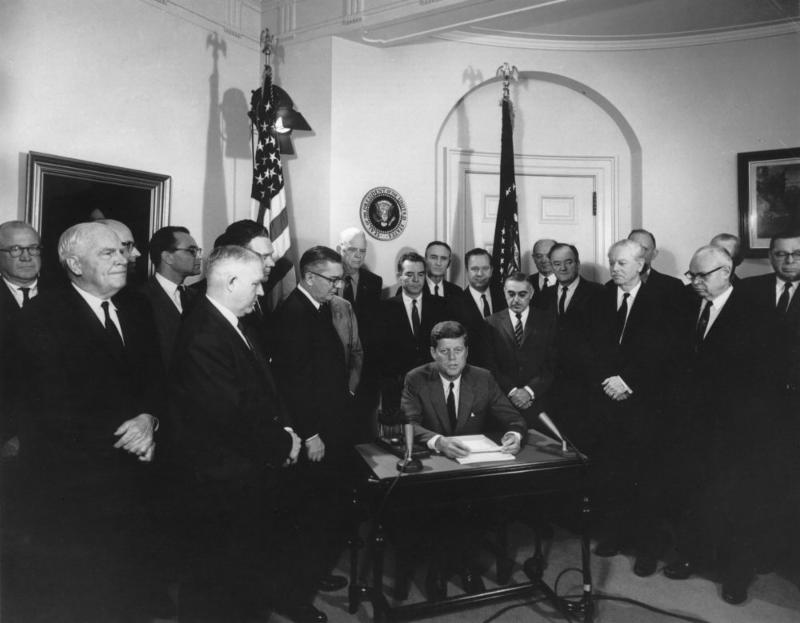
President Kennedy signs the Trade Expansion Act - Oct. 11, 1962
White House Photo
The Trade Expansion Act of 1962, the landmark legislation of the Kennedy Administration, was largely an effort to ensure that America and American trade would continue to adapt effectively to the growing role of the European Economic Community in global commerce, especially if, as expected, the United Kingdom joined the bloc. In addition to negotiating and tariff-cutting authority, the Act included provisions for trade adjustment assistance, and created what was to become the Office of the U.S. Trade Representative.
It is not these elements of the 1962 Act that are ruffling feathers and roiling markets today however. No the provision that is doing those things is the section that deals with trade and national security, Section 232. Today's featured quote is taken from that part of the bill. Here is the full paragraph:
For the purposes of this section, the Secretary and the President shall, in the light of the requirements of national security and without excluding other relevant factors, give consideration to domestic production needed for projected national defense requirements, the capacity of domestic industries to meet such requirements, existing and anticipated availabilities of the human resources, products, raw materials, and other supplies and services essential to the national defense, the requirements of growth of such industries and such supplies and services including the investment, exploration, and development necessary to assure such growth, and the importation of goods in terms of their quantities, availabilities, character, and use as those affect such industries and the capacity of the United States to meet national security requirements.
In the administration of this section, the Secretary and the President shall further recognize the close relation of the economic welfare of the Nation to our national security, and shall take into consideration the impact of foreign competition on the economic welfare of individual domestic industries; and any substantial unemployment, decrease in revenues of government, loss of skills or investment, or other serious effects resulting from the displacement of any domestic products by excessive imports shall be considered, without excluding other factors, in determining whether such weakening of our internal economy may impair the national security.
We have broken the paragraph up for ease of reading, but in the law it is a single paragraph.
It was Joanne Thornton of the Global Business Dialogue who brought this passage to our attention. She did that with an excellent article/blog post on the Origins of Section 232.
As she explains in her article:
Section 232, entitled "Safeguarding National Security," was neither innovative nor hotly contested in 1962. Except for some conforming changes, the language was identical to prior law - i.e., provisions of Section 2 of the Trade Agreements Extension Act (TAE Act) of 1954 as amended by the TAE Acts of 1955 and 1958.
|
|
President Kennedy proposed the legislation in a message to Congress on January 25, 1962.
The House and Senate both approved the conference report on the bill on October 4, 1962, the House by 257 to 91 and the Senate by a voice vote. Earlier the Senate had approved the underlying bill by a vote of 78 to 8.
President Kennedy signed the bill on October 11, 1962.
The question is, what does it mean today? To say the least, there is a world of individuals and interest groups who are unhappy with the way the
Trump Administration has used the National Security provisions of the act, from the tariffs already implemented on imports of selected steel and aluminum products to those threatened on automobile imports. And those actions are being challenged. Trading partners are challenging them in the World Trade Organization. We shall talk more about those challenges next. There is also at least one major legal challenge here in the United States.
On June 27, the
American Institute for International Steel, Inc. and others filed a petition with the Court of International Trade. Their argument is not that the 1962 Act has been violated in any sense but rather that the Act itself is unconstitutional. The first sentence of their petitions reads:
This action challenges the constitutionality of section 232 of the Trade Expansion Act of 1962, as amended, 19 U.S.C. § 1862 ("section 232") on the ground that it constitutes an improper delegation of legislative authority to the President, in violation of Article I, section 1 of the Constitution and the doctrine of separation of powers and the system of checks and balances that the Constitution protects.
Where is all of this going? It is a fair question, but the answer is more likely to be revealed through the current difficult national debate about the direction of U.S. trade policy than from any single court filing.
And the Trade Balance. Finally, there was a paragraph in President Kennedy's message to Congress that, though it did not relate to national security
per se, is is pertinent to other issues in today's trade policy debate, particularly the role of trade balances and the weight they should be given. He wrote:
The growing pressure on our balance of payments position have, in the past few years, turned a new spotlight on the importance of increasing American exports to strengthen the international position of the dollar and prevent a steady drain of our gold reserves. To maintain our defense, assistance and other commitments abroad, while expanding the free flow of goods and capital, we must achieve a reasonable equilibrium in our international account by offsetting these dollar outlays with dollar sales.
The United States was still running surpluses in the 1960s, but the President was worried.
|
From the U.S. Code is a link to 19 U.S. Code Section 1862, which is in effect Section 232 of the Trade Expansion Act of 1962 as amended, as it has been integrated into the U.S. Code. This was the source for today's quote.
Origins of Section 232 takes you to the article by Joanne Thornton that reviews the history of this provision.
A Message to Congress is President Kennedy's message to Congress of January 1962 on Foreign Trade Policy.
Unconstitutional takes you to the petition by the American Institute for International Steel, Inc. at the Court of International Trade, which argues that the national security provisions of 1962 act are unconstitutional.
Trade Balances is a Census Bureau table showing U.S. trade balances from 1960 to 2017.
|
| TO GET THE TTALK QUOTES IN YOUR INBOX
Or Other GBD Notices, click below.
|
|
©2018 The Global Business Dialogue, Inc.
1717 Pennsylvania Ave., NW, Suite 1025
Washington, DC 20006
Tel: (202) 463-5074
R. K. Morris, Editor
Joanne Thornton, Associate Editor
|
|
|
|
|
|
