Welcome to the quarterly NC STC newsletter. These newsletters will keep you updated on NC STC activities and provide you with related resources and opportunities. | |
What is the NC STC?
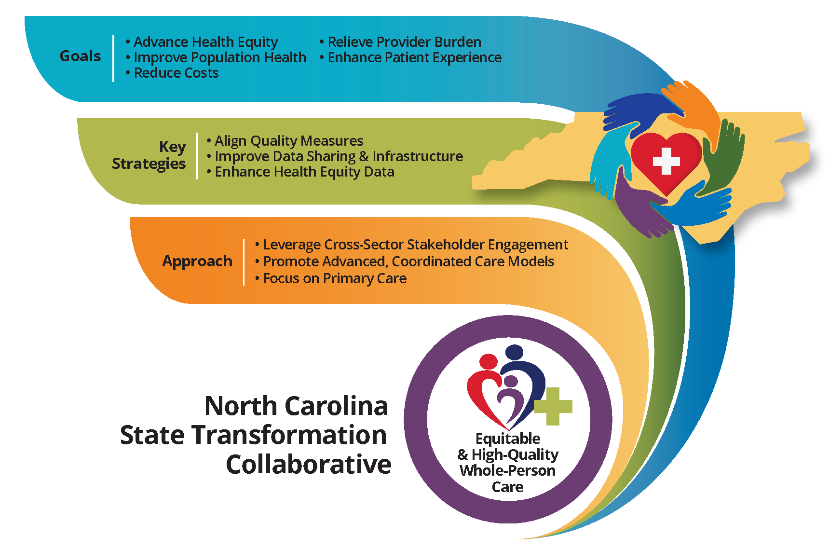
The North Carolina State Transformation Collaborative (NC STC) is a public-private partnership designed to advance value-based and whole-person care through multi-stakeholder alignment with federal engagement (CMS) and state leadership (NCDHHS). North Carolina is one of four states—along with Colorado, California, and Arkansas—selected to participate in this initiative operated by the Health Care Payment Learning & Action Network (LAN). Duke-Margolis, in partnership with the NCDHHS Division of Health Benefits and the LAN, is establishing technical working groups and gathering strategic feedback to build a path forward to address shared challenges across key NC STC strategies—aligning quality measures, improving data sharing infrastructure, and enhancing health disparities data to enable advanced, coordinated care models, starting with primary care.
|
|
Enhancing Data on Health Disparities through the Health Disparities Data Workgroup (HDDWG):
| |
|
On September 18, with support from the NC Department of Health and Human Services, Duke-Margolis convened the NC STC Health Disparities Data Workgroup (HDDWG) to establish guiding principles driving the NC STC's aligned approach to improving health disparities data in North Carolina. For the purposes of this meeting, HDDWG focused on data to measure and identify health disparities, or the preventable differences in the burden of disease, injury, violence, or opportunities to achieve optimal health that are experienced by populations who have been socially, economically, geographically, and environmentally disadvantaged. HDDWG used the CMS definition of health disparities data to guide our work within the NC STC—the combination of quantitative and qualitative elements to examine health differences, and their causes, between populations. At the meeting, HDDWG members also discussed key challenges in the collection, sharing, and use of health disparities data and identified practical opportunities for alignment across health-related social needs (HRSN) data practices as the first use-case to improve health disparities data. The choice of HRSN data as the first use-case was based on HDDWG member feedback and survey responses, and builds upon established infrastructure and bipartisan interest in strengthening HRSN across the state (e.g., Healthy Opportunities Pilots, CMMI’s Making Care Primary, and screening and measurement requirements within Medicaid and Medicare).
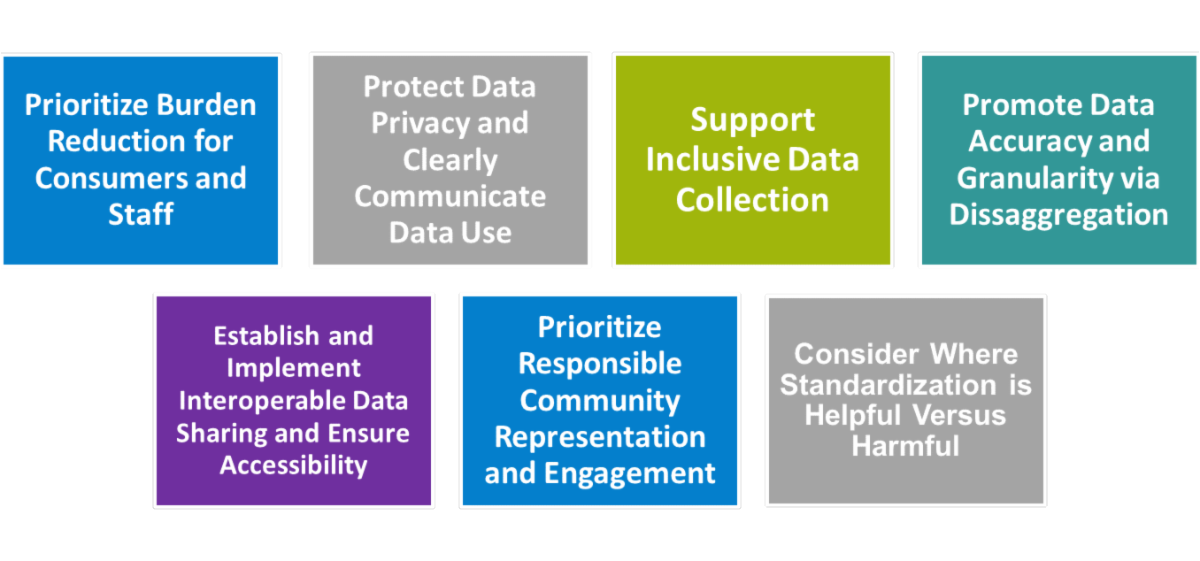
HDDWG met to address the objectives of establishing guiding principles, discussing key challenges, and identifying areas of opportunity, with the broader goal of supporting efforts across organizations and in collaboration with communities to establish more coordinated and targeted interventions to address health disparities and improve overall health and well-being. HDDWG members encompass a broad range of health care stakeholders in North Carolina including representation from: providers, provider organizations, and provider associations; health systems; payers; state partners; community-based organizations and subject matter experts. During the meeting, attendees came to informal consensus on the principles that should guide the NC STC’s continued efforts in using data to address health disparities in the state.
| |
Informal Consensus Achieved on Proposed Health Disparities Data Guiding Principles | |
The above guiding principles were then used to inform HDDWG’s discussion on opportunities and challenges in multi-stakeholder alignment within the NC STC. Through this conversation, HDDWG members prioritized three main alignment opportunities: | |
|
Workforce development to improve quality of data capture, shared messaging, and ability to collect and use data.
- Prioritize trauma-informed screening tools and workforce training to reduce the collection burden on patients and families and improve data quality.
| |
|
Shared understanding of and alignment of incentives to address health-related social needs (HRSN).
- Assess financial incentives currently available through public payers related to HRSN screening, referral, and intervention.
- Identify gaps and opportunities for alignment across payers and lines of business.
| |
|
Explore opportunities for leveraging HRSN data beyond internal use by improving interoperability with external organizations for referrals and care coordination efforts, including engaging CBOs in those efforts.
- Build on learnings from existing initiatives (e.g., NC Health Information Exchange Authority efforts to enable HRSN data sharing).
- Enhance coordination between plans and providers to improve referrals to external organizations (i.e., CBOs) by identifying common HRSN data sharing formats (e.g., HL7 FHIR), standardized data inputs, open APIs to enhance data sharing between payers, providers, care managers, and community-based organizations.
| |
|
Key takeaways from this meeting will be used to identify areas of alignment that will be incorporated into the Alignment Proposal for the NC STC.
The NC STC is looking forward to hosting the next NC Health Care Transformation Workgroup in early December to build on our efforts over the last year. The NC Health Care Transformation Workgroup is a multi-stakeholder group comprised of health system representatives, health care providers, health plans, clinically integrated networks, employers, and state government entities including NC Medicaid and the NC Health Information Exchange Authority (NC HIE). Acting as the overall guiding body for the NC STC efforts, the Workgroup will gather to discuss findings from both the NC STC Data Sharing and Health Disparities Data Workgroups, hear feedback on potential updates to the Alignment Proposal informed by workgroup findings, and discuss NC STC member feedback on proposed implementation steps.
| |
|
(New Resource!) Publication of the NC STC FAQ:
Duke-Margolis recently published a Frequently Asked Questions document to answer questions and illustrate the goals of the NC STC. The NC STC FAQ addresses questions related to the NC STC’s work and priority areas, stakeholders engaged by the NC STC, the efforts of the NC STC’s three workgroups focused on health care transformation, data sharing, and health disparities data, and how the NC STC’s efforts align with other state and federal initiatives.
| |
State Efforts in Response to the Impacts of Hurricane Helene | |
|
Temporary Flexibilities in Place for Medicaid Beneficiaries in Wake of Hurricane Helene
Hurricane Helene caused devastating impacts to Western North Carolina, requiring unprecedented emergency response and recovery services in the region. To ensure everyone is able to access care when they need it, the Centers for Medicare and Medicaid Services (CMS) has granted temporary changes to NC Medicaid. These flexibilities are in place until the end of the Hurricane Public Health Emergency declaration for North Carolina. The North Carolina Department of Health and Human Services (NCDHHS) has additional information on its webpage dedicated to Hurricane Helene recovery resources, including the following:
CMMI also granted flexibilities to participating practices in the Making Care Primary model that are located in Western, NC. Additionally, the NC General Assembly recently approved two relief packages for Hurricane Helene recovery: an initial $273 million for recovery efforts through the Disaster Recovery Act of 2024 which also extended the North Carolina State of Emergency through March 1, 2025, and an additional $604 million approved last week to further aid recovery efforts. Additional updates on how Medicaid benefits and additional service flexibilities are impacted are expected as recovery response to Hurricane Helene continues. The NCDHHS Hurricane Helene Recovery Resources webpage has the most up-to-date information as flexibilities are added and/or updated.
| |
NCDHHS and National Efforts to
Support Whole-Person Health
| |
|
NCDHHS Releases New Health Disparities Analysis Report
On September 18, 2024, NCDHHS published the 2024 Health Disparities Analysis Report, which highlights the effects of health disparities on health outcomes across North Carolina and highlights opportunities for improvement and action.
NCDHHS Makes Progress on Transforming the Behavioral Health System in the State
On September 11, 2024, NCDHHS released a new report outlining North Carolina’s efforts to transform the public behavioral health system to deliver high-quality, equitable, and accessible care. This report details the changes NCDHHS has made following the $835 million the NC General Assembly invested to improve the health and well-being of North Carolinians and their families. As part of efforts to transform the behavioral health system, NC Medicaid launched its Behavioral Health and Intellectual/Developmental Disabilities Tailored Plans on July 1, 2024 for individuals who have a serious mental illness, a serious emotional disturbance, a severe substance use disorder, an intellectual or developmental disability or a traumatic brain injury. Tailored Plans aim to ensure beneficiaries’ physical health, behavioral health, and home and community-based service needs are met.
NCDHHS Announces NC Medicaid Managed Care Children and Families Specialty Plan
On August 15, 2024, NCDHHS announced its Child and Families Specialty Plan (CFSP), a statewide NC Medicaid Managed care plan and first-of-its-kind initiative for Medicaid-enrolled children, youth, and their families in the child welfare system that aims to provide seamless, integrated, and coordinated health care. Blue Cross Blue Shield NC was selected to operate CFSP.
North Carolina Celebrates More Than 500,000 Enrolled in Medicaid Expansion
As of October 9, 2024, more than 557,000 North Carolinians have enrolled in Medicaid expansion since the program launched in December, 2023. Beneficiaries now have coverage to access quality and necessary health services at low cost. NCDHHS is planning to launch a Medicaid Expansion Service Utilization Dashboard to show monthly health service trends since expansion launched in December 2023.
CMS holds Rural Health Hackathon in North Carolina
In August 2024, the Centers for Medicare and Medicaid Services (CMS) Center for Medicare and Medicaid Innovation (Innovation Center) held in-person hackathons in three cities across the country, including in Wilson, North Carolina, to generate innovative and actionable ideas to address rural health challenges. The CMS Innovation Center brought together a variety of stakeholders for these collaborative sessions including rural health community care providers, community organizations, industry and tech entrepreneurs, funders, policy experts, and beneficiaries. The CMS Innovation Center will highlight top opportunities for action from the hackathons in an upcoming public report.
CMS Provides Updates to Making Care Primary Model
In July 2024, CMS announced participants in its new Making Care Primary model, which utilizes multi-payer alignment to strengthen primary care through payment reform, quality measures and incentives, data sharing, and learning systems. There are approximately 130 participants across the eight states (including North Carolina) that are participating in Making Care Primary. CMS also released the list of payer partners as of June 2024.
| |
NC General Assembly Legislative Updates | |
On September 11, 2024, the NC General Assembly (NCGA) passed HB10, a mini-budget bill, to make budget adjustments needed for several programs in the state. NCDHHS requested $458 million for NC Medicaid program obligations, and the mini-bill allocated $377 million. Governor Roy Cooper vetoed HB10 on September 20th, 2024. The NCGA recently convened to vote on funding for the recovery response to devastation in Western North Carolina from Hurricane Helene through the Disaster Recovery Act of 2024. The NCGA reconvened on October 24 to pass a second relief bill for Hurricane Helene recovery efforts known as the Disaster Recover Act of 2024 - Part II. The NCGA will reconvene on November 19 for its next session, and may potentially take action on an additional budget bill in this session. | |
Any Feedback, Comments, or Questions? | |
Contact us using this form on the STC web page: | |
Scroll down to “Stakeholder Engagement Opportunities through NC STC.” | |
In these discussions, “alignment” is defined to mean the application of evidence and experience to assess and identify measures, administrative components, and data that would be impactful and practical for potential use to improve performance in the provision of value-based health care. These measures, components, and data concepts, combined with evidence, will be made available to the public as a resource for consideration and use by any interested stakeholders to further the Workgroup’s goals of reducing complexity for clinicians and advancing high-quality care for all patients. | | | | |