|
Next Century Cities Tech Tidbits
July 23, 2024
| | |
|
The NCC team is well into the summer months and working alongside communities like yours to ensure that local leaders and residents have the resources needed to thrive in today's broadband landscape. In this month's NCC Tech Policy Bulletin, "Tech Tidbits," our policy team examines current issues in broadband, highlights the good work that is happening in localities around the country, and shares upcoming opportunities for members.
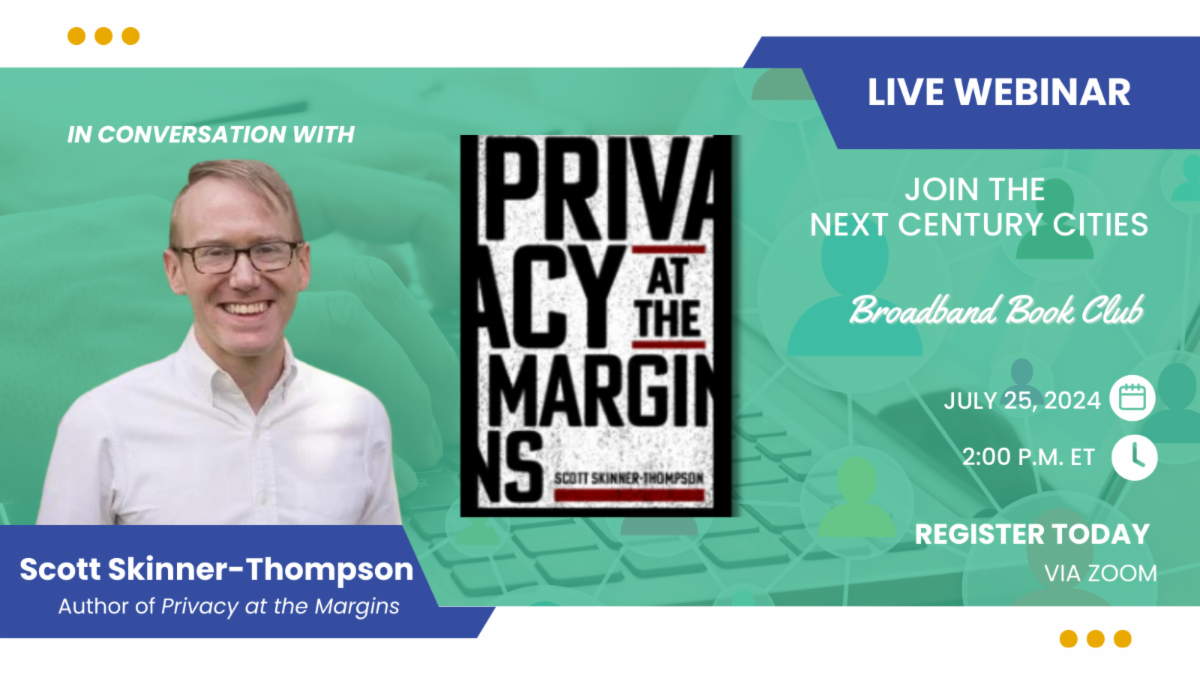
We look forward to being in community with you soon and hope that you will join the Next Century Cities team for our next Broadband Bookclub webinar this Thursday, July 25, 2024 at 2:00 p.m. ET. Author and professor Scott Skinner-Thompson of University of Colorado Law School will discuss his book Privacy at the Margins and recent article "Trans Animus" published in the Boston College Law Review. Register for the timely conversation here.
|
| |
Tech Policy Insights from the NCC Team | |
|
FCC Updates E-Rate Rules; A Win for Students
By Stacey Baxter, Program Manager
Although school may be out for the summer, the Federal Communications Commission (“FCC”) is preparing for next school year by adopting an order that supports students nationwide.
On Thursday, July 17, 2024, the FCC adopted an order allowing modifications to how E-Rate funding can be spent by eligible schools and libraries. Schools and libraries who qualify for E-Rate funding will now be able to purchase Wi-Fi hotspots and wireless broadband services that function outside of the classroom, for their students.
The E-Rate program was originally created as part of the Telecommunications Act of 1996, and provides support for schools and libraries to obtain affordable, high quality broadband access. Over the past 20+ years, the program’s rules have been modified by the Commission to reflect changes in education and technology. For example, in 2010, the FCC updated E-Rate rules to include mobile devices, as tablets and iPads came onto the market. In response to the COVID-19 pandemic in 2023, the FCC updated the E-Rate rules again to include Wi-fi services on school buses to allow students to access the Internet on the bus and its surrounding location.
In the FCC’s most recent order updating the E-Rate program rules, the Commission acknowledged that the pandemic changed where educational technology is used. Students need to access the Internet to complete homework, turn in assignments, communicate with their teachers, and more. The Commission also acknowledged that these changes affected what researchers call the “Homework Gap,” which accounts for the learning divide between students who have access to the Internet at home and those who do not. With these new challenges faced by students, the Commission has looked to update their program rules to fall more in line with the needs of today’s students. (Find out more about how education technology is impacting students in NCC’s report “The High Cost of Connectivity Has a Disparate Impact on Public School Students”.)
With this modernization of the program, students are able to access public Wi-Fi and obtain broadband service from their local library or school. It is imperative that students have access to the services that are required for their learning. In the 21st century, this includes high quality Internet access inside and outside classroom walls. Learning is no longer tied to a chalkboard or textbook. In today’s climate, learning is tied to the student. Wherever the student goes, the learning should too, and that includes the safety of their home and communities.
| |
Summer Summary: AI and the Digital Divide
By Corian Zacher, Senior Policy Counsel - State and Local Affairs
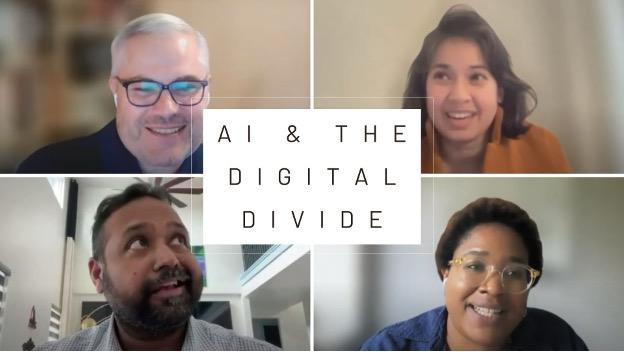
Local leaders from San Jose, California, to Baltimore, Maryland, are grappling with the impacts of emerging technology on their communities. During Next Century Cities’ April 2024 Bipartisan Tech conference in Washington, D.C., local leaders discussed many ways that artificial intelligence (AI) and autonomous vehicles impact policymaking and community governance. Expanding on those conversations, NCC’s June 20, 2024 webinar, AI & the Digital Divide, focused on gaps in connectivity and their impact on local participation in the global economy and related equity concerns.
NCC’s Executive Director Andy Stutzman moderated a conversation with Sachin Gupta, Vice President of Business and Technology Strategies at CentraNet; Amina Fazlullah, Head of Tech Policy Advocacy at Common Sense Media; and Professor Jasmine McNealy, College of Journalism and Communications at the University of Florida. Andy discussed the role that AI plays in promoting accessibility for people with disabilities. Sachin Gupta explained that in spending $150 billion over the next several years on broadband, quality is key to effectively preparing for next generation technologies.
Jasmine McNealy highlighted the important role that community anchors like libraries play, while also acknowledging that physical infrastructure alone is not enough to counter the digital divide. Equitable telecommunications policies are necessary for filling longstanding gaps. Amina Fazlullah shared findings from Common Sense Media’s survey on Teen and Young Adult Perspectives on Generative AI Patterns, which illustrate generational knowledge gaps about practical applications for emerging technologies.
Audience members asked critical questions about data privacy concerns around generative AI. One person shared an article from the Verge, which documents one journalist’s experience with an exception in a cloud-based provider’s policy that allowed them to share communications with third parties.
Additional Resources:
| |
Spectrum and Public Safety: The 4.9 GHz Band
By Ryan Johnston, Senior Policy Counsel, Federal Affairs
One of the many uses for the radio spectrum, that is all around us, is for public safety. Public safety spectrum is used by first responders and state and local governments to address their mission-critical emergency response and public safety needs. Recently, the Federal Communications Commission (“FCC” or “Commission”) has asked for public comments on how 50 MHz of the 4.9 GHz band should be used to further public safety missions.
The Commission has allocated the 50 megahertz of spectrum between 4940 and 4990 MHz for both fixed and mobile services designated for use in support of public safety. Utilities and commercial entities may enter into sharing arrangements with traditional public safety entities to use the band to support the protection of life, property, and national security. Specifically, the 4.9 GHz band supports uses such as wireless local access networks for scene management, permanent fixed point-to-point networks providing video surveillance, and other temporary fixed communications uses.
The debate about how this spectrum could be best used is nothing new. Most recently the Public Safety Spectrum Alliance has urged the Commission to pass all 50 MHz of the 4.9 GHz band to FirstNet. While major cellular carriers such as Verizon have expressed concern with the proposal, so have NCC members such as Boston, Massachusetts and River Falls, Wisconsin.
Municipal commenters almost universally agree that stripping existing 4.9 GHz licencees of their ability to expand their public safety systems that utilize this spectrum ultimately harms community public safety efforts. Requiring municipalities to surrender spectrum that they are not currently using guarantees municipal public safety technologies will need to find alternative available spectrum, or migrate to other solutions.
The FCC is at another turning point. Potentially stripping municipalities of the authority over their own public safety airwaves, or putting more resources in their hands. The choice the Commission must make is clear, municipalities understand how best to utilize this spectrum to meet the needs of their individual communities, where FirstNet cannot.
|
| |
NCC Members Are in the News | |
|
|
Broadband Expansion is No High-Speed Fix
One in five New Mexicans don’t have reliable high-speed Internet at a time when such technology is a necessity, not a luxury. It’s imperative that constituents, households, businesses and other entities have broadband that delivers telehealth, distance learning, government services, job creation, economic growth and other vital services.
Throughout New Mexico — particularly in rural areas and the 23 Tribal communities — lack of accessible and reliable internet continues to hinder people from getting online.
Continue reading here.
| | | |
|
|
Three Bay Cities Receive Grants to Bring Broadband Internet to Least Served Residents
San Francisco, Oakland and Fremont have been awarded a combined $32 million from the California Public Utilities Commission to expand internet access to underserved communities.
The cities are among the recipients of the first round of funding from the $2 billion Last Mile Federal Funding Account Grant Program. Since the application cycle closed last September, the utilities commission said it received 484 grant applications that totaled more than $4.6 billion in requests.
Read more about the Bay area.
| | | | |
Opportunities for Members | |
The Annual SHLB Conference will be held October 2-4, 2024 in Crystal City, Virginia. This year's Conference will have a special focus on the wide variety of federal broadband funding opportunities, including the IIJA Programs, Emergency Connectivity Fund, the Treasury Department Capital Projects Fund, as well as E-rate, Rural Health Care, and digital equity programs. | |
The 2024-2025 Cycle for the Marjorie and Charles Benton Fund Fellowship has opened. Applicants are encouraged to propose other approaches and questions to the overarching theme of barriers to building and using broadband networks. Completed applications are due August 31, 2024. Learn more about the fellowship and its requirements here. | |
Support Us
Everything Helps!
| | |
Be Sure to Follow & Share | | | | |