NCCIH

NCCIH webinar notification

Date and time:
Tuesday, March 31, 2026
11 AM - 12:30 PM PDT
2 PM - 3:30 PM EDT


Zoom webinar
registration link


Please note: webinar registration is limited to 1000 participants. This webinar will be recorded; by registering for this webinar you are providing your consent to this recording. The webinar registration and delivery is in English only.


© 2026 National Collaborating Centre for Indigenous Health. All rights reserved.


Unauthorized recording, screen capture, or distribution of this webinar is strictly prohibited.


What is distinctions-based
health impact assessment


A webinar hosted by the National Collaborating Centre for Indigenous Health (NCCIH). View in browser.


Webinar description

Health impact assessment (HIA) provides a systematic process to identify and analyze the potential effects of a proposed development project on the health and well-being of a population. For Indigenous Peoples in Canada, standardized HIAs are not able to adequately measure potential health impacts as these processes do not consider the full range of cultural, social, spiritual and economic determinants of Indigenous well-being. Instead, distinctions-based HIA approaches are required that begin from place-based, community-specific and holistic environmental health frameworks. In this webinar, join Drs. Diana Lewis and Elana Nightingale for a discussion of distinctions-based health impact assessment: what it is, what it could look like in Canada, and how it could transform HIA into a process that reflects Indigenous Peoples’ diverse worldviews, knowledge systems and values. Drawing on more than a decade of Indigenous community-led health research experience, the presenters discuss what it means to meaningfully collaborate with Indigenous communities and develop impact assessment processes grounded in distinctions-based models of well-being.


Learning objectives

  • Identify distinctions-based models of health and well-being and how they differ from mainstream health models.
  • Understand the implications of Indigenous community-specific models of health and well-being for HIA processes in Canada.

Suggested readings

Dr. Diana Lewis

Dr. Diana Lewis


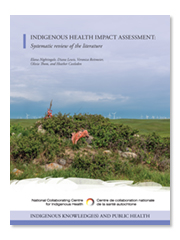
Indigenous health impact assessment: Systematic review of the literature

Indigenous health impact assessment: Systematic review of the literature


Presenters

Dr. Diana Lewis is a member of Sipekne’katik First Nation and Associate Professor/ Canada Research Chair (Tier II) in Indigenous Environmental Health Governance in the Department of Geography, Environment and Geomatics, University of Guelph. She is also Director of the IndigenERA Lab and a Member of the Royal Society of Canada (2025). Her research focuses on promoting understanding of Indigenous worldviews in environmental decision-making and advocating for Indigenous-led approaches to give communities baseline health data and sovereignty over the data in environmental decision-making. She is currently working with Indigenous communities across Canada to develop an Indigenous-led environmental health risk assessment approach.


Dr. Elana Nightingale is a Postdoctoral Scholar in the IndigenERA Lab at the University of Guelph where she works on Indigenous economic impact assessment. She holds a PhD in Geography from Western University, a MSc in Local Economic Development from the London School of Economics, and a BA in Economics from Carleton University. Elana aims to support community-led research as a means to advance health and social equity for First Nations, Inuit and Métis communities in Canada. Her research interests include the social determinants of Indigenous health, community economic development, community-based research methodologies and knowledge translation.


Click to register for the Zoom webinar
Tuesday, March 31, 2026
11 AM - 12:30 PM PDT,
2 PM - 3:30 PM EDT

Under Canada’s anti-spam legislation, by registering for this webinar, you agree to receive information from the NCCIH regarding knowledge resources, publications, and activities.
We won’t share your email with anyone and you can unsubscribe at any time.

NCCIH
NCCIH  

HOME | NEWS | PUBLICATIONS | RESOURCE LIBRARY


National Collaborating Centre for Indigenous Health (NCCIH)
3333 University Way, Prince George, BC, Canada, V2N 4Z9
T: (250) 960-5250 | F: (250) 960-5644
nccih@unbc.ca
nccih.ca


Follow the NCCIH on BlueSky Like the NCCIH on Facebook Connect to the NCCIH on LinkedIn Watch NCCIH videos on Vimeo Watch NCCIH videos on YouTube Listen to NCCIH on SoundCloud Read NCCIH knowledge resources on ISSUU