Between the Lines: The students of Epic Theatre Ensemble present a new show, commissioned by the Poverty & Race Research Action Council (PRRAC), about the relationship between housing and education. Check out the trailer above. Additionally, a recent interview with Epic appears in the latest issue of Poverty & Race. They were also featured in a recent EmbraceRace webinar, discussing their process and inspirations that help them create their transformative pieces. If you are interested in hosting a screening of Between the Lines , contact Jim Wallert at jim@epictheatreensemble.org.
|
|
NCSD STAFF UPDATES
What We've Been Up To Recently
|
|
Deadline: January 5, 2022 |
|
Support Federal Efforts to Further Local School Integration
NCSD is currently circulating two sign-on letters to advocate for school diversity in this Congress:
The second letter asks the House of Representatives to bring the Strength in Diversity Act (H.R. 729) to the floor for a vote. The bill provides funding for school districts and states voluntarily seeking to diversify their schools. A version of this bill passed the House of Representatives on a bipartisan basis in the last Congress.
Please email gchirichigno@prrac.org with any questions.
|
|
|
|
On Dec. 10, the Department of Education released its final “Supplemental Priorities and Definitions for Discretionary Grants Programs,” which will be used to guide selection priorities in future grant competitions. The priorities cover six broad categories (COVID, Equity, Diverse Workforce, Student Social-Emotional Needs, Post-Secondary Access, and “Cross-Agency Coordination and Community Engagement to Advance Systemic Change”). As you'll recall, NCSD submitted comments in response to the proposed priorities, namely calling for the Department to include "school diversity...as a separate and free-standing priority in the Secretary’s final priorities."
Although the Department did not make this change, diversity and inclusion are highlighted throughout the final priorities. The most pointed priorities are spelled out in the Equity section, which calls for “project[s] designed to promote education equity and adequacy in resources for underserved students…[t]hat [examine] the sources of inequity and inadequacy” through various means including “more equitable and adequate approaches to school funding,” high-quality, inclusive early learning, improved learning environments for multilingual learners, and “increasing student racial or socioeconomic diversity” through a variety of means, including interdistrict transfers, changes to school assignment and admissions policies, and cross-agency collaboration with housing and transportation agencies.
It remains to be seen how the priorities will be used in specific grant programs, but the Secretary’s announced priorities look like a good start.
|
|
|
|
NCSD Offers Recommendations for the FY2023 Department of Education Budget
-
Related: Several members of a housing/schools working group co-led by NCSD also submitted a letter outlining funding initiatives that the Department should consider in FY2023 to enhance coordination on housing and schools integration.
|
|
PLEASE HELP US REACH OUR
END-OF-YEAR FUNDRAISING GOAL
We need your support to sustain our advocacy efforts!
|
|
Thanks to the incredible generosity of our network, we've raised about $2,500 since #GivingTuesday ($1,215 on Facebook and the remainder via our website and the mail).
Since 2009, NCSD has been working to ensure that federal policymakers know that a cross-sector, intergenerational, cross-racial, nationwide constituency of support exists for school integration. Our partnership with The Raben Group brings critical capacity to NCSD's legislative and administrative advocacy efforts (the advocacy training they led in 2020 is still an excellent resource).
Unrestricted private donations are essential in helping us sustain our work on the Hill, as NCSD works to mobilize our constituencies around the country in support of initiatives like The Strength in Diversity Act. We are in this work to effect change, and our commitment to passing Strength in Diversity is stronger than ever.
|
|
New Poverty & Race issue explores housing/schools connection
|
|
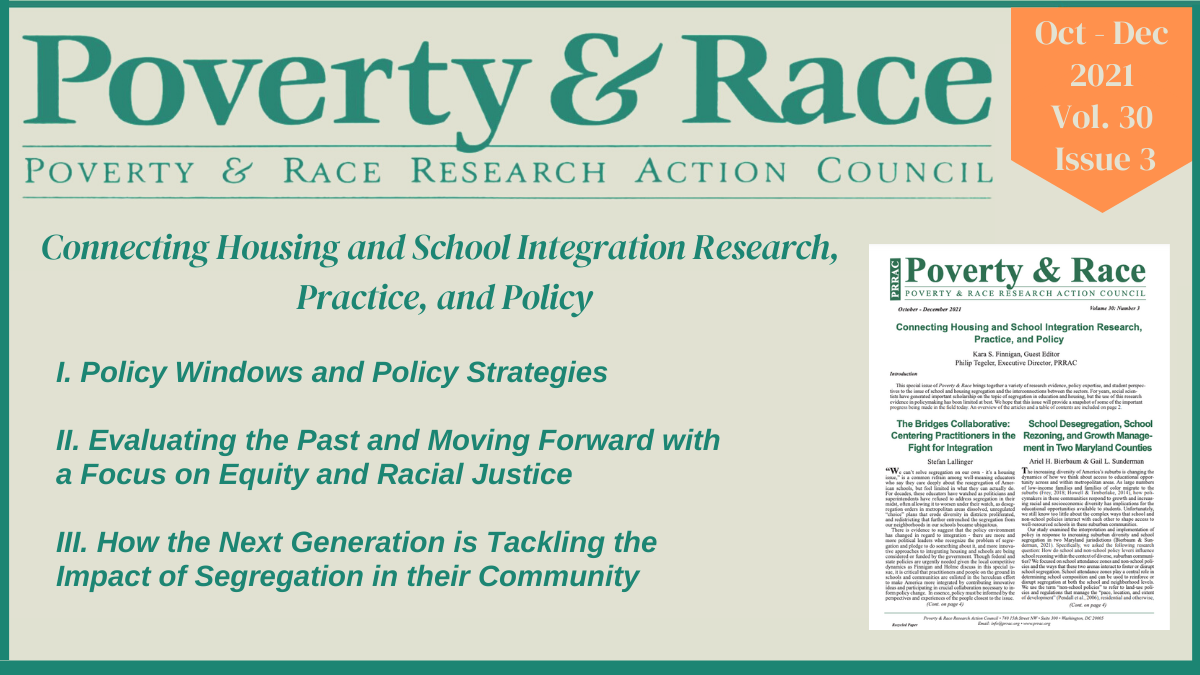
The Poverty & Race Research Action Council (PRRAC) recently released a new issue of Poverty & Race, guest-edited by Kara Finnigan of the University of Rochester, dedicated to "Connecting Housing and School Integration Research, Practice, and Policy."
|
|
"A deep and compelling look at the research evidence from a racial equity perspective should convince anyone serious about advancing racial justice that integration is worth the fight, that segregation must always be resisted, that White supremacy resists integration, and that integration cannot exist where White supremacy persists."
|
|
INDIVIDUAL MEMBER UPDATES
NCSD member Jennifer B. Ayscue and her co-author Elizabeth M. Uzzell released the research article How Teachers and Leaders Facilitate Integration in a Two-Way Dual Language Immersion Program in Columbia University's Teachers College Record: "[U]ntil recently, researchers have not examined the way in which TWI programs are structured to facilitate integration among racially and linguistically diverse students who are learning in the same classroom. This emerging area of research has received less attention than other aspects of TWI programs. Therefore, the purpose of this study is to examine the following question: How do teachers and leaders facilitate integrative interactions among students of different racial and linguistic groups in a TWI program?"
NCSD member Janel George authored a piece for Teen Vogue (Critical Race Theory Fights Resemble Anti-Integration Fights) exploring how the anti-CRT campaign resembles historic resistance to desegregation efforts: "This response appears to be a backlash to the international outcry over systemic racism ignited by the murder of George Floyd and of President Joe Biden’s efforts to promote racial equity. The U.S. has experienced this kind of reactionary pushback before. In fact, it closely mirrors the virulent response from white Southern lawmakers and parents who were opposed to school integration in the 1950s and 1960s. Decades after the U.S. Supreme Court ruled that separate could not be equal, educators trying to teach students about this history are being silenced."
|
|
|
 |
National Convening in Baltimore!
-
The Bridges Collaborative is planning an in-person convening in Baltimore on May 19th and 20th, 2022. If you are interested in presenting to the Bridges Collaborative, please reach out to lallinger@tcf.org.
|
|
|
|
|
|
|
|
New episode:
-
OBI’s newest episode of their podcast, Who Belongs, explores co-creation as a necessary ingredient to make spaces of belonging. Debbie Lacy of Eastside for All reflects on the impact of the co-creation framework on her work.
|
|
|
|
|
|
|
|
Update:
-
LDF Issues Statement on Misleading References to Brown v. Board of Education by Supreme Court Justices: “The violence and clear error of the Plessy decision should not be compared to Roe v. Wade. Brown and Plessy stand for much more. Brown represents the power of the Supreme Court—to demonstrate courage and leadership in articulating and upholding the rights guaranteed to every American. And Plessy represents the catastrophic result for our country, and for millions of Americans, when those rights are denied.”
|
|
|
|
New Podcast Episodes:
-
Education Policy Fellows Get Things Done in the Suppression Session – Podcast Episode 216: As IDRA’s groundbreaking Education Policy Fellows Program closed its inaugural year, they sat down with their four fellows to reflect on their experience. With this program, IDRA set out to change the landscape of state education advocacy by training advocates with a commitment to and experience with communities of color to influence state laws and lead a powerful network of impacted communities.
|
|
|
|
|
|
|
|
New Executive Director:
-
"We are excited to introduce our new Executive Director, Dr. Fabienne Doucet, who succeeds Dr. David E. Kirkland’s seven-year tenure of leadership at NYU Metro Center. Fabienne joins a strong legacy of visionary leadership driven to enhance the educational experiences of students who historically have faced marginalization within schooling." Learn more about Fabienne here.
|
|
|
|
RESEARCH ADVISORY PANEL UPDATES
-
NCSD RAP member Genevieve Siegel-Hawley and co-author Taikein Cooper published the essay Toward a Vision of Racial Equity in Richmond Schools in RVA Magazine as part of its "Richmond Racial Equity Series" - "De facto segregation has not only limited educational opportunities available to students from economically disadvantaged backgrounds (who are disproportionately Black and Brown), it permeates throughout the fabric of this city. As we grapple with heightened awareness to racial injustice in America, it’s important for us to find viable solutions in this city as well. Embracing the aforementioned vision of real integration in Richmond Public Schools is the step in the right direction."
|
|
|
bell hooks reflecting on a conversation with her pastor: "Your heart has to be ready to handle the weight of your calling." Watch john a. powell in dialogue with bell hooks at the 2015 Othering & Belonging Conference. |
|
As the year comes to a close, we are still processing the loss of two larger-than-life leaders in the struggle for social justice: bell hooks and Archbishop Desmond Tutu.
In this newsletter, we focus on the legacy of bell hooks and how her scholarship does, can, and should inform our movement. We anticipate that these reflections will carry on into the new year.
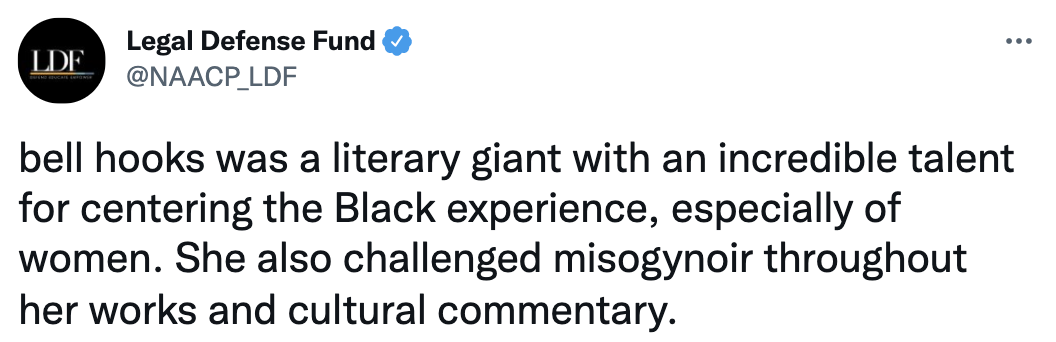
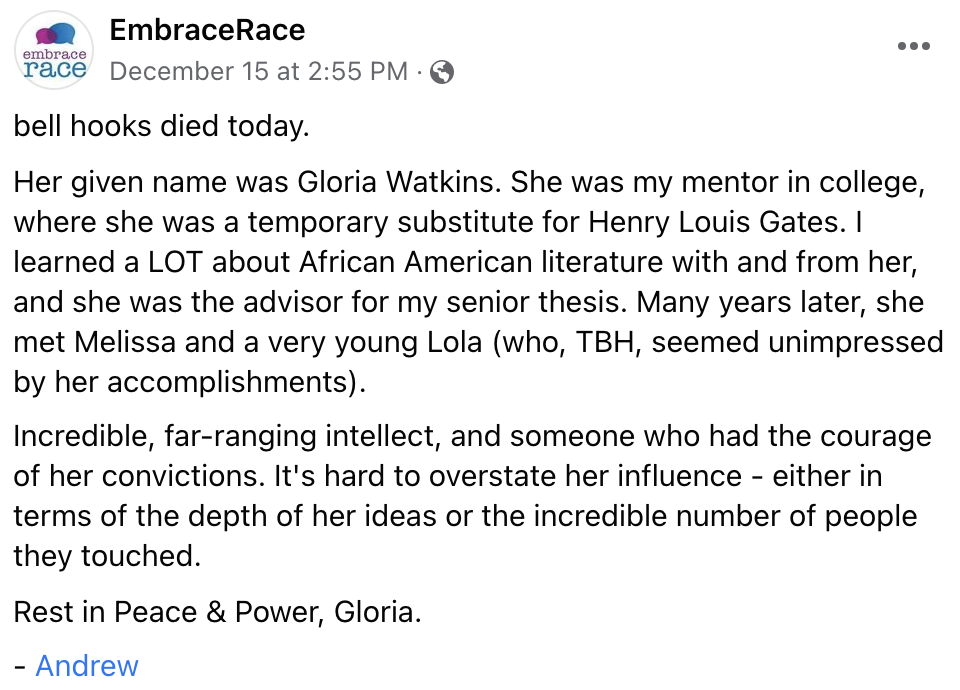
Immediately following the announcement that bell hooks had passed away, NCSD members and partners were among those sharing powerful testimonies about how hooks had shaped them as scholars, advocates, and educators -- and, importantly, as human beings. We've shared some examples below.
"When we entered racist, desegregated, white schools we left a world where teachers believed that to educate black children rightly would require a political commitment. Now, we were mainly taught by white teachers whose lessons reinforced racist stereotypes. For black children, education was no longer about the practice of freedom. Realizing this, I lost my love of school. The classroom was no longer a place of pleasure or ecstasy. School was still a political place, since we were always having to counter white racist assumptions that we were genetically inferior, never as capable as white peers, even unable to learn. Yet, the politics were no longer counter-hegemonic. We were always and only responding and reacting to white folks. That shift from beloved, all-black schools to white schools where black students were always seen as interlopers, as not really belonging, taught me the difference between education as the practice of freedom and education that merely strives to reinforce domination. The rare white teacher who dared to resist, who would not allow racist biases to determine how we were taught, sustained the belief that learning at its most powerful could indeed liberate. A few black teachers had joined us in the desegregation process. And, although it was more difficult, they continued to nurture black students even as their efforts were constrained by the suspicion they were favoring their own race.“
Of course, this excerpt only scratches the surface of bell hooks's vast and nuanced work. Yet, it is an essential perspective for school integration advocates to remember. As the backlash to anti-racist teaching and learning continues, and policymakers discuss the merits of educator diversity and work to formulate concrete solutions, hooks's testimony reminds us of the interconnectedness of educational justice issues, the need to acknowledge and work to repair harm, and the importance of consistently advocating for holistic integration. After all, integration is fundamentally "about getting all children something better." (See "A Framework For Integration Rooted In Racial Justice" by Matt Gonzales.) As we continue to imagine "something better," bell hooks's work remains an incredible resource.
An inspiring obituary about bell hooks penned by Noliwe Rooks, we think, articulates a vital aspiration for our movement as we move into 2022: "Because of bell hooks, we know we can bring our whole selves to our work. We can trust and believe in our intellect. We can be complicated in our humanity. We can be gentle with our critiques. We can be fierce in our protection. We can keep talking to, and talking with, and talking back, until the last breath."
|
|
“As a classroom community, our capacity to generate excitement is deeply affected by our interest in one another, in hearing one another’s voices, in recognizing one another’s presence.”
- bell hooks, Teaching to Transgress: Education as the Practice of Freedom
|
|
|
Additional reflections by members and partners: |
|
We invite our community to share personal reflections via Twitter, using this tweet as a starting point: In what ways did bell hooks shape your work and life? How might these insights inform the school integration movement in 2022?
|
|
NEWS FROM
ACROSS OUR
COUNTRY
|
|
|
|
|
An Education Week explainer video explores the decades-long issue of public schools lacking teacher diversity.
Flashback: NCSD hosted a virtual keynote in May 2020, featuring NCSD Research Advisory Panel member Vanessa Siddle Walker in conversation with Elizabeth McRae. With the help of facilitator Dani McClain, panelists discussed interconnections between educator diversity and desegregation (and, in particular, White resistance to it).
|
|
-
Perspective: Why We Must Shed Old Fears of Changing School Boundaries to Help Poor and Minority Kids by Jay Mathews (Washington Post, Dec. 19) - "Where you live, however, remains much more important than what you need as a student in deciding where you go to school. The resulting inequities, the authors say, 'happen at a microgeographic level, making them easy to hide.” Since government institutions created these boundaries, they argue, it is government’s responsibility to fix them. 'Policymakers have had numerous opportunities to amend the school boundaries to redress these harms,' Monarrez and Chien say, 'but many of them have simply chosen not to do so.'"
-
Related: Dividing Lines: Racially Unequal School Boundaries in US Public School Systems by Tomás Monarrez & Carol Chien (Urban Institute, Sept. 2021)
-
Integration Versus Meritocracy? Competing Educational Goals During the COVID-19 Pandemic by Elise Castillo, Molly Vollman Makris, & Mira Debs (AERA Open, Dec. 16) -"Alongside the immediate challenges of operating schools during the COVID-19 pandemic, over the past year, parents, students, and policymakers around the country have also debated equity and access to some of the country’s most elite and segregated public schools. This qualitative case study examines how New York City activists conceptualized educational equity during the pandemic. Conceptually framed by Labaree’s (1997) typology of the three competing purposes of education—democratic equality, social efficiency, and social mobility—we document different lessons learned from the pandemic by integration activists, who emphasized school integration for democratic equality; and meritocratic activists, who prioritized retaining the existing stratified system mainly to foster social mobility and social efficiency. Our findings highlight the challenge of sustaining a vision oriented around the public good amid powerful framings emphasizing the individual purposes of education."
-
NEPC Review: How to Regulate Critical Race Theory in Schools: A Primer and Model Legislation - Manhattan Institute, August 2021 by Kevin D. Brown (National Education Policy Center, Dec. 14) - "The Manhattan Institute’s How to Regulate Critical Race Theory in Schools: A Primer and Model Legislation manufactures a case against Critical Race Theory (CRT), building on a foundation of right-wing talking points...This review examines some of the ways that the report mischaracterizes CRT. The review also explains how and why the model legislation might, if adopted, lead to anti-discrimination lawsuits. For these reasons, the Manhattan report does not provide serious guidance to lawmakers interested in understanding or legislating about issues related to race in schools."
-
The Adequacy and Fairness of State School Finance Systems (Albert Shanker Institute & Rutgers Graduate School of Education, Dec. 1) - "In this report, we evaluate the K-12 school finance systems of all 50 states and the District of Columbia. We assess each system (and the U.S. overall) using a small set of measures focused on how much states leverage their capacity to fund schools (fiscal effort), how that money is distributed (progressivity) and, most importantly, whether it is enough to meet common outcome goals (adequacy)."
-
Centering Black Students in Language Education by Louisa Shepherd (Penn Today, Nov. 9) - "Bilingual education has always been committed to equity, right? That’s part of why bilingual education was created as a policy, to challenge inequities in education. But there has not been much work done specifically on the needs of Black students in bilingual education, and by Black students I mean African Americans, Afro-Latinxs, African immigrants, among others. The limited amount of research and experience that does exist seems to suggest that they are being marginalized in these programs. But there haven’t been systematic conversations about this in the field, so bilingual education has inherited the anti-Black ideologies and practices that have oftentimes informed other areas of education practice. This is even true with dual-language education programs, where I do most of my research."
|
|
Arkansas -
-
Appeals Court Refuses Review of Decision Opening Door to School Resegregation in Four South Arkansas Districts by Kimberly Sellery (Arkansas Times blog, Nov. 9) - "The reversal also indicated the 8th Circuit is tired of hearing old desegregation cases. 'Freedom of choice,' as unlimited transfer law proponents label it, is now the law. It was the banner slogan employed in resistance to school desegregation in the 1960s by opponents of the implementation of the Brown. v. Board of Education Supreme Court ruling that ended dual systems of education."
|
|
California -
-
These Maps Show How Oakland's School District Reinforces Segregation by Jeremy Gormley (Great School Voices, Nov. 11) - "Providing neighborhood preference without evaluating boundaries to account for demographic shifts will lead to schools that reflect the same level of displacement (see the decline of OUSD’s Black population), exclusivity, and racial isolation as Oakland’s neighborhoods...At the very least, we need to admit that school boundaries, as designed by the district, play just as significant a role in reinforcing racial segregation as the underlying neighborhoods."
|
|
Maryland -
-
View of School Desegregation, School Re-Zoning, and Growth Management in Two Maryland Counties by Ariel H. Bierbaum & Gail L. Sunderman (Education Policy Analysis Archives, Dec. 6) - "This article examines how school and non-school policies interact to reinforce or disrupt school segregation in the context of suburban communities and how these systems are maintained by structural and institutional mechanisms...We find that school district rezoning policies provide a weak regulatory framework for desegregating schools because school zoning decisions are not made in a vacuum but rather are shaped by policies and actions taken by other actors in a multi-level governance structure."
|
|
Minnesota -
-
In Minneapolis Schools, White Families Are Asked to Help Do the Integrating by Sarah Mervosh (New York Times, Nov. 27) - "Minneapolis, among the most segregated school districts in the country, with one of the widest racial academic gaps, is in the midst of a sweeping plan to overhaul and integrate its schools. And unlike previous desegregation efforts, which typically required children of color to travel to white schools, Minneapolis officials are asking white families to help do the integrating — a newer approach being embraced by a small group of urban districts across the country."
|
|
Mississippi -
-
Why School Integration Never Happened in Noxubee County, Miss. by Sarah Mervosh (Mississippi Free Press, Oct. 29) - "Within months of the early 1970 Alexander v. Holmes decision meant to finally end segregated education, the Noxubee Mennonites pulled their kids out of public schools and launched their own private institutions. That included Magnolia Mennonite School between Macon and Brooksville (now called Magnolia Christian School since the 1990s) and South Haven Mennonite School about 10 miles from Magnolia east of Macon near Prairie Point."
|
|
New Jersey -
-
Opinion: What Will a Second-Term Murphy Administration Do to End School Segregation? by Willie Dwayne Francois III (New Jersey Star-Ledger, Dec. 9) - "The abolition of school segregation represents a powerfully unifying undertaking because it is morally unassailable and in the self-interest of the vast majority of working-class New Jerseyans of all colors. It’s a winning strategy. I, along with our partners in civil rights, faith, labor, and the education communities, stand ready to help Governor Murphy fulfill this goal."
|
|
Texas -
-
Preserving History of Mexican American School Segregation by Russell Contreras (Axios, Dec. 9) - "The U.S. House of Representatives on Wednesday passed the Blackwell School National Historic Site Act, clearing one of the last hurdles in the National Parks Conservation Association’s campaign to make the school a national park site...Mexican American former students would later recall the emotional abuse and discrimination they faced on campus. For example, some teachers made students write Spanish words on paper, place those papers in a box and bury 'Mr. Spanish' in a symbolic funeral in front of Marfa’s Blackwell School, according to the 2015 PBS Voces documentary Children of Giant."
|
|
Wisconsin -
-
Milwaukee Public Schools: Diversity Unmatched by Any District in Wisconsin by Bob Peterson (Shepherd Express, Dec. 9) - "The recent [Afghani ]immigrants add to what was already an impressive multiracial, multilingual student body at MPS, from our African American, Latinx, Native American and Hmong students, to our white students. It’s hard to explain how proud this makes me feel."
|
|
CROSS-MOVEMENT RESOURCE LIST |
|
|
|
“My whole personal history has been a struggle to meet standards of excellence in a society, which has been dominated by the ideas that Blacks were inherently inferior to Whites and women were inherently inferior to men.”
-Pauli Murray
|
|
American Civil Liberties Union (ACLU) |
|
|
|
African American Policy Forum (AAPF) |
|
|
|
Civil Rights Projects/Proyecto Derechos Civiles |
|
|
|
Lincoln Institute of Land Policy |
|
|
|
Maryland State Department of Education, Office of the State Superintendent |
|
|
|
Metropolitan Center for Research and Equity and the Transformation of Schools |
|
|
|
New Venture Fund (Communities for Just Schools Fund Director of Movement Partnerships) |
|
|
|
Othering & Belonging Institute |
|
|
|
Poverty & Race Research Action Council |
|
|
|
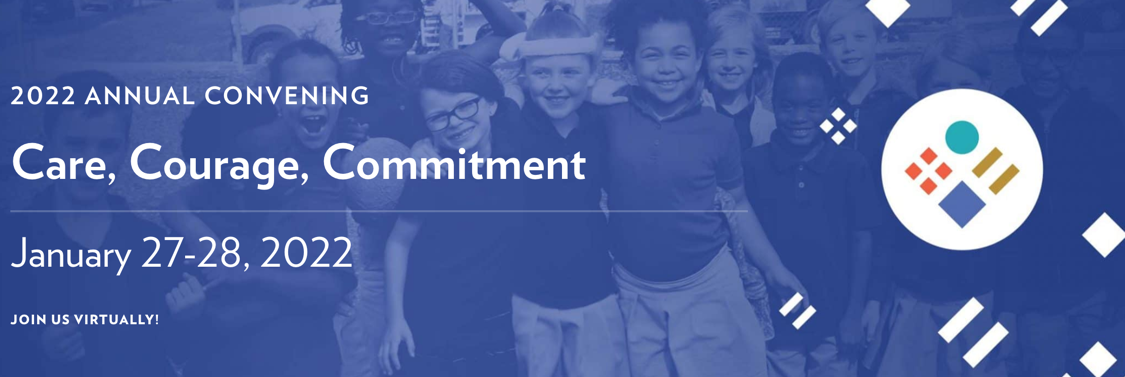
The Diverse Charter Schools Coalition’s (DCSC) Virtual Annual Convening will bring together 200 leaders from member schools and networks as well as partners from across the nation. With this year’s theme of "Intentional Integration," DCSC will deepen the practice of leading your school or network by learning from experts in the movement, examining real-world experiences, data, and strategies, and sharing best practices through networking.
|
|
|
|
|
Truth, Racial, Healing, & Transformation (TRHT) - It is not the responsibility of one person, one group, or even one organization to drive this work. The responsibility belongs to all of us to participate in these honest, powerful, and moving experiences, and pursue this journey together. Download the Action Kit here.
|
|
|
|
|
National Schools Board Association (NSBA) - A forum for school board members, public school advocates, and community leaders to examine and discuss the strategies, current trends, research, and best practices around equity in our nation’s public K-12 schools. Join your colleagues at NSBA’s Equity Symposium, January 22, 2022 in Washington, D.C.
|
|
|
|
|
Magnet Schools of America - The Conference will provide an opportunity for magnet district and school professionals to dig in on education policy that impacts magnets. Attendees will hear from: Members of Congress and agency officials, school district officials, and policy and foundation organizations.
|
|
|
2/16 - 2/22
New Orleans, LA
|
|
National Title I Association - The Conference is intentionally aimed at coordination among federal education programs under the Elementary and Secondary Education Act (ESEA) and other federal programs.
|
|
|
2/17 - 2/19
Nashville, TN
|
|
American Association of School Administrators - Researchers, educators and practitioners will come together for intensive debate and discussion on Leading for Student-Centered, Equity-Focused Education, and what that means for your leadership role, community collaboration, district outcomes, and student success.
|
|
|
|
|
Contact Us
National Coalition on School Diversity
c/o Poverty and Race Research Action Council
Mailing Address: 740 15th St. NW #300
Washington, DC 20005
Phone: 202-544-5066
|
|
|
|
|
|
|