NCWRPC News | Winter 2026 | Issue 88 | | | |
North Central Wisconsin
Regional Planning Commission
|
Serving Adams, Forest, Juneau, Langlade, Lincoln,
Marathon, Oneida, Portage, Vilas, and Wood Counties since 1973
| | |
Changes to Wis. Statutes Regarding
Local Subdivision Ordinances
| |
Communities with subdivision (aka land division) ordinances should be aware of recent changes to Wisconsin Statues Chapter 236 relating to subdivision plat approvals. 2025 Wisconsin Act 68 was enacted on December 9, 2025. This Act amends several sections of chapter 236. The changes take effect on July 1, 2026.
These changes do not necessarily require immediate update of local subdivision ordinances, but communities with subdivision ordinances should be aware of potential impacts on how subdivision ordinances are interpreted and administered after July 1.
The following provides an overview of the changes to Chapter 236 and the implications for communities with subdivision ordinances:
- Several items are added or removed in the purpose of the statute. Communities should ensure that ordinance actions do not impede selection of housing types or accessibility by pedestrians, bicycles, transit, or other transportation options. In addition, reducing overcrowding or traffic congestion should not be used as a basis for ordinance decisions.
- Communities must provide an opportunity to subdividers for a pre-submission concept review. Basically, an informal meeting with representatives of the community to discuss if the proposal will comply with requirements and conditions for approval before submission of a preliminary (or final) plat. The outcomes of these reviews are non-binding.
- A community may not reject a preliminary plat submission on the basis that the plans and reports are not final. However, approval may be made conditional to submission of final plans and reports.
- The handling of public improvements is changed slightly. The community may require the subdivider to agree to install reasonably necessary public improvements within a reasonable time after approval and provide financial security for those improvements. In other words, installation or acceptance of public improvements may not be required as a condition in the plat approval or recording process. In addition, building permits for structures meeting all relevant requirements may not be withheld solely on the status of public improvements.
- An approved plat is entitled to be recorded. The community must make a certificate to that effect on the face of the plat no later than 10-days after the subdivider submits the plat with all the necessary requirements.
The NCWRPC recommends that communities with subdivision ordinances share this information with elected officials, committee members and staff that deal with reviewing and approving subdivisions in the community, so that any future ordinance actions are consistent with the statutory changes. Potential changes to local ordinances to accommodate these new statutory provisions can be made at a later time that is convenient for the community, such as when making other updates or amendments.
For more information see the full text of 2025 Wisconsin Act 68 at https://docs.legis.wisconsin.gov/2025/related/acts/68.
If you have any questions regarding subdivision ordinances or the Act 68 changes, the NCWRPC may be able to help. Contact Darryl Landeau, AICP at dlandeau@ncwrpc.org or 715-849-5510 ext. 308.
| | WisDOT Local Small Structures Improvement Program (LSSIP) 2026-2027 | |
WisDOT recently held an informational webinar focused on the State Fiscal Year (SFY) 2026-2027 Local Small Structures Improvement Program (LSSIP) project solicitation.
The webinar covered the 2026-2027 LSSIP project solicitation, program eligibility, application procedures, and other related information.
The subject matter will help inform local governments and other interested parties about the content of the application and what is expected of the applicant.
The Local Small Structures Improvement Program (LSSIP) is a one-time appropriation authorized as part of the 2025-2027 Wisconsin Biennial Budget (Act 15) and part of Wisconsin State Statute 85.64 (2)(a).
This program aims to repair or replace deteriorated small structure crossings. Projects may be funded at up to 90% state cost share.
For those who were unable to join us, the direct link to the recorded webinar can be accessed here: https://www.youtube.com/watch?v=y-hQ-vJhRxA
WisDOT strongly encourages potential applicants and other interested parties to view the video prior to submitting an application.
More information about LSSIP can be found on WisDOT's LSSIP website.
To be considered for funding in this 2026-2027 LSSIP project solicitation, local agencies must apply by May 1, 2026.
For questions about LSSIP, please contact the Program Manager, Izzy Schultze, at izzy.schultze@dot.wi.gov.
| | |
Opportunity Zones are economically distressed communities designated at the census tract level. U.S. taxpayers who reinvest eligible capital gains into Qualified Opportunity Funds that invest in Opportunity Zone property may qualify for several federal tax benefits.
The Opportunity Zones program, originally established in 2017, was updated in 2025 as part of the 2025 Reconciliation Act. The renewed Opportunity Zones 2.0 program will take effect on January 1, 2027. As part of the changes to the Opportunity Zones program, new census tracts will need to be designated as Opportunity Zones.
Per the 25% statutory cap, Wisconsin will be able to nominate 77 of their 306 eligible census tracts as Opportunity Zones. The nomination window for each state opens on July 1, 2026 and runs for a period of up to 120 days. Note: OZ 1.0 designated tracts will not be automatically recertified under Opportunity Zones 2.0. However, they may be submitted for reconsideration under the new program. Opportunity Zone 2.0 designations are effective for 10 years beginning January 1, 2027.
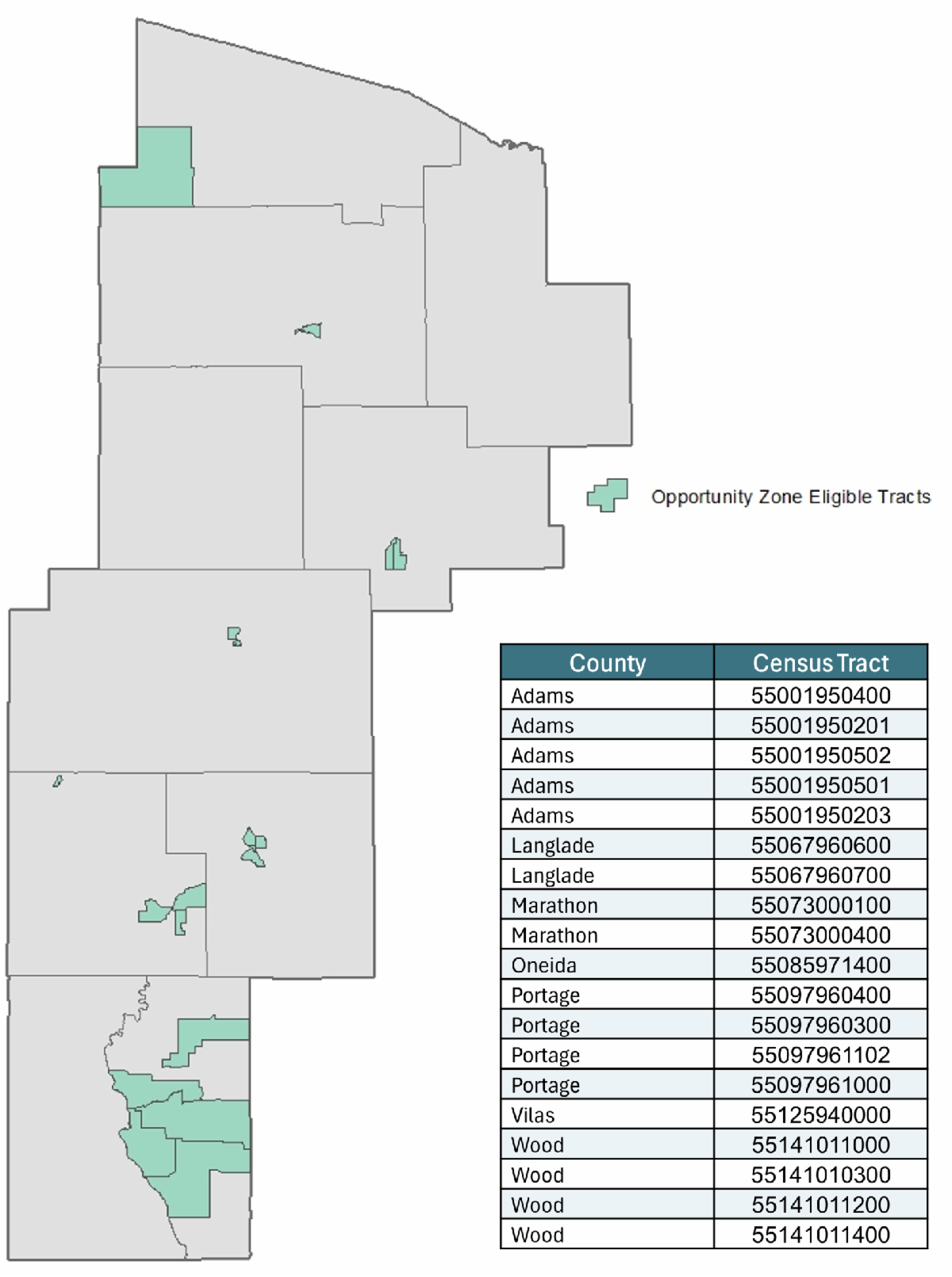
There are 19 census tracts eligible for designation as an Opportunity Zone within North Central Wisconsin. These tracts are mapped and listed below. Alternatively, eligible tracts can also be identified via Novogradac's interactive Opportunity Zones 2.0 Mapping Tool.
| | 2026 Central Wisconsin Housing Summit | | |
Join community leaders, practitioners, and partners to revive, repair, and reimagine housing on April 15th in Stevens Point!
The 2026 Central Wisconsin Housing Summit is focused on the builder’s perspective, addressing the real challenges contractors, developers, and partners face in housing today. Learn best practices, explore resources, and connect with peers to find solutions that move projects forward.
Topics that will be discussed at the Housing Summit include:
- Networking & Resource Connections
- Setting the Foundation for Housing in Central Wisconsin
- Regional Housing Insights & Local Tools
- Reimaging What's Possible
- Small-Scale Development & Community-Led Solutions
- Financing Community-Driven Housing
- Housing Conversations That Matter
- Workforce & Contractor Capacity Building
- Public, Private, and Community Partnerships
- Hands-On, Interactive Learning
- From Ideas to Implementation
The Housing Summit will be held on Wednesday, April 15th from 8:00 AM - 4:00 PM at the Dreyfus University Center in Stevens Point. Click below to learn more information and register for the 2026 Central Wisconsin Housing Summit.
| | |
The NCWRPC continues its partnership with the Wisconsin Economic Development Corporation (WEDC) to provide economic development analysis data throughout the Region. A comprehensive economic modeling program, called Analyst, developed by Economic Modeling Specialists International (EMSI) is a tool that provides industry/ occupation data, impact assessments, and economic base analysis information.
Detailed quarterly summary economic reports have been prepared for each county. Those are available on our website. Requests for additional data can also be made on the website.
| | 2026 1st Quarter Economic Overviews | | |
Adams County
Rocky Gilner
Rick Pease
Appointment Pending
Juneau County
Betty Manson
Terry Taft
Dennis Krejci
Lincoln County
Loretta Baughan
Alan Bishop
Hans Breitenmoser
Oneida County
Robb Jensen
Ted Cushing
Michael Tautges
Vilas County
Holly Tomlanovich
Appointment Pending
Appointment Pending
| | |
Forest County
Tom Tallier
Paul Millan
Appointment Pending
Langlade County
Reinhardt Balcerzak
Angela Close
Ronald Nye
Marathon County
Randy Fifrick
Jami Gebert
Joshua Klingbeil
Portage County
John Pavelski
Larry Raikowski
Ray Reser
Wood County
Jason Grueneberg
Douglas Machon
Dave LaFontaine
| | | |
North Central Wisconsin
Regional Planning Commission
210 McClellan Street, Suite 210
Wausau, WI 54403
715-849-5510
Fax: 715-849-5110
| | | | |