NDMTSS website
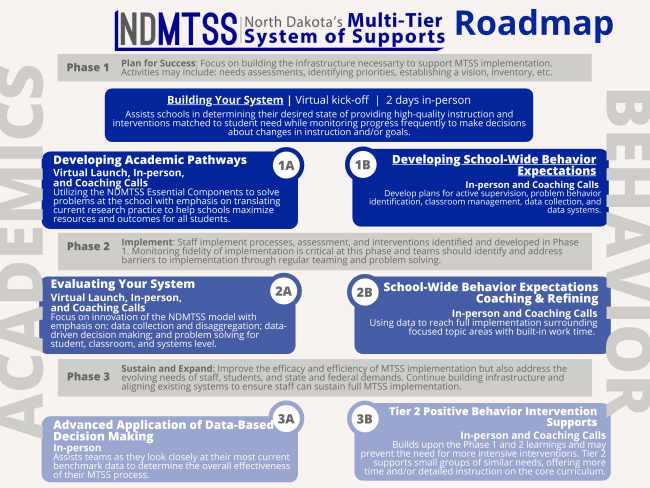
NDMTSS Roadmap
Registration Calendar

February 2024 Newsletter


NDMTSS Overview

Why is Tier 1 so Important?


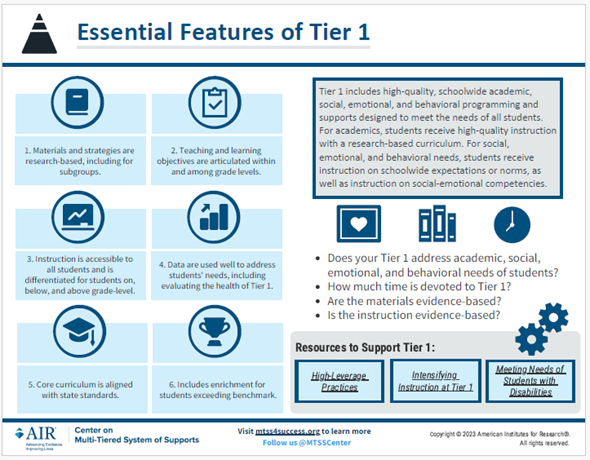
A Multi-Tiered System of Supports organizes supports for students in three tiers of intensity for instruction and intervention. Tier 1 is high-quality, schoolwide academic, social, emotional, and behavioral programming and supports designed to meet the needs of ALL students and is the foundation for the rest of the tiers. Strongly considering the effectiveness of Tier 1 and what can be done to improve it may involve reviewing our curriculum, instruction, environment, and what we know about our learners. School-based leadership teams make decisions for continuous improvement and resource allocation by using data well at all tiers of support. 

To achieve the highest outcomes for students, teachers must be able to design and implement evidence-based programs and instructional practices that have the highest likelihood of working with the students that we serve. They must also understand how the data they collect can inform instructional decisions and which strategies can be employed to intensify instruction at Tier 1. Many of the resources and supports developed by the American Institutes of Research and the Center for Intensive Intervention outline the Essential Features of Tier 1 (above).


Additional Resources to Support Tier 1 listed on the flyer are linked here:


Action Item: Consider how these tools and resources could be utilized in your school to engage in the questions about Tier 1 Instruction:

  • Does your Tier 1 address academic, social, emotional, and behavioral needs of students? 
  • How well is Tier 1 working? Are more than 80% of our students being successful with Tier 1 instruction only? 
  • Are the curricular materials evidence based? 
  • Is the instruction evidence-based? 
  • Has your school explicitly stated what high-quality instruction looks like/sounds like/is planned for in all classrooms? 
  • Do teachers understand the practices for intensifying instruction?
 

NDMTSS News & Updates


NDMTSS Rundown

Brief yet exciting recaps of our PD Trainings that happened around our region!

NDMTSS Academic Trainings Recap


Phase 2A: Evaluating Your System

During days 3 & 4, Wayne Callender led teams through the process of determining Adequate Progress within their system. In general, are the individual schools moving in the right direction? If not, why not? What changes are needed?


"Very much appreciate the guidance and 'next steps' of how to use our data to evaluate the effectiveness of our MTSS pathways, curricula, groupings at all the different levels."

(MS teacher - Glenburn)


Participating schools: Centennial Elementary, Bismarck, Eight Mile, Glenburn, Jamestown, Oak Grove, Tate Topa, Washburn


Phase 3A: Advanced Applications of Data-Based Decision Making

Using the Data Meeting Focus Questions, created by Wayne Callender, teams are able to go back to their schools and conduct efficient data meetings where intervention groups are the focus. Teams engaged in problem-solving and created Action Plans to implement changes they identified.


"Most effective professional development I've ever attended. Everything pertained to our system in some way and made many aspects of my job much clearer."

(Special Education Teacher - Barnes County North Public School)


"I took away a lot of information regarding data meetings and data record keeping. We will implement immediately."

(Administrator - LaMoure Public School)


Participating schools: Garrison, Barnes County North, Carrington, LaMoure

NDMTSS Behaviors Trainings Recap


Phase 1B: Developing Schoolwide Behavior Expectations

We just wrapped up days 3 & 4 of Developing Schoolwide Behavior Expectations in Jamestown. Weather played a bit of a factor in our meeting days, but we made the most of our time together with some extremely good conversations around Rewards & Recognition and Relationship-Based Discipline, including some tough, but valuable dialogue around culture, trauma, equity, and biases. Teams continue to improve their systems and build capacity around the importance of teaching expected behaviors and what that looks like, while networking with other teams in attendance.


Teams participating: Ojibwa, Hankinson, Glenburn, Sawyer, Washington and Roosevelt Elementaries (Jamestown)


Upcoming Trainings


Behavior Supports for ND Educators

FREE Live Webinar Series


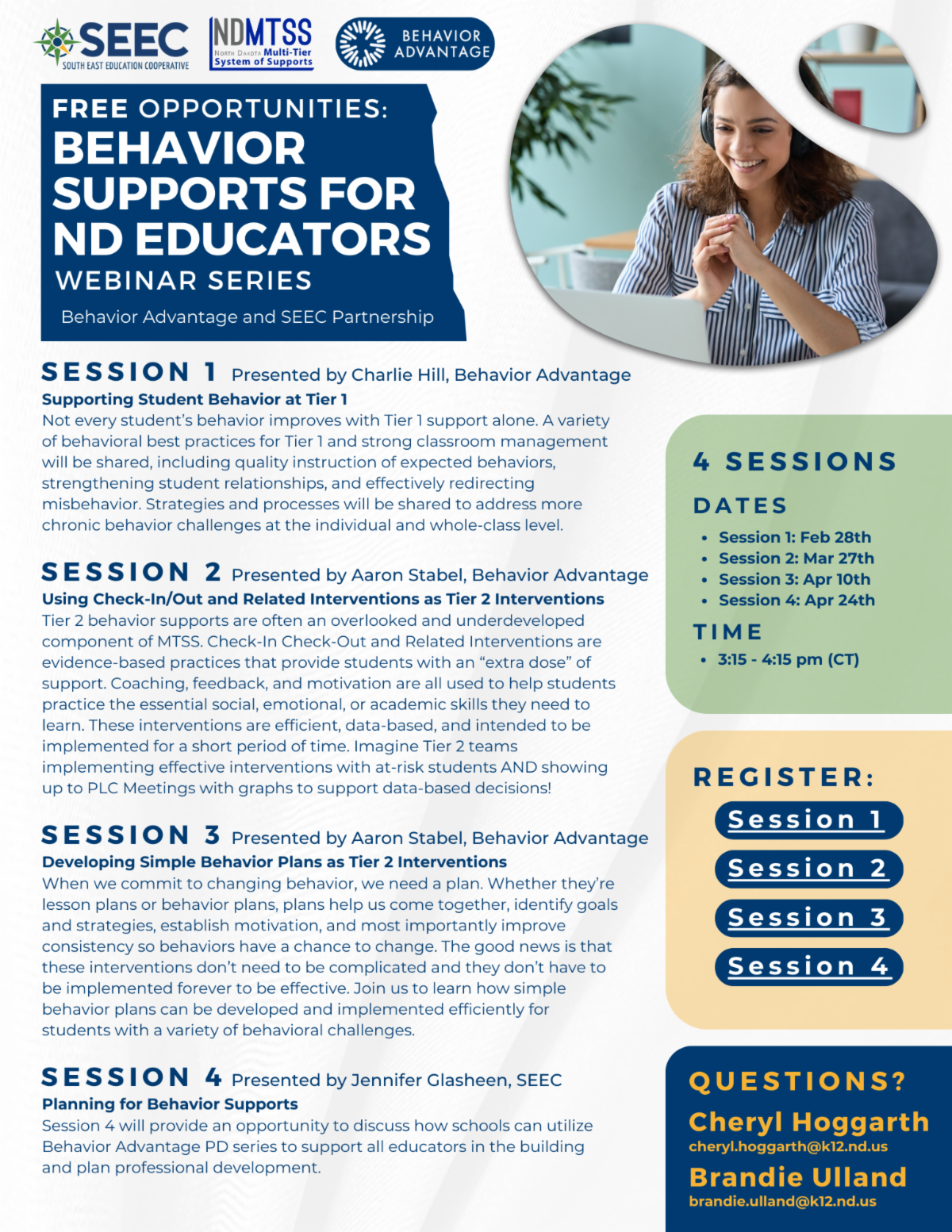
The SEEC is excited to again be partnering with Behavior Advantage to support the ongoing requests and needs for supporting and growing positive student behaviors (and decreasing negative behaviors!) in our schools.


If you are looking for some insight and an opportunity to wrap your head around how to get started, we have the following FREE Webinar series. You are invited to join us live for any or all of the sessions, but you must register ahead of time. See the flyer below!


Session 1: Supporting Student Behavior at Tier 1

Presented by Charlie Hill from Behavior Advantage

February 28th, 2024 | 3:15 - 4:15 pm (CT)


Session 2: Using Check-In/Check-Out and Related

Interventions as Tier 2 Interventions

Presented by Aaron Stabel from Behavior Advantage

March 27th, 2024 | 3:15 - 4:15 pm (CT)


Session 3: Developing Simple Behavior Plans as Tier 2 Interventions

Presented by Aaron Stabel from Behavior Advantage

April 10th, 2024 | 3:15 - 4:15 pm (CT)


Session 4: Planning for Behavior Supports

Presented by Jennifer Glasheen, Cheryl Hoggarth, and Brandie Ulland - SEEC/NDMTSS

April 24th, 2024 | 3:15 - 4:15 pm (CT)


The first three sessions are for ANY educator; Session 4 will be for Administrators, PD Coordinators, MTSS team leads, Beginning Teacher Coordinators, mentors - anyone who is looking for ideas on designing a professional learning plan for those you support utilizing the Behavior Advantage PD series.


Our SEEC/NDMTSS team will be on hand to assist and support for all sessions.

If you have any questions, please reach out.

Cheryl Hoggarth | Brandie Ulland

Features of Effective Math Instruction (FEMI) Part 1


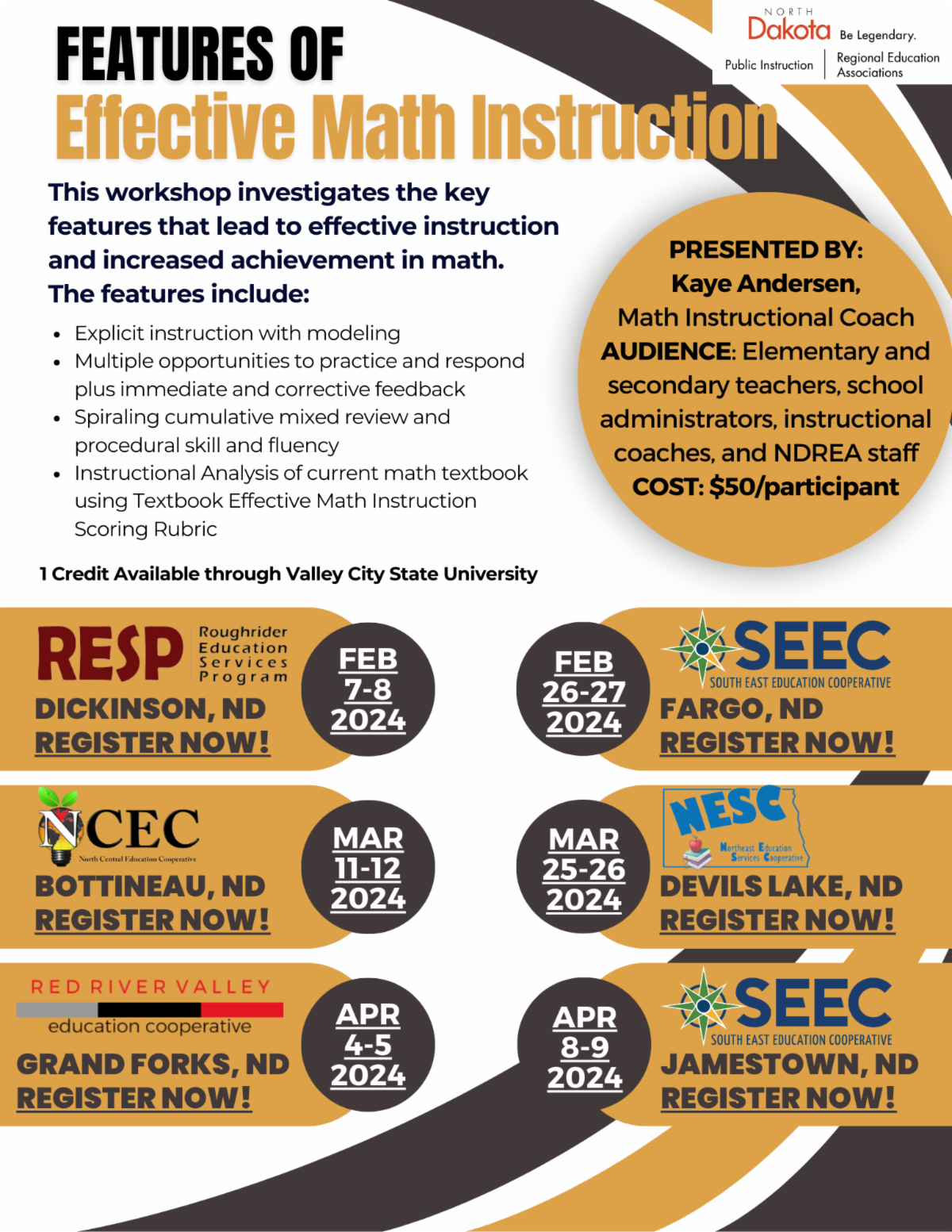
In response to the growing requests for mathematics support in ND, the NDREAs, through the support of an NDDPI Math Grant, are excited to invite leaders and educators to explore the new Effective Math Instruction webpage on the NDREA website.


We have multiple opportunities being designed to help educators review the research about effective math instruction, identify evidence-based practices that have demonstrated positive student outcomes, and engage in designing instruction that translates that research into practice. Click the flyer below to register for the location nearest you!


For more information, REA contacts are listed on the webpage linked above.


NDMTSS Spring Happenings

Site Visits for Schools Completing

Phase 1A: Developing Academic Pathways


Spring visits are coming up in April. Wayne Callender, along with a Regional Support Liaison, will be making their way through North Dakota, visit schools to individually support the implementation of MTSS.

SAND Administration for those completing

Phase 2A: Evaluating Your System


Schools completing year 2 of training engage in a facilitated process of Evaluating their System using the Self-Assessment of North Dakota MTSS (SAND). This tool helps schools identify the growth that they have made over the past two years as well as generate an action plan for continued work. REA Regional Support Liaisons support the MTSS Leadership Teams in this process.

NDMTSS Overview Webinar


Join us Tuesday, March 26th at 1:00pm to learn more about 2024-25 NDMTSS Training Opportunities and Resources available to North Dakota schools.

Join us live on Zoom

We are finalizing dates for 2024-25 NDMTSS Trainings.

Keep an eye out for more information coming from us soon!

 
Some additional resources...

CharacterStrong Weekly


Every Monday morning from CharacterStrong, receive a 2 to 3 minute video with a low-burden, high impact strategy to transform your daily work.

Sign up here!


Click on the image for a favorite strategy from your NDTMSS Team:

"They should know how to behave in my classroom." But if we haven't taught them what our expectations are, how will the students know? Keep in mind that our students come from various backgrounds and the expectations at home may not always match the expectations in our classrooms, so we need to teach and support behaviors the same way we teach and support academics.

Jennifer Glasheen

South East Education Cooperative

Jennifer.Glasheen@k12.nd.us


Brandie Ulland

South East Education Cooperative

Brandie.Ulland@k12.nd.us

Cheryl Hoggarth

South East Education Cooperative

Cheryl.Hoggarth@k12.nd.us


Kayla Durkin

Central Regional Education Association

Kayla.Durkin@k12.nd.us