New England
Prison Education Collaborative
Bi-Monthly Newsletter
| | October 22, 2025 | Issue No. 7 | | |
1. State Strategic Planning in New Hampshire
2. Accelerator Grant Updates
3. NEPEC Attends Boston College Prison Education Program Graduation
4. Program Spotlight: LARC at Clark University
5. NEPEC Presents at the Correctional Leaders Association Northeast Meeting
6. NEPEC Quarterly Workshop Series
7. Upcoming Events and Opportunities
8. Staying Connected
| |
State Strategic Planning in
New Hampshire
| | |
October marks the eighth month of NEPEC’s year-long state strategic planning work in New Hampshire. On September 16, 2025, the group leading this effort – the Corrections Education and Vocational Planning Group (CEVPG) – held their most recent monthly meeting.
The meeting was co-facilitated by Nick Duffy, NH Department of Corrections Director of Rehabilitative Services, and Sarah Kuczynski, NEPEC Director, with support from Matt Cookson, the strategic planner NEPEC has contracted with to support this work. The agenda featured updates on the Unlocked Labs technological infrastructure assessment of NHDOC facilities.
Matt and his colleague Charlotte Ulrich then led an interactive session where the group engaged with an early draft of specific year one goals for the state strategic plan that is being developed. For background, a key element in NEPEC’s state strategic planning process is the creation of measurable goals that detail how various agencies, institutions, and stakeholders in the state will support specific efforts to expand access to and success within higher education in prison programs as well as pathways to other forms of workforce aligned programming including vocational education. September’s debut of the draft goals comes after months of stakeholder interviews and planning group meetings focused on analyzing the current state of programming, developing a vision for what a future improved state would look like as well as assessing strengths, weaknesses, opportunities, and threats.
Some of the goals that will be part of New Hampshire’s state strategic plan will be informed by the recommendations made in the technology infrastructure report produced by Unlocked Labs. NEPEC contracted with Unlocked Labs to conduct a comprehensive technology assessment. As of the publication of this issue of the newsletter, the final draft of this report has been submitted to Sarah and Nick for dissemination to all CEVPG members in advance of the October meeting.
We continue to be energized by our work in New Hampshire and the tireless efforts of our partners on the ground. This inaugural planning cycle has underscored how powerful cross-state agency planning work can be and we look forward to continuing to leverage NEBHE’s network and expertise as a facilitator and convener to support institutional, state, and regional efforts to expand higher education in prison. The NEPEC team is beginning to prepare for the next cycle of year-long state strategic planning work – during which time we will work with two more New England states.
| | Accelerator Grant Updates | | |
As reported in the last issue of the newsletter, NEPEC is collaborating with Ithaka S+R – specifically, the team that is focused on supporting higher education institutions in data infrastructure to meet evolving federal requirements — to provide targeted technical support to the cohort of five Year 1 Accelerator Grant awardees. Specifically, this team has been engaged to assist grantees in the development of project success metrics and in setting grantee programs up for success as it pertains to data collection for federal best interest determination requirements.
From late August through mid-September, Ithaka S+R held individual introductory calls with each of the project teams at the five awardee institutions: Boston College, Quinnipiac University, Roger Williams University, Washington County Community College, and White Mountains Community College. Based on those conversations, the Ithaka S+R team identified the four most pertinent themes pertaining to the needs of the grantee cohort: (1) data and tracking, (2) partnerships and opportunities, (3) student recruitment and cohort development, and (4) correctional facility infrastructure adaptation.
On October 1, NEPEC hosted the first virtual convening for the Accelerator Grant recipients. The event featured an interactive discussion facilitated by Ithaka S+R, which centered on the four themes outlined above. The goal for the event – and the future touchpoints that have been planned – was to begin to foster a supportive community among grantees so that they can not only receive technical support from the team at Ithaka S+R but also feel empowered to learn from one another.
We look forward to having representatives from Ithaka S+R gathering in-person on Thursday, February 5, 2026, when we hold a mid-year meeting of all grantees in conjunction with the inaugural NEPEC Acceleration Summit.
| |
NEPEC Attends Boston College
Prison Education Program Graduation
| | |
|
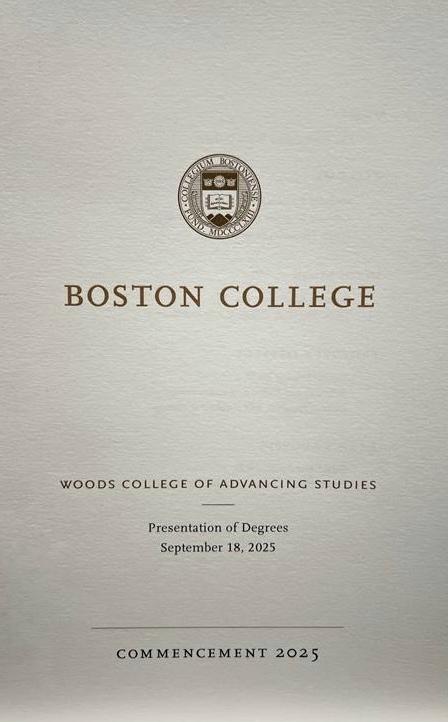
On September 18, 2025, NEPEC Project Manager Zeia Fawaz was in attendance as Boston College’s Prison Education Program (BCPEP) held its second graduation ceremony, this time for four students who have completed the Liberal Arts baccalaureate program at Massachusetts Correctional Institution - Shirley (MCI-Shirley).
The excitement, pride, and celebratory energy was palpable throughout the crowd as the music of a brass band filled the white tent where the ceremony was being held. Those in attendance included the personal guests of graduates, program alumni, current residents, representatives from local nonprofits, state Senator Jamie Eldridge, Commissioner Shawn Jenkins, and higher education in prison program staff and faculty.
Three of the graduates gave remarks at the commencement, highlighting their unique paths to graduation and – in some instances – the impact of mentorship on their academic journeys. In his speech, the cohort’s valedictorian remarked on the irony inherent in the name 'Second Chance Pell,’ as some people need more than one second chance and provided with the consistent opportunity to do better that so many of us are afforded outside of prison. The speeches were not only moving; they were inspiring and affirmed the simple, yet powerful fact that when people have support, opportunities, and belief in their ability to achieve great things, they can.
After the ceremony’s conclusion, guests were given the opportunity to network and mingle. Zeia was grateful for the opportunity to speak with program providers, members of the corrections team, and MCI – Shirley residents.
Many of those in Boston College’s (BC) program noted that their initial experiences with education in the facility were with Tufts and Mount Wachusett Community College’s (MWCC) program – the latter began as a certificate offering before growing into an associate degree and eventually a 2+2 pathway with BC. These experiences with other institutional programming inspired them to eventually apply for admission to BC’s baccalaureate program. In fact, several attendees – residents and non-residents alike – made note of how grateful they were for the hard work of Tressa Stazinski at MWCC, who was in attendance, and Hilary Binda at Tufts. In this way, the event underscored the highly collaborative nature of efforts to expand access to and success within higher education in prison.
We look forward to seeing some of the September ceremony graduates at Boston College’s on-campus commencement ceremony in the spring of 2026.
| |
Program Spotlight:
LARC at Clark University
| | |
|
Professor Shelly Tenenbaum’s work teaching in prisons reinforced her belief in the “transformative power of knowledge” and ultimately inspired her to co-found Liberal Arts for Returning Citizens (LARC) — a tuition-free, non-matriculating, credit-bearing college program for formerly incarcerated individuals. The program is affiliated with Clark University in Worcester, MA, where Tenenbaum is a faculty in the Sociology department.
The program, which launched in the fall of 2022, has steadily increased the number of classes they offer from six during its first year to 14 in 2025. The coursework encompasses a broad spectrum of liberal arts subjects as well as entrepreneurship and essential computer skills. All classes are taught at night (from 6 to 9 PM ET), are seven weeks long, and graded pass/fail. LARC’s programming is continuing to grow with their inaugural certificate program in digital literacy launching this fall.
LARC strives to offer students well-rounded support by providing dinner during class time, free textbooks, sponsored internships, and laptops and stipends for course completion. In 2025, LARC financially sponsored three internships and partnered with the city of Worcester to fund two more. Students who take courses through LARC are eligible to receive internship stipends of $2,500 once per year if they complete a 14-week internship for 10 hours a week. Similarly, if students successfully complete three classes in any given year, they are awarded $1,000 and are eligible to receive such a stipend annually.
“There are many challenges that the students face, and we’re trying to eliminate at least whatever institutional barriers that we can. It’s not just about teaching content, it’s about building confidence.” — Shelly Tenenbaum, LARC co-founder and director, Clark University, in ClarkU news.
| |
NEPEC Presents at the
Correctional Leaders Association
Northeast Region Meeting
| | |
|
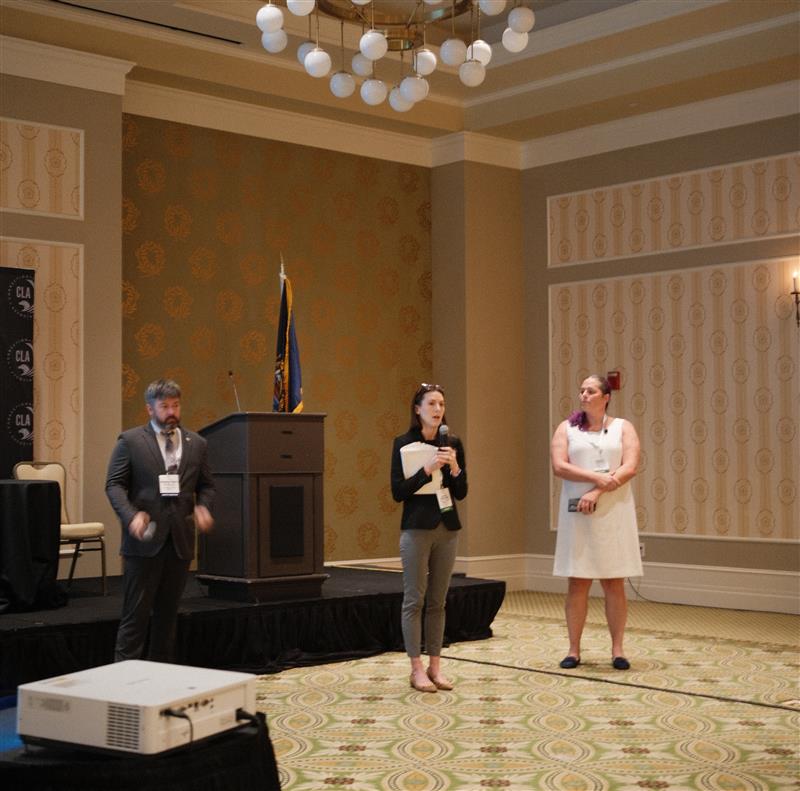
On September 10 and 11, 2025, NEPEC Director, Sarah Kuczynski, attended the Correctional Leaders Association Northeast Region Meeting in Bretton Woods, NH. The event was full of familiar faces from NEPEC's current coalition-driven work in the Granite State as well as from NEBHE’s previous work facilitating the New England Commission on the Future of Higher Education in Prison.
Sarah had the opportunity to present alongside some of NEPEC’s partners, who are engaged in the ongoing state strategic planning work we are supporting in New Hampshire, including Nicholas Duffy, Director of Rehabilitative Services at the New Hampshire Department of Corrections (NHDOC), and Jessica Hicklin, Co-Founder and Co-Executive Director of Unlocked Labs. The presentation was organized around the central question of how advances in student success and technological infrastructure can be made and sustained in a complex system like Corrections.
The group explored the journey from the formation of the Corrections Education and Vocational Planning Group (CEVPG) under NH SB376 and RSA 651-A:22-b, the expansion of this group from year one to present day, and the crucial role this planning group has played in meaningfully laying the ground work to expand access to twenty-first century technology and higher education in prison programming over the last two years. The CEVPG has been supported by the NEPEC team at NEBHE over the eight months as the group has moved through NEPEC’s cross-state agency strategic planning work.
As the presentation underscored, this group has been beneficial in forging direct, practical lines of communication for those working to expand access to education in NH correctional facilities. Where the ecosystem is concerned, the CEVPG has enhanced a shared sense of responsibility and ownership over higher education in prison to encompass as true partners state higher education system leads. Moreover, the presentation emphasized some promising early indicators of the way that the planning group has been able to maintain momentum even in the face of individual agency staff transitions—including transitions in executive leadership.
"It was an honor to share the stage with collaborators like Nick and Jess for whom I have truly infinite amounts of respect. The cross state-agency planning process that NEPEC is supporting in New Hampshire can be intensive work that asks a lot of state stakeholders who are already juggling many competing priorities and never-ending to-do lists,” says Sarah. “It was a real joy to get to look up from that work for a moment to join with Nick and Jess to provide exciting updates to executive correctional leadership from across the Northeast region.”
Sarah and Nick were not the only CEVPG members to present at CLA Northeast. Laurie Foster, who is the Deputy Director of Rehabilitative Services at NHDOC, was part of a presentation about the department's collaboration with the NH Department of Health and Human Services on New Hampshire’s new Community Reentry (CRE) Medicaid 1115(a) waiver, which uses federal Medicaid funds to provide pre-release behavioral health services and strengthen care connections for individuals transitioning from incarceration back into the community. Laurie highlighted the multiple benefits this new initiative provides for reentering individuals, including prioritized, timely care and more robust prescription support for folks releasing to ensure continuity of care while folks meet with their new community health providers.
Additionally, Evenor Pineda, who is the Intervention Services Director with the Manchester Police Athletic League, co-presented alongside Bill Duffy, Chief Probation Parole Officer at NHDOC, on the CHOICES High Risk Mentoring Program. The program, which is housed within the Manchester Police Athletic League, seeks to divert youth from the criminal legal system through mentorship and community engagement. The program is providing mentor training to currently incarcerated individuals to ensure they are able to support the growing need for mentors when they release.
The NEPEC team continues to be inspired by the CEVPG members, who work tirelessly to continuously improve the state of educational and vocational opportunities within NHDOC facilities. We are excited to continue to share more about this work as it unfolds.
| | NEPEC Quarterly Workshop Series | | |
|
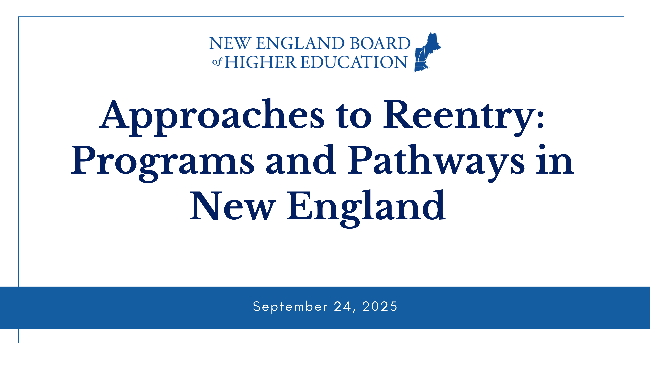
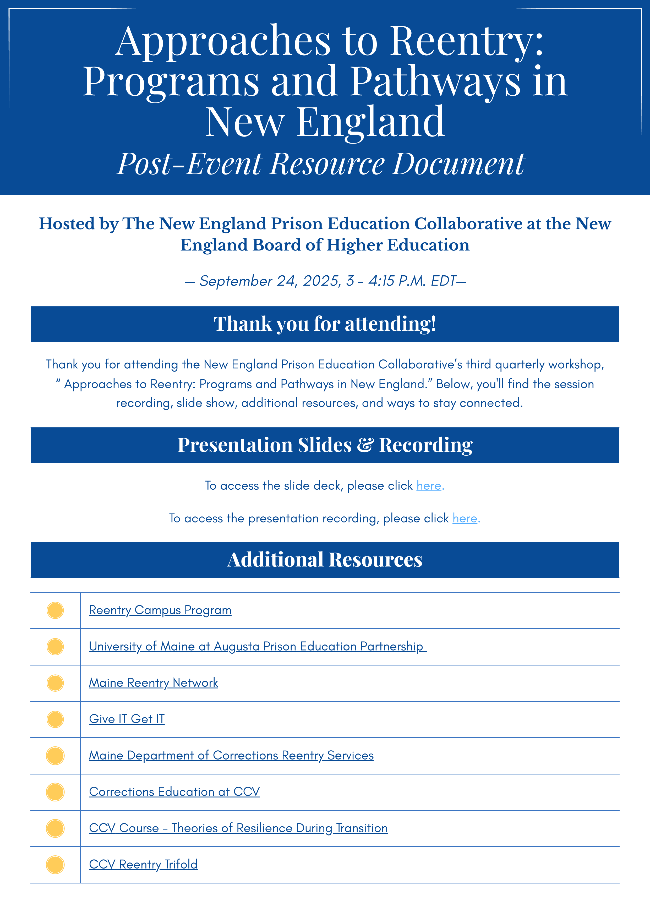
On September 24, 2025, NEPEC hosted its third quarterly workshop, “Approaches to Reentry: Programs and Pathways in New England.” The workshop explored different approaches to providing reentry services, featuring three expert panelists that took attendees through their programs’ unique reentry offerings.
James Monteiro, Executive Director and Founder of the Reentry Campus Program (RCP) in Rhode Island, highlighted RCP’s use of prior learning assessments to award college credit for learning that occurs outside of a traditional classroom and the program's dedicated housing unit pilot, which aims to foster a supportive and collaborative environment among incarcerated students.
Patrick Flynn, Student Services Coordinator and Prison Education Partnership Reentry Specialist at the University of Maine at Augusta (UMA), spoke to UMA’s comprehensive, student-centered approach to reentry support. In his role, Patrick begins working with incarcerated students up to a year before their release, meeting in-person with students on a monthly basis to support career readiness and educational planning. Upon release, students receive laptops and welcome packages to foster connection and support students continuing their education on UMA's campus.
Billi Dunham, Associate Director of Corrections Post-Secondary Education Initiative at the Community College of Vermont (CCV), showcased CCV's educational vouchers, which are available to students transitioning into the community from correctional facilities but also to correctional officers employed in Vermont facilities. The vouchers cover tuition, fees, and textbooks for up to two classes at CCV. She also introduced CCV’s new course, Theories of Resilience During Transition, which is designed to help students understand and navigate the emotional, psychological, and social challenges of reentry.
The workshop concluded with a lively Q&A. The approaches shared by our presenters offered powerful examples of how educational programs adopt a student-centered approach and partner with community-based organizations to prepare individuals for long-term success post-release. By sharing these models, the NEPEC team hopes to facilitate cross-state knowledge-sharing among program providers working to strengthen reentry support across New England and beyond.
To access the workshop recording, slide deck, and post-event resources shared by our presenters, please click here. We look forward to seeing everyone at our next virtual workshop--the fourth in this inaugural quarterly series. Save the date for Wednesday, December 17, 2025 at 3 PM EST for an expert panel conversation on how states in our region are working to establish stakeholder groups and set success metrics for the purposes of meeting the Best Interest Determination (BID) requirement for Pell-eligible Prison Education Programs.
| | | |  | | Upcoming Events and Opportunities | | |
NEPEC Quarterly Workshops
Best Interest Determination: Forming Stakeholder Groups
December 17, 2025 | RSVP link coming soon
Follow us on LinkedIn to stay updated!
NEPEC on the Road
Common Challenges, Collective Leadership: New England Strategies for a Changing Federal Landscape (invitation only)
-
Organizer: Education Commission of the States
-
Date: October 30-31, 2025
-
Location: Hartford, CT
Life After Incarceration: A Panel Discussion on Re-Entry, Justice, and Belonging
-
Organizer: Boston College
-
Date: November 4, 2025
-
Location: Chestnut Hill, MA
Ascendium HEP Coalition Learning Community Kickoff Symposium (invitation only)
-
Organizer: Ascendium Education Group
-
Date: November 5-7, 2025
-
Location: Albany, NY
Unlocked Opportunities: An Evening with John Legend
-
Organizer: Jobs for the Future
-
Date: November 6, 2025
-
Location: Boston, MA
Yale Prison Education Initiative and University of New Haven Prison Education Program Graduation (invitation only)
-
Organizers: Yale Prison Education Initiative and University of New Haven Prison Education Program
-
Date: November 19, 2025
-
Location: Suffield, CT
The 15th National Conference on Higher Education in Prison
-
Organizer: The Alliance for Higher Education in Prison
-
Date: April 9-10, 2026
-
Location: Cleveland, OH
| | |
Thank you for your continued support and partnership as we work to make higher education accessible to all learners who are incarcerated in New England. We look forward to keeping you informed and engaged in our shared mission.
Best regards,
The NEPEC Team
| |
ABOUT NEPEC:
The New England Prison Education Collaborative (NEPEC) is a regional initiative led by the New England Board of Higher Education (NEBHE). In February 2024, NEBHE was awarded five years of grant funding from Ascendium Education Group to establish the Collaborative to build upon the recommendations of the 2023 New England Commission on the Future of Higher Education in Prison, a nine-month regional convening of leaders from across multiple sectors aimed at preparing the region for the reinstatement of federal Pell Grants for all currently incarcerated learners.
Through this initiative, NEBHE seeks to accelerate, support, and collaborate to help create a future where every incarcerated person in New England has access to high-quality, workforce-aligned, equitable postsecondary opportunities with a diverse range of educational pathways.
| |
Sign up for our newsletter to
make sure you don’t miss a thing!
Follow us on LinkedIn
Email us: nepec@nebhe.org
| | | | |