NEW "In A Car with IPR" starring Laura Duda, SVP and CCO of The Goodyear Tire & Rubber Company!

Institute for Public Relations

“In A Car with IPR" is a video series by the Institute for Public Relations where we get to know leaders in the public relations industry


Brace yourself for IPR’s most high-flying episode yet. In this edition of “In A Car With IPR,” Dr. Tina McCorkindale, President and CEO of IPR, joins Laura Duda, SVP and CCO of The Goodyear Tire & Rubber Company, on a ride in the iconic Goodyear Blimp.


Join them as they give you much more than a bird’s eye view of everything from Goodyear’s unique community engagement approach to Laura’s career evolution — from journalist to communications leader. You also might learn a little bit about what makes something “blimp-worthy” too. 


Watch the latest episode of “In a Car with IPR” here!

Navigating the Intersection of AI, Public Relations & Race

Nneka Logan, Ph.D., Virginia Tech University & Damion Waymer, Ph.D., University of South Carolina

This blog is provided by the IPR Center for Diversity, Equity, and Inclusion and Digital Media Research Center


One of the most exciting things about the public relations discipline is that it is intricately linked to major technological innovations throughout history – from the early days of the railroad to the development of the telephone, to the birth of the internet, to the rise of social media and now artificial intelligence (AI). In this research, we examined the social, cultural, and ethical implications of AI and the racial dynamics involved in AI. 


We examined three case examples in which AI, race, and public relations intersect, including Microsoft’s chatbot Tay, a Facebook recommendation feature, and “FN Meka,” an AI-powered rap avatar. To illuminate the three case examples, we introduced a framework we coined Inclusive, Responsible Communication in Artificial Intelligence (IRCAI). The IRCAI framework consists of three key principles: inclusivity, responsibility, and communication, which we outline in the blog.


We conclude that it is important for the public relations field to navigate the intersection of AI and race, and we reiterate that our IRCAI framework can facilitate such efforts within and beyond the context of race…


Learn how this framework can help practitioners navigate the intersection of AI and race

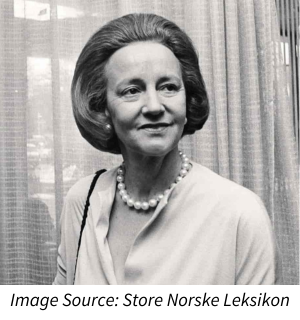
Pioneer Katharine Graham (1917-2001)

Institute for Public Relations

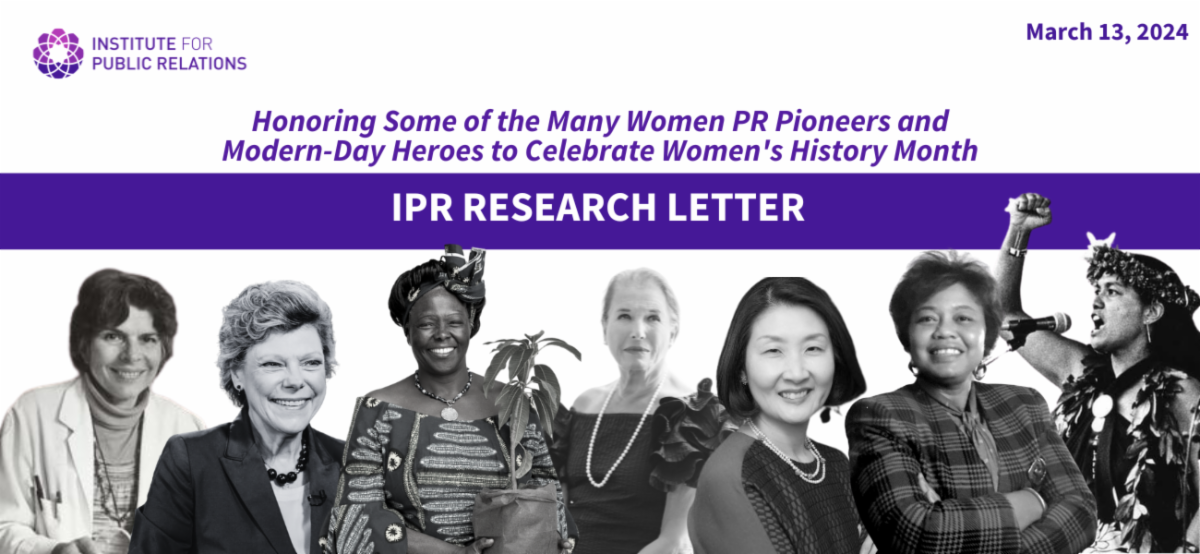
IPR is featuring research and some of the many women pioneers in the communications industry in celebration of Women’s History Month


Katharine Graham was born in New York City in 1917. After graduating from the University of Chicago in 1938, Graham worked as a reporter for the San Francisco News. She then joined the editorial staff at The Washington Post, the newspaper her father had purchased in 1933.  


In 1946, Graham’s husband was appointed publisher of The Post, and the couple bought voting stock in the corporation. In 1963, Graham became president of The Washington Post following her husband’s death. She simultaneously worked in a publishing role at The Post from 1969 to 1979.


In 1971, Graham famously led The Post through its publication of the Pentagon Papers and investigation of the Watergate scandal, eventually making The Post one of the most influential newspapers in the U.S. She made the call to proceed with publication despite facing legal threats from the Nixon administration and pushback from her male colleagues. 


In 1972, Graham became CEO of The Washington Post Company, making her the first female CEO of a Fortune 500 company. Graham remained CEO until 1991 and received a Pulitzer Prize for her autobiography, Personal History, in 1998. She died in 2001. 


Learn more about Katharine Graham’s leadership role at The Washington Post

How Has Generative AI Impacted Workplace Communication?Grammarly & The Harris Poll

Grammarly and The Harris Poll explored the state of business communication and how generative AI plays a role in challenges such as privacy, bias, and productivity. 


An online survey of 1,002 full-time employees and 253 business leaders was conducted from Sept. 29 – Oct. 3, 2023. The study also referenced two studies from October 2021 and October 2022, each of which surveyed 1,001 employees and 251 business leaders.


Key findings include:

  • 55% of respondents reported spending “excessive time” crafting messages or deciphering others’ communications.
  • 55% of respondents said the constant flow of notifications makes it hard to concentrate on important tasks.
  • 53% of respondents said they experience anxiety over misinterpreting written messages.
  • 47% of respondents said they feel unsure about choosing the right channel to communicate information.
  • 89% of business leaders said they actively use generative AI for professional purposes, compared to 53% of employees.
  • 52% of employees said they don’t know how to use generative AI tools effectively.
  • 61% of employees said their teams plan to implement generative AI for communication tasks within the next year.
  • Employees who have used generative AI in their workplace said it has transformed the way they communicate (71%) and improved how effective their communication is (68%).
  • Of these respondents, 66% said they believe AI will enhance their work, rather than replace them.


Learn more about how generative AI can improve the quality of workplace communication

Facebook  X  Instagram  Linkedin  


Institute for Public Relations | 352-392-0280 | info@instituteforpr.org | https://instituteforpr.org