|
Please share this edition of Wildlife Highlights with other outdoor enthusiasts
and help our subscription list grow!
| |
Wildlife Division Launches Fisher Research Project | |
|
The DEEP Wildlife Division, with the assistance of Central Connecticut State University, recently launched a new research project to learn more about the state’s fisher population.
The fisher, sometimes incorrectly called a “fisher cat”, is a large member of the Mustelidae (weasel) family that typically inhabits large tracts of coniferous or mixed hardwood-softwood forests containing large trees for denning. Males typically weigh 8 to 14 pounds, and females typically weigh 4 to 6 pounds.
Contrary to popular belief, the fisher is not responsible for the “cries” or “screams” residents may hear at night coming from the forest. The culprit behind those noises is actually the red fox.
Despite having very suitable habitat in Connecticut, the fisher population has been gradually declining, and this study will help wildlife biologists better understand why.
Through live-trapping, biologists are fitting select fishers with lightweight, GPS collars to track their movements on the landscape.
The information collected from the GPS collars will give biologists a much better understanding of fisher habitat use, den selection, reproduction rates, and mortality.
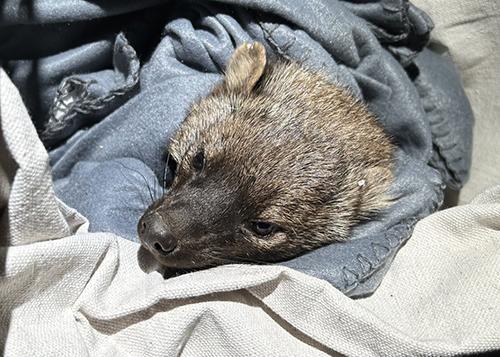
In this featured photo, a female fisher is about to be released back into the wild where her GPS collar will provide biologists valuable insight into her movement patterns and habitat preferences. The collars being used by biologists are specially designed to detach over time.
Report fisher sightings . . .
Fisher Fact Sheet . . .
| |
2024 Hunting and Trapping Guide Now Available | |
|
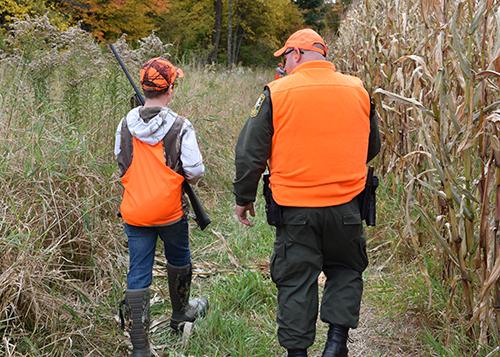
The 2024 Connecticut Hunting and Trapping Guide is now available online on the DEEP website. Limited quantities of the printed version will be available at town halls and vendors that sell hunting and fishing licenses in January 2024. A PDF of the printed version of the guide, which can be downloaded to a mobile device and accessed while out in the field, is also available.
2024 licenses, permits, and stamps are currently on sale on DEEP's Online Outdoor Licensing System.
Hunters and trappers are encouraged to use the online guide to keep up to date with any regulation changes that might occur during the year.
2024 Hunting and Trapping Guide . . .
| |
Will Black Bears Find a Good Winter Den at Your Place? | |
|
The mild weather we have been experiencing in Connecticut means black bears can still be active, and many will soon be looking for a place to den if they have not already.
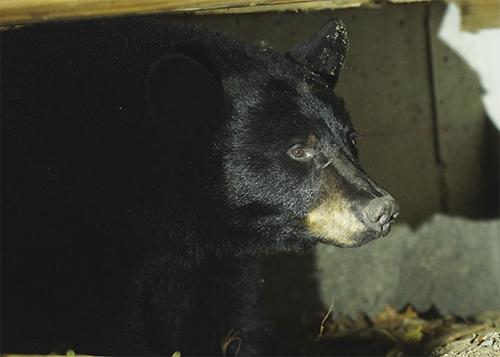
Bear dens come in all shapes and sizes and most commonly include brush piles, hollow trees, mountain laurel groves, and rocky outcrops. Black bears are well adapted to the cold — they have thick fur coats, loads of insulating fat, and will often sleep covered in snow. However, the crawl space or storm cellar you forgot to seal up for the winter can be very appealing for a bear looking for a sheltered place to sleep.
By late fall, it is always a good idea to walk around your home and property and think like a bear. Where would you den up for the winter?
Black bears denning in crawl spaces and underneath decks may unintentionally rip out wiring and pull down insulation, causing a lot of damage while they make themselves comfortable for the coming winter. Be sure your crawl space is closed up tight for the winter and securely block off any small opening that may entice a bear or other wildlife.
More tips from BearWise . . .
| |
Enter the 2024 Jr. Migratory Bird Conservation Stamp Contest | |
|
Entries are now being accepted for the 2024 Connecticut Junior Migratory Bird Stamp Art Competition, part of a U.S. Fish and Wildlife Service environmental education program administered since 1987 by the Connecticut Waterfowl Association (CWA), in cooperation with the Connecticut DEEP Wildlife Division.
This annual contest is open to all students, kindergarten through grade 12, who are Connecticut residents. To enter, students create and submit a drawing or painting featuring native waterfowl (ducks or geese). There is no cost, and submissions must be postmarked by March 15, 2024.
Last year, there were over 120 pieces of student artwork submitted amongst the four age groups (grades K-3, 4-6, 7-9, and 10-12). Awards are given to the winners for each age group.
This effort is intended to encourage more young people to explore the natural world and increase conservation awareness. The “Best in Show” winner will have their art featured as the 2025 Connecticut Migratory Bird Conservation Stamp! The winning submission will also be entered in the Federal Junior Duck Stamp Contest.
Pictured is last year's winning entry of a beautifully painted long-tailed duck by Sulan Zhang from Tolland.
Details on how to enter . . .
| |
Statewide Comprehensive Outdoor Recreation Plan (SCORP) | |
|
The Statewide Comprehensive Outdoor Recreation Plan (SCORP) is a strategic planning document that identifies outdoor recreation issues of statewide significance and evaluates the supply of, and demand for, outdoor recreation resources and facilities in Connecticut. The SCORP provides unified guidance to state and municipal officials as they develop and expand outdoor recreation opportunities for their respective constituents. A 2024-2029 SCORP draft is now available for public review and comment. Please submit all SCORP-related feedback before December 15, 2023.
More on SCORP . . .
| |
Watchable Wildlife: A Bald Eagle's Dinner Menu | |
|
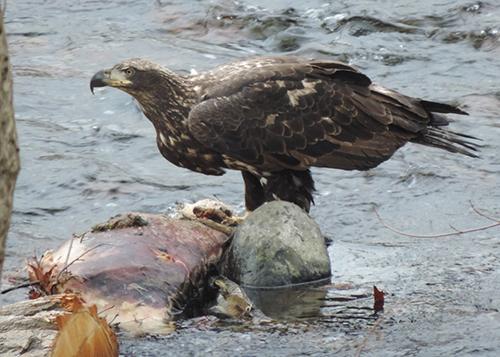
Although bald eagles feed primarily on fish, they also are opportunistic predators and scavengers that will eat anything that can be caught easily or scavenged, such as waterfowl, small and large mammals, and livestock carrion. In this case, a white-tailed deer carcass in the Farmington River does the trick!
Wintering eagles come to Connecticut looking for open water in which to feed when the land and waters in Northern New England and Canada are frozen.
Special thanks to Mark Warren for sharing this great photo. For those wondering, the distinctive adult white plumage that comes to mind when thinking of a bald eagle, is not attained until 4 to 5 years of age. This young eagle is smart to take a free and easy meal.
More on the bald eagle . . .
| |
Species Spotlight: Dwarf Wedgemussel | |
|
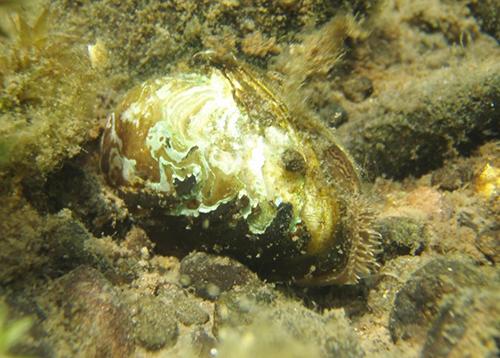
The dwarf wedgemussel is Connecticut’s smallest freshwater mussel. Though historically distributed throughout parts of the Connecticut River and Quinnipiac River watersheds, its range in Connecticut has contracted to only a few Connecticut River tributaries. Dwarf wedgemussels can be found partly buried in sandy stream bottoms, especially along silty banks where currents are slower.
Water pollution is thought to have played a large role in the decline of this species. Ironically, a major benefit of having freshwater mussels is the ecological service they provide by improving water quality. Freshwater mussels feed by passing water through their gills, removing bacteria, phytoplankton, and detritus from water. They are also an important food source for other wildlife species.
The dwarf wedgemussel is listed as an Endangered species in Connecticut and is afforded legal protection under the federal Endangered Species Act (ESA) of 1973. The ESA was enacted 50 years ago to prevent the loss or harm of endangered and threatened species and to conserve the places they live. For over half a century, the ESA has proven to be one of the most effective wildlife conservation laws.
More on the dwarf wedgemussel . . .
| |
|
Stay Connected!
Follow us on Social Media
| |
|
-- Quick Links --
Your Feedback Is Important to Us!
Send your comments or suggestions to deep.ctwildlife@ct.gov
|  | |
The Connecticut Department of Energy and Environmental Protection is an Affirmative Action/Equal Opportunity Employer that is committed to complying with the requirements of the Americans with Disabilities Act. If you are seeking a communication aid or service, have limited proficiency in English, wish to file an ADA or Title VI discrimination complaint, or require some other accommodation, including equipment to facilitate virtual participation, please contact the DEEP Office of Diversity and Equity at 860-418-5910 or by email at deep.accommodations@ct.gov. Any person needing an accommodation for hearing impairment may call the State of Connecticut relay number - 711. In order to facilitate efforts to provide an accommodation, please request all accommodations as soon as possible following notice of any agency hearing, meeting, program or event.
This program receives Federal financial assistance from the U.S. Fish and Wildlife Service.
Under Title VI of the 1964 Civil Rights Act, Section 504 of the Rehabilitation Act of 1973, Title II of the Americans with Disabilities Act of 1990, the Age Discrimination Act of 1975, and Title IX of the Education Amendments of 1972, the U.S. Department of the Interior prohibits discrimination on the basis of race, color, national origin, age, sex, or disability. If you believe that you have been discriminated against in any program, activity, or facility, or if you need more information, please write to:
Office of Diversity, Inclusion and Civil Rights
U.S. Department of the Interior 1849 C Street, NW
Washington, D.C. 20240
| | | | |