ALTERNATIVE FINANCIAL SERVICE PROVIDERS ASSOCIATION | | Industry News, Regulatory Updates & Market Insights | Edition: October 15, 2026 | | |
How Agentic AI Will Disrupt Retail Banking’s Future
Executive Summary
AI agents are poised to rapidly transform both the internal processes of retail banking as well as consumer interaction.
The first wave of agentic AI is already automating repetitive tasks such as data entry and transaction processing, boosting productivity and freeing employees for more strategic work.
But agentic AI will have its most profound impact in customer-facing applications, as autonomous agents respond to customer needs individually and real-time, transforming personalization.
Read more at The Financial Brand
| | |
Optimize Lending Decisions with Real-Time Financial Data.
Enhance lead purchasing, underwriting, and product line
assignment with ValidiFI’s data-driven solutions
| |
|
These are the most affordable places to live in America, see where your state ranks
Here is the full state-by-state ranking from most affordable to least affordable based on the source's cost-of-living comparison: 1. Mississippi, 2. Oklahoma, 3. Kansas, 4. Alabama, 5. West Virginia, 6. Missouri, 7. Arkansas, 8. Tennessee, 9. Iowa, 10. Indiana, 11. Michigan, 12. Ohio, 13. Kentucky, 14. Nebraska, 15. South Dakota, 16. North Dakota, 17. Louisiana, 18. Georgia, 19. Wyoming, 20. South Carolina, 21. Texas, 22. North Carolina, 23. Wisconsin, 24. Minnesota, 25. Pennsylvania, 26. Idaho, 27. Arizona, 28. Florida, 29. New Mexico, 30. Nevada, 31. Delaware, 32. Montana, 33. Virginia, 34. Colorado, 35. Maine, 36. Utah, 37. Vermont, 38. Rhode Island, 39. Connecticut, 40. New Hampshire, 41. Oregon, 42. Washington, 43. Alaska, 44. Maryland, 45. New York, 46. Massachusetts, 47. New Jersey, 48. California, 49. Hawaii, and 50. Washington, D.C. These rankings are based on the source's affordability methodology and should be viewed as a comparison rather than a guarantee of what an individual household will spend..
Read more at MSN
| | |
The Aging Population Is Changing States’ Revenue, Spending, and Service Demand Outlook
Assessment and planning can help manage the budget challenges of this ongoing demographic shift
Overview
The United States’ population is aging rapidly. And as with other long-term shifts in social and economic conditions, the transition to an older population is already affecting state revenue and expenditures.1 Understanding and preparing for these ongoing changes will be critical to states’ future fiscal sustainability.
Although the share of the population age 65 or older has been increasing for at least a century, the pace of growth has surged over the past 15 years, and states are taking a variety of actions in response to the aging of their populations.2 Many states are assessing specific fiscal impacts, such as revenue and expenditure changes and rising service costs. Most states also produce needs assessments to understand which services their older populations will require, and these results can help inform future investments across state programs.
Read more at The Pew Charitable Trusts
| |
Why You Don’t See Credit Card Switchers Until It’s Too Late
Why Cardholders Switch, and What It Takes to Keep Them
Credit card issuers know how important it is to achieve top-of-wallet status. Being a consumer’s most-used card can have a significant impact on revenue and profitability, increasing net interest margins, customer lifetime value (LTV), and the interchange and other fees it earns. Consider the following:
Primary cards generate significantly more interest and fees because gross interchange scales based on total volume and most-used cards tend to hold higher monthly balances.
Read more at The Financial Brand
| | |
Maximize Your Call Center
E-Complish, LLC Launches: IntellAgent™, a 24/7
AI Companion for Customer Account Management &
Payment Processing
| | |
Beyond Banking: Embedded Finance, Open Banking and the ESG Data Gap
Distribution Is Changing Faster Than the Data Behind Sustainability Claims
For decades, a bank was a place customers went to. Increasingly, it comes to them, often under another company's brand: credit appears at an online checkout, insurance is sold alongside a purchase, and licensed third parties can read payment account data. Banks are also expected to show that the money they lend and invest supports the low-carbon transition. Both shifts depend on reliable data. On sustainability, that data remains the weakest link.
Read more at FinanceX Magazine
| | |
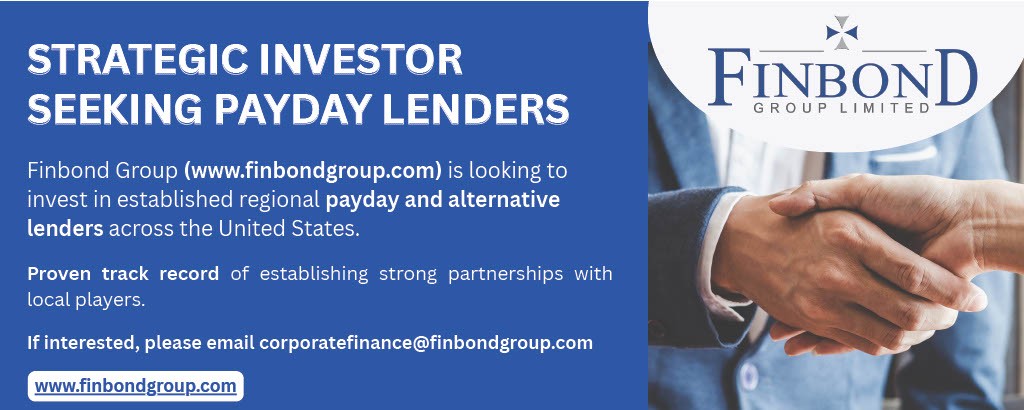
Our Vision is to become the leading
PAYDAY + ALTERNATIVE LENDER
in NORTH AMERICA
| | |
Do You Know How Federal Funds Flow Into Your State?
How Federal Funding Flows to State Governments by Policy Area
Federal dollars are the second-largest source of funding for state governments, historically ranging from about a quarter to a third of total state revenue.
In fiscal year 2026, Medicaid—which provides medical coverage for eligible children, adults, people with disabilities, and older Americans—accounted for 69.9% of total federal grants to states and was the largest source of federal funding in all but one state.
Other funds were divided into five other broad policy areas. Grants such as the Temporary Assistance for Needy Families and the National School Lunch Program that focus on income security for individuals and families in need made up 10.9% of total federal dollars to states,
Read more at The Pew Charitable Trusts
| |
Can banks buy fintechs without losing what makes them work?
Can a bank absorb a fintech’s customers, technology, and talent without losing the product judgment and culture that made those assets valuable in the first place?
Valley Bank’s acquisition of Bluevine puts that question into practice, with implications for product development, customer acquisition, and technology strategy.
What happens to a fintech’s operating model after it becomes part of a bank? Valley National Bank’s planned acquisition of Bluevine offers a window into that question, particularly how products are built, decisions are made, and technology teams operate.
Read more at the Tearsheet
| |
PayYield lifts net portfolio yield on every consumer repayment: clearing available funds on debits that
decline today, and cutting what you pay to accept
the dollars that do clear.
| |
California Enacts Sweeping New Regulation of Commercial Financing
By John D. Socknat, Alan S. Kaplinsky & John L. Culhane, Jr.
California has once again expanded its regulation of financial services. On September 30, 2026, Governor Gavin Newsom signed Assembly Bill 2116, which will subject a broad range of commercial financing providers and brokers to licensing, substantive conduct requirements, and regulatory oversight by the California Department of Financial Protection and Innovation (DFPI). A legislative analysis of the Bill appears here.
AB 2116 represents a significant expansion of California’s existing regulatory framework for commercial financing. Although the law does not become operative until January 1, 2028, commercial finance companies, merchant cash advance providers, factors, equipment finance companies, and brokers potentially within its scope will need to begin assessing the law well before then.
Read more at Ballard Spahr L.L.P.
| |
Payliance enables organizations to streamline
payment acceptance, minimize processing costs,
and reduce the risk of fraud.
| |
When AI Agents Act for Customers, Banks Must Rethink Trust
Agentic commerce is moving from closed trials into live pilots and early scaling, even as the standards and consumer protections governing it continue to develop.
A new paper — Building Trust in Agentic Commerce — co-authored by ASB Bank, Bank of America, Capital One, Commonwealth Bank of Australia, ING Group, and NatWest Group outlines five principles for creating a trusted ecosystem: transparency, safety, privacy and data, choice, and interoperability.
The framework addresses a fundamental change in how transactions happen when AI agents can recommend products, make decisions, handle payment credentials, and complete purchases on a customer’s behalf.
Read more at The Financial Brand
| | |
Sitting on the Sidelines Until After the Midterms?
You’re not alone. Many business owners and executives are waiting for greater clarity from the November elections before committing to their
next phase of growth.
But waiting to make the decision doesn’t mean you
should wait to prepare for it.
If additional capital will be part of your growth strategy once the political
and economic environment becomes clearer, now may be the right time
to begin the conversation.
| | |
New Study Finds Fintech CMOs Growing Teams as AI Raises the Value of Human Judgment
Despite AI taking on more execution, fintech marketers are adding headcount and investing in GEO as buyers increasingly turn to AI search
Fintech CMOs are taking on greater responsibility for revenue and business strategy while shifting investment toward GEO and other AI tools as the technology changes how buyers discover companies, according to new research from The Fletcher Group.
The 2026 Women CMOs in Fintech Report, now in its fifth year, examines how women marketing leaders are adapting their teams and priorities now that AI has become embedded in day-to-day work.
Read more at MORNINGSTAR
| | |
These are the happiest places to live in America, see where your state ranks
WalletHub's 2026 Happiest States in America ranking evaluated all 50 states across 30 measures related to emotional and physical well-being, work environment, and community and environment. The results show that happiness varies widely across the country, with Hawaii taking the top spot and West Virginia ranking last. Below are the eight highest-ranked states, followed by the complete national ranking at the end.
No. 1: Hawaii
Hawaii ranked No. 1 with an overall score of 69.53. The state benefited from the nation's highest reported life satisfaction, the second-lowest adult depression rate and the longest life expectancy in the country. About 84% of Hawaii adults report being in good or better health, nearly 72% say they are active and productive each day, and the state's unemployment rate is about 2.5%.
No. 2: New Jersey
Read more at MSN
| | |
Start your FREE trial TODAY.
We'll use this to build free listings and create a
growth strategy for your business.
| |
Lean into AI to Orchestrate Your Customers’ Experience
As early AI deployments start to show tangible gains, many of the financial industry’s most promising applications are emerging in customer experience, where high volumes of customer-interaction data, a significant concentration of operating expense, and a direct connection to revenue combine to shape powerful use cases.
These advances come as more financial service providers, from fintechs to community banks and credit unions, push past their initial AI hesitancy. Perhaps the most telling finding in a spring 2026 American Bankers Association survey was that financial institutions ranked AI as their most important issue to address, ahead of cybersecurity and data privacy — and identified “doing nothing” as the greatest AI-related risk of all.
Read more at The Financial Brand
| |
CFPB Announces New Initiative to Address OCC-Uncovered Debanking by Large Banks
Today, the Consumer Financial Protection Bureau (CFPB) announced the next step in its work to advance President Trump’s fight against the debanking of businesses and individuals on the basis of their constitutionally protected rights, including support of President Trump, MAGA, pro-life causes, and industries disfavored by the Left. The CFPB will address any consumer harm caused by the nation’s largest banks in response to the Report on debanking practices by Office of the Comptroller of the Currency (OCC).
The OCC report, “Guaranteeing Fair Banking for All Americans,” found that the nine largest national banks under its supervision – JPMorgan Chase Bank, Bank of America, Citibank, Wells Fargo Bank, U.S. Bank, Capital One, PNC Bank, TD Bank, and BMO Bank – maintained policies or engaged in practices that denied or restricted financial access on the basis of Americans’ political or religious beliefs or a customer’s otherwise lawful business activities. The OCC report provides excerpts from bank documents, including emails, revealing this biased and discriminatory decision-making. The report shows that entire sectors were victims of debanking, most notably those related to firearms, oil and gas, and tobacco.
Read more at Consumer Financial Protection Bureau (CFPB)
| | |
Choose a logo for your website to show you
SUPPORT AFSPA.
| | ALTERNATIVE FINANCIAL SERVICE PROVIDERS ASSOCIATION | | |
Alternative Financial Service Providers Association
757.737.4088
315 Tuscarora St., Lewiston, NY 14092
dan@afspassociation.com
www.afspassociation.com
Copyright © AFSPA 2007-2026
| | | | |