|
|
|
|
 |
Driving research to maximize the productivity, sustainability and competitiveness
of the American grape industries.
|
A RAISIN IN THE SUN
Many NGWI members across the country are deep in the throes of harvest season. But for one segment of the grape industry, harvest is now in the bag...or in the box, as it were. Congratulations, raisin grape growers!
Sun-Maid and its cooperative growers in California's southern San Joaquin Valley comprise the epicenter for the American raisin industry. Kingsburg, where the Sun-Maid packing operation is located, and the small towns around it are blanketed with raisin vineyards. It is wide open, arid land with ample heat and reflective sandy soil--perfect conditions for growing yellow raisin-grape varieties (collectively referred to as "goldens") and shriveling them into raisins.
|
|
I spent one 100+-degree day in the field earlier this month. I got to meet some of the growers (most are family-owned businesses and often more than one generation was onsite) and learn how and why they do what they do (and don't do). And I got to
see what harvest looks like
across all three methods used to bring in the fruit:
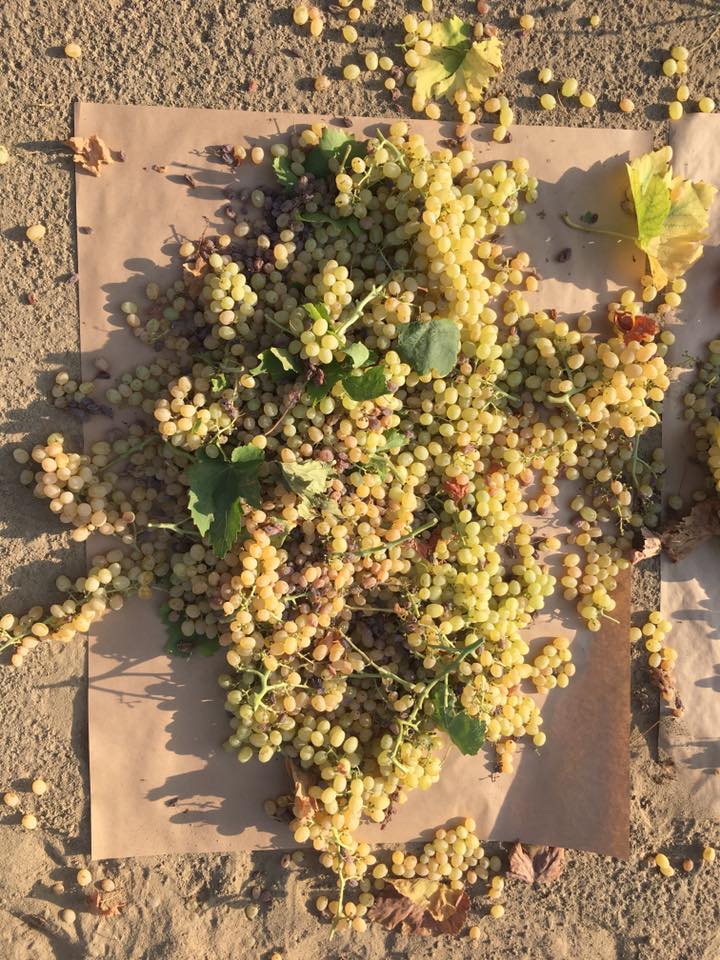
- Hand-harvested (shown above), using individual paper "trays." Because this method requires up to two weeks for drying grapes on these trays on the hot, dry ground and is most labor-intensive, these are typically first in line for harvest.
- Continuous tray, a semi-mechanized method using a machine harvester with workers following, spreading the fruit evenly on one long sheet of paper between rows.
- Dried on the vine (DOV), where the canes are cut and grapes shrivel into raisins as they hang. The fruit is harvested as raisins, not grapes, using mechanical harvesters. DOV is the industry's newest innovation, employing the highest level of mechanization and therefore the least labor.
Raisins' viticultural differences from their wine, juice and fresh-consumed brethren are fascinating. One obvious one is tonnage. From a fresh-fruit weight of 11 tons, for example, a raisin grower can anticipate a finished, shriveled weight of just over two. Wow!
Differences aside, the raisin industry ongoingly seeks innovation in many of the same areas other
grape sectors do. Mechanization, improved production systems and breeding programs are critical. And exploration in water, nutrition, sustainability and other environmental concerns are top-of-mind, too. As the raisin industry ups its research game, so do all sectors of the industry.
So, let that raisin enjoy its time in the sun. Its successful, cost-effective harvest is a win for all of us!
|
|
|
|
|
|
|
DR. JACOBS-YOUNG NAMED ACTING DEPUTY UNDER SECRETARY, USDA REE
Dr. Chavonda Jacobs-Young, who is Administrator of the USDA's
Agricultural Research Service (ARS), has been designated to serve as Acting Deputy Under Secretary of the USDA's
Research, Education, and Economics (REE). The temporary appointment follows the recent departure of Dr. Ann Bartuska from the post, for which Sam Clovis has been nominated but not yet confirmed. Dr. Jacobs-Young will serve in this acting capacity until further notice, and concomitantly continue to serve as Administrator of ARS, with two ARS Associate Administrators Dr. Simon Liu (Research Operations) and Dr. Steven Kappes (Research Programs).
|
|
NIFA TO HOST LISTENING SESSIONS THIS FALL
The USDA's National Institute of Food and Agriculture (NIFA) is seeking stakeholder input. Four regional listening sessions are being held in person in locations around the country from 8:30 a.m. to 5 p.m. on...
- Thursday, Oct. 19, Kansas City, Missouri
- Thursday, Oct. 26, Atlanta, Georgia
- Thursday, Nov. 2, Sacramento, California (NGWI's Donnell Brown will be there!)
- Wednesday, Nov. 8, Hyattsville, Maryland
NIFA also is accepting input in writing via an online submission form.
|
|
WINE INDUSTRY DELIVERS $219.9 BILLION TO U.S. ECONOMY
WineAmerica this week revealed the results of its national economic impact study, which shows that the wine industry's total benefit to the American economy is a whopping $219.9 billion in 2017.
"Wine is an all-American art form produced in all 50 states, and the ultimate value-added product which preserves precious agricultural land, provides American jobs, attracts tourists, generates taxes, and enhances the quality of life," said WineAmerica President (and long-time NGWI Board Member) Jim Trezise. "We have long known intuitively that our industry's economic impact was enormous, but it's nice to now have hard numbers which illustrate that. As our industry grows, so will our many contributions to the American economy."
This comprehensive, first-of-its-kind study measured direct, supplier, induced and total output including jobs, wages and taxes at all three levels. Of the total $219.9 billion impact, the wine industry's direct impact is $84.5 billion, the supplier impact $58.8 billion, and the induced impact $76.6 billion. The wine industry provides nearly 1 million direct jobs (998,496) and more than $33.5 billion in annual wages. When supplier and induced figures are included, the totals are 1,738,270 jobs and $75.8 billion in wages.
The wine industry generates a total of $36.5 billion in total taxes, including more than $19 billion to the federal government and $17.4 billion to states and localities.
|
|
NOMINATIONS DUE BY OCTOBER 20:
Rich Smith Distinguished Service Award
Nominations are still being accepted for the Rich Smith Distinguished Service Award. The award annually honors the
spirit and legacy of Rich Smith of Paraiso Vineyards, and his significant and selfless contributions of time, energy and funds to organizations like NGWI, WineAmerica and the Winegrape Growers of America that advance the American grape and wine industry.
The Rich Smith Distinguished Service
Award was created by our three organizations in collaboration with the Smith Family. The first-ever recipient was the inimitable John Martini of Anthony Road Wines, who received the award at the Unified Symposium last January. If you know another highly effective, collegial and tireless leader who is a force for positive change in the grape and wine industry,
click to review the nomination criteria and complete the simple nomination form before October 20.
Thanks for taking the time to nominate a respected colleague! We look forward to honoring the next recipient this January.
|
WASHINGTON STATE PEST & DISEASE SURVEY:
Vineyards Needed
The Washington State Department of Agriculture (WSDA) is looking for participants for their annual vineyard survey. The WSDA is focusing on light brown apple moth, European grapevine moth, European grape berry moth, summer fruit tortrix, grape phylloxera, Australian grapevine yellows, flavescence doree, Rotbrenner/red fire disease, and Pierce's disease. These surveys help provide early detection of pests and diseases.
Volunteer your Washington vineyard.
|
|
EFFICIENT VINEYARD BEGINS INTEGRATION
From fledging pilot project privately funded via NGWI in 2010 to a multi-state, multi-institution project funded via Specialty Crop Research Initiative (SCRI) grant in 2015, Efficient Vineyard represents the promise of mechanization and precision viticulture. With five specific themes--sensor development, spatial data processing, vineyard management applications, economic evaluation and technology outreach--the project has largely focused on making advances in each individual area. But now, as the project enters its third year of government funding, it will begin integrating the technologies the team has developed and seeing how they work together, as they would in practice.
This is where the rubber meets the road.
"Although the team communicates regularly, progress has mainly happened in silos--until now," says PI Dr. Terry Bates of Cornell University. "We are at a point where activities across disciplines are starting to happen, and that will have a bigger impact on project deliverables."
Terry notes that, already, there are examples from this growing season that show that integration is happening with positive results on several levels. In certain research plots in both East Coast and West Coast vineyards, the team now has a full complement of soil, canopy and crop sensor data layers that have been validated against viticulture metrics. The data also is being semi-automatically processed through spatial statistics software with which researchers can impose and test variable rate management, including variable vineyard mechanization.
"All the puzzle pieces are on the table," Terry says. "Now the challenge is figuring out how they all fit together."
|
September 27, 2017 │ The LoCA Life & Times
Lodi Winegrape Commission's Stephanie Bolton is a "cheerleader" for grower outreach, education and research in her AVA (and a member of the NGWI Extension & Outreach Committee). Here, she describes her first year on the job and the challenges growers face.
September 26, 2017 │ Science
Canada now has a Chief Science Advisor: Mona Nemer, a cardiology researcher and vice president of research at the University of Ottawa. Nemer's office will have a CA$2 million budget; her mandate includes providing scientific advice to government ministers, helping keep government-funded science accessible to the public, and protecting government scientists from being muzzled.
September 26, 2017 │ WineBusiness.com
The first known commercial crop of California-grown Mencia, a red wine grape variety native to Spain, was harvested this month from Silvaspoons Vineyards in the Lodi AVA. Once thought to be related to Cab Franc, it has similar aromas and flavors but has been found to be genetically distinct. Grower Ron Silva says, "The wines I've tasted have a European character, they are more austere and go well with food."
September 26, 2017 │ Phys.org
Ever wonder how the ashtray character of smoke taint gets expressed in wine? Researchers at the Technical University of Munich explain how it's bound in grapevine sugars and released in fermentation. And they provide insight into mitigating it genetically in this article from Phys.org.
September 20, 2017 │ The Daily Herald
Wine writer Elin McCoy reports that this year's extreme weather has had a serious effect on wine around the world. From more than two dozen days over 100 degrees in Napa to wildfires in Washington and Oregon to devastating spring frosts and summer heat that will give France its smallest crop since World War II, this is "wine's new normal."
September 18, 2017 │ The New York Times
Scientists from
Cornell University have used Crispr-Cas gene editing to successfully alter the genes that control color in butterfly wings. "These are experiments we could only have dreamed of years ago," one scientist said. "The most challenging task in my career has become an undergraduate project overnight."
September 15, 2017 │ Science
"It took me several years after getting tenure to come back to some semblance of a balanced life," writes professor Jeffrey McDonnell in Science Magazine. If you're a university scientist, you might see yourself in this professor's early-career plight and path to a sustainable pace!
September 14, 2017 │ ABC Australia
One New York company, Finger Lakes Wine Flour, is following in the footsteps of the ancient Romans, grinding grape pomace (the skins after the grapes have been pressed) to make wine flour. That's one way to tackle wine waste!
September 13, 2017 │ NPR Oregon Public Broadcasting
When it comes to wildfires, smoke taint in wine isn't the only concern for Oregon winemakers. This article from Oregon Public Broadcasting outlines effects for workers, livestock and tourism, too.
September 13, 2017 │ Western Farm Press
"One treatment and, maybe, a booster later, should be enough to prevent infection with Pierce's disease," says Don Hopkins, a University of Florida plant pathologist.
September 6, 2017 │ American Agriculturist
Farming juice grapes for the
Welch's/National Grape Cooperative Association in upstate New York, the Betts Family saves as much as $3,000 per acre--just in thinning--using variable-rate vineyard management technology.
September 2017 │ AgResearch Magazine
When asked what "genomics" is and why it matters, simply refer to this great article in the latest USDA-ARS AgResearch magazine.
Undated │ The SOMM Journal
Archaeologists at the University of South Florida have discovered that wine was on the menu in Sicily 6,500 years ago. The find pushes the timeline for established viticulture in Italy back from the Bronze Age (1600-1100 BCE) to the Copper Age (4500-3500 BCE). That's some aging!
|
|
November 14, 2017
November 29-30, 2017
USDA Agricultural Research Service Grape Industry Workshop
Portland, OR
December 1, 2017
NGWI Year-End Board Meeting
Portland, OR
January 26, 2018
NGWI Annual Board Meeting
Sacramento, CA
February 6-8, 2018
May 20-22, 2018
National Viticulture & Enology Extension Leadership Conference (NVEELC) 2018
Prosser, WA
Find all upcoming events
on the NGWI website.
|
|
|
|