Advancing research to maximize the productivity, sustainability and competitiveness
of the American grape industries.
|
|
If it's New Year's, it's time for lists celebrating the highlights of the year. For NGWI, 2017 was big, so listing our top accomplishments is a bit daunting. Of course, coming aboard as president in April was the highlight of the year for me. (Many thanks to Wine Business Monthly for including me as one of the "Top People Moves of 2017" in the December issue!) But the year brought many major milestones. Here are my top five (in no particular order):
|
|
|
|
|
|
●
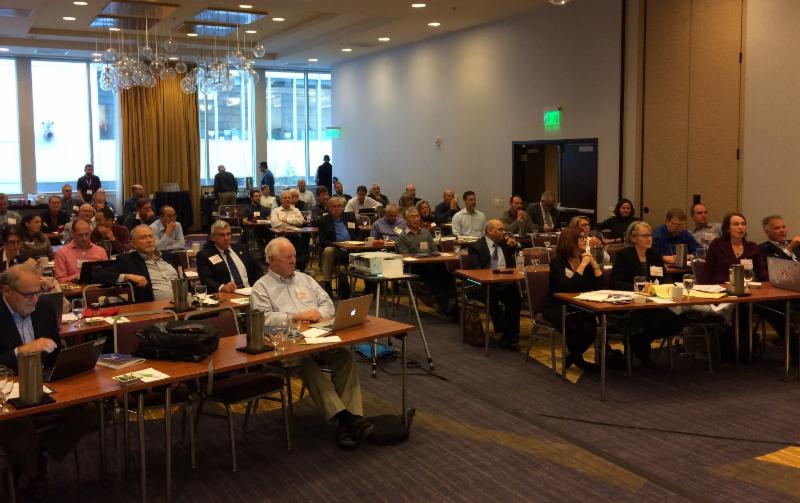
The USDA Agricultural Research Service (ARS) Grape Research Workshop:
P
lanned with support from NGWI, the ARS Workshop (shown above)
in Portland, OR, November 29-30, was the first in seven years. It gathered nearly 100 attendees, including
ARS Administrator
Dr. Chavonda Jacobs-Young,
who is currently Acting Deputy Under Secretary, Research, Education and Economics, and the nation's Chief Scientist. Her
welcome remarks kicked off the event, where ARS scientists shared their work, and
grape and wine industry representatives
gave their input on research needs going forward. The theme of "precision viticulture to improve productivity and quality" echoed across all four breakout groups held there, becoming the winning concept for the inaugural NGWI-ARS Cooperative Planning Grant Challenge, announced at the workshop. More on that in 2018.
● Community-building:
An NGWI core value is fostering a strong community of
grape growers, processors, wineries
,
and representatives of government and academic institutions and cooperative extension organizations committed to
improving the wine and grape industry through research.
Accordingly, a big part of the year was spent on the road, participating in 14 industry events across the nation, meeting and talking with scientists and industry folks about the research that unites us.
● Research priorities refresh:
My last column focused on our new research priorities. Our top five big ideas plus specific priorities within our
four research themes
will be ratified at our Board meeting in January then communicated in detail. Research was front and center this year and will be brought to life in the year to come.
● National Viticulture & Enology Leadership Conference 2017: NGWI believes strongly in the role of extension and outreach, so proudly supports this important annual event. NVEELC 2017 was held April 2-5 in Napa at UC Davis' Oakville Station, hosted by Dr. Kaan Kurtural and planned with help from NGWI Board member Keith Striegler (E&J Gallo) and Vicky Scharlau (Washington Winegrowers), who had stepped off the NGWI Board to serve as our interim president at the beginning 2017.
The event gathered nearly 50 extension and outreach specialists for professional development, information-sharing and networking. If you work in an extension role, don't miss NVEELC 2018,
to be held in Prosser, WA, May 20-22, 2018!
● Branding
and communications:
It may not seem that critical, but upping our branding-and-communications game was a big focus this year. 2017 brought a crisp new logo, a redesigned website and renewed commitment to a monthly newsletter. These changes help build community, extend research results and broadcast our message to the industry at large.
Many more momentous changes are in store for 2018.
Want a hint of what's to come? A new Board Chair will be elected at our January meeting. Our Research Theme Committees will begin work, forming new projects to address research priorities and advising on others that align with our themes as they receive SCRI and other grant funding. And what better way to celebrate our 15th anniversary than with a
new name? Approved by the NGWI Board of Directors this month, with adoption to come in the year ahead, the name is currently under wraps. Stay tuned for this and other developments in 2018!
It's been a privilege to lead the organization in this productive time, and I look forward to all that we'll achieve together in the months ahead. Till then, best wishes to all for a happy, healthy new year!
|
|
RICH SMITH AWARD TO BE PRESENTED IN JANUARY
Are you attending the Unified Symposium this January? Reserve your seat at the
Winegrowers of America (WGA) Annual Leadership Luncheon
(separate registration required) on Wednesday,
January 24, to witness the presentation of the Rich Smith Distinguished Service Award. The second-annual award honors the legacy and service of the late Rich Smith (Paraiso Vineyards and Smith Family Wines), one of our industry's most prolific patrons, as it celebrates a like-minded leader of Rich's caliber. It is collaboration of NGWI, WGA and WineAmerica--three organizations to which Rich was invaluable.
|
|
REFLECTIONS FROM RETIRING CORNELL RESEARCHERS
A special edition of the Appellation Cornell newsletter
provides retrospectives by three key faculty members involved in grape pest management research and extension at Cornell University's New York State Agricultural Experiment Station in Geneva-all three of whom are retiring at the close of the year:
Newsletter co-editors Tim Martinson and Chris Gerling write, "Collectively, Tom Burr, Wayne Wilcox and Andrew Landers represent 91 years of expertise in research and extension at Cornell. Their accomplishments have significantly benefited the industry here in New York-and have had a global impact on the science of disease management in grapes and spray technology."
Many thanks to Drs. Burr, Landers and Wilcox, for their contributions to the industry!
|
ALSO AT CORNELL: NEW ANALYTICAL TOOLS FOR WINE, CIDER
New York's wine and hard cider industries now have access to new analytical capabilities, thanks to Cornell's
New York State Wine Analytical Laboratory.
These tests--often needed for quality assurance, trouble shooting and regulatory compliance--are subsidized by the
New York Wine & Grape Foundation
.
|
|
NEW FARM BILL WEBSITE, VIDEOS
|
ASEV SEEKS SPEAKERS
Are you a scientist with compelling new work to share with research and industry colleagues? Apply to speak at the 69th ASEV National Conference in Monterey, CA, in June! ASEV seeks submissions suitable for research sessions topics and industry seminars, due February 15. See ASEV's
call for abstracts
for details.
|
|
TRUNK DISEASES PROJECT CONCLUDES
At the end of November, Dr. Kendra Baumgartner et al. submitted the
final report
of their SCRI project, "New detection, research, and extension tools for managing wood-canker diseases of fruit and nut crops," focusing on grape, almond and pistachio. As they explain in the report, wood-canker diseases
are a serious problem in vineyards in the U.S. and other mild grape-growing regions where the trunk of the vine is long-lived. These diseases significantly reduce yields and shorten the lifespan of infected vines, which means that the high startup costs of establishing a vineyard are unlikely to be repaid.
With no cure for trunk diseases, prevention is essential. Gaps in our ability to detect the pathogens in the nursery and the field, insufficient knowledge of disease-resistant cultivars, and limited grower adoption of preventive practices contributed to a high disease incidence. Accordingly, the team proposed three objectives, outlined below with highlights of their results as they relate to grape.
Goal 1: Develop new detection tools for diagnosticians, growers and nurseries
- Developed an assay to detect infection of woody tissues as an expression of grape genes and pathogen genes, which can be used in nurseries to screen mother plants and other propagation materials. See www.TrunkDiseaseID.org for the team's DNA-sequence database on which the assay is based.
- Justified to grape growers the need for prevention of trunk diseases in young vineyards, using spore traps for detection of trunk pathogens.
Goal 2: Identify disease-resistant cultivars and germplasm accessions
- Collaborated with VitisGen (also an NGWI-supported SCRI project) to identify molecular markers of grape resistance to Phomopsis dieback, thereby establishing a basis for future crosses that are trunk-disease resistant. The team notes that, as acceptance of new cultivars in the table-grape industry is high, this work accelerates the possibility of resistant plant material as a long-term approach for trunk-disease management for this sector.
- Identified table grapes with resistance to Esca, a common trunk disease in California's table-grape regions. The team found that the wood anatomy--particularly the size of the xylem vessels--seems to render plants more susceptible and may be a phenotype to screen for in breeding Esca-resistant table grapes. With its large xylem vessels, Thompson Seedless is more vulnerable than Flame Seedless and Scarlet Royal, which have smaller vessels.
Goal 3: Develop and deploy extension tools that increase adoption of preventative practices in young vineyards
- Used impactful economic (vs. scientific) data to demonstrate the long-term benefits of prevention. The team also created excellent management plans and an economic decision tool, available online.
Congratulations to Kendra and the team for completing this important project! For more information about their findings, visit treeandvinetrunkdiseases.org or email Kendra.
|
|
GRANTS AVAILABLE FOR ORGANIC RESEARCH, EXTENSION & EDUCATION
The USDA's National Institute of Food and Agriculture (NIFA) announced this month the availability of $17.6 million in grants focused on organic agriculture research, education and extension, funded through the agency's Organic Agriculture Research and Extension Initiative (OREI). The OREI supports programs that enhance the ability of producers and processors who have adopted organic standards to grow and market high-quality organic agricultural products. Priority areas include biological, physical and social science research, including economics. Funded projects will aid farmers and ranchers with whole-farm planning by delivering practical, research-based information to improve their ability to develop an Organic System Plan required for certification.
|
December 21, 2017 │ The Weather Channel
In a season of predictions, The Weather Channel
has a hair-raising warning for growers (and people in general) in California.
December 21, 2017 │ Ithaca.com
This article cites five ways climate change will impact
Finger Lakes Wine Country. One positive: vinifera varieties will thrive, says Cornell's Dr. David Walter Wolfe
.
December 14, 2017 │ The Advocate
Tasmanian researcher Dr. Angela Sparrow developed a new winemaking technique called Accentuated Cut Edges (ACE) maceration. Based on the idea that "the good stuff comes from the grape skins" and observation that a warmer growing season puts pressure on tank space, ACE maceration slices the skins into smaller pieces. The resulting increase in surface area speeds up the development of skin tannins and flavor in wine. And now it has been commercialized by an Italian company.
December 13, 2017 │ Infowine.com
A European project, Stabiwine, developed an additive called potassium polyaspartate (KPA), a stable polymer of L-aspartic acid, that inhibits the formation of tartrate crystals in wine. KPA was just included as an approved food additive by the European Union.
December 11, 2017 │ NPR
As wind-fueled late-season wildfires threaten California wine country, Governor Jerry Brown said, "This is the new normal," as he surveyed damage from the Thomas Fire. "We're about ready to have firefighting at Christmas. This is very odd and unusual."
December 8, 2017 │ Forbes
On December 8, a Google Doodle (the artwork on the Google homepage) commemorated the 287th birthday of the man who discovered photosynthesis. Jan Ingenhousz ID'ed the process by observing that, in sunlight, leaves emit oxygen, but in the dark, they emit carbon dioxide. He published his groundbreaking paper in 1779. On behalf of grapevines (and other plants that are photosynthesizing as we speak), happy belated birthday, Jan!
December 6, 2017 │ NewsDeeply.com
Gr
oundwater recharge projects could provide about six times more storage capacity than surface water storage for the same price, reported Stanford University's Water in the West in 2014. And a 2016 study estimated the price of on-farm recharge at $36 per acre-foot--significantly cheaper than surface water storage and dedicated recharge basins. So why hasn't this practice been more widely adopted? Read on!
December 5, 2017 │ AgWeb.com
|
January 26, 2018
NGWI Annual Board Meeting
Sacramento, CA
February 6-8, 2018
Kennewick, WA
February 22-24, 2018
Charlottesville, VA
Find all upcoming events
on the NGWI website.
|
|
|
|