|
|
|
|
 |
Driving research to maximize the productivity, sustainability and competitiveness
of the American grape industries.
|
|
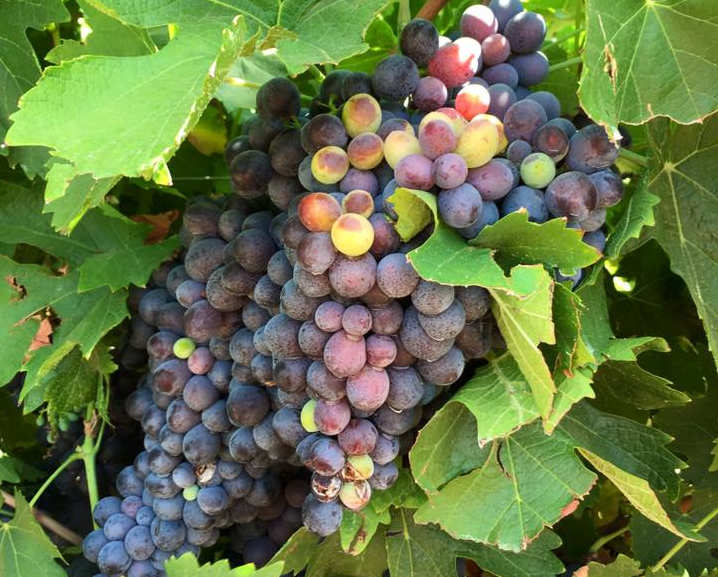
A mammoth cluster at Wolfskill
|
I HAVE SEEN THE FUTURE
Is there anything more hopeful than a living, growing plant?
I had the good fortune to visit not one, but two of the USDA Agricultural Research Service's grapevine germplasm repositories this month and was overwhelmed by the beauty and diversity of grapes each has growing:
|
|
- Overseen by Dr. Thomas Chao, the Cold Hardy Grape Collection at the Clonal Repository Farm of the Plant Genetic Resources Unit in Geneva, NY, has more than 1,500 accessions of grape germplasm growing under commercial field conditions across five rolling acres in the Finger Lakes region.
- The Wolfskill Experimental Orchards in Winters, CA, is run in cooperation with UC Davis, and is home to the grape collection of the National Clonal Germplasm Repository at Davis. Dr. John Preece is responsible for the more than 3,600 accessions of grapes that live here, framed by the Mayacamas Mountains.
Tended by proud and passionate growers who see each plant as an expression of our industry's past
and
possibility, these repositories serve as living libraries of fruit (and other crops) and ensure that thousands of varieties survive into the future. They also preserve their unique traits--not only flavor, color and berry size and shape, but also growing habit, tolerance to environmental stresses and natural resistance to pests and diseases--
for grape geneticists and plant breeders who seek to develop cultivars that help to advance the sustainability, quality and competitiveness of American grapes and grape products.
If you've never visited a germplasm repository, go...and see the future!
|
|
|
|
|
|
|
HONOR A COLLEAGUE AND A LEGEND:
Rich Smith Distinguished Service Award
Richard (Rich) Smith of Paraiso Vineyards and Smith Family Wines in California's Monterey wine region was first and foremost a family man, and also a successful grape grower, winery owner and respected colleague.Through his significant and selfless contributions of time, energy and funds to organizations that advance the American grape and wine industry, he came to be known as a highly effective, collegial and tireless leader.
Three of those organizations--NGWI, WineAmerica and the Winegrape Growers of America--collaborated to create the Rich Smith Distinguished Service Award to honor his spirit and legacy. It recognizes people who demonstrate similar qualities and make a similarly positive impact on the industry.
John Martini of Anthony Road Wines won the first-ever award at the Unified Symposium last January. Click now to the
nomination criteria and simple nomination form and make your nomination(s) by October 20, 2017. We look forward to honoring the recipient and the memory of Rich Smith.
|
|
ED HELLMAN GOES TO TEXAS TECH, LAUNCHES NEW APP
Dr. Ed Hellman has been named a professor of viticulture and enology in Texas Tech University's Department of Plant and Soil Science. Formerly Professor of Viticulture and Extension Specialist with Texas A&M AgriLife Extension, he begins his new post, based at Texas Tech University at Fredericksburg, on September 1, 2017.
Learn more about what Dr. Hellman will be tackling in his new role.
Prior to leaving Texas A&M, Dr. Hellman this week launched a powerful new mobile app for vineyard managers: The Vineyard Advisor. The app provides recommendations for managing some 350 problems afflicting grapes nationwide, from diseases, insects, mites, nematodes and wildlife, to environmental stress, physiological disorders and weeds, drawing in part from the EPA label database to deliver the most current list of all pesticides labeled for use on grapes to control a specific problem.
|
NEW YORK ECONOMIC IMPACT SURVEY
In an effort to support and grow the craft beverage industry in New York, Empire State Development (ESD) has launched an
online survey to measure the impact of the industry on the state's economy. The survey is designed to collect important (and confidential) information from manufacturers regarding production levels, agriculture inputs, employment, tourism and other pertinent economic data that can help identify ways the State can further support the industry, such as research funding. If you're in New York, be sure and
click to complete the survey by September 15, 2017. Questions? Contact ESD's Stefan Fleming at
Stefan.Fleming@esd.ny.gov.
|
USDA SEEKS ADVISORY COMMITTEE MEMBERS
The USDA Agricultural Marketing Service (AMS) is seeking to fill 10 seats on the Fruit and Vegetable Industry Advisory Committee--a great opportunity for those of serving specialty crops industries. New members are appointed for a two-year term by the Secretary of Agriculture. Act fast--nominations are due on September 1, 2017. Complete details and nomination/application information can be found on the
USDA AMS website.
|
CLIMATE CHANGE EXPERTS WANTED
The National Academies of Sciences, Engineering, and Medicine are establishing a new
Climate Communications Initiative (CCI) to facilitate rapid and effective communication of evidence-based insights to the public and decision makers. CCI will leverage existing National Academies' consensus reports and ongoing activities across its wide range of disciplines it covers to offer a suite of authoritative and objective materials and engagement opportunities. Expert oversight and guidance will be provided by a new Advisory Committee, which will develop a strategic plan for the CCI. The NAS is seeking individuals to serve on the Advisory Committee with expertise in climate science, climate impacts and economics, potential response options, science communication, social media engagement, science education, and experience with other issues considered to be contentious in public discourse. Nominations are due by September 15.
Nominate yourself or a climate-savvy colleague.
|
|
VITISGEN LIVES ON
It's official: VitisGen2 has received Specialty Crop Research Initiative (SCRI) grant funding, and is set to begin work September 1, 2017.
Congratulations--and good luck--to co-PIs Dr. Bruce Reisch, professor of grapevine breeding and genetics at Cornell University's New York State Agricultural Experiment Station in Geneva, NY, and Dr. Lance Cadle-Davidson, plant pathologist with the USDA-ARS Grape Genetics Research Unit also located at Geneva!
VitisGen was launched to work toward
developing new grape cultivars with high fruit quality (FQ) and
resistance to powdery mildew (PM). In the second phase of this game-changing research, the VitisGen team will
expand on progress made in developing novel economic, phenotyping and genetics knowledge and tools related to new grape cultivars. And they plan to translate these and previous VitisGen innovations into new applications for improving grape breeding programs
and managing existing vineyard plantings. Specifically...
- The Economics team will evaluate the consequences of introducing new grape traits, including impacts upon cost, yield, revenue, profit, pesticide use, and the environment.
- The Trait Evaluation team will develop novel high-throughput methods, and apply these along with proven approaches to characterize a range of phenotypes, such as PM resistance durability and undesirable fruit qualities, as well as locally important traits.
- The Genetics team will couple phenotyping results with high-resolution genetic maps, which can be combined with genome assembly and RNA-Seq analyses to develop inexpensive, high-resolution markers spanning key genes.
- The Breeding team will maintain the grapevine families under study, apply the team's new knowledge in genetics and marker-assisted selection to current breeding programs, and study the genetics of traits of local interest.
- The Outreach team will communicate scientific opportunities and discoveries, and provide stakeholders with knowledge of the benefits of adopting new high-quality PM-resistant cultivars along with new tools for characterizing PM and FQ in their existing plantings.
The work will utilize plant breeding and genomics approaches to improve grape characteristics and enhance the economic and environmental sustainability of grape production, potentially saving the U.S. grape industry millions each year and improving the quality of American grapes and grape products, according to Dr. Reisch.
To learn more about the team's accomplishments to-date, check out the just-published
Appellation Cornell article. And stay up-to-date with the project at
vitisgen.org
. Also note that the VitisGen team will be hiring eight post-doc associates and technicians stationed at Cornell and UC Davis and some graduate student roles funded at Cornell, Washington State University and beyond
. To inquire about these opportunities, email
bruce.reisch@cornell.edu or
lance.cadledavidson@ars.usda.gov.
|
| 40 Under 40 Tastemaker September 2017 │ Wine Enthusiast Lucas Pope, vineyard manager at Halter Ranch Vineyard has achieved what no other viticulturist before him has: recognition on one of Wine Enthusiast's coveted "40 Under 40" lists! Pope was named to the list for his efforts battling red blotch disease at the ranch. Congrats, Lucas! How I found my outreach niche August 25, 2017 │ Science This scientist's path to outreach may ring true for other extension specialists: "My audiences responded best when they saw me as a real person who wanted to share my stories, not the faceless author of a science textbook or a vaguely imagined 'researcher' mentioned in a news article. In person, I could dispel the myth of an awkward or arrogant scientist in the ivory tower. That human connection made a huge difference." Attention turns from soil quality to soil health
August 2017 │ Wines & Vines Glenn McGourty, University of California Cooperative extension specialist for Lake and Mendocino counties, gives a beautiful account of soil health in this month's Wines & Vines. "New discussions about soil health," he writes, "take a broader view of agricultural land that includes enhanced soil conservation and building soil carbon." Short-handed in the vineyard and winery? Think tech August 22, 2017 │ North Bay Business Journal Mechanization and automation are becoming more and more critical in the US grape and wine industry--not just to stave off labor shortages and reduce costs, but to stay competitive with other regions around the world. A layman's guide to reading research articles August 14, 2017 │ GoodFruit.com A new publication from horticulture extension specialists at WSU provides a guide to "Scientific Literacy for the Citizen Scientist," seeking to decode academic research articles for growers. Auction of Washington Wines celebrates 30 years, raises record $4.1 million August 21, 2017 │ WineBusiness.com Cheers to Auction of Washington Wines, which raised a record $4.1 million to benefit both the Seattle Children's Hospital and research via the WSU Viticulture & Enology Program!
|
|
UPCOMING EVENTS
November 29-30, 2017
USDA Agricultural Research Service Grape Research Workshop
Portland, OR
December 1, 2017
NGWI Year-End Board Meeting
Portland, OR
January 26, 2018
NGWI Annual Board Meeting
Sacramento, CA
February 6-8, 2018
May 20-22, 2018
National Viticulture & Enology Extension Leadership Conference (NVEELC) 2018
Prosser, WA
Find all upcoming events
on the NGWI website.
|
|
|
|