|
|
|
|
 |
Advancing research to maximize the productivity, sustainability and competitiveness
of the American grape industries.
|
|
As surely as fall brings harvest, the winter, spring and early summer seasons bring industry conferences. From the Unified Wine & Grape Symposium in January to state meetings happening now, to ASEV's national and Eastern Section events in June and July respectively, there is much to be learned and shared as the fruit begins to set. (See the calendar below and
on our website
for events on our radar.) So far, one theme spans
them all: labor.
|
|
|
|
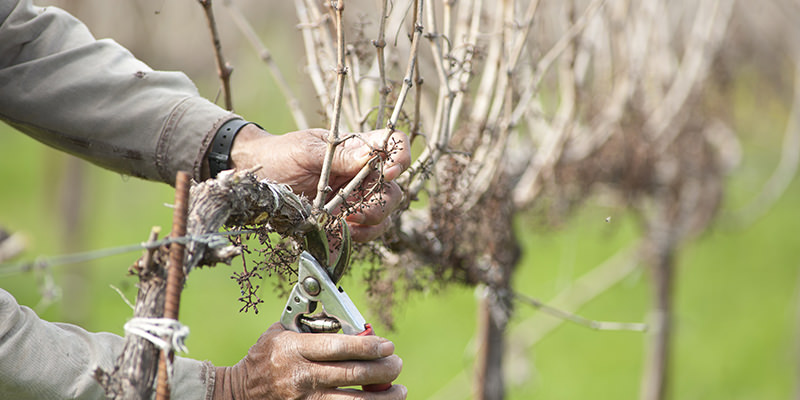
The labor shortage extends from coast to coast and has growers in every state and sector talking about what can be done. H2A (and the forthcoming H2C) is one solution, helping vineyard managers to supplement their workforce here at home with workers from other countries. But many believe that, as an industry, we must start thinking outside the box-beyond labor itself.
Mechanization of harvest, pruning and other labor-intensive cultural practices is gaining traction in many places, from the Central Valley and Coastal regions of California to the High Plains of Texas to the Finger Lakes of New York. But at an industry level, there's less discussion about the future of mechanization and the promise of developing technologies like sensors, data analytics and differential management. There's even less recognition of genetics and marker-assisted breeding as ways to reduce labor requirements, plant by plant. Perhaps that's because technology requires development, testing and training. Vineyards need workers NOW. But lasting change takes time...and research.
Finding practical solutions to difficult problems like labor is core to the mission of NGWI, and it's one of the key initiatives established by our Research Committee. Labor is an issue we can solve. It will require us to collaborate within and across institutions and industries, to learn from one another and to broaden our perspective to innovations beyond what we can imagine ourselves. Let's get to work!
|
|
|
|
|
RAISIN GROWERS AMEND THEIR MARKETING ORDER
- Authorize production research;
- Establish new nomination procedures for independent grower member and alternate member seats;
- Add authority to regulate quality;
- Add authority to establish different regulations for different market destinations;
- Add the requirement for decisions to continue the marketing order be made through referenda.
- Remove volume regulation and reserve pool authority from the order.
The amendments were favored by more than 90% of the growers voting in the referendum, representing more than 90% of the total volume of raisins produced by those voting. A tremendous show of support for the changes...and for research!
|
|
TABLE GRAPES FREE OF PESTICIDES
|
|
REGISTER FOR NVEELC 2018
Registration opens tomorrow, March 1, for the
National Viticulture & Enology Extension Leadership Conference (NVEELC) 2018
!
Join us
May 20-22, when NVEELC 2018 unfolds in Prosser, WA--the heart of Washington Wine Country--hosted by Washington State University
Viticulture Extension
.
Check out the agenda
, which is packed with professional development, site visits, best-practice-sharing and networking with other extension and outreach colleagues. Thanks to funding from sponsors E&J Gallo, J. Lohr Vineyards & Wines, the California Table Grape Commission, Oregon Vineyard Supply, WSU, NGWI and others, tickets are just $100 per person.
|
|
NOMINATE AN EXTENSION COLLEAGUE FOR EXCELLENCE
The Association of Public & Land-Grant Universities (APLU) is seeking nominations for its top extension awards for 2018: the Excellence in Extension Award and National Extension Diversity Award. Nominations are due May 1, and awards will be selected by the end of July. Recipients receive cash awards and travel to the APLU 2018 Annual Meeting in New Orleans this November
.
Complete details and the nomination form are available online.
|
BEN GUTIERREZ IS NEW GRAPE REPOSITORY CURATOR IN GENEVA
Dariusz Swietlik, USDA Agricultural Research Service Director, Northeast Area, announced this month
the appointment of Dr. Benjamin Gutierrez as the grape
repository curator in the USDA-ARS Plant Genetic Resources Unit (PGRU) in Geneva, NY
. Dr. Gutierrez has been with ARS as a Pathways Student since 2012, earning his Ph.D. from Cornell University through the Pathways Internship Program. For his graduate work, Dr. Gutierrez studied the genetic diversity of phenolics in the PGRU apple collection with Dr. Susan Brown (Cornell University) and Dr. Gan-Yuan Zhong (PGRU), and recently successfully defended his dissertation, "Dihydrochalcones in
Malus
Mill. Germplasm and Hybrid Populations." He also holds a Bachelor of Science in Botany and Biology from Utah Valley University. Dr. Gutierrez will work alongside Dr. Thomas Chao, who has served as the PGRU curator for apple, tart cherry and grape since he joined ARS in 2011. Dr. Chao will continue his work on the apple and tart cherry collections.
|
NIFA ANNOUNCES SARE PARTNERS
The USDA's National Institute for Food and Agriculture this month announced that it has selected a partner for its National Reporting, Coordination and Communications Office (NRCCO) and four regional host institutions for the Sustainable Agriculture Research and Education (SARE) program. They are:
- NRCCO: University of Maryland
- West: Montana State University
- North Central: University of Minnesota
- Northeast: University of Vermont
- South: University of Georgia
NIFA's SARE program supports farmer-focused solutions that boost production, increase profitability, promote environmental stewardship, and enhance quality of life in rural communities. NRCCO works with NIFA and the national SARE Operations Committee to administer national reporting, coordination, and communications. Each regional host institution collaborates with NIFA to implement regional competitive grant and outreach programs as guided by the Regional Administrative Council. Information about the regions, their grant programs and reports from more than 6,000 SARE-funded projects can be found at
www.sare.org.
|
|
NGWI SEEKS FEDERAL FUNDING FOR GRAPE GENETICS RESEARCH
The USDA Agricultural Research Service is charged with the advancement of grape genetics research in the US, and operates laboratory facilities in Geneva, NY, and plant material repositories in both Geneva and Davis, CA. Despite the economic importance of the grape and wine industry and the tremendous promise of genetics for grapeveine improvement, current funding for these efforts is woefully inadequate. Critical gaps exist in the facilities and knowledge needed to advance key industry research needs and initiatives. NGWI is working with partners across the country to request a Congressional appropriation of an additional $10 million per year in ARS funding for grape genetics research.
Why does genetics research matter?
- Grapes are vulnerable to an increasing number of threats-invasive pests and diseases, and extremes of drought, cold and soil salinity-all with potentially devastating economic consequences. Only with a greater understanding of the tolerance of grape species and varieties to these threats can we be ready for the next deadly virus or severe climatic shift.
- The US houses the world's reservoir of grape germplasm believed to have resistance to many of the industry's most economically important pests and diseases. However, most of this germplasm remains uncharacterized due to insufficient funding for grape genetics research. By characterizing the sources of genetic resistance to the major biotic and abiotic threats to US grape production, we can breed new cultivars and develop new growing practices that can relegate these threats to the past. Even the tradition-bound French wine industry has begun to embrace newly developed disease-resistant varieties. (See headline below.) Will we be left behind?
If you or an organization you belong to has a relationship with your elected officials, please
download and use our appropriations request
to help advocate for an additional $10 million per year for grape genetics research. Help lawmakers understand that...
- Grapes are the largest and most economically important fruit and specialty crop in the US, representing approximately 1 million acres and more than $6 billion in farm-gate revenue.
- Grapes are commercially produced in 49 of the 50 states, and vineyards represent a critical component of the US agroecosystem and rural economy-a hot button for the current USDA administration.
Investment in grape genetics research is essential to maintain the long-term viability and competitive advantage of the US grape industry. As part of this collective effort, you can help make grapevine improvement part of our national DNA!
|
|
VITISGEN2 KICKS OFF WEBINAR SERIES
The NGWI-supported VitisGen2 project is kicking off its 2018 webinar series with a discussion of changing attitudes toward genetics methods entitled, "Europe is Starting to Embrace New, Disease-Resistant Varieties." The online chat, hosted by Drs. Bruce Reisch, Professor, Cornell University, and Tim Martinson, Senior Extension Associate, Cornell University, takes place March 15 at 2 p.m. Eastern. Click for details and registration.
|
February 16, 2018 │ French Tribune
France's
Institut National de la Recherche Agronomique (INRA)
has released four new grape varieties--two whites and two reds--that are resistant to downy and powdery mildew.
February 16, 2018 │ Science
In wartime, science is among the casualties. This article in the Quarterly Journal of Economics
shows that leading-edge science including Nobel-nominated breakthroughs and patented innovations are among the hardest hit.
February 15, 2018 │ Water Deeply
As worries over drought mount, a new breakthrough proves the process believed to make cloud seeding work to produce snow.
February 15, 2018 │ WineBusiness.com
"Climate change is increasing the risk of fires, in both frequency and intensity, and smoke taint from wildfires has been an issue in wine grape growing regions in the U.S., Canada, Chile, Europe, South Africa and Australia," said Dr. Mark Krstic of the Australian Wine Research Institute (
AWRI
). Dr. Krstic's remarks were part of a co-presentation with Dr. Tom Collins of
Washington State University
at this year's
Unified Wine & Grape Symposium
.
February 14, 2018 │ Water Deeply
According to the U.S. Drought Monitor, most of California is either abnormally dry or experiencing drought, and about two-thirds of Arizona and three-fourths of New Mexico are facing severe or extreme drought.
February 13, 2018 │ Water Deeply
A $2.2 million grant will enable the
University of California
to monitor hydrology across UC's 750,000-acre Natural Reserve System. The project, called California Heartbeat Initiative-Freshwater, will equip reserves with wireless sensor nodes to track weather, soil moisture, and transpiration. And drones fitted with special cameras will track how vegetation changes with the climate.
February 13, 2018 │ DeborahParkerWong.com
For everyone who insists on storing wine on its side, this research uncorks the myth, showing no difference in the amount of oxygen found in wines that have been stored horizontally or vertically.
February 7, 2018 │ Growing Produce
The Spotted Lanternfly is a threat to apples, grapes, peaches, stone fruits and various tree species. It was first, well, spotted in PA in 2014, fanning out quickly from 174 affected square miles in 2016 to 3,000 by the end of 2017, now including NJ and NY. Newly approved emergency funding will help the USDA
's Animal and Plant Health Inspection Service (APHIS) stop the spread.
February 6, 2018 │ Farm Journal AgTech
Clearly, the logistics are different, but the mechanization taking shape in cotton harvesting is pretty compelling.
February 6, 2018 │ Wester Farm Press
The Farm Bill expires in September 2018, but
House Agriculture Committee
Chairman Mike Conaway hopes to get a vote in March.
February 5, 2018 │ Wines & Vines
NGWI Board member Keith Striegler of E&J Gallo Winery
told an audience at the Unified Wine & Grape Symposium,
mechanization may become less a question of "can you afford it" and more about "can you farm or not?" (NGWI Research Committee member
Andrew Meggitt
of
St. James Winery is also shown and quoted
.)
February 5, 2018 │ Decanter
Are trunk diseases the next phylloxera? In France, trunk diseases have rendered roughly 13% of the nation's vines unproductive, costing vintners more than 1 billion euros a year.
February 2, 2018 │ Science
In a thoughtful opinion piece, Susan Hockfield, president of t
he American Association for the Advancement of Science
(
AAAS
) and president emerita of MIT, says: "In this environment, how can we ensure that science prevails and continues to flourish? We can start by recognizing the critical role of institutions in nurturing the scientific enterprise."
February 1, 2018 │ MSU Extension Online
Scientists at
Michigan State University
and USDA
ARS are making a stink about a pest attacking Mid-Atlantic region specialty crops.
January 31, 2018 │ Met Office
Scientists in the UK say we could be in for some serious global warming in the next five years.
January 31, 2018 │ KQED.com
A 10-year study led by Dr. Gregory Gambetta of A.S. Bordeaux Sciences Agro
quantifies the threshold for grapevine mortality during drought--and in California, at least, vines never reach that level. "Now, we can say that these are the levels of stress that vines can endure during a period of drought. That sets a bar for farmers," he says.
|
Corvallis, OR
June 22, 2018
NGWI Mid-Year Board Meeting
Monterey, CA
July 9-11, 2018
Find all upcoming events
on the NGWI website.
|
|
|
|