|
The NJSSA Pulse
September 2022
| | |
|
From the President
Amanda Burden, MD, FASA
| |
|
Dear NJSSA Members:
As we head into the fall of 2022, we continue to face the realities of COVID-19. While we anticipate some challenging surges this fall, most activities have returned to pre-pandemic levels. Thank you all for your tremendous service to our patients and our profession in the difficult work of caring for patients during these unprecedented times. We, along with ASA, continue to inform the public about your excellent work and value.
As you know, we are in an election season. Here in New Jersey, there are ongoing challenges on the political front, particularly in the state legislature. We continue to educate our legislators about the value of our profession, the importance of physician anesthesiologists, and how physician-led care ensures safe, cost-effective care for patients. Some of the Governor’s emergency executive orders related to expanded scope of practice remain in place and we continue to inform legislators on the reasons these should not become permanent. Recently we sent representatives from the NJSSA Executive Committee to the Democratic Governors Association Conference. The meeting was held in Jersey City and included very informative panels and educational sessions. This experience provided an opportunity for us to discuss issues that affect our roles as anesthesiologists and important safeguards for our patients with governors and gubernatorial candidates from around the country. We had many lively and engaging discussions with these leaders. On a national level, the midterm elections are this November. We will continue to work with ASA to ensure that we educate these candidates about the important role of physician anesthesiologists here at home in NJ and nationally.
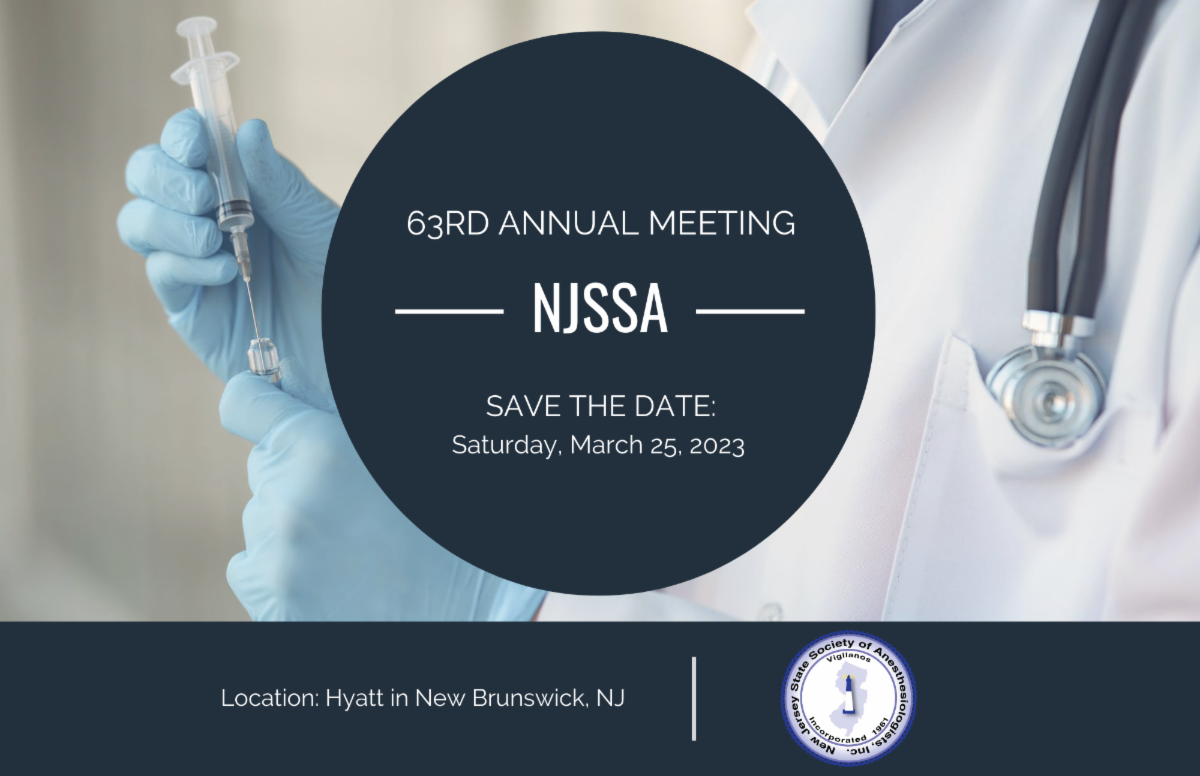
Looking ahead to 2023, we are actively planning our 2023 Annual Meeting and look forward to seeing everyone on March 25, 2023 when we expect to return to an in-person meeting! We expect to have excellent and informative speakers, and a return of the very popular ACLS, BLS and PALS renewal workshop. We also plan to hold poster presentations for our residents as well as our research contest. Please forward this newsletter to all residents in New Jersey and encourage them to participate in sharing their scholarly work and attend the meeting.
As we have been discussing, this is a critical time for our profession! We need everyone to please get involved and make your voices heard. There is power in numbers. You may be asked to send letters, make phone calls, or even arrange a meeting with legislators to educate them. Some of these may take as little as a minute of your time. You are the most powerful voice to help demonstrate the important role of physician anesthesiologists in providing the safest care in the safest environment for our patients. In addition, we need to make sure that we are reimbursed fairly for the work that we do. As the surprise billing legislation is implemented, we are learning that this legislation is even more challenging than anticipated. We are also learning that the rules regarding the legislation are still being written and we are working to assure that the arbitration process is as intended in the law when it was written in 2020. At a minimum, please make sure that all of your colleagues are members of ASA and NJSSA to help support this work. We will continue to work with ASA leadership and with our state lobbyists on this important issue and will inform our NJSSA membership as we learn more.
Please reach out to let us know how NJSSA can help you in your practice and thank you for the work you do!
Amanda Burden,
NJSSA President
| |
|
Legislative Update
Brianna Donahue, Lobbyist
| |
|
In mid-September the Legislature reconvened the 2022-2023 legislative session. We want to provide a brief overview of what to expect in the fall of 2022. New Jersey operates on a two-year legislative cycle and all legislation introduced in the first year of the cycle will be continued into the second year. All legislation that we are currently tracking will still be in play through 2023. The congressional midterm elections have no impact on the state’s legislative business but will be a strong indicator of the political climate ahead of the 2023 statewide elections.
In 2021, Democrats lost 7 seats to Republicans in the Legislature and Republicans are hoping to keep that momentum going over the next few years with the statewide elections in 2023 and the 2025 gubernatorial election. Democrats in the NJ Legislature have aimed to temper some of the progressive legislative efforts after the results of the 2021 election, but that is running counterintuitive with Governor Murphy’s progressive national agenda and his speculated run for higher office in the future.
There has not been any legislative activity over the two-month hiatus, but we wanted to give a brief synopsis of legislation we are monitoring heading into the fall.
| |
|
Legal Report
John D. Fanburg, Esquire
Carol Grelecki, Esqui
| |
|
I. COVID-19 LEGAL UPDATES
Brach Eichler has strived to keep abreast of the numerous legal developments that occurring during the nationwide novel coronavirus (COVID-19) public health emergency. Brach Eichler has created a COVID-19 Resource Center that consolidates our various important client alerts and webinar series information in one place.
Please visit the Resource Center for updates at https://www.bracheichler.com/covid-19-resource-center/.
II. NEW JERSEY DEVELOPMENTS
A. New Jersey Law Protects Health Care Workers During Change of Ownership
On August 18, 2022, Governor Murphy signed into law Senate Bill 315, which establishes employment protections for eligible employees during a change in control of their health care entity employer. The law will be effective November 16, 2022.
Under the new law, non-governmental health care entities must offer continued employment to all eligible employees for at least four months following the transfer of control, without any reduction in wages, paid time off, or the total value of their benefits – including health care, retirement, and education benefits. Eligible employees include any individuals employed within a 90-day period immediately preceding the change in control, with the exception of managerial employees and any person discharged for cause by the during that 90-day period.
During the four-month transitional period, all available employment positions must be offered in writing to eligible employees who previously held those positions, and the offers must remain open for at least ten business days. In the event that the number of available employment positions are less than the total number of eligible employees, then employment will be based on seniority and experience. An employee who is retained pursuant to the new law cannot be terminated without cause during the transitional period, unless the termination is a result of downsizing, in which case priority must be given to senior and experienced employees. Further, laid off employees must be offered any positions they held, if they are subsequently restored during the transitional period. After the transitional period, the successor employer must evaluate all retained employees and offer to continue to retain them if their performance during the transitional period was satisfactory.
Health care entities subject to the new law include general and special hospitals, ambulatory surgical centers, ambulatory care facilities, licensed imaging centers, mental hospitals, public health centers, diagnostic centers, treatment centers, rehabilitation centers, extended care facilities, skilled nursing homes, nursing homes, intermediate care facilities, outpatient clinics, dispensaries, home health care agencies, and residential health care facilities.
B. Amendments to Out of Network Arbitration Process Becomes Law
On July 29, 2022, Governor Phil Murphy signed into law Bill S1177 to amend certain aspects of the “Out-of-network Consumer Protection, Transparency, Cost Containment and Accountability Act” (the Act) relating to the arbitration process for claims involving health insurance carriers who are subject to the Act. Specifically, the amendments extend the amount of time that an insurance carrier and healthcare provider have to negotiate a settlement in the event of an inadvertent use of out-of-network services from 30 to 60 days, and extends the deadline for the carrier, provider, or covered person to initiate binding arbitration in the event of a failure to reach a settlement from within 30 days of the final offer to within 60 days of the final offer. The amendments also require an arbitrator to include detailed written findings with each arbitration decision. The detailed written findings are to be an analysis of the decision, including information concerning any databases, previous awards, or other documentation or arguments that contributed to the arbitrator’s decision.
| |
|
Protect Physician-led Anesthesia Care in NJ
There is an effort mounting in New Jersey to push legislation (S-1522/A-2286) that would authorize APNs to practice without physician oversight or supervision in all specialties, including primary care, dermatology, and anesthesia care. NJSSA needs your immediate assistance voicing our strong opposition to legislation "eliminating certain practice restrictions for advanced practice nurses"(A-2286/S-1522), as it is vital to the continued practice of safe, physician-led anesthesia care in New Jersey.
If enacted into law, S-1522/A-2286 would...
- Permit APNs in all specialties to practice on their own without physician involvement, collaboration, communication, or the availability of a collaborating physician.
- Create a new licensure of CRNAs titled "APN-Anesthesia" and permit them to provide anesthesia care for patients without a joint protocol agreement or supervision by a physician, completely removing the anesthesiologist from the care team.
- Authorize CRNAs with under 24 months, or 2,400 hours, of practice to be supervised by other APNs instead of current law requiring a collaborating physician.
| |
Help us in our fight to protect your specialty. Pl ease consider contributing to the NJAPAC and make sure anesthesiologist voices are heard in the halls of Trenton! | |
|
More information on speakers and our program coming soon!
| |
|
NJSSA will see you in New Orleans for the ASA Annual Meeting!
Mid-Atlantic Caucus Meet Up 10/24 11am
NJ Caucus Meeting 10/25 1pm
NJSSA Dinner 10/25 6pm
Email Stephanie Summers for more details.
| |
|
State Affairs Update
Federal Legislative Update
Federal Regulatory Update
Upcoming Meetings:
News Highlights:
South Carolina Board of Nursing Prohibits Use of Misleading Term “Nurse Anesthesiologist”
The South Carolina Board of Nursing approved a motion at its May meeting preventing use of the term “nurse anesthesiologist” by limiting nurse anesthetists to using only their statutorily defined term in professional written and verbal communications. The request to use the term “nurse anesthesiologist” as a generic descriptor was presented to the board by several nurse anesthetists, including the current president of the South Carolina Association of Nurse Anesthetists. After which the Board voted to remind licensees that the law defines CRNA as a “certified registered nurse anesthetist” and that is the term to be used for all professional communications – written and verbal.
ASA congratulates the South Carolina Society of Anesthesiologists for their proactive efforts in protecting patients from misleading titles like “nurse anesthesiologist.” This is a topic of great concern and is quickly spreading across many states and rapidly expanding to include a variety of medical titles. ASA is strongly engaged in this topic and can provide legislative guidance for your state. Please contact Allison Kronback, JD at a.kronback@asahq.org for more information, resources, and guidance.
ASA Resource on Integrating Certified Anesthesiologist Assistants (CAAs) into Practice
The Centers of Medicare and Medicaid Services (CMS), Tri-care, and all major commercial insurance payers recognize CAAs as qualified, safe and competent non-physician anesthesia providers, just like their nurse anesthetist counterparts.
With legislative efforts moving at a furious pace to bring CAAs into practice in multiple states, the “Resource on Integrating Certified Anesthesiologist Assistants (CAAs) into Practice” authored by the Committee on Anesthesiologist Assistant Education and Practice (CAAEP) will be an excellent resource to both review CAA education and practice, and summarize the important steps needed to bring these anesthesia providers into a practice.
Incorporating CAAs into an Anesthesia Care Team will require consultation and engagement with organization/hospital legal counsel, medical board, credentialling and bylaws committees, insurance contracted companies or agencies, billing services, and accountants. Credentialing can occur only after the facility’s bylaws recognize a CAA as an approved healthcare practitioner.
This resource paper provides a complete authoritative review of CAA practice, education, state regulation for State Licensure vs. Delegated Authority, Hospital and Facility Credentialing and Privileges processes, Billing, Coding, Reimbursement and Compliance guidelines for CAAs, and suggested steps to Communicate (to hospital administration/partners/ surgeons /OR staff ) the introduction of CAAs into a Practice.
The ASA web team will be working to post this on the ASA Committee Resources (Work Products) page in the next few days.
Thanks to the following members of the Committee on AA Education and Practice: Deborah Rusy MD, MBA, FASA, Laura Knoblauch CAA, Gregg Mastropolo CAA, Lois Connolly MD, FACHE, Tommy Verdone MD, Jocelyn Blake MD, Melanie Donnolly MD, Stacie Wong MD , Matthew Norcia MD, Carie Twitchell CAA, Brienne Seekford CAA, Nicole Cabell CAA, William Paulson MMSc, PhD, CCE, AAC, Kaley Hisghman CAA, Emily Mycyk CAA and Kraig de Lanzac M.D., FASA, for bringing this resource to fruition.
| |
Stephanie Summers
NJSSA Executive Director
| |  |
Please do not hesitate to reach out with questions, comments or concerns. I am here to serve and support you on behalf of the NJSSA. | | |
Thank you for your NJSSA membership!
| |
150 West State Street, Suite 110 | Trenton, NJ 08608 | | | | | |