February 9, 2026 • View in browser | | NLBMDA Weekly is our newsletter covering everything from the latest activity in Washington to updates from our members. This is the premier source of federal legislative, regulatory, and industry news for NLBMDA members. | | U.S. House expected to vote on Housing for 21st Century Act this Week. | | |
The House of Representatives is scheduled to consider H.R. 6644, the Housing for the 21st Century Act, on the House floor later this week. A floor vote would mark a significant step toward final House passage and advancing the legislation to the Senate for consideration. The bill reflects growing bipartisan momentum in Congress to address high housing costs and persistent housing supply constraints through targeted federal reforms.
In 2025, both chambers advanced major bipartisan housing packages, with the Senate Banking, Housing, and Urban Affairs Committee approving S. 2651, the ROAD to Housing Act, and the House Financial Services Committee advancing H.R. 6644. While developed separately, the two bills share substantial overlap, including provisions to streamline regulatory requirements, expand financing options, modernize housing programs, and improve oversight and coordination. Of the 38 sections in the House bill, 17 align at least in part with provisions in the Senate package. With both measures advancing independently, lawmakers will need to reconcile differences between the two bills before final enactment. Next month, NLBMDA members will be on Capitol Hill advocating for bicameral action to reconcile the differences between the ROAD to Housing Act and the Housing for the 21st Century Act, ensuring that housing remains a top priority for this Congress. NLBMDA continues to meet with committee and congressional staff and remains actively engaged throughout the process.
For those interested in learning more about the structural differences between ROAD and Housing for the 21st Century, the Bipartisan Policy Center has released a resource that compares each provision of the two bills, highlighting areas of overlap and key differences.
| | Congress Holds Hearing Putting Spotlight Back on Fix Our Forests Act | |
Last week, the House Natural Resources Committee’s Federal Lands Subcommittee held a hearing examining wildfire risks one year after Southern California’s devastating wildfires, which displaced thousands of residents and caused an estimated $130 billion in damages. Members highlighted how overgrown federal lands, extreme weather, and delayed mitigation efforts can contribute to catastrophic outcomes, with many displaced residents still unable to return due to rebuilding costs and limited insurance options. The hearing also renewed calls for the Senate to bring the bipartisan Fix Our Forests Act to the floor for a vote.
NLBMDA supports the Fix Our Forests Act (FOFA), a bipartisan approach that would expand federal tools and resources for wildfire mitigation, accelerate the deployment of modern monitoring technologies, and reduce duplicative processes that can slow coordination among local, state, and federal officials. The legislation passed the U.S. House last winter, and in the spring NLBMDA members met with Senate lawmakers to advocate for advancing the bill to a final vote. While a floor vote has not yet been scheduled, the bill has cleared a Senate committee with bipartisan support, signaling momentum toward final passage. Witnesses and members stressed a clear takeaway: wildfire moves fast, while bureaucracy often moves slowly, making proactive management and streamlined action critical to protecting communities prone to wildfires. NLBMDA continues to engage with Senate offices to advocate for a final vote on FOFA and will remain closely engaged as the legislative process moves forward.
| | Inside the Issues: NLBMDA’s 2026 Fly-In Legislative Priorities | |
On Friday, NLBMDA shared an overview of the legislative priorities members will be advancing during our 2026 Spring Meeting and Legislative Conference. As a reminder, this year’s Fly-In will focus on three core issues critical to the lumber and building material dealer industry.
First, NLBMDA is advocating for policies that expand housing supply and improve affordability by reducing regulatory barriers, modernizing zoning and permitting, and encouraging new construction and rehabilitation. This includes NLBMDA’s support for the Neighborhood Homes Investment Act, as well as key provisions in the Housing for the 21st Century Act and the ROAD to Housing Act. Second, members will advocate for workforce development solutions that strengthen the residential construction labor pipeline and address ongoing skilled labor shortages. Third, NLBMDA will continue pressing Congress to rein in excessive credit card swipe fees by restoring competition in the credit card market and lowering costs for dealers and consumers.
You can read the full breakdown of these priorities by visiting the full post here.
| | Early Bird Registration for the 2026 Spring Meeting & Legislative Conference is Now Open! | | |
Registration is now open for NLBMDA's Spring Meeting and Legislative Conference to be held on March 17-18 in Washington, D.C. If you register by February 20, you can save $100 on full-priced registration!
This premier event is an incredible opportunity to remind leaders of the importance of our industry and advance the advocacy agendas of NLBMDA. This conference includes many opportunities to learn about key issues affecting the lumber and building material industry from Washington policy experts.
The event will culminate with a day for you to conduct in-person meetings with your elected officials in Congress, making your voice heard on Capitol Hill. You won’t want to miss a minute of this program.
| | Apply for Dealers to D.C. Advocacy Grant Program to Participate at NLBMDA's Annual Legislative Fly-In | | |
NLBMDA has introduced Dealers to D.C., a new grant initiative aimed at boosting dealer participation at the 2026 Spring Meeting and Legislative Conference. The program offers ten $750 advocacy grants to help cover registration, travel, and lodging for LBM dealers—especially those who haven’t attended recently or represent underrepresented states. By broadening dealer involvement, NLBMDA strengthens its voice on Capitol Hill and ensures a wider range of industry perspectives are heard.
Participants will receive advocacy training, issue briefings, and hands‑on support from NLBMDA staff to prepare for effective meetings with lawmakers. Grant recipients will be announced ahead of the March 17–18, 2026 conference.
| | NLBMDA Meets with Senator Rosen’s Office to Discuss Workforce Development | |
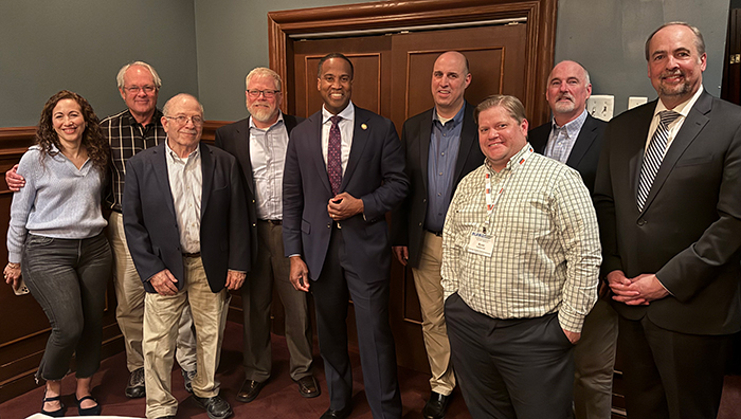
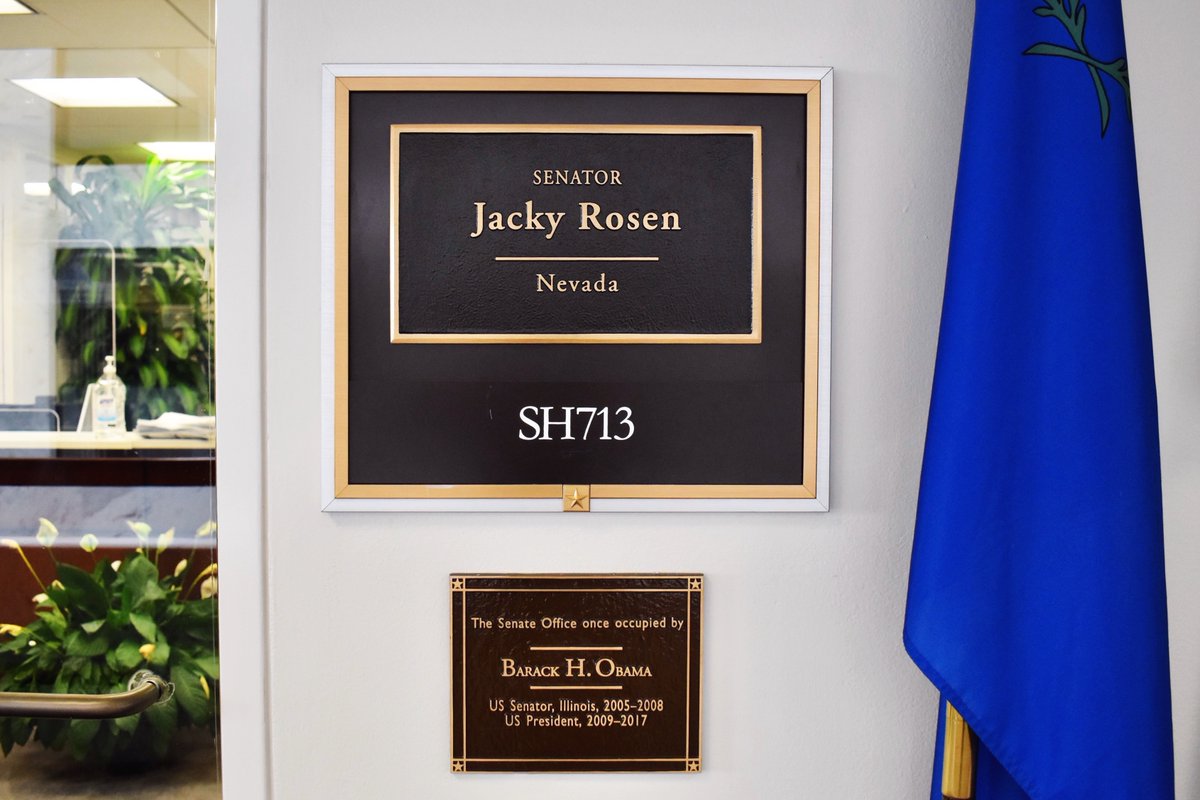
Earlier this month, NLBMDA met with Senator Jackie Rosen’s (D-NV) legislative team to discuss workforce development priorities for this year and to share that NLBMDA will be advocating for Senator Rosen’s CONSTRUCTS Act at this year’s Spring Meeting and Legislative Fly-In. CONSTRUCTS establishes a new, dedicated workforce development program focused on residential construction careers, expanding access to education and training. While designed to benefit the broader construction workforce, the legislation would also support LBM dealers by helping address persistent labor shortages that limit housing supply, growth, and project delivery. The legislation is also supported by the National Association of Home Builders (NAHB), whose members advocated for its passage at NAHB’s 2025 legislative fly-in. NLBMDA will continue engaging with congressional offices to identify and advance workforce development opportunities that support the next generation of workers across the industry.
| | |
Registration is now open for the ProDealer Industry Summit, an exclusive live educational forum designed to advance the growth of lumber and building product dealers, distributors, wholesalers, and their supplier partners. The event will be held at The Westin Michigan Avenue in Chicago and is co-hosted by NLBMDA and HBSDealer.
The summit brings together leaders from across the LBM industry for education, peer collaboration, and strategic discussion focused on strengthening businesses in a competitive marketplace.
| | Job Openings Fall as Labor Market Weakens, NAHB Says | |
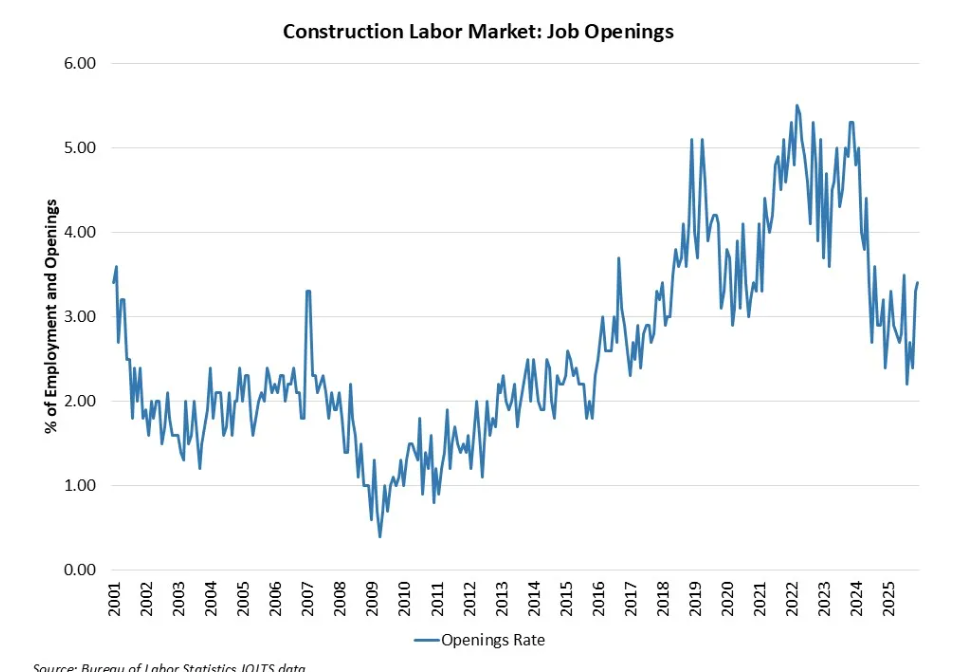
Running counter to the data for the full economy, the count of open, unfilled positions in the construction industry increased in December, per the delayed Bureau of Labor Statistics Job Openings and Labor Turnover Survey (JOLTS). The current level of open jobs is down measurably from two years ago due to declines in construction activity, particularly in housing.
The number of open jobs for the overall economy declined as the labor market weakened at the end of 2025, falling from 6.982 million in November to 6.542 million in December. The December reading was down from a year ago (7.508 million).
Previous NAHB analysis indicated that this number had to fall below eight million on a sustained basis for the Federal Reserve to move forward on interest rate reductions. With estimates remaining below eight million for national job openings, the Fed, in theory, should be able to cut further.
The number of open construction sector jobs increased from 284,000 in November to 292,000 in December. This total is higher compared to a year ago (205,000), although the reading is notably lower than two years ago. The chart below notes the declining trend that has been in place for unfilled construction jobs since the Fed raised the federal funds rate and home building weakened. While home building employment was declining during the second half of 2025, other subsectors of the construction industry have expanded (e.g. data centers).
The construction job openings rate increased to 3.4% in December, higher than the 3.2% rate estimated a year ago.The layoff rate in construction declined to 1.5% in December. The quits increased to 1.5% for the month.
| | The outlook for the US housing market in 2026 according to J.P. Morgan | |
After nearly doubling in the last decade, J.P. Morgan Global Research sees U.S. house prices stalling at 0% in 2026, with a slight improvement in demand likely offsetting any increased supply.
While fixed-rate mortgage rates are projected to stay elevated at 6+%, adjustable-rate mortgage (ARM) rates could tick downward if the Fed decides to ease, thereby making homes more affordable. In addition, homebuilders are continuing to offer rate buydowns — in which they pay a sum upfront to help lower the buyer’s mortgage rate — in a bid to clear their inventory. “We think this could be enough, along with a rising wealth effect, to shift demand higher while supply increases subside. Consequently, we expect home prices to stall at 0% nationally in 2026,” observed John Sim, head of Securitized Products Research at J.P. Morgan.
There are, of course, regional variations. House prices are falling the most along the West Coast and Sun Belt, where there remains a glut of new homes following the pandemic-era construction boom. “It should not be a surprise that supply is a key factor in areas where we see home prices decline,” Sim said.
Indeed, the size of the housing shortage in the U.S. has been overemphasized, with J.P. Morgan Global Research putting the figure at around 1.2 million homes — significantly below other market estimates. Looking back over the past 30 years, new household formations and housing completions net out to nearly zero. In addition, housing supply has climbed in recent months. “Overbuilding is a sure path to home price declines, and builders have been navigating an increasing supply of new homes,” Sim added.
Key takeaways
- J.P. Morgan Global Research sees U.S. house prices stalling at 0% in 2026, with a slight improvement in demand likely offsetting any increased supply.
- U.S. home sales held firm at the tail-end of 2025 following a sluggish year, and are projected to further improve in the coming months.
- While the Trump administration has announced two new housing reforms, their impact on the housing market is likely to be limited.
| |
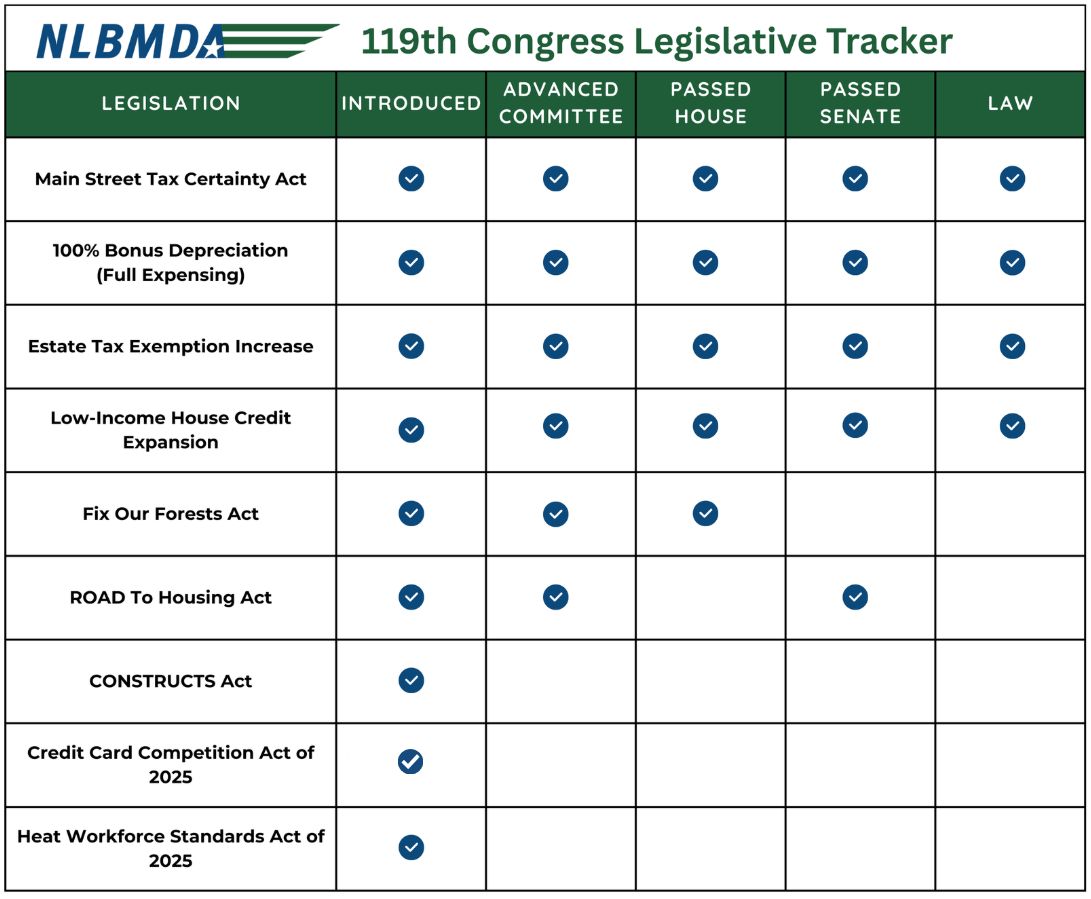
NLBMDA's 119th Congress Legislative Tracker
| | NLBMDA now offers a new legislative tracker highlighting the status of priority bills NLBMDA is actively supporting on Capitol Hill. The tracker will be updated regularly to reflect the progress of key legislation impacting the lumber and building material industry. Since our last newsletter, lawmakers have officially reintroduced the Credit Card Competition Act in both the House and Senate, this official reintroducing represents meaningful progress over the last few weeks to advance CCCA this Congress. | | Congress Approves Spending Package, Ending Weekend-Long Partial Government Shutdown | | |
On Tuesday, February 3rd, the U.S. House passed a revised spending package that ended a partial government shutdown lasting three days. The package secures funding for the vast majority of federal agencies through September, including the Department of Housing and Urban Development, and was approved by the Senate the previous Friday. In the House, the measure passed in a bipartisan 217-214 vote. Appropriations is expected to remain a top priority for lawmakers this week, as the funding agreement includes a short-term extension for the Department of Homeland Security through the end of the week.
Late last week, House Minority Leader Hakeem Jeffries (D-NY) and Senate Minority Leader Chuck Schumer (D-NY) sent Republican leaders a list of reforms they want enacted within U.S. Immigration and Customs Enforcement (ICE) activities following recent fatal shootings in Minneapolis involving federal immigration agents. The DHS funding bill also includes support for FEMA, TSA, and the U.S. Coast Guard. Despite the potential lapse in funding, Immigration and Customs Enforcement operations are expected to face minimal disruption, as the agency received appropriations in last year’s tax and spending package passed by Congress. NLBMDA will continue to closely follow developments as negotiations are expected to dominate much of the conversation on Capitol Hill this week.
| | Rep. Janelle Bynum (D-OR) Introduces LIMBER Timber Act | |
Oregon Rep. Janelle Bynum (D-OR) has introduced H.R. 7245, the Leveraging Investment in Mass Building and Employment with Renewable Timber (LIMBER) Act of 2026, legislation that would establish a new 30 percent investment tax credit to support the construction, expansion, and modernization of mass timber manufacturing plants. The bill is intended to spur investment across the U.S. mass timber supply chain through targeted tax incentives, including a workforce development credit covering hiring, training, and apprenticeship-related costs, as well as a per-square-foot tax credit for buildings that incorporate mass timber as a primary structural component.
NLBMDA has engaged with Rep. Bynum’s legislative team this week now that the bill has been introduced to learn more about the legislation and its potential impact on the industry. Since the LIMBER Timber Act establishes tax credits, its provisions could advance as part of a broader tax package or be incorporated into a larger year-end tax extenders bill, budget reconciliation measure, or other must-pass legislative vehicle moving through the Ways and Means Committee. To date, the bill has been formally endorsed by the International Mass Timber Conference and the Forest Business Network, but it does not yet have additional cosponsors or a Senate companion measure.
| | Orgill kicks off 2026 Dealer Market with tech focus | | |
Before a packed house at the Orange County Convention Center in Orlando, Tenn.-based hardware giant Orgill held its 19th annual tech symposium.
CEO Boyden Moore opened the event, recalling how the tech-centric gathering started with “just a handful of people” and has grown into a key pillar of its yearly dealer shows.
“Technolgy is a journey we’re investing in,” Moore said, adding that the company continues to use its CNRG stores “as a proving ground to help our customers more successfully run their business.”
| | Ring's End subsidiary acquiring Somerset Paint | | |
Effective February 23, 2026, Johnson Paint | A Ring’s End Brand will acquire Somerset Paint, with locations in Swansea and North Dartmouth, Mass.
As part of this transition, Johnson Paint will move its New Bedford, Mass., operations from 1193 Ashley Blvd to 668 State Road, Dartmouth, Mass. According to Connecticut-based Ring's End, the locations in Swansea and North Dartmouth provide Johnson Paint with better access to "premium coastal markets."
| | LMC Promotes Geoff Hesselton to Director of Technology Delivery | | |
LMC is pleased to announce the promotion of Geoff Hesselton to Director of Technology Delivery. In this role, Geoff will report directly to Jack Phipps, Vice President of Technology.
Geoff started at LMC in January 2024 as a Senior IT Program Manager. Before joining the co-op, he came with over 15 years of experience managing various, complex IT projects. He holds a Bachelor’s of Business Administration majoring in Supply Chain and Management Information Systems from Penn State University.
| | Weyerhaeuser Distribution Completes Inland Northwest Expansion; Billings, Montana, Location Now Fully Operational | | Weyerhaeuser Distribution reached a significant milestone in the business' continued growth journey. The Inland Northwest expansion is officially complete, as the newest distribution center in Billings, Montana, began operations in early January. This expanded geographic reach enhances service for customers across the West and marks an important moment for the business and the lumber and building materials customers Distribution proudly serves. | | | | |