March 23, 2026 • View in browser | | NLBMDA Weekly is our newsletter covering everything from the latest activity in Washington to updates from our members. This is the premier source of federal legislative, regulatory, and industry news for NLBMDA members. | | At the Spring Meeting & Legislative Conference, NLBMDA Government Affairs Coordinator Matthew Delaney speaks with the LAT delegation ahead of their meetings on Capitol Hill. | |
NLBMDA Hosts Dealers in Washington for 2026 Spring Meeting & Legislative Conference
| | |
Last week, NLBMDA welcomed more than 65 attendees to Washington for its annual Spring Meeting & Legislative Conference. With Congress actively considering the most ambitious housing package in decades and a swipe fee bill newly endorsed by the White House, the conference took place at a time when federal policy decisions carry significant implications for the industry, underscoring the importance of strong, coordinated advocacy.
Day one of the legislative conference began with a packed afternoon of sessions designed to inform attendees on this year’s key issues and provide a clear view of the current legislative and regulatory landscape. The program kicked off with a congressional staff briefing on the Credit Card Competition Act, where attendees heard directly from key offices leading the effort on Capitol Hill. That was followed by a keynote from NAHB’s Chief Advocacy Officer Ken Wingert, who highlighted shared priorities across the residential construction sector. Attendees then received a forward-looking update on the 2026 regulatory environment from the Small Business Administration’s Office of Advocacy, including key rulemakings and recent deregulatory actions impacting small businesses.
The afternoon also featured a breakdown of the Senate Banking Committee’s ROAD to Housing Act and an insider update from Speaker Mike Johnson’s office on priorities for the 119th Congress, before concluding with NLBMDA’s policy briefing and advocacy training to prepare attendees for meetings on Capitol Hill. On Capitol Hill the next day, NLBMDA members met with more than 100 congressional offices across over a dozen states to advocate for this year’s legislative priorities.
Together, these efforts reinforced NLBMDA’s commitment to ensuring the voice of the lumber and building materials industry is heard as policymakers shape housing and broader policies impacting our industry, and we thank all attendees for their engagement and advocacy in making the conference a success.
| |
White House Issues Executive Order to Remove Regulatory Barriers to Affordable Home Construction
| |
On March 13, 2026, the White House issued an executive order aimed at reducing federal regulatory barriers to housing construction, with a focus on improving affordability and increasing supply. The order directs multiple federal agencies, including HUD, EPA, DOT, and Treasury, to review and revise rules tied to permitting, environmental standards, and development requirements that can slow projects and increase costs. Key priorities include streamlining federal permitting under laws like NEPA, reassessing stormwater and wetlands regulations, scaling back certain energy-efficiency mandates, and encouraging faster approvals for residential and infrastructure projects that support housing development.
At a high level, the order also promotes greater flexibility for state and local governments by advancing “best practices” such as faster permitting timelines, reduced development fees, and fewer restrictions on manufactured and modular housing or development outside urban cores. Many of the themes in the executive order align with ongoing bipartisan efforts in Congress to advance what could be the most significant housing package in more than three decades, efforts NLBMDA has been actively shaping through ongoing meetings and negotiations with Members of Congress and their offices. While implementation will depend on agency rulemaking and local adoption, the highly anticipated order signals a broader federal push to address housing affordability by increasing supply and easing regulatory constraints across the development pipeline.
| | |
Registration is now open for the ProDealer Industry Summit, an exclusive live educational forum designed to advance the growth of lumber and building product dealers, distributors, wholesalers, and their supplier partners. The event will be held at The Westin Michigan Avenue in Chicago and is co-hosted by NLBMDA and HBSDealer.
The summit brings together leaders from across the LBM industry for education, peer collaboration, and strategic discussion focused on strengthening businesses in a competitive marketplace.
| | Nominate the 2026 ProDealer of the Year | |
The ProDealer of the Year Award program highlights companies that set the standard for success, innovation, and community engagement. This long-standing tradition spans two centuries, and has honored some of the most respected names in the industry.
Each year, NLBMDA and HBSDealer recognize outstanding industry leaders in two categories:
- ProDealer of the Year – Recognizing a company that demonstrates exceptional growth, innovation, and leadership in the LBM industry.
- Independent ProDealer of the Year – Celebrating a standout dealer with five or fewer locations that exemplifies the values and business acumen of the independent lumberyard sector.
The program relies heavily on the expertise of the industry at large. Do you know a company that deserves to be recognized? Nominations are open now. Submit your entry by March 27 and help us celebrate the best in the industry.
| | Builder Sentiment Inches Higher but Affordability Concerns Persist | | |
Builder sentiment ticked up in March, with the NAHB/Wells Fargo Housing Market Index rising to 38—its second consecutive monthly gain—even as affordability pressures continue to weigh on the market. Builders cite elevated construction, labor, and land costs, along with shortages of buildable lots, as persistent challenges. Buyer hesitancy remains high as many wait for lower interest rates amid broader economic uncertainty, including the recent conflict with Iran. Despite these headwinds, all major components of the index improved in March, including current sales, future sales expectations, and prospective buyer traffic.
To help support demand, nearly two‑thirds of builders continued offering sales incentives in March, and 37% reported cutting prices, with average reductions holding steady at 6%. Mortgage rates have eased from 2023 highs—February’s 30‑year fixed rate averaged 6.05%—but down‑payment barriers and geopolitical uncertainty remain obstacles. Regional sentiment was mostly steady, with the Northeast, Midwest, and South unchanged, while the West saw a slight decline. Industry leaders note that recent federal actions aimed at reducing regulatory burdens could help expand attainable housing supply over time.
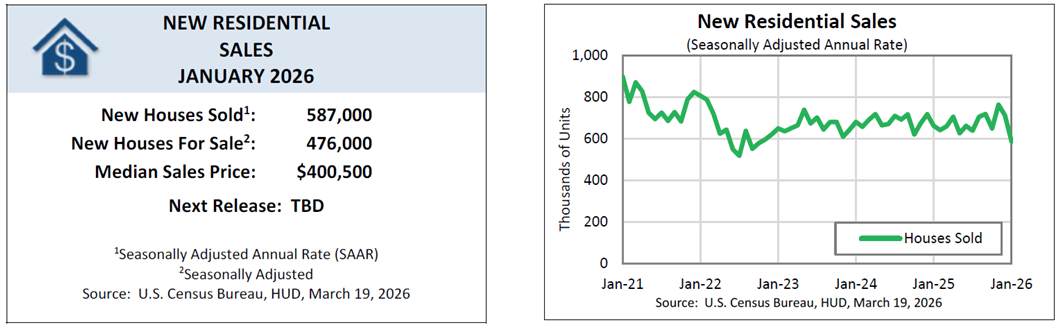
| | Monthly New Residential Sales for January 2026 | | |
Sales of new single-family houses in January 2026 were at a seasonally-adjusted annual rate of 587,000, according to estimates released jointly today by the U.S. Census Bureau and the Department of Housing and Urban Development. This is 17.6 percent (±13.3 percent) below the December 2025 rate of 712,000, and is 11.3 percent (±15.6 percent)* below the January 2025 rate of 662,000.
The seasonally-adjusted estimate of new houses for sale at the end of January 2026 was 476,000. This is 0.4 percent (±1.2 percent)* above the December 2025 estimate of 474,000, and is 4.0 percent (±5.1 percent)* below the January 2025 estimate of 496,000. This represents a supply of 9.7 months at the current sales rate. The months' supply is 21.3 percent (±18.2 percent) above the December 2025 estimate of 8.0 months, and is 7.8 percent (±21.3 percent)* above the January 2025 estimate of 9.0 months.
The median sales price of new houses sold in January 2026 was $400,500. This is 4.5 percent (±8.0 percent)* below the December 2025 price of $419,200, and is 6.8 percent (±8.4 percent)* below the January 2025 price of $429,600. The average sales price of new houses sold in January 2026 was $499,500. This is 5.9 percent (±7.9 percent)* below the December 2025 price of $530,900, and is 3.6 percent (±8.2 percent)* below the January 2025 price of $518,200.
| |
U.S. Senate Passes 21st Century ROAD to Housing Act, Bill Moves to House
| | |
On March 12, the U.S. Senate passed the 21st Century ROAD to Housing Act by a bipartisan vote of 89-10, sending the legislation back to the House for further consideration. The Senate-passed bill represents a combination of the Senate’s original ROAD to Housing Act and the House’s Housing for the 21st Century Act which it had passed earlier this year. NLBMDA has been engaged on the bill since it first advanced out of the Senate Banking Committee last summer, working closely with lawmakers to help shape provisions that impact housing supply and affordability.
The legislation represents one of the most comprehensive bipartisan housing packages in years, combining elements from both House and Senate proposals. It includes a wide range of policies aimed at increasing housing supply, improving affordability, and modernizing federal housing programs. Key provisions expand access to financing, incentivize local housing production through grants and zoning reforms, streamline environmental reviews, and support alternative housing types such as manufactured and modular homes.
As the legislation returns to the House, lawmakers are expected to revisit and refine key provisions of the Senate-passed bill. House leaders have already raised concerns about elements that could unintentionally constrain housing supply, including provisions requiring large institutional investors to divest certain single-family homes within a set timeframe, an issue NLBMDA flagged with lawmakers earlier this month.
This morning, Rep. Maxine Waters (D-CA), Ranking Member of the House Financial Services Committee, formally called for the House and Senate to convene a conference committee to resolve policy differences between their respective bills. In her letter to colleagues, Waters acknowledged concerns raised by NLBMDA and other stakeholders, noting “stakeholder concerns… about whether the bill now curtails the construction of new homes and creates other unintended consequences.” While Committee Chairman Rep. French Hill (R-AR) has not formally called for a conference, he has indicated a preference to revise the legislation before it is sent to the White House. Moving to a conference committee could extend the legislative timeline, particularly as Congress faces a limited number of legislative days before the midterm election season begins to dominate the calendar. NLBMDA will continue to closely engage with lawmakers throughout this process to help ensure the final legislation supports policies that expand housing supply and improve affordability.
| |
Partial Government Shutdown Enters 38th Day
| | |
A funding impasse over appropriations for the Department of Homeland Security has stretched on for more than a month, as mounting pressure points, including significant TSA staffing shortages and lengthy airport wait times, intensify calls for a resolution. The partial shutdown, which began in mid-February, has left TSA agents working without pay, contributing to increased absences and travel disruptions nationwide.
Despite growing urgency, the Senate has failed multiple times to advance a funding package, including a fifth unsuccessful vote last week. In response, Senate Democrats have pursued a series of narrower appropriations bills to fund specific DHS components such as TSA, the Coast Guard, and FEMA, while broader negotiations remain stalled over immigration policy and enforcement priorities. Senate Republicans have rejected this approach, arguing that any measure must fund the department in full. President Trump has called on Senate Republicans to waive the filibuster and allow passage by a simple majority, though Senate Majority Leader John Thune has pushed back, citing concerns about long-term precedent.
With Congress set to begin a two-week Easter recess later this week, pressure is mounting on lawmakers to reach an agreement before departing Washington.
| |
16 U.S. Senators Urge Reconsideration of OSHA Pending Heat Rule
| | |
A number of Senators, led by HELP Committee Chairman Bill Cassidy (R-LA), are urging the Department of Labor to withdraw the Biden-era OSHA heat rule, arguing it would impose a burdensome, one-size-fits-all regulatory framework on employers, feedback that directly reflects concerns raised by NLBMDA throughout rulemaking process of the pending rulemaking. In a March 11th letter to Labor Secretary Lori Chavez-DeRemer, lawmakers emphasized that OSHA’s existing authority under the General Duty Clause already enables enforcement against heat-related hazards and warned that a new federal standard could complicate enforcement and create challenges for states that have developed their own tailored approaches to worker safety.
The letter raised concerns that the proposed rule’s rigid requirements, including mandated breaks, staffing designations, acclimatization schedules, and detailed safety plans, could increase costs, create operational challenges, and in some cases unintentionally reduce safety. They also warned that prescriptive standards may be difficult to implement across diverse industries and worksites, particularly for small businesses, and called for a more flexible, practical approach to protecting workers from extreme heat. Late last year, NLBMDA commended House lawmakers for introducing legislation that would repeal the rulemaking and require the agency to restart the rulemaking process allowing for additional stakeholder input.
| | Reaching New Heights at the LMC Annual in Chicago | | |
Few sentiments rang truer than “unity is strength” at the LMC Annual Meeting, held March 10–12 in Chicago. Hundreds of LMC dealers, suppliers, and the LMC team spent three days together building upon the trust and quality that defines the co-op. As LMC’s largest event of the year, the Annual proved highly successful, equipping LMC dealers with education sessions, exclusive savings, and lasting partnerships that extend well beyond the show floor. In addition to measurable savings, dealers gained insights that exemplify the value of being part of LMC.
| | Hancock Lumber Debuts Brand-New Kitchen Design Showroom | | |
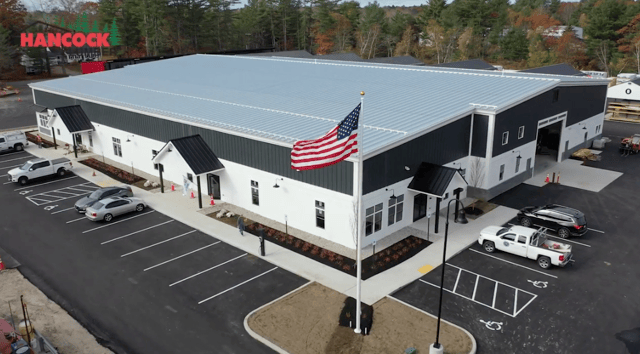
Maine stalwart Hancock Lumber has opened its new Kitchen Design Showroom in Brunswick. Aligning with trend-leading Top Showrooms peers, the new location features thoughtfully curated displays and Maine-flavored aesthetics.
The company, which operates nine other showrooms throughout Maine and New Hampshire, features a team of designers at the Brunswick location who select displays that represent projects being built in Maine—from "coastal charm to rustic beauty."
| | ECI appoints Residential Construction leader | | |
ECI Software Solutions, Inc. has appointed Bob Cain as Industry President, Residential Home Construction.
Cain will lead strategy, growth and customer engagement for ECI’s Residential Home Construction industry, bringing more than two decades of leadership experience in residential construction technology since joining MarkSystems in 1999, prior to its acquisition by ECI. He succeeds Scott Duman, who recently retired.
| | Weyerhaeuser THRIVE Initiative Seeks to Add Attainable Workforce Housing in Washington — and Beyond | | |
In Raymond, Washington, where we’ve operated a lumber mill since the 1930s and owned timberland in the surrounding Willapa Hills for even longer, finding a home can be more of a challenge than buying one. The reasons run the gamut and reflect many of the same complexities driving housing shortages in rural communities across the country, including an aging population, limits on developable land and a significant share of local houses being used as vacation homes or short-term rentals.
There are few quick fixes for any of these concerns. But for the past 18 months, our THRIVE team, led by Nancy Thompson, senior director of advocacy and philanthropy, and Katie Hooker, corporate giving manager, has been building a coalition of partners determined to make housing in Raymond more attainable for the local community.
And if their project goes as planned, they hope to have a blueprint that can be shared, replicated and scaled in similar communities across the country.
| | | | |