|
NNA Community Newsletter
May 2026 Issue
| |
- Applications Open: Navigating the New Arctic Research Experience for Undergraduate Students
- Recording Available: NSF OPP Update Office Hour
- NSF Vacancies Now Available
- Community Stories Wanted: QGreenland in Action
- Polar Steam Seeking NSF-funded Polar Researchers for Collaboration
-
NNA Project Highlight - Interactions of natural and social systems with climate change, globalization, and infrastructure development in the Arctic
- Upcoming Events
| | Applications Open: Navigating the New Arctic Research Experience for Undergraduate Students | | |
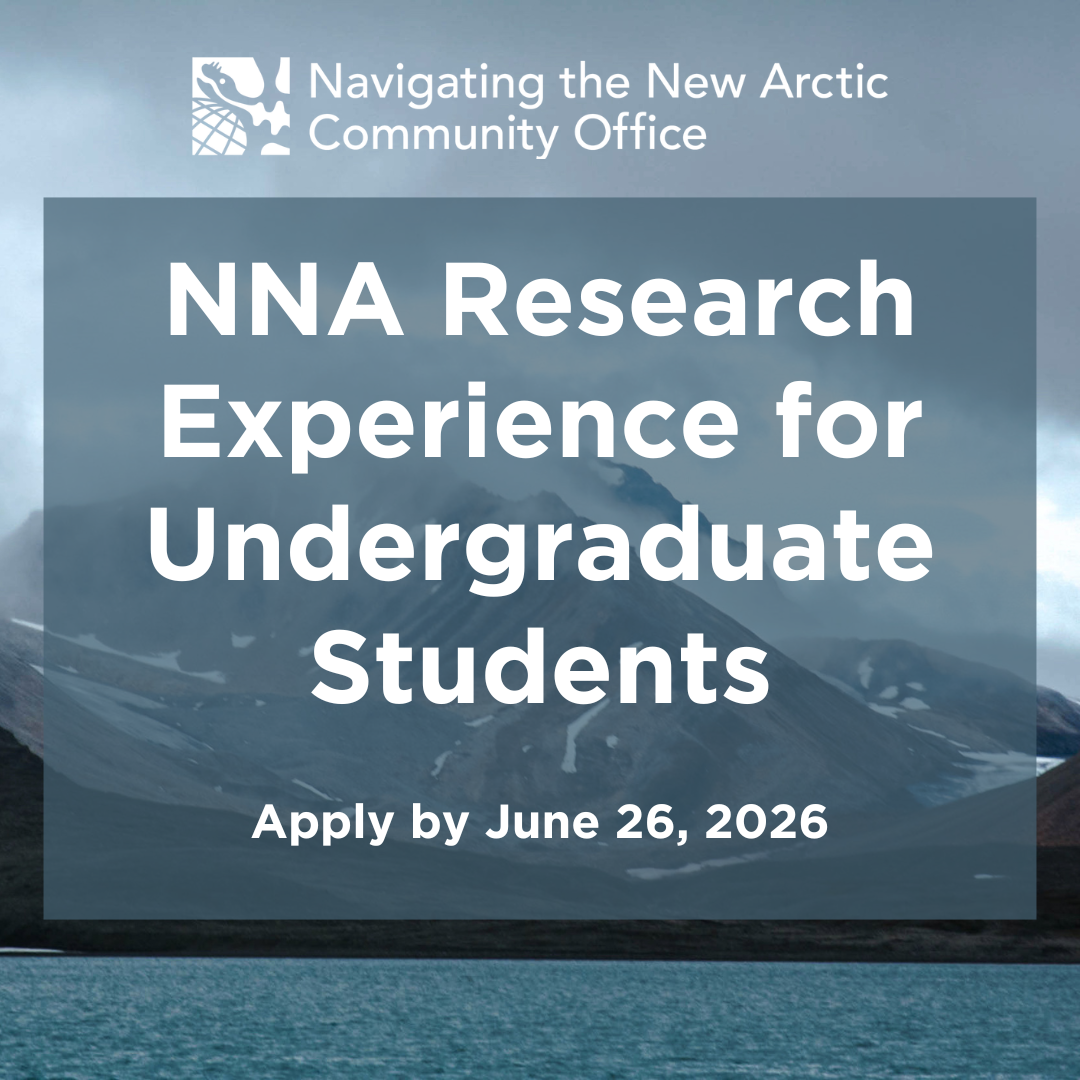
The Navigating the New Arctic (NNA) Research Experience for Undergraduate Students (REU) is a paid research program designed to provide Alaska community college and university undergraduate students with an authentic research experience with Arctic community priorities at the center. This hybrid research experience focuses on exploring Indigenous and western science methods of studying how a changing climate impacts Arctic communities.The REU will take place in August and September, you can find more information here.
Call for Students: Do you know of any Alaskan undergraduate students who would be interested in this opportunity? Please share the following information with them:
NNA REU website for more information
Application form
Sign up for application deadline reminders
Sign up for June 9, 2026 info session
Applications are due by Friday, June 26, 2026 at 11:59 PM ET.
Call for Mentors: Are you interested in mentoring students leading up to and at the NNA Annual Community Meeting in Fairbanks, AK in August and September? We’re seeking mentors to guide 2–3 undergraduate students (as a group) as they engage in hands-on, community-connected Arctic research. Mentors will receive a $500 stipend. If interested, please reach out to alicia.christensen@colorado.edu.
| | Recording Available: NSF OPP Update Office Hour | | |
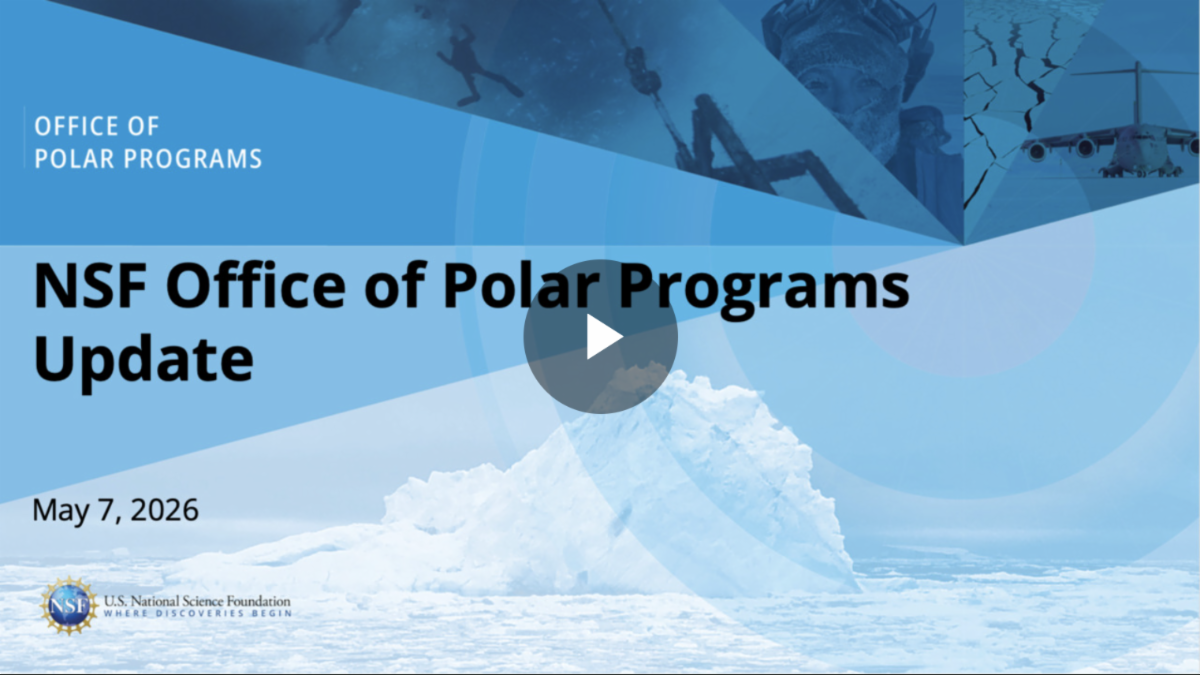
The recording of the National Science Foundation Office of Polar Programs (NSF OPP) office hour held on May 7, 2026 at 1:30 p.m. EDT is now available. Leadership and staff invited researchers to attend the virtual office hour to discuss recent organizational updates and what to expect going forward. The goal of this event was to help researchers understand how these changes may affect proposal development and review, and to answer questions from the research community. The recording is available here.
| | NSF Vacancies Now Available | | On Monday, May 11, the U.S. National Science Foundation (NSF) released vacancy announcements of particular interest to early career scientists and engineers. The staff in these positions work with program directors to plan and analyze program portfolios, identify emerging research areas, and support/manage the merit review of proposals and use data analysis to understand the landscape of the principal investigator community and the impact of current NSF investments. The incumbents will work internally and externally to engage with the research community through outreach and other community activities. NSF also supports the professional development of entry level scientists and engineers through interdisciplinary activities, training, and opportunities to engage in independent research and collaboration. You can find job openings here. | | Community Stories Wanted: QGreenland in Action | | |
Do you use QGreenland in your studies, teaching, work, or research? The QGreenland team is looking to feature community members on their website to showcase how QGreenland is being used in real‑world contexts and to inspire other users.
Those interested are invited to complete a very short Google form (about three minutes or less). Participants will be contacted to schedule a brief interview about how they’ve found QGreenland most useful in their work to share with the wider Arctic science and educator community.
| | Polar Steam Seeking NSF-funded Polar Researchers for Collaboration | | |
Polar STEAM is seeking NSF-funded polar researchers interested in collaborating with educators either virtually or in the field. The flexible virtual option allows researchers to engage using existing data, samples, or models from any year, while field-based collaborations will take place during the 2027 Arctic field season. This no-cost opportunity supports broader impacts by embedding professional educators into research teams to co-create educational products that connect the science being produced with wider audiences. Join a national cohort of polar researchers, strengthen your science communication, and share your work in new and meaningful ways. Learn more at polarsteam.info or email polarsteam@oregonstate.edu.
| | Interactions of natural and social systems with climate change, globalization, and infrastructure development in the Arctic | | |
The NSF-funded NNA project “Interactions of natural and social systems with climate change, globalization, and infrastructure development in the Arctic” is a transdisciplinary research project examining how climate change, industrial development, and changing snow and vegetation conditions are reshaping Arctic socio-ecological systems in northern Finland and Norway. The project brings together researchers in anthropology, biotic systems, and Earth system science with reindeer herders and local knowledge holders to co-produce knowledge on issues of direct relevance to northern communities.
| | |
The project uses a convergence-science framework that integrates field observations, remote sensing, ecosystem measurements, climate analyses, and community-based research to investigate interactions among natural systems, infrastructure development, and reindeer herding livelihoods. Current research threads focus on how warming winters and changing snow structure affect reindeer herd dynamics, how industrial activities impact nutritional content of landscapes, and how expanding infrastructure influences reindeer migration routes and landscape connectivity.
Through workshops, collaborative field activities, and ongoing dialogue with herders, the project is developing research questions and methodologies jointly with local communities while advancing interdisciplinary Arctic systems science. The project includes collaborators from the United States, Finland, Norway, the United Kingdom, and France.
| | |
Article submitted by Valeriy Ivanov, PI of Interactions of natural and social systems with climate change, globalization, and infrastructure development in the Arctic
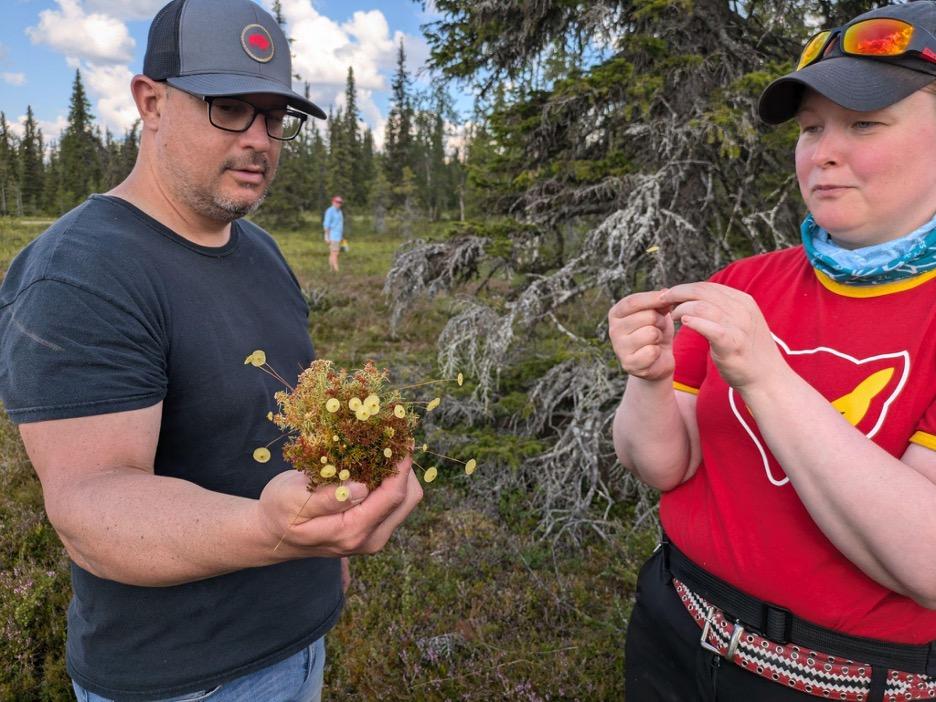
Figure 1 caption: Dr. Gerardo Celis (University of Arkansas), a member of the project’s biotic systems sub-team, works with reindeer herder Iida Melamies to identify plant species preferred by reindeer for forage. This shared knowledge has laid the foundation for a recent study identifying preferred reindeer migration routes across the herding district.
(Photo credit: Dr. John Ziker, Boise State University; Sattasniemi Reindeer Herding District, Finland, July 2025.)
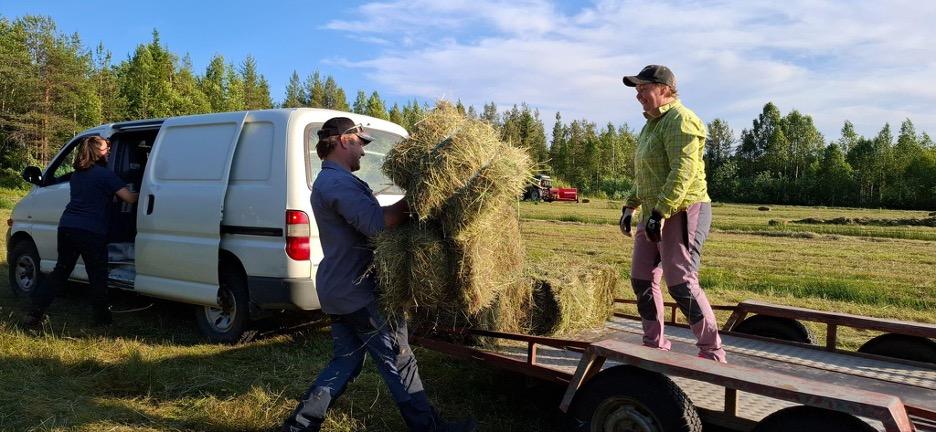
Figure 2 caption: Dr. Karl Mertens (Boise State University), a member of the project’s anthropological science sub-team, works with reindeer herder Kirsi Mäkitalo in preparing hay used as supplemental winter feed for reindeer. Joint work with herders and scientists has contributed to improved research design and interpretation of results, including a recent study on snow metamorphism and another study on nutritional resources across the district.
(Photo credit: Iida Melamies; Sattasniemi Reindeer Herding District, Finland, July 2025.)
| |
- 2026 NNA Annual Community Meeting
- September 15-17, 2026
| |
Copyright © 2021 CIRES, All rights reserved.
The Navigating the New Arctic Community Office (NNA-CO) is jointly implemented by the University of Colorado Boulder, Alaska Pacific University, and the University of Alaska Fairbanks. The NNA-CO is supported through a cooperative agreement with the U.S. National Science Foundation (Award #2040729).
| | | | |