|
NNA Community Newsletter
October 2024 Issue
| |
- Call for Community Outreach Fair Flash Talks
- Upcoming NNA-CO Learn & Connect Series Events
- Call for Nominations to the ARCUS Board of Directors
- Applications Open for Scalable and Computationally Reproducible Approaches to Arctic Research Workshop
- IARPC Public Webinar Series: Arctic Research Implementation Plan 2025-2026 Launch
-
NNA Project Highlight - Permafrost Grown: Building Collaboration for Sustainable Permafrost Agroecosystems
- Upcoming Events
| |
Call for Community Outreach Fair Flash Talks | |
|
Do you want an opportunity to connect your NNA project to Arctic community members and decision-makers across Alaska? The NNA-CO is hosting a session of NNA flash talks in the upcoming Arctic Outreach Fair that will take place as part of the Alaska Forum of the Environment (AFE) on February 6, 2025. AFE gathers environmental professionals from government agencies, non-profit organizations, businesses, community leaders, and Alaska youth to discuss the latest projects, processes, and issues that affect the environment in Alaska.
If you are interested in participating, please fill out the form below. If accepted, we will ask you to prepare a 3-minute flash talk about your project’s relevance to Arctic communities and what outreach opportunities you have to offer attendees.. The session will be a hybrid event, with both in-person and online audience members. Your flash talk may be in-person, online, or pre-recorded (presenters receive a complimentary day pass for the conference). We will hold a practice flash talk session prior to the event.
Apply here for one of our 10 spots in the Arctic Outreach Fair by January 10, 2025 at 11:59pm AK. Any questions? Email sjclement@alaska.edu.
| |
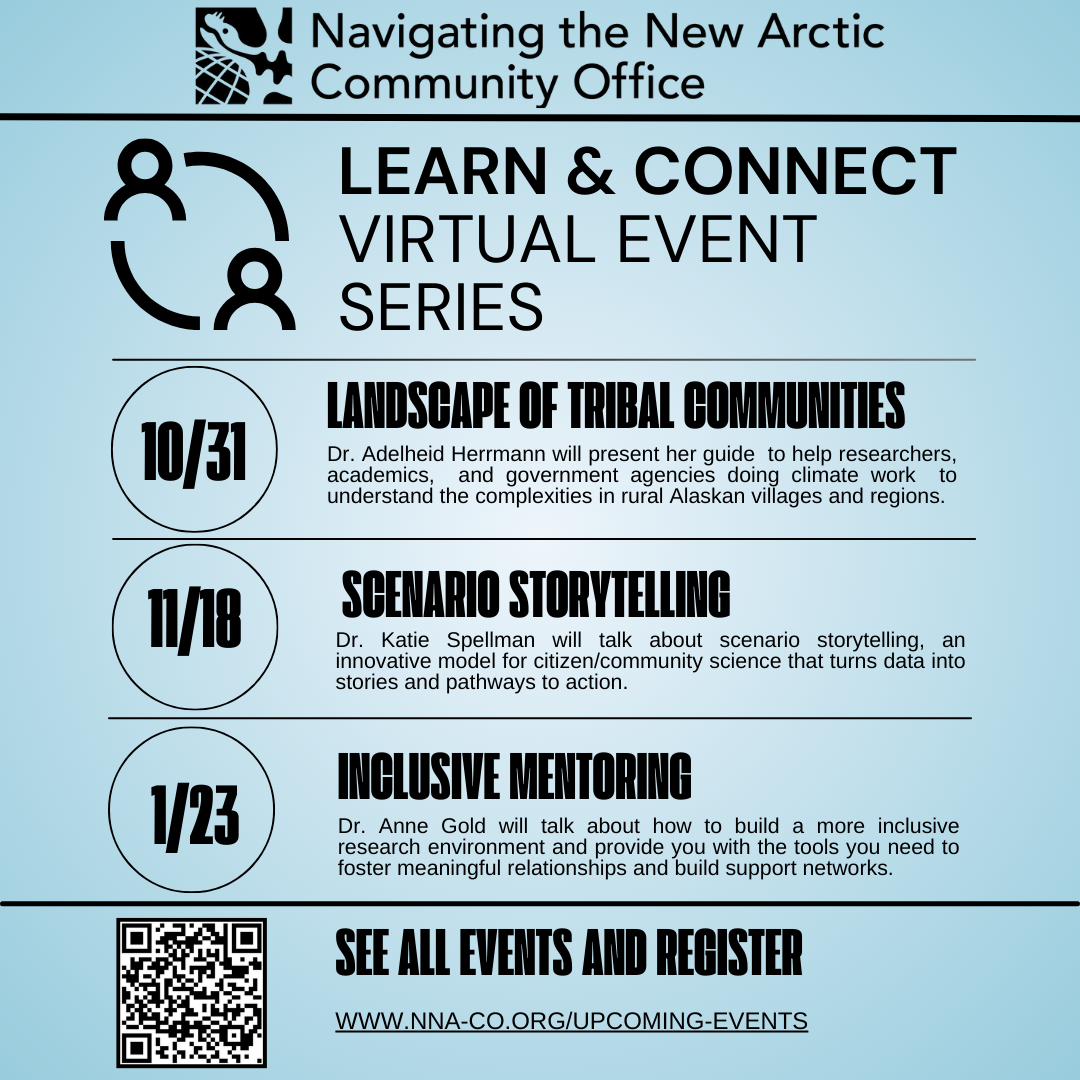
Upcoming NNA-CO Learn & Connect Series Events | The NNA-CO Learn & Connect Series (formerly Broader Impacts Network) is designed to bring NNA projects that work across the Arctic together to learn from and connect to each other, as well as increase the capacity for culturally appropriate education and outreach. | |
Call for Nominations to the ARCUS Board of Directors | |
|
The Arctic Research Consortium of the U.S. (ARCUS) invites nominations for two open seats on its Board of Directors. The elected members will serve a three-year term starting in January 2025, with the election to be held in December by the ARCUS Membership Council. ARCUS seeks candidates passionate about helping ARCUS fulfill its mission and strategic goals, with a commitment of at least 40 hours per year. Nominations are welcome from any career level and organization, with a focus on advancing diversity, equity, inclusion, and belonging within ARCUS leadership. Key responsibilities include promoting ARCUS' mission, fulfilling fiduciary duties, and supporting the Arctic research community. To submit a nomination, send the nominee's name, affiliation, contact details, CV or resume (max two pages), and a brief statement outlining the candidate’s potential contributions to brit@arcus.org. Self-nominations are also welcome.
The deadline for submissions is Monday, November 4, 2024, 5:00 p.m. AKT. For more information, please view the full job description for ARCUS Board Members here.
| |
Applications Open for Scalable and Computationally Reproducible Approaches to Arctic Research Workshop | |
|
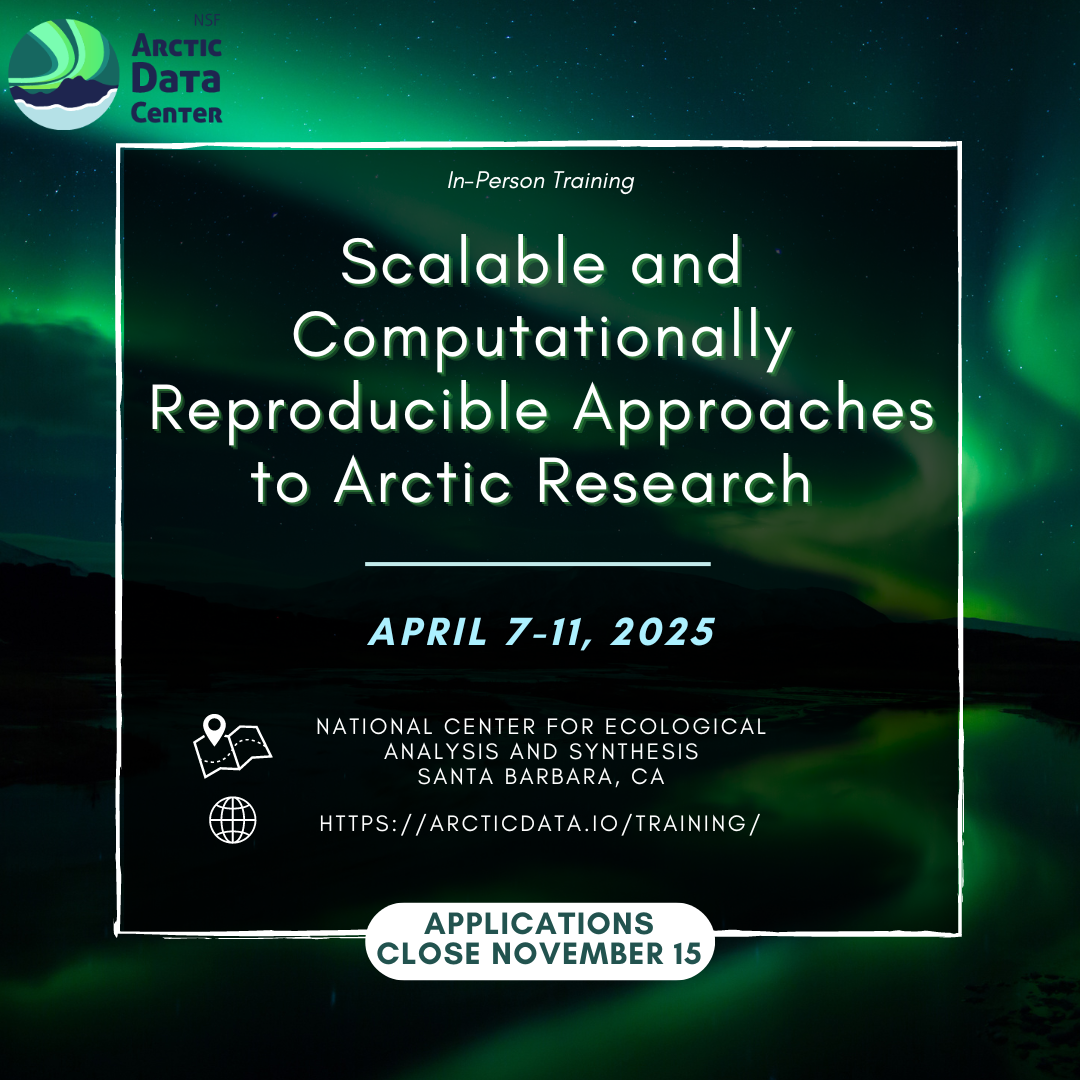
The Arctic Data Center has applications open for their 5-day, in-person "Scalable and Computationally Reproducible Approaches to Arctic Research” workshop, taking place April 7-11, 2025. This workshop, held in Santa Barbara, CA, will provide researchers with an introduction to advanced topics in computationally reproducible research in python, including software and techniques for working with very large datasets. This includes working in cloud computing environments, docker containers, and parallel processing using tools like parsl and dask. Organizers welcome individuals participating in Arctic research with a wide variety of backgrounds, experience, and career stages to apply. However, this course is intended for Arctic researchers with a solid foundation in programming (R, python, or similar), who have a need to take their skills to the next level to maximize efficiency working with big datasets or running computing-intensive processes.
Limited support for travel is available. For more information, visit the course application. Deadline to apply is November 15, 2024.
| |
IARPC Public Webinar Series: Arctic Research Implementation Plan 2025-2026 Launch | |
November 21, 2024 | 9-10am AKT / 11am-12pm MT / 1-2pm ET
Please join IARPC for a webinar premiering the updated implementation plan for the Arctic Research Plan 2022-2026. This implementation plan provides specific actions that IARPC and its member agencies will take through 2026 to promote research aimed at improving community resilience and well-being, advancing scientific understanding of climate change and ongoing changes in the Arctic system, creating more sustainable economies and livelihoods, and improving risk management and hazard mitigation.
This webinar will provide an overview of what has changed from the previous implementation plan, what is continuing on, and how to get involved. To join this webinar, register via Zoom.
| |
|
Permafrost Grown: Building Collaboration for Sustainable Permafrost Agroecosystems
The Permafrost Grown Project was co-developed with farmers in the Tanana Valley and Bethel, Alaska to understand how permafrost-agroecosystem functions in this region. Project methodology includes installing a network of sensors and weather stations, conducting permafrost and soil analyses; using drones and remote sensing techniques, employing near-surface geophysics; on-farm agricultural experiments, interviews, participant observations, and surveys. The use of farm visits, socio-economic risk modeling and in-person workshops foster two-way learning between the research team and farm-collaborators.
Project objectives are: (1) Co-producing knowledge with farmers to understand permafrost and agriculture interactions and feedbacks, (2) documenting legacy effects of farming over the last ~120 years, (3) evaluating the socio-economic trade-offs and providing decision-making tools for farmers, and (4) utilizing education and outreach activities to broaden public and farmer participation to advance knowledge and foster opportunities for improved food security in the North.
Project farmer-collaborators reported that the primary problems they face related to permafrost thaw are changes to surface water flow, problems with fencing, and thaw subsidence. Some farming operations have been affected by declining crop yield, damage to equipment, and increasing cost and effort to farm, which often caused abandoning whole or parts of fields.
Permafrost Grown is co-developing management strategies and a best practice guide for farmers cultivating on permafrost-affected soils. On-going work to develop these guides includes testing crops, monitoring permafrost and ground temperatures between uncleared and cleared land, and common season extension practices (e.g. plastic mulches). Permafrost Grown is contributing to sustainable agricultural development practices in high latitude areas.
For more information, visit www.permafrostgrown.org or email project PI, Melissa Ward Jones (mkwardjones@alaska.edu).
|  | |
|
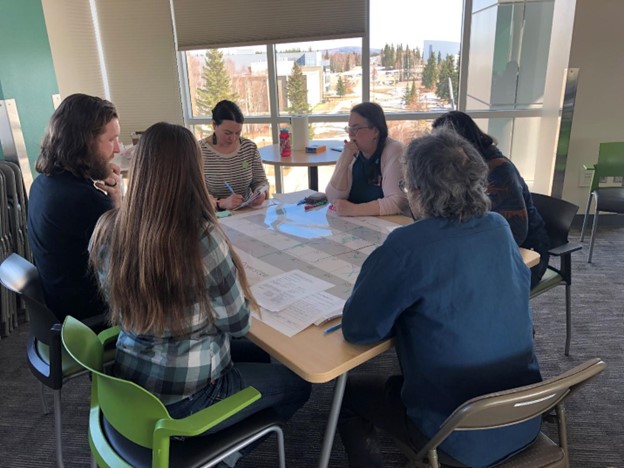
Top image: Farm-collaborators participate in a permafrost-degradation scenario game at a workshop in Fairbanks, AK in April 2024 where they had to farm an imaginary farm for six growing seasons.
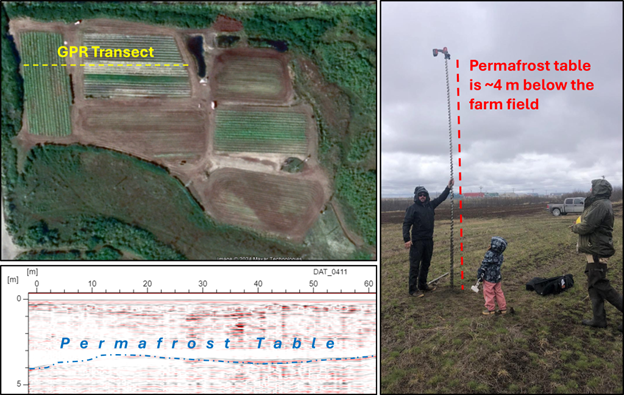
Bottom image: Top left shows GPR transect with the output showing the depth to the permafrost table (3 to 4 m) at a farm site in Bethel, AK. On the right shows team members drilling in the field to validate GPR results. This work is determining the rate of permafrost thaw since land clearing.
| |
Article and photos submitted by Melissa Ward Jones and project team. | |
Copyright © 2021 CIRES, All rights reserved.
The Navigating the New Arctic Community Office (NNA-CO) is jointly implemented by the University of Colorado Boulder, Alaska Pacific University, and the University of Alaska Fairbanks. The NNA-CO is supported through a cooperative agreement with the U.S. National Science Foundation (Award #2040729).
| | | | |