A Black family got their beach back — and inspired others to fight against land theft |
|
Danny Hajek, A Martinez, and Kelley Dickens, NPR |
|
OCTOBER 10, 2921 - Duane "Yellow Feather" Shepard stands at the top of a narrow park that slopes downward toward a lifeguard training center and panoramic views of the Pacific coast.
"We're looking over the horizon at a beautiful, beautiful ocean," Shepard says. "It's blue, serene — it's quiet. It's just a gorgeous, gorgeous view."
For Shepard, this oceanfront park known as Bruce's Beach — located in Manhattan Beach, Calif., just south of Los Angeles — holds a painful history. "This is the land that our family used to own," he says.
|
|
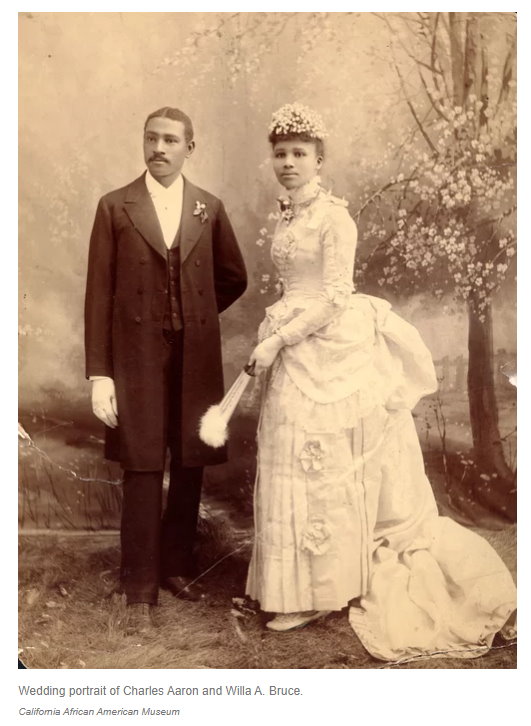
Shepard's ancestors, an African American couple named Charles and Willa Bruce, owned this land a century ago. The couple built a beachfront resort called Bruce's Beach Lodge in 1912 and welcomed Black beachgoers with a restaurant, a dance hall, and changing tents with bathing suits for rent.
But the Bruces were run out of Manhattan Beach and forced to shut down their successful resort. Their property was seized by the city, and they lost their fortune. For years, the land was owned by the county of Los Angeles — until last month, when California passed a law that allowed the property to be transferred back to the couple's descendants.
The historic Bruce's Beach case is inspiring social justice leaders and reparations activists to fight for other Black families whose ancestors were also victims of land theft in the United States.
|
|
A Black resort faced harassment from white neighbors
Shepard, a cousin of the direct descendant of Charles and Willa Bruce, says Bruce's Beach offered a refuge for Black patrons during the Jim Crowe era.
"There weren't many areas where Black people could get into the water along the entire coast of California at that time," Shepard, 70, tells NPR. He's a clan chief of the Pocasset Wampanoag Tribe of the Pokanoket Nation.
"[Bruce's Beach] was a place where people could have social functions," he says. "You had Black entertainers, actors and actresses, jazz artists, Black politicians as well as business owners and socialites."
|
|
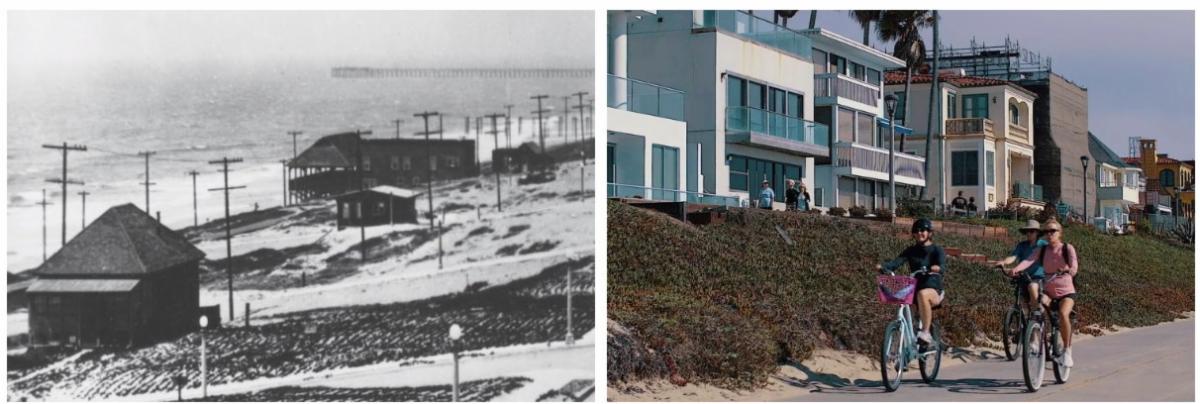
Bruce’s Beach in 1915 and in 2021
Credit: Manhattan Beach Historical Society; Bethany Mollenkof for NPR
|
|
However, some white residents of Manhattan Beach feared an "invasion" by the African American community, according to local historian Robert L. Brigham's 1956 Fresno State master's thesis Land Ownership and Occupancy by Negroes In Manhattan Beach, California. White residents set up barricades to keep Black beachgoers from getting to the ocean, and the Ku Klux Klan, active along the California coast, reportedly planned attacks against the Bruce's resort.
"They slashed tires, they burned mattresses under the porch of the resort, they tried to blow up a gas meter of one of the residents here," Shepard says. "They had 24/7 phone campaigns and made threats against Willa and her family."
The city of Manhattan Beach seized the resort
In November 1923, a white realtor named George H. Lindsey approached Manhattan Beach's Board of Trustees with an option to condemn Bruce's Beach through the Park and Playground Act of 1909, according to an April 13, 2021 report by the Bruce's Beach Task Force, a resident-led task force appointed by the Manhattan Beach city council last year.
By 1924, Manhattan Beach city officials invoked eminent domain, claiming the city would build a public park over 30 lots, including the Bruces' land and four other lots owned by African American families.
Bruce's Beach resort was shuttered and demolished, and the property sat vacant for decades. Willa and Charles Bruce requested $120,000 for both damages and the value of their property, but the city granted them $14,500.
Today, the two parcels of land are worth an estimated $75 million.
On Sept. 30, California Gov. Gavin Newsom signed SB 796, authorizing the county to transfer the land back to the Bruce family after nearly 100 years.
On Tuesday, the Los Angeles County Board of Supervisors voted unanimously to begin the process of transferring the land. That process will also include confirming the Bruce's rightful heirs.
"Today, we're making history," Newsom said at the ceremony held on Bruce's Beach. "I'm proud to be here, not just for the descendants of the Bruce family, but for all of those families torn asunder because of racism."
|
|
Two African American couples stand on a walkway at Bruce's Beach, Manhattan Beach, circa 1920. Miriam Matthews Photograph Collections, Library Special Collections, Charles E. Young Research Library, UCLA |
|
Black landowners have faced eminent domain abuse for generations
Bruce's Beach stands as just one example of land theft that's taken place across the United States through violence, intimidation and legal maneuvers. For generations, Black landowners like Willa and Charles Bruce have been victimized by eminent domain abuse and unjust property laws.
"One of the reasons why the Bruce's case has been generating so much attention is because it represents the first instance in the history of the United States where an African American family or community that had their property taken unjustly, ended up having it returned," says Thomas W. Mitchell, a property law scholar at Texas A&M University. He's worked to reform discriminatory policies that have stripped African Americans of their land.
Mitchell is part of a research team called the Land Loss and Reparations Research Project, which is trying to put an economic value on agricultural land unjustly taken from Black farmers over the last hundred years.
"Our research team has come up with a preliminary estimate of $300 billion," Mitchell says, noting that it only accounts for the farm land itself. "We're also going further and saying that as a result of losing this land, we lost the ability to benefit from the land ownership in terms of families getting loans to send their children to college, which then has a negative impact on economic mobility — and that's just Black farmers."
Mitchell estimates the total loss of generational wealth for Black Americans across the U.S. falls into the trillions.
|
|
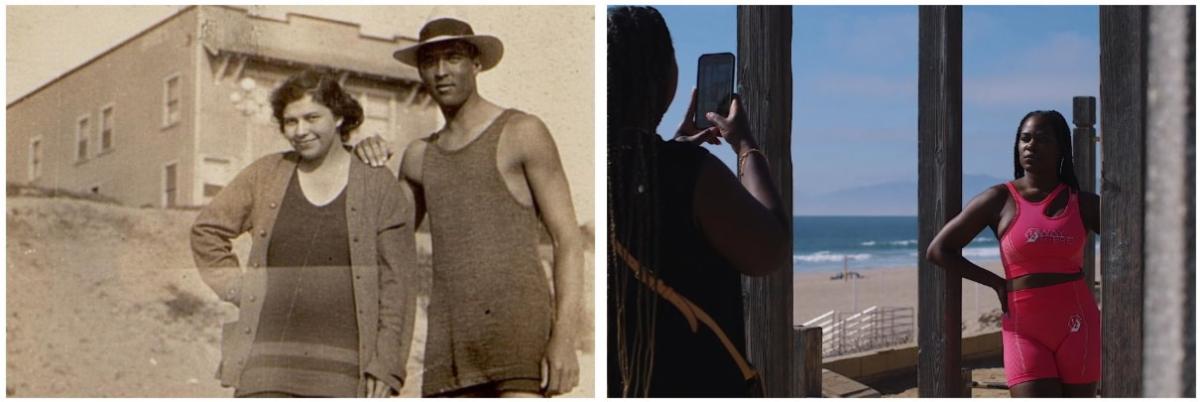
Louise and Byron Kenner at Bruce’s Beach, Manhattan Beach circa 1920. Fitness coach Jasmine Dobbs poses for a photo on the walkway of Manhattan Beach in 2021.
Credit: Miriam Matthews Photograph Collections, Library Special Collections, Charles E. Young Research Library, UCLA.; Bethany Mollenkof for NPR
|
|
But families such as the Bruces whose property was taken generations ago don't have legal recourse to get their land back, Mitchell says. Statutes of limitation restrictions prevent families from successfully filing lawsuits.
Mitchell points to the Tulsa Race Massacre of 1921 in Tulsa, Okla., when white mobs tried to destroy what was known as Black Wall Street.
"Yes, there was a state commission. Yes, it did do a detailed report. Yes, that detailed report documented tremendous and horrible abuses and killings and burning of businesses and taking of property," he says. "But it didn't lead to one penny — it didn't lead to a single property being returned."
Bruce's Beach had a different outcome because the government actually stepped in to make amends for a historical wrong. The California legislature passed a law allowing for the land to be given back to the Bruce family, making it a unique case.
"Is the Bruce's Beach case a recognition that the time has come for real racial justice in this country?" Mitchell asks. "Can this serve as a template for providing effective redress to other African American families who have had their property taken unjustly? We'll see."
Activists are trying to help other Black families reclaim their land
During the signing ceremony in Manhattan Beach, Newsom recognized activist Kavon Ward as the driving force behind the Bruce's Beach movement. Advocating for the Bruce family led to the founding of her organization called Where Is My Land, dedicated to helping Black Americans reclaim stolen land and secure restitution.
"I informed the [Bruce] family that I would do anything in my power to help them," Ward, 39, tells NPR. "Not only to get restitution for their loss of civil rights — their loss of business enterprise, but for me, I felt like justice was getting their land back."
At about the same time on the opposite coast, in Philadelphia, Pa., 43-year-old Ashanti Martin was on a similar mission. The two were introduced through a mutual friend — and together, Ward and Martin co-founded Where Is My Land. Both say they were compelled to take action after the murder of George Floyd on May 25, 2020.
"I read about George Floyd's ancestor Hillery Thomas Stewart who back in the late 1800s had owned 500 acres of land in North Carolina, and that land was stolen by white farmers," Martin says. "I think there's no question, had George Floyd's ancestors kept that land in their family, his life outcomes would have transformed."
Through their organization, Martin and Ward are fielding dozens more requests from African American families across the U.S., hoping to reclaim their land.
"I don't think that we can handle all of this within my lifetime," Ward says. "It took a long time for the land to be stolen — it didn't happen overnight. And so getting it back is going to take even longer because there's so many obstacles and road blocks in the way. And so the only thing we can do is to make sure we're dealing with this, one family at a time."
As for the Bruce family, they say they won't move to Manhattan Beach or build on the land that's now being returned to them. Instead, they'll rent the lifeguard training center back to the County of Los Angeles.
Shepard, their descendent, says reclaiming Bruce's Beach was just the first step. Now, he says his family will continue their fight for restitution for the loss of revenue over the past 97 years.
|
|
One reason for supply shortages: No one to drive the trucks
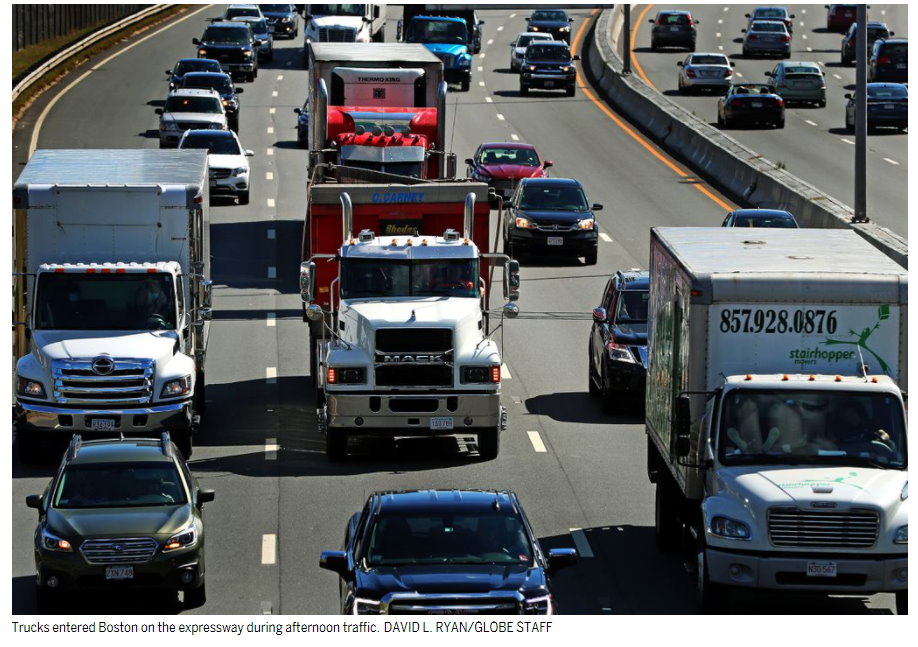
Exploding demand for deliveries during a demographic shift is driving a nationwide deficit of truckers
By Angela Yang Globe Correspondent
|
|
OCTOBER, 2021 - Local coffee shop constantly out of your favorite ingredient lately? Can’t find what you’re looking for at the store? Packages arriving late?
The problem might be as simple as having too few people to drive the stuff around.
A shortfall of truck drivers is one factor clogging every facet of the supply chain right now, and Massachusetts is feeling the impact. It’s not a new problem, industry experts say, but like so much else, the global pandemic has made it worse.
It’s even affecting America’s oldest county fair.
This year, the Trucking Association of Massachusetts had hoped to participate in a Touch-a-Truck event Friday at the Topsfield Fair, parking a truck there for kids to climb on and play around. But executive director Kevin Weeks said his group had to back out. They couldn’t spare a driver.
One reason, Weeks said: The need for trucking just “exploded” during the pandemic, with all the online shopping from consumers working from home.
Then there’s the impact of the pandemic on truck drivers themselves, who skew older..
Sharing a truck with another driver — who has spent hours in the cab on the previous shift — always posed some risk, Weeks said, especially for older folks more vulnerable to COVID-19. And while the association lobbied for truckers to move up in the vaccination line, it and other trucking groups were largely unsuccessful.
With many rest stops closed during the early stage of the pandemic, truck drivers also struggled to find places to shower and sleep along their routes. Dining options were limited, too: Many fast-food restaurants shuttered indoor ordering, and 18-wheelers aren’t built for a drive-through lane.
Through it all, Weeks said, truckers were working “probably more than they want to work” while trying to stay within safety guidelines that dictate the maximum number of hours they can drive. The combination of these dilemmas has pushed some drivers to leave the industry or retire early.
|
|
“Nobody wants to put anybody in harm’s way, whether it’s the driver or the contents of the truck or certainly the vehicles and the people that are around them,” he said. “So it’s difficult, and they’re coping as best they can, delivering as much as they can as quickly as they can. But the fact of the matter is it takes longer to get things now.”
And as older drivers age out of trucking, younger ones aren’t replacing them fast enough. Qualifying to be a commercial driver requires a lot: a stellar driving record and passing background checks, drug testing, and a slew of other requirements. And the long-haul life’s not for everyone; turnover among newly minted drivers is high.
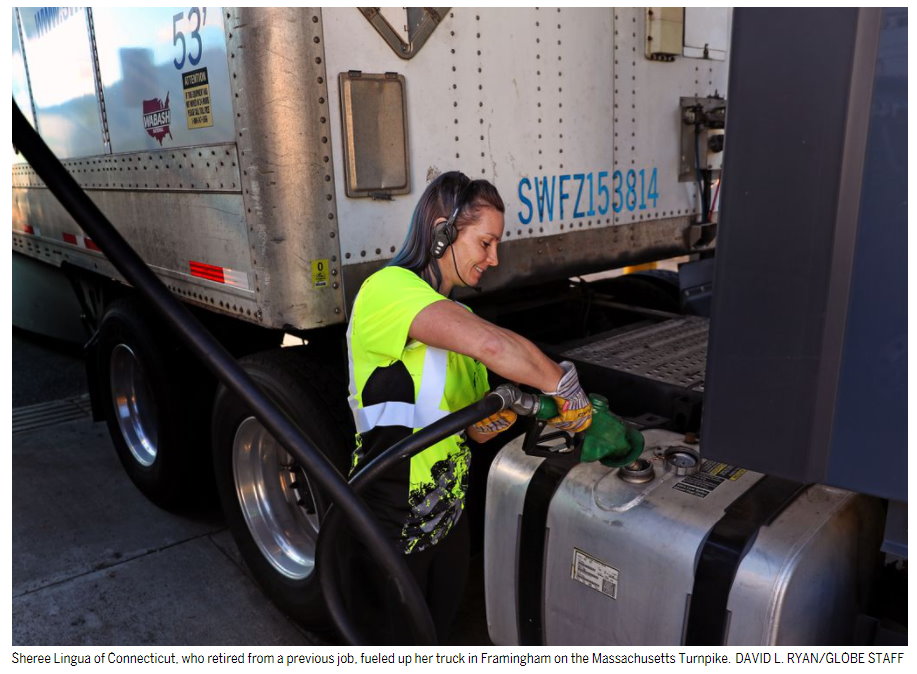
Gerard Geise, 62, has been behind the wheel of his tractor trailer since the 1980s. He said he makes a good living, but the job is stressful. Not only are more cars on the road, but there’s less camaraderie among drivers now than in decades past.
“Back in the ‘80s and ‘90s, you would stop to help people on the side of the road and you would ask for help and not have any problem getting it,” Geise said. “These days, it’s really difficult to even get to know people and it just seems like [a] very backstabbing kind of mentality.”
And Geise is driving more since the pandemic began, often working 14 hours at a time — the maximum he’s allowed to log without taking a break. Meanwhile, trucking companies have begun offering retention bonuses in hopes of getting drivers to stay.
While Geise plans to give it another five years, he said other drivers have found it increasingly difficult to love the trade like they used to. Larger companies tend to treat their drivers as “just a number,” Geise said, and increased government regulation, such as an electronic device that logs drivers’ hours, has made the work environment more unpleasant.
“Before, you worked as you needed to. If you were tired, you could stop and take a nap,” Geise said. “Now, you’re kind of racing a clock and don’t have any breaks throughout that day other than maybe a half an hour or so.”
The latest census counted more than 3.5 million truck drivers in the United States — an all-time high — but the American Trucking Associations reported in 2019 that the industry will need to add about 1.1 million drivers this decade to keep up with demand. That’s even before the pandemic touched everything.
Still, there are young workers who seem eager to join the industry, according to Mark Greenberg, president of New England Tractor Trailer Training School. He said the school’s enrollment rates remained steady throughout the pandemic, helped by public relations efforts to remind communities about the economic importance of trucking.
“It’s still a fun opportunity for people to enter an industry that gives them freedom of individuality and no direct supervisory oversight. That’s very appealing to some people,” Greenberg said. “Obviously, it’s a bit challenging, but it does offer some great opportunities to literally see the country and be independent while you’re doing it.”
|
|
IRMA: MY LIFE IN MUSIC
The documentary repeats Sunday, October 17 at 5:30 pm on WYES!
TWYES-TV will broadcast and stream a new documentary on the life and career of GRAMMY Award-winning artist Irma Thomas. The 90-minute program is produced by Michael Murphy Productions with the New Orleans Jazz & Heritage Foundation and will include an extensive interview with Irma herself.
|
|
The documentary will also feature archival and new interviews from many of her colleagues including record producer Scott Billington; producer and director of the New Orleans Jazz & Heritage Festival Quint Davis; former GRAMMY Awards telecast producer Ken Ehrlich; recording artist Erica Falls; recording artist and actress Ledisi; singer and songwriter Bonnie Raitt; creative director of Preservation Hall Ben Jaffe; pastor of the Nazareth Baptist Church Reverend Marc A. Napoleon; musician, songwriter and record producer, the late Allen Toussaint, and his children Alison Toussaint-LeBeaux and Reginald Toussaint; and Recording Academy Membership & Industry Relations representative Reid Wick.
Watch it on WYES-TV, wyes.org/live and on the WYES and PBS apps. It repeats Saturday, October 9 at 8pm and 9:30pm; Sunday October 17 at 5:30pm.
IRMA: MY LIFE IN MUSIC is written and directed by Cilista Eberle and Michael Murphy.
|
|
Would you like these programs and events to continue?
|
|
“The New Orleans Jazz & Heritage Festival and Foundation, Inc. promotes, preserves, perpetuates and encourages the music, culture and heritage of communities in Louisiana through festivals, programs and other cultural, educational, civic and economic activities.” |
|
Apply for an account online
At Liberty Bank, we're passionate about helping more people achieve more freedom.
There's real freedom here-the freedom you have as an individual to attain your goals, as a business to achieve your idea of success or even as a community that is gathering strength to reach its full potential.
By investing in the development of personal goals, business objectives and communities, we're making a difference by making the word "bank" a verb rather than a noun, using our resources to get things done.
We work hard. Play hard. Invest where our heart lives. And pursue freedom for all.
Trust Liberty Bank. There's freedom here.
|
|
The National Urban League
The mission of the National Urban League movement is to enable African Americans to secure economic self-reliance, parity, power and civil rights.
|
|
Marc H. Morial, President & CEO
|
|
EXCELLENCE INNOVATION RESPONSIVENESS
Metro Service Group, located in New Orleans, Louisiana is a multi-faceted corporation with specific expertise and certifications in the areas of Environmental Services, Construction/Demolition and Disaster Response and Recovery. Metro Service Group is a licensed Contractor, certified in Building Construction; Heavy Construction; Highway, Street and Bridge Construction; Municipal and Public Works Construction and Solid Waste Management.
|
|
Stephanie Jordan
"Lady Jazz!"
"Every so often a new voice stands up and proclaims itself, but few do so
with such supreme depth and understated soul."
- Ted Panken, Jazz at Lincoln Center Playbill
|
|
Jazz Vocalist Stephanie Jordan is a proud user of Audix Microphones!
Available for Bookings:
Vincent Sylvain
504-232-3499
Vincent@SylvainSolutions.com
|
|
Pick It Up New Orleans!
An Anti-Litter Campaign by
The New Orleans Agenda and Metro Service Group
|
|
Your Alternative Newsletter - News, Arts, Culture & Entertainment |
|
Newswire Service
The New Orleans Agenda newsletter is the leading local alternative for information on New Orleans and the Gulf Coast Region. A provider of turnkey Web-Based Internet Marketing Services, we specialize in servicing community and faith-based entities, corporate and professional organizations, and arts & cultural interest events.
The New Orleans Agenda newsletter has received more than 12 Million Page Views!
Let us introduce you to our audience.
#TheNewOrleansAgenda
|
|
Public Relations
The Internet has fundamentally changed the way we do business with our customers. As such, 21st Century promotion requires a balance of e-technology with the art of persuasion. Using years of Web experience; the latest best-practice approaches; a responsive support system; and a proven database; market share is optimized.
We implement creative customized communication campaigns designed to impact our clients' specific goals. We have a history which is unmatched and unparalleled; while diverse in our experience we specialize in the following areas:
- Internet Marketing / Web Development
- Media Relations
- Political Campaign
- Public Policy
- Entertainment Promotion & Special Events
- Earned/Free Media Placement.
Vincent T. Sylvain, President
The New Orleans Agenda
Expert Solutions for Your Communication Needs!
|
|
Opinions expressed on this mailing are not necessarily the views of The New Orleans Agenda, POLICAMP, Inc., or Vincent Sylvain unless explicitly stated.
Copyright © 2015. All Rights Reserved.
|
|
The New Orleans Agenda | 5627 Paris Avenue, New Orleans, LA 70122 |
Email: Vincent@SylvainSolutions.com
|
|
|
|
|
|
|