Celebrating National Rural Health Day | | Happy National Rural Health Day! Today we celebrate rural communities across the country and the people and providers who show up every day to make a difference.
National Rural Health Day (NRHD) was established in 2011 by the National Organization of State Offices of Rural Health (NOSORH) to recognize and honor the individuals and communities who work every day to support and strengthen rural health across America. We're proud to join NOSORH in recognizing the Power of Rural. | | |
The 2026 NRTRC Telehealth Survey results are now available! This year’s results provide a comprehensive look at telehealth utilization, access, and sustainability across the country, highlighting the Northwest. This year, NRTRC separated the survey into behavioral health (BH) providers and non-behavioral health providers (nonBH). Our BH providers submitted just over SEVEN times as many surveys as non-BH providers!
The 2026 NRTRC Telehealth Survey results may be accessed here; please note that there are three summaries: NRTRC Telehealth Survey 2026 All Respondents, NRTRC Telehealth Survey 2026 Behavioral Health, NRTRC Telehealth Survey 2026 Non-Behavioral Health
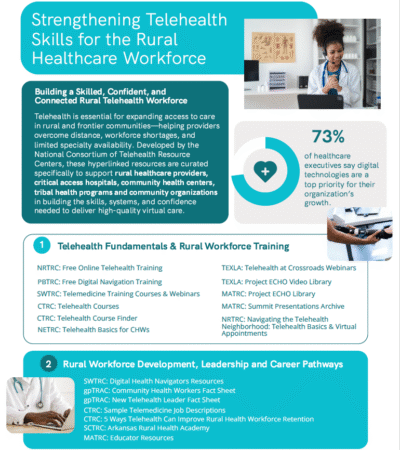
| | A New Resource from the NCTRC on Strengthening Telehealth Skills For The Rural Healthcare Workforce is Available | | |
This resource, created by the National Consortium of Telehealth Resource Centers (NCTRC), compiles hyperlinked training materials, tools, and technical assistance resources in one convenient place to help rural healthcare organizations build telehealth workforce capacity. Organized into eight key areas, it covers telehealth fundamentals, workforce development, clinical best practices, patient engagement, technology and innovation, emergency preparedness, reimbursement and sustainability, and regional support. The resource is designed to help rural providers strengthen telehealth skills, expand access to care, and deliver high-quality virtual services.
View the workforce resource. View all NCTRC resources.
| |
2027 Physician Fee Schedule: New Telehealth Billing Requirements
| | |
CMS released the CY 2027 Physician Fee Schedule Final Rule on November 4. Starting January 1, 2027, two new claim modifiers will be required on certain telehealth claims:
- BB—Claims for telehealth services furnished through a telehealth virtual platform by a physician or practitioner who contracts with the entity that owns the platform, or who has a payment arrangement with an entity to use it
- BC—Telehealth services furnished incident to a physician’s or practitioner’s professional services)
CMS noted in the rule that “Guidance on use of these modifiers will be available on the CMS website.” We checked, and that guidance is not currently posted. In addition, a face-to-face or telehealth visit will be required before remote patient monitoring (RPM) or remote therapeutic monitoring (RTM) can be billed for a new patient.
For a broader look at how telehealth rules are evolving state by state, see the CCHP Fall 2026 findings on the changing shape of state telehealth policy.
| |
DEA Prescribing Deadline: December 31, 2026
| | |
Temporary DEA flexibilities for prescribing controlled substances via telemedicine expire on December 31, 2026. The DEA’s special registration rule, which would create a longer-term pathway, is still under White House review and has not been finalized.
This deadline is especially timely for behavioral health and substance use disorder programs that rely on telehealth to prescribe controlled substances. Now is a good time to review your prescribing workflows and plan for how services would continue if the flexibilities lapse before a final rule is in place.
For more detail, see Telehealth.org’s overview of the special registration rule and the Dec. 31 deadline.
| | ACCESS Model Update: How Your Feedback Is Shaping Our Resources. | | |
Thank you to everyone who shared feedback on the ACCESS Model last month. Your responses are helping NRTRC develop practical tools for organizations exploring participation and for educators preparing the next generation of healthcare professionals.
The Advancing Chronic Care with Effective, Scalable Solutions (ACCESS) Model is a 10-year CMS initiative that ties Medicare payments to health outcomes for eligible people with Original Medicare receiving technology-supported care for chronic conditions. What stands out to us is the opportunity to support patients between visits. ACCESS Participants can extend the reach of existing care teams by helping patients track their progress at home and work toward their health goals.
A nurse educator at Seattle Pacific University suggested we include materials educators can use with nursing and other health professions students in our ACCESS resources. In our follow-up, we outlined how nurses can help patients use home monitoring tools, review readings, and coordinate follow-up with the care team. We’ll include examples like these in our ACCESS readiness and planning resources so educators can show students what team-based chronic care looks like between visits.
What would help your organization or educational program prepare for ACCESS? If you haven’t responded yet, we’d love to hear your questions, concerns, and ideas. Share your feedback through our short ACCESS form.
ACCESS Webinar—Worth a Listen. On November 6, 2026, Manatt Health hosted the webinar The CMS ACCESS Model: Advancing Technology-Enabled Chronic Disease Care. The first 15 minutes cover what it takes to become an ACCESS participant, and the remaining 45 minutes feature a panel of current ACCESS participants. We appreciated the passion and commitment they bring to supporting both patients and the primary care and other clinicians who refer them. The panel discussion provides a window into the true potential of the ACCESS Model.
| | Rural Health Transformation Program: Year 2 awards announced | | |
On November 9, HHS and CMS announced $10 billion in Year 2 awards to all 50 states. FY2027 awards for our region:
-
Alaska: $272.7M
-
Idaho: $182.7M
-
Montana: $239.7M
-
Oregon: $197.3M
-
Utah: $191.9M
-
Washington: $177.1M
-
Wyoming: $207.2M
Montana received the third-highest award nationally, along with the third-highest increase from Year 1 to Year 2. Idaho’s award, by contrast, is a reduction from its first-year funding.
Mark your calendar: State budget revisions tied to the new allocations are due to CMS by November 30. See more information and resources on the NRTRC Website.
| |
Women’s Health in the Spotlight: Three Ways to Get Involved | |
Share Your Voice: AI & Women’s Health Survey.
How do women in the U.S. use AI for health information, especially reproductive health? Researchers at the George Washington University Milken Institute School of Public Health want to know! This anonymous online survey takes about 15 minutes and is open through December. Participants can enter a raffle for one of several $25 gift cards. Open to U.S. residents who are over 18 and identify as women.
| |
Utah Women Wanted: Pelvic Floor Care Interviews.
Expect is piloting an AI-enabled pelvic floor physical therapy pathway, now officially authorized by the State of Utah. They’re seeking Utah women for confidential 30-minute Zoom interviews about accessing pelvic floor care and what they’d want from an at-home option. Participants receive a $50 gift card, and rural Utah voices are especially welcome. Please share with friends and community groups!
| |
Funding Alert: $1M HHS/HRSA Opportunity for Women’s Preventive Care.
HRSA has opened the Women’s Initiative for Screening and Health (WISH) program, offering up to $1 million to establish a multidisciplinary coalition that will update the Women’s Preventive Services Guidelines and share them with communities with limited resources. The work advances priorities in Executive Order 14437. Applications are due January 8, 2027 via Grants.gov (HRSA-27-072).
| |
Join the Weekly Didactic for the University of Washington's (UW) TelePain Program
| | |
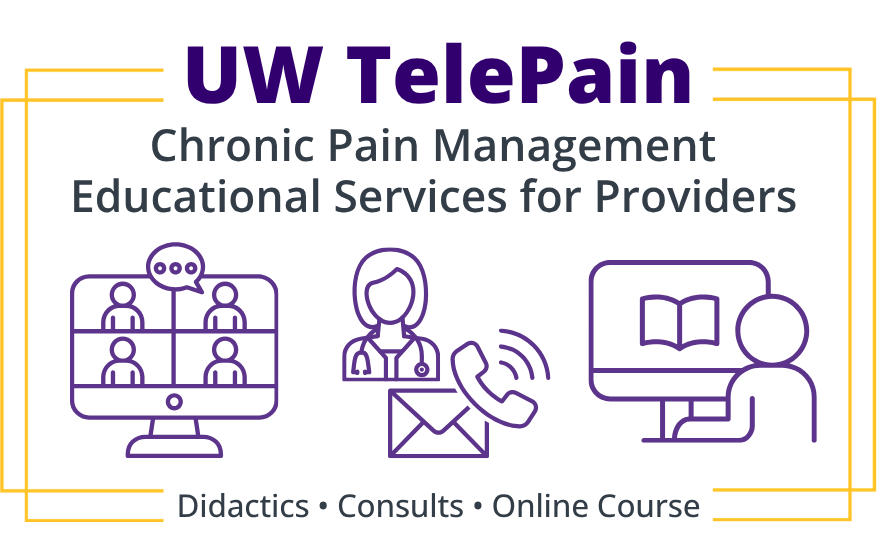
UW’s TelePain is a free Zoom-based weekly series offering pain education and consultation for community providers. Brief expert presentations and case discussions with an interprofessional specialist panel build knowledge and confidence in managing complex chronic pain.
Sessions are held every Wednesday, alternating between Didactics with Case Discussion (11:30 a.m.–1:30 p.m. PT / 12:30–2:30 p.m. MT), and Office Hours (12–1 p.m. PT / 1–2 p.m. MT).
The session agenda and weekly schedule can be found on the UW TelePain website. Providers can earn CME/CNE by attending live sessions or by viewing past didactics in the UW TelePain Recorded Didactics Library.
UW TelePain Series Live/Enduring Sessions (OT2606)
Credit Offered: AMA PRA Category 1 Credit™; Nursing Contact Hours; Interprofessional Continuing Education (IPCE) credit. Full accreditation information can be found at: https://bit.ly/telepain.
| | |
November
NCTRC Webinar - TeleICU Services to Monitor Critical Care Patients
November 19 12:00 p.m. - 1:00 p.m.
Organizer: National Consortium of Telehealth Resource Center
The Problem: Rural and Frontier Critical Access Hospitals (CAHs) face severe structural disparities, including a critical shortage of board-certified intensivists and high-level medical equipment. This frequently forces the premature or risky transfer of unstable, critically ill patients to distant urban tertiary medical centers. The TeleICU Intervention: By leveraging advanced telecritical care systems—including real-time multiparameter telemetry, synchronized ventilator monitoring, and 24/7 high-definition audio-visual feeds—off-site intensivists can directly co-manage patients alongside local, on-site bedside nurses.
TeleBehavioral Health 2026: Assessment of Cognition in Older Adults
November 20 12:00 p.m. - 1:00 p.m.
Organizer: University of Washington Behavioral Health Institute
TeleBehavioral Health 2026 Training Series is a free twelve-part webinar series open to anyone providing services to individuals who live with mental health and substance use issues. This Zoom-based series takes place the third Friday of each month, January through December 2026, from 11 am – 12 pm (PT). You are invited to attend all webinars, but you will need to register for each webinar separately.
December
TeleBehavioral Health 2026: From Text to Touch: Managing Professional Boundaries in Modern Healthcare
November 20 12:00 p.m. - 1:00 p.m.
Organizer: University of Washington Behavioral Health Institute
TeleBehavioral Health 2026 Training Series is a free twelve-part webinar series open to anyone providing services to individuals who live with mental health and substance use issues. This Zoom-based series takes place the third Friday of each month, January through December 2026, from 11 am – 12 pm (PT). You are invited to attend all webinars, but you will need to register for each webinar separately.
| | Do You Provide Healthcare or Services via Telehealth? | | Northwest State Telehealth Networks | | |
Northwest Regional Telehealth Resource Center
This publication was made possible by grant number UiUTH42531-04 from the Office for the Advancement of Telehealth, Health Resources and Services Administration, DHHS
| | | | |