|
In spring 2024, the California Education Lab at the University of California, Davis, partnered with the California Cradle-to-Career Data System (C2C) and the California Student Aid Commission to document the experiences of high school seniors. The web-based survey was sent via email to all seniors statewide who completed the Free Application for Federal Student Aid (FAFSA) or California Dream Act Application (CADAA) in spring or summer of 2024.
The recently released report presents survey responses from 11,238 graduating high school seniors, offering insights into their post-high school plans, college application experiences, and financial aid processes. The survey primarily includes students intending to attend college and does not capture those who did not attempt or were unable to apply for financial aid via the FAFSA or CADAA.
The 2024–25 FAFSA cycle was particularly notable due to major federal changes aimed at simplifying the application process by linking it to IRS income data. However, rollout challenges resulted in fewer applications compared to the previous year. Given these circumstances, the survey provides a unique snapshot of high school seniors navigating the transition to college.
The latest report is packed with valuable data, covering everything from college plans and attitudes toward higher education to high school experiences and expectations for college. Findings are broken down by student background, offering a deeper look at how different groups navigate these key transitions.
One standout section, “Many Students Enrolled in College Coursework While in High School,” highlights the growing impact of dual enrollment—a program that allows high school students to take college courses, often through partnerships with local community colleges or universities. Since the launch of College and Career Access Pathways (CCAP) in 2016, participation has surged. In fact, 22.2% of California’s 2022 high school graduates took at least one dual enrollment course, nearly 10 percentage points higher than the class of 2016.
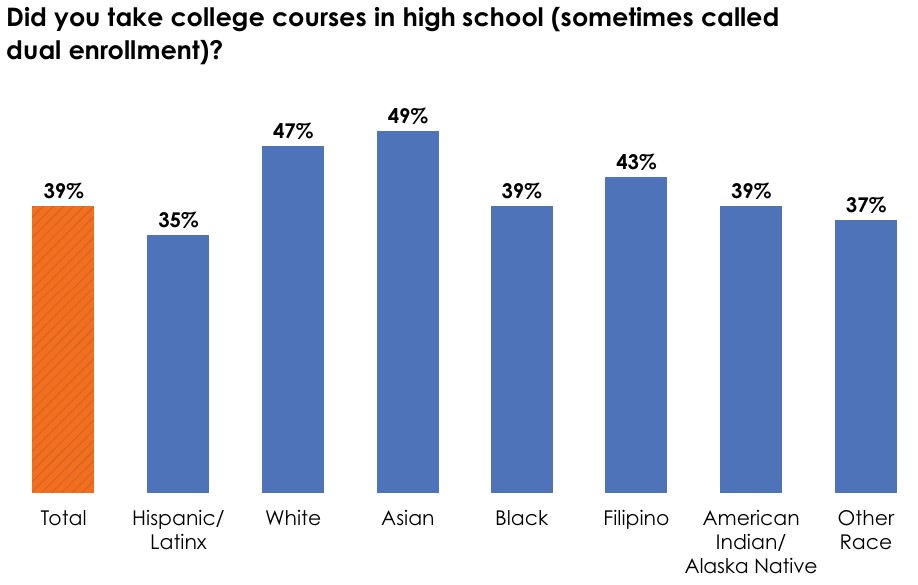
Among the class of 2024 survey respondents, 39% reported taking dual enrollment courses, while 52% did not, and 8% were unsure. Because this survey primarily includes students planning to attend college, it provides a unique opportunity to dive deeper into dual enrollment trends.
However, despite its growth, racial and ethnic disparities in dual enrollment persist. White, Asian, and Filipino students were more likely to participate compared to Black, Hispanic/Latinx, and American Indian/Alaska Native students. These gaps stem from multiple factors, including access to information, support with applications, course availability, and scheduling challenges. Addressing these barriers is key to ensuring all students have equal opportunities to get a head start on college coursework.
|