Newsletter

April 15, 2026

Quick Links


Our Website

Our Facebook Page

ISMTA

MTNA

April General Meeting

Monday, April 20, 2026

Rolling Meadows Library and Zoom Meeting

Mtg ID: 896 1963 3607

Passcode: 219505

Click here to join via Zoom

Click here for the March General Meeting Minutes

Upcoming Events

APRIL


PROGRAM

Svetlana Belsky

"BACH'S FRENCH SUITES: MUSIC AS LOVE LETTER AND LESSON"

Monday, April 20, 2026

Rolling Meadows Library and Zoom

9:45 A.M. Meeting


Monday, April 20, 2026

Deadline: Teachers Musicale


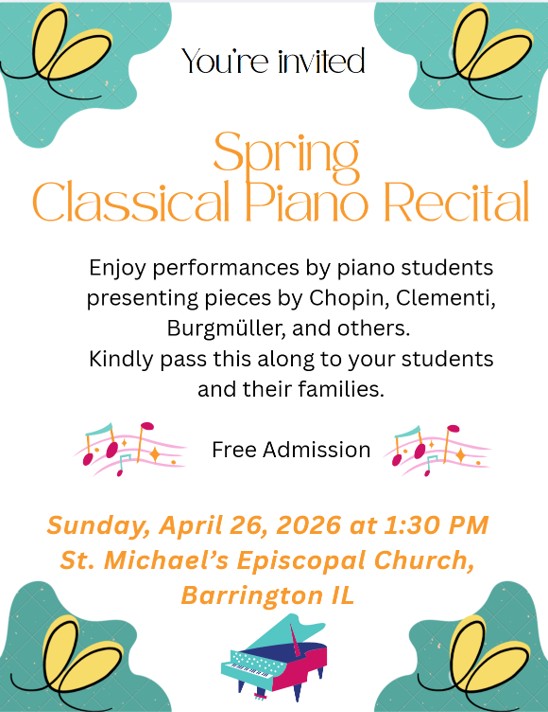
SPRING CLASSICAL RECITAL

Sunday, April 26, 2026

St. Michael’s Episcopal Church

647 Dundee Ave, Barrington

1:30 p.m.


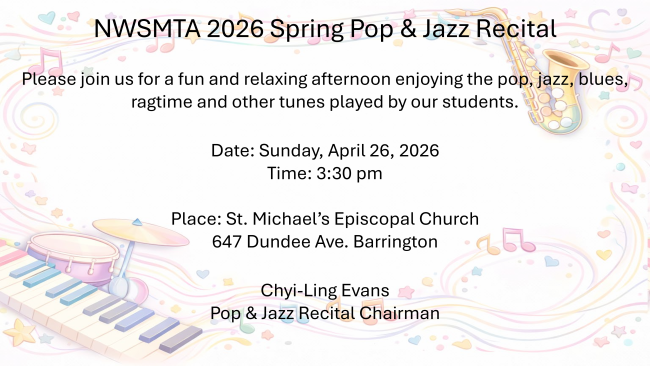
SPRING POP & JAZZ RECITAL

Sunday, April 26, 2026

St. Michael’s Episcopal Church

647 Dundee Ave, Barrington

3:30 p.m.


MAY


Friday, May 1, 2026

Deadline: Music Camp Scholarship

Send entries to Suyi Su, 313 Dundee Road, Barrington Hills, IL. 60010


Friday, May 1, 2026

Deadline: College Scholarship

Send entries to Suyi Su, 313 Dundee Road, Barrington Hills, IL. 60010


TEACHERS MUSICALE

Monday, May 4, 2026

Rolling Meadows Library

10:00 A.M.


Monday, May 4, 2026

Deadline: Annual Report/Budget Request Forms Due for 2026 events


LUNCHEON / BUSINESS MEETING

Monday, May 11, 2026

10:45 A.M. Followed by Lunch

THE GARDEN BERRY CAFE

440 W. Northwest Highway (Rte. 14 - East of Quentin Road)

Palatine, IL


PRESIDENT'S MESSAGE

To Attend or Not to Attend: Circumstances that Can Prevent Attendance at Professional Development Conferences


Lois Veenhoven Guderian, President NWSMTA


   In reflecting on the recent MTNA National Conference, besides a short report on the highlights of my experiences at the conference and takeaways, I include here some thoughts on the realities of access to professional development. In some previous articles I have written about the merits of professional development. Before embarking on my recounting of the sessions and performances I attended, I would like to acknowledge the plethora of reasons why individuals may decide not to attend a national conference in their field. 


Likely, family schedule and available funds are two of the primary reasons for not attending a national conference, especially when it is close to home. An educator’s teaching schedule – including their role in their family’s schedule and as caretaker of their own children, can be inflexible. Plus, national conferences are expensive. One must have a strong belief in the benefits of attending a conference to be willing to sacrifice earned income toward the cause. For private teachers, the cost can be a “double whammy:” the cost to attend plus the cost from lost income by not teaching for 3-5 days. In families, childcare and family schedule can add significantly to the cost of attending a conference. Finding reliable, loving care for young children while mom and/or dad attend a conference is not always possible. I remember well the challenges of trying to find caretakers for my own children when they were young. My husband and I had only one living parent and that parent worked and did not live close enough to us that day-care would be practical. Except for my husband’s brother, our siblings lived in different states and countries. The one sister-in-law was who lived somewhat close by was kind enough to help. However, she was not always available for childcare especially when it included overnight stays during the school year.


Thus, In the early years of our marriage, when I attended an MTNA national conference, I attended them with my whole family. We planned our annual vacation around it. My husband and children swam in the hotel pool, went sightseeing and hung out in the room while I attended sessions the entire day. Of course, we were not able to do this every year! On a few occasions, when my husband was not able to be with us and I was not able to secure childcare, my children attended local conferences and workshops with me. Sometimes my preschoolers sat on a blanket on the floor next to my chair playing with toys, coloring, drawing or looking at books. Amazingly, they never caused a disturbance. I expected them to behave and they did; plus, they often found some of the content of the workshop interesting. There were never out of my sight. On one of our family ventures at the MTNA conference, my baby daughter and I ran into a pregnant Gayle Kolwalchyk. I believe I had my daughter in a baby carrier. Gayle was very taken with seeing a baby at the conference. The next year, she was at the conference with her baby girl in a carrier. After that point in time, we always recognized each other at conferences and were on friendly terms.


Was it a good idea to have my children at a conference with me? I do not know nor would I recommend it to anyone. For me, I believed so strongly in the merits of professional development, I felt that I did not have a choice. I needed to be there. In advance, I also had a good idea of how my children would react to the experience. Thankfully, there were many aspects of the experience they enjoyed similar to a “Take your child to work day.” They also received attention not only from me but from other attendees. My children never complained about attending nor have they mentioned it in their adult life.

Besides childcare and funding for conference registration and hotel, there are other reasons that either keep or prevent individuals from attending a national conference. If a conference is not local and is several states away from home, travel and lodging will be additional costs. Dependent on the policy of a college or university, at times, professors are able to apply for whole or partial funding to attend a conference – especially if they are going to be a presenter at the conference. Private studio educators do not have that opportunity. However, an organization might fund individuals serving in particular officer roles; or, the organization might offer professional development grants to support attendance at a conference as does our NWSMTA group. Since the establishment of the NWSMTA professional development grants in 2025, this is definitely an opportunity that members can tap and I hope that many will this year and in the future.

More reasons an individual may choose not to attend a conference: At times, a conference will appear not to have enough connection to an educator’s work or perhaps the conference theme holds no interest for them. Perhaps they have studied the conference schedule and found too few sessions to make it worth their while. Still other educators might feel that they know everything they need to know to keep their work and business going. Still others might recognize that they have already attended many sessions on the same or similar topics in the past.

As an educator and their family age, health and older children family responsibilities also become a substantial reason for not attending a conference. Sometimes, it is just impossible.  

With all these possible reasons, challenges and more for not attending, it is good to not give up on the thought of attending a conference in the future, and good to remind ourselves of two of the most important reasons for attending a conference: 1) professional growth and refreshment of mind and spirit. No matter how educated and experienced an individual might be, there are always new things to become aware of whether it is a new program, idea, approach to teaching or initiative. 2) Networking within one’s own local group and within the greater circle of those in the profession. There is no question as to merits of new and renewed friendships and the bonds that are made from them.


There were approximately ten NWSMTA members who attended the conference. I do not know how many of us were able to attend the full four and a half days of the conference. However, the few times our conference schedules crossed paths and we were able to spend time together were bonding experiences. Such experiences support our personal and collective endeavors in our field and in our local association.


This year, I was not able to attend the full four and a half days of the conference so I made every minute that I was able to attend, count. Below I share a few experiences, highlights from the conference sessions I attended, and key take aways that I hope you will find interesting and useful. I carefully planned my schedule and the sessions I would attend in advance of the conference.


Sessions


Upon arriving at the conference at 8:02 AM, I immediately ran into old friends in the lobby. That was a great start to my day. Soon thereafter, I preceded to the registration area and then to the first session I had planned to attend – a commercial presentation on new publications by the Willis Music Company. The company had advertised a new publication of pieces by William Gillock. An admirer of Gillock’s writings for piano teaching and learning, I was interested to become acquainted with the new collection of pieces for beginners. I bought a copy of The Easiest Gillock Pieces for my grandchildren and was delighted to become aware of Gillock’s 3 Jazz Preludes, intermediate level piano. I bought a copy for an adult student who has loved learning Gillock’s three books of New Orleans Jazz Styles pieces.

Next, I attended a session Untangling Copyright: Navigating Legal Hurdles in Music Creation, Performance, and Promotion. This was an excellent session for individuals who are looking to make their composed or authored works available to the world and have no experience in how to go about it. The session was loaded with pages worth of information. Having worked with the U.S. Copyright Office, publishers and lawyers closely during the last 25 years, there was very little new information for me personally. However, I was very glad for the review and reinforcement of knowledge and that I could even contribute a couple of important points at the end of the discussion: Namely, to protect your creative work and to have the right to make decisions about it, the first step in the endeavor is to register the work in the Copyright Office. Establishing “rights owner” status on your work secures your right to collect royalties. As rights owner, if you are offered a deal by a publishing company,  you can still sign over your rights to a publisher if you want to make that decision.

The third session I attended was Memory and Music: Empowering Older Piano Students by Amy Glennon. I was glad to pick up an more strategies for working with older students. The clinician showed the audience how to mark hand positions and patterns in the music right on the keyboard with colored sticky notes. For memory purposes, the student is able to take a visual picture of their hands on the and move from one section in the music to another eventually becoming free from looking at the score. Another strategy was to make a musical map of the score by marking off the patterns, sequences and other events in the music in color to help the memorization process.

The next session I attended was Unlocking South American Rhythms in Piano Repertoire. The young presenters not only provided visuals of rhythms from folk and dance music and related these to specific classical piano works, but they also performed them.  The performances were most enjoyable. The session is a good reminder to pianists to research the background on a piece, and to look for connections and influences surrounding its creation. Becoming familiar with the sounds of the “musics” of the culture is invaluable to the learning and performing of classical works written by composers of that culture.

Another very interesting multicultural presentation that included stunning performance examples of duets for advanced players was Melodies of Home: Cultural Inspirations in Piano Duet Repertoire. The beautiful duets were inspired by the cultural legacies of China, Argentina and Australia.

Since my working area during the last two and a half years has included the teaching of musicians who were educated under the RCM Certificate Program, I was interested in attending The RCM Certificate Program: Decoding the Evaluation Process. Several of the individuals I work with have completed various levels of the RCM performance and theory programs. To increase my knowledge of my students’ backgrounds and how to increase my understanding of how to support them in their learning, I followed up on this conference session by visiting the RCM Booth for further examination of RCM publications. This was also interesting to me in comparison to my work with the AIM Voice Syllabus and as an adjudicator for National Piano Guild. If you are interested in becoming an adjudicator for the RCM, you can go to their website and contact them about going through their training program for adjudicators.

For the higher education and high school students who I teach and/or mentor, that is, those who hope to pursue music careers in one or more of the music industry professions, I attended the session Pop Star Pedagogy: Teaching Keyboard Skills to Songwriters and Music Producers. Having been engaged in this kind of teaching for twenty years, there was not a substantial amount of new information for me at this session. However, there are always new insights to be gained from any session. What was excellent to me about this session was the organization of the information and also the generalizations about the musical characteristics of individuals who are drawn to this aspect of music making. For example, educators who work with young people who want to pursue careers in music production should realize that many of these individuals are aural and pattern-oriented learners first. The important adage, “sound before sight” must be an ongoing and vital aspect of the approach to teaching them and in keeping their interest and engagement in the learning processes. Another important aspect to remember, for these industry bound music students, a computer is their primary instrument – not a piano, guitar or some other instrument. Important to their success is teaching these students how to interface their keyboard skills and lessons in theory with what they create in their choice of DAW (Digital Audio Workstation) using programs like Logic, Garageband, ProTools and others. Becoming fluent in playing chords and their inversions and cadences in all keys supports their ability to create and harmonize melodies and create tracks for producing their music.

During lunch I roamed through the exhibits looking to become familiar with new companies and technologies. I enjoyed visiting the Sproutbeat booth and speaking with the creator of the program, Eik Mar. Some of you may remember Jennifer Cohen’s presentations for NWSMTA and the ISMTA last fall that included the Sproutbeat program as an excellent resource and companion for the AIM program. I will have Sproutbeat cards available for NWSMTA members with more information on the program at the NWSMTA April meeting.

The last session I attended was presented by the MTNA Representation and Advocacy Committee, We Have a Dream: the MTNA of the Future. The committee brought up topics that I have been passionate about for more than 20 years – how we can better interface with schools and communities in educating the children and youth in our country while at the same time, in mutually beneficial ways, support private educators means to make a living as professional musicians. Some of you may remember my session on the very topic in November of 2024. Needless to say, I was happy to contribute ideas and experience to the discussion at this session.

The ending to this invigorating day of professional development was a dinner that included almost all of the NWSMTA members who attended the conference. The dinner get-together did exactly what one would hope: it provided the opportunity for enjoyable conversations and bonding. After sitting at sessions all day, after dinner, some of us took a walk together around the city. The weather was perfect for it.

After dinner and the walk, together, we attended the Angela Hewitt concert in the large ballroom in the conference hotel. Angela performed complex works that required enormous technical ability and the ability to memorize and perform such works all on the same concert program. It was a very difficult program to pull off – and she did! It was an outstanding experience to witness and hear her performance.

Partita No, 5 in G Major, J.S. Bach

Sonata No. 2 in G minor, Op 22, Robert Schuman

From the Sixieme Ordre, Francois Couperin

Le Tombeau de Couperin, Marice Ravel

Was my investment of even one day and evening of jam-packed conference attendance worth it? Absolutely! It goes without saying. Wishing you many of the same kinds of experience as you live through the years of your careers.

APRIL PROGRAM - SVETLANA BELSKY

"BACH'S FRENCH SUITES: MUSIC AS LOVE LETTER AND LESSON"

The French Suites are singular among Bach's works -- they were not written for either performance or publication, but as a gift to his young bride Anna Magdalena, as some combination of teaching aid and love letter. The music is filled with love and humor, as well as the grief of a recent widower. In our teaching and performance, therefore, we should strive to create expression that is beautifully expressive -- following the suggestions of historically informed performance practices. This talk will introduce the dances as they were understood by Bach and his contemporaries and suggest keyboard techniques to make them come to life. We will also discuss the changed understanding of rhythmic notation, dynamics, phrasing and articulation.


Critically acclaimed as “a passionate pianist and scholar,” Svetlana Belsky is a highly regarded performer, noted for her remarkable rapport with audiences and stylistic versatility. Her recent albums, Into Darkness: Piano Music of 1910-1920 (Sheridan Music Studio, 2021) and Ferruccio Busoni: The Late Works (Ravello, 2019) were selected by Spotify for its Best New Releases list, and received rave reviews from Fanfare, American Record Guide, Whole Note Magazine, and others, and has been heard on radio stations around the world. Dr. Belsky won the 2019 American Prize in Piano Performance for her earlier recording of Stravinsky’s Rite of Spring, which American Record Guide described as “an extraordinary performance” and “astounding”. In commemoration of Women’s History Month 2019, Dr. Belsky was awarded the Outstanding Woman Award for Excellence in Music and Theater Arts from the Clerk of Cook County District Court. Dr. Belsky has toured in Europe, East Asia, Canada and throughout the United States. Her performance credits include Carnegie Recital Hall, Kiev Philharmonic Hall, Dame Myra Hess Series, live recitals on Chicago’s WFMT and New York’s WQXR, and guest appearances with symphony and chamber orchestras. Belsky is considered an authority on the music, writings and pedagogical legacy of Ferruccio Busoni. Her Doctoral Thesis - an annotated translation of Busoni as Pianist by the Russian musicologist Grigori Kogan, was published by the University of Rochester Press in January 2010, and was nominated for the prestigious Claude V. Palisca Award by the American Musicological Society. According to one reviewer, Belsky “has some claim to call herself Ms. Bach-Busoni”. Born in Ukraine, Belsky received most of her education in the United States, first as a student of Emilio Del Rosario in Chicago, receiving her Bachelor’s (summa cum laude) and Master degrees at the Peabody Conservatory in the studio of Ann Schein and her Doctorate at the Manhattan School of Music with Nina Svetlanova. Dr. Belsky served as the Director of Piano Studies at the University of Chicago for fifteen years, and is in great demand as a lecturer, masterclass guest teacher, and competition adjudicator.

TEACHERS MUSICALE

grand piano

“The time has arrived to register for the long awaited Teachers Musicale! Come join us for a time of sharing wonderful music with each other. You’re welcome to perform or just support your fellow members by attending. Register to attend and/or perform today by completing the online form found on the Teacher Musicale Page in the For Members tab. The Registration deadline is Monday, April 20, 2026.”

MY FIRST MTNA CONFERENCE - JUSTYNA WEIRICH

This past March, I attended my first MTNA conference hosted in Chicago. With it being my first time attending at this level, I truly wanted to experience everything, immersing myself in new ideas, connecting with my peers, and gaining insight that would shape my growth as a musician and educator. I also had the chance to connect with composers while engaging with fellow teachers and peers in meaningful ways. The variety of master classes introduced me to new approaches and perspectives, and the energizing environment left me feeling inspired, motivated, and excited to keep growing.


While attending the conference, I was able to experience a variety of learning sessions, masterclasses, and even two whole recitals! My first experience of the event was an intermediate master class led by Nancy O’Neil Breth. Conveniently, the class focused on O’ Polichinelo by Villa-Lobos, a piece I am currently working on with my students, which made the experience even more meaningful. Hearing a perspective on the piece besides my own was incredibly helpful, and Breth shared useful teaching techniques for understanding technically challenging phrases and bringing the music to the next level.


As an educator, I always want what is best for my students, so I decided to attend a class led by Penelope Roskell, called, “Can Every Student Be Taught to Play Musically?”. The part of the session that stayed with me most was reflecting on our role as piano educators and what we can truly do to help our students reach their full potential. It emphasized the importance of connecting with students, understanding what inspires and motivates them, and encouraging their artistic independence by supporting their own musical choices. I especially loved the idea that “music is an art of sound and motion,” which reminded me to approach teaching in a more expressive and student-centered way.


The first event I attended on Tuesday was a beautiful recital performed by Svetlana Belsky and Elena Doubovitskaya on, “From Ukraine With Love, Works for Piano Duet”. The program celebrated Ukrainian music and culture, featuring pieces that are not widely known. Even though it was a shorter recital, the music was incredibly engaging, full of energy and character. Each piece felt inspiring and expressive, telling its own unique story and leaving a strong impression on me.


However, the best session was by far, the last. “Like a Chef That Creates a Stupendous Meal, How Do Teachers Help Their Students Foster Artistic Personality at the Piano?” by Helen Marlais helped open up my eyes to the history that lies behind each and every piece that we play. Marlais taught us how introducing our students to the lives of the composers, and the era in which they lived, can completely transform a performance. She emphasized analyzing a piece before even starting to play it, practicing rhythmic discipline by clapping the rhythm before performing, and using composers’ own writings to guide students’ interpretations on their pieces. We also explored using good and bad examples of musicality and having our students guess the difference, which will make learning both engaging and memorable. Her happy, uplifting personality made the session fun and I left thinking I would love to be her student myself!


Attending my first MTNA conference was an incredibly inspiring experience that gave me new ideas, practical strategies, and renewed motivation as both a musician and educator. It was also a great opportunity to connect with my peers, sharing stories and experiences that highlighted just how much creativity and care go into teaching. Every session, recital, and interaction left a lasting impression, and I feel energized to bring what I’ve learned back to my students. Thank you to the Northwest Suburban Music Teachers Association for allowing me to experience such a lovely event, I would be thrilled to attend again in the future.


— Justyna Weirich

SPRING CLASSICAL PIANO RECITAL

Registration for the 2026 Spring Classical Student Recital is now open. Enrollment is accepted on a first-come, first-served basis, so early registration is strongly encouraged. Please note that only online registrations will be accepted.


Before registering your students, carefully review all rules and procedures. Complete details are available on the Northwest Suburban Music Teachers Association website under Student Activities – Student Recitals or click the links below.


1. Link to the online registration form:

https://www.nwsmta.org/classical-recital-entry-form.html


2. Link to the Rules and Procedures:

https://drive.google.com/file/d/1TB2xFtIPWByNqjbPJRWiJGw9_jyoWO9B/view


Any questions? Contact: 

Michelle Ho - mycmichelle.mk@gmail.com

Elizabeth Lieberman - ejuleslieberman@gmail.com

SPRING POP & JAZZ RECITAL

NWSMTA MAY 11 MEMBER LUNCHEON

As our NWSMTA members and guests come together to celebrate the nearly final event of a meaningful and successful ‘25/‘26 year for all of our members and our students, please mark your calendars now and join us at:


THE GARDEN BERRY CAFE

440 W. Northwest Highway (Rte. 14 - East of Quentin Road)

Palatine, IL


The Business Meeting will begin at 10:45 am with the luncheon to follow.

MTNA CONFERENCE EXPERIENCE - MAUREEN FLOOD

MTNA Conference Experience


The 2026 MTNA Conference was exciting, inspiring, invigorating — just what I needed to get my enthusiasm for teaching piano revved up! I was a little surprised by so many sessions there were on Artificial Intelligence, because I think music is so personal and human!   But, AI is here and we all must adapt.  Some sessions concentrated on piano students using AI to improve their practicing and solve problems. And piano teachers can use it for lesson planning, choosing repertoire, and writing studio policies. 


The most useful session I attended was one by Clinton Pratt: “Let’s Make Something Up — A Universal Approach to Improvisation.”  He gave some very practical ideas on learning and teaching improvising, that a teacher can utilize immediately — and I have! He offered some parameters, such as familiar rhythms, in children’s songs like London Bridge and Skip to my Lou, and wrote out those rhythmic patterns. Then he gave types of accompaniment to use, with 3-4 options for texture, pattern, rhythm and register, and demonstrated how we could have a student improvise a melody over a teacher’s accompaniment, using just 1 note, or just the black keys, just the white keys with 1 flat, or an F blues 5-finger scale. He demonstrated each and allowed teachers to experiment.   He also gave accompaniment options for black keys improv, as well as for the 12-bar blues. 


Mr. Pratt said that instead of being afraid of improvising, that we should JUST DO IT….JUST PLAY MUSIC!!! And, like speech and language, we can learn to read and write it later. He reminded us that we are already improvising every time we have a conversation.  We are using words and phrases in different combinations, which he likened to using the musical language that we are familiar with as we create patterns and phrases.  He offered more chord progressions to use with minor scales, and Dorian, Lydian, and Mixolydian modes, whole tone scales, circus music, Japanese music, and even scary music and sound effects. 


In the past, when I have attended workshops on improvisation, I’ve found it intimidating, as jazz musicians seem to talk quickly and throw out chord names and flat 9ths, etc. — and it always hard to visualize when you are sitting and listening. So this workshop was very helpful to me because it was hands-on, and I was able to go home and apply all of his parameters and work easily with my students!


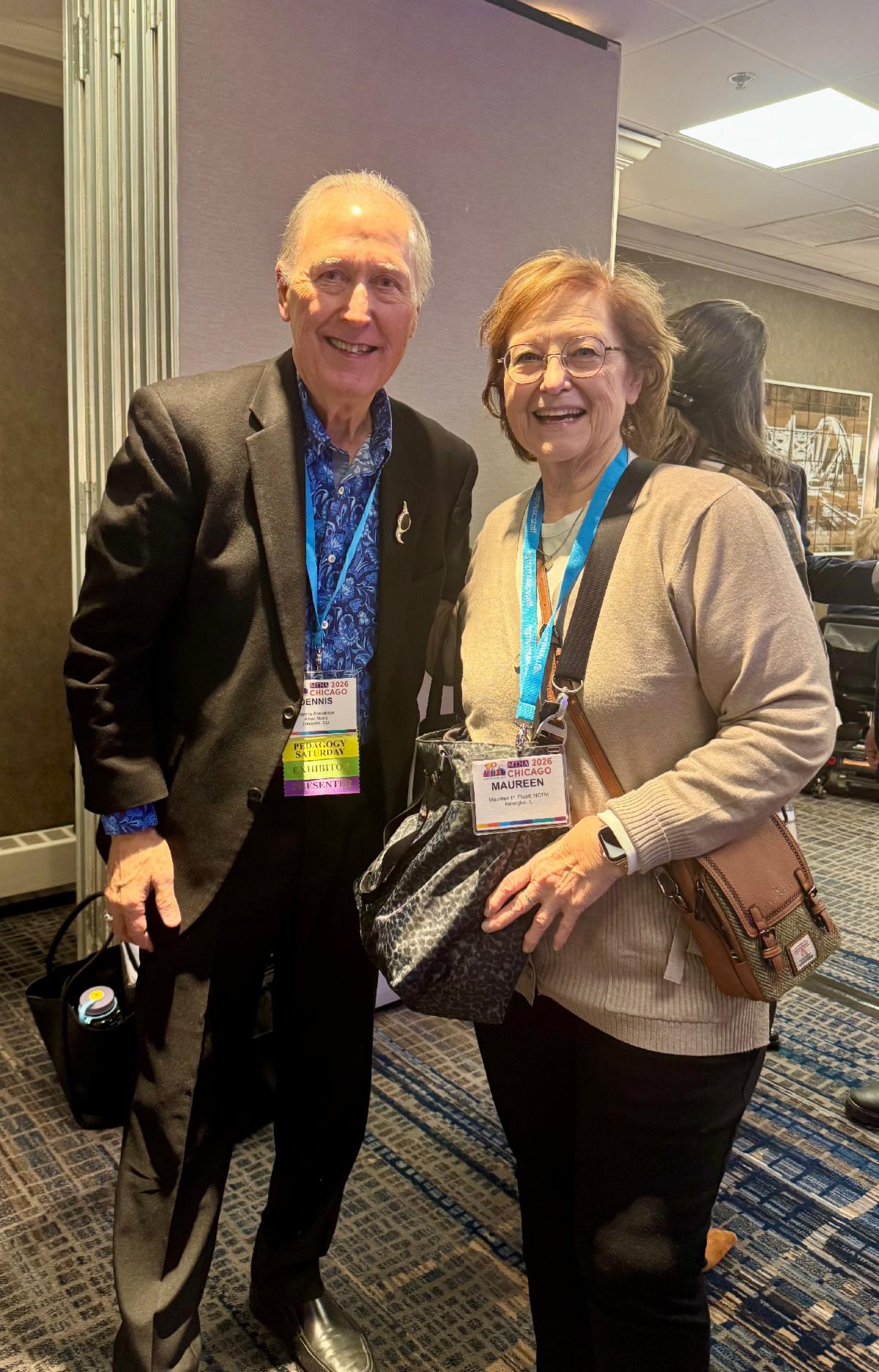
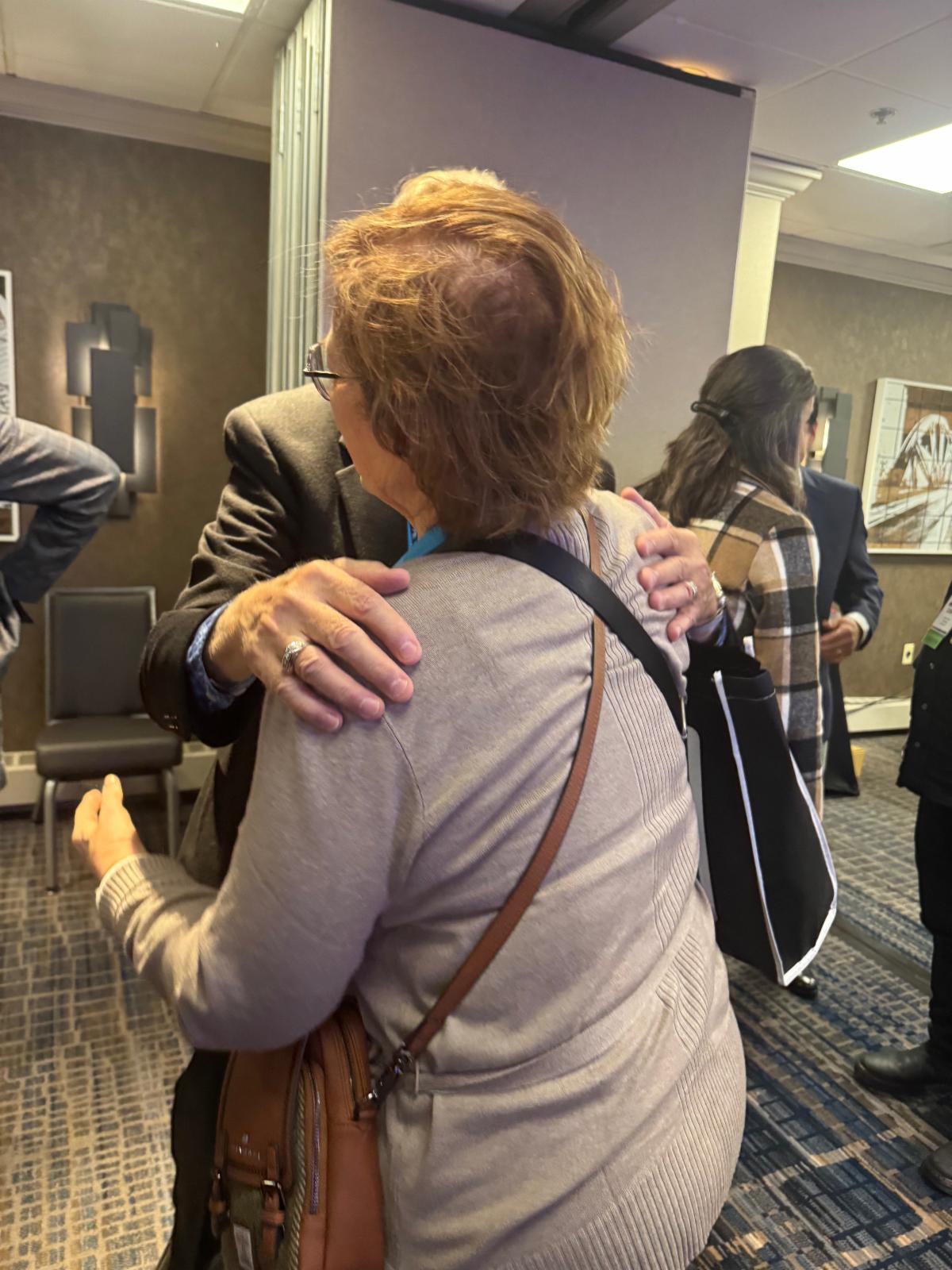
And I have to add a picture of the high point (for me) of the conference — getting a hug from and a photo with Dennis Alexander!! I have several older adult students who absolutely LOVE his music, so I wanted to share that with him. 


Maureen P. Flood

ALL THAT JAZZ

Registration for ALL THAT JAZZ is now open! 

This event is NWSMTA’s Jazz Combo Experience, in which students get to perform live onstage with a professional jazz trio backing them up!


It will take place on Father's Day, Sunday, June 21st, at 12 noon, at the

         House Of Music & Entertainment

         1227 N Rand Rd. Arlington Heights


All information, is available on our website at:

https://www.nwsmta.org/jazz-combo-experience.html


If you have questions, please contact:


Maureen Flood at mfloodamir@aol.com or 847-208-4518

Justyna Weirich at justyna.weirich@gmail.com or 847-322-4393

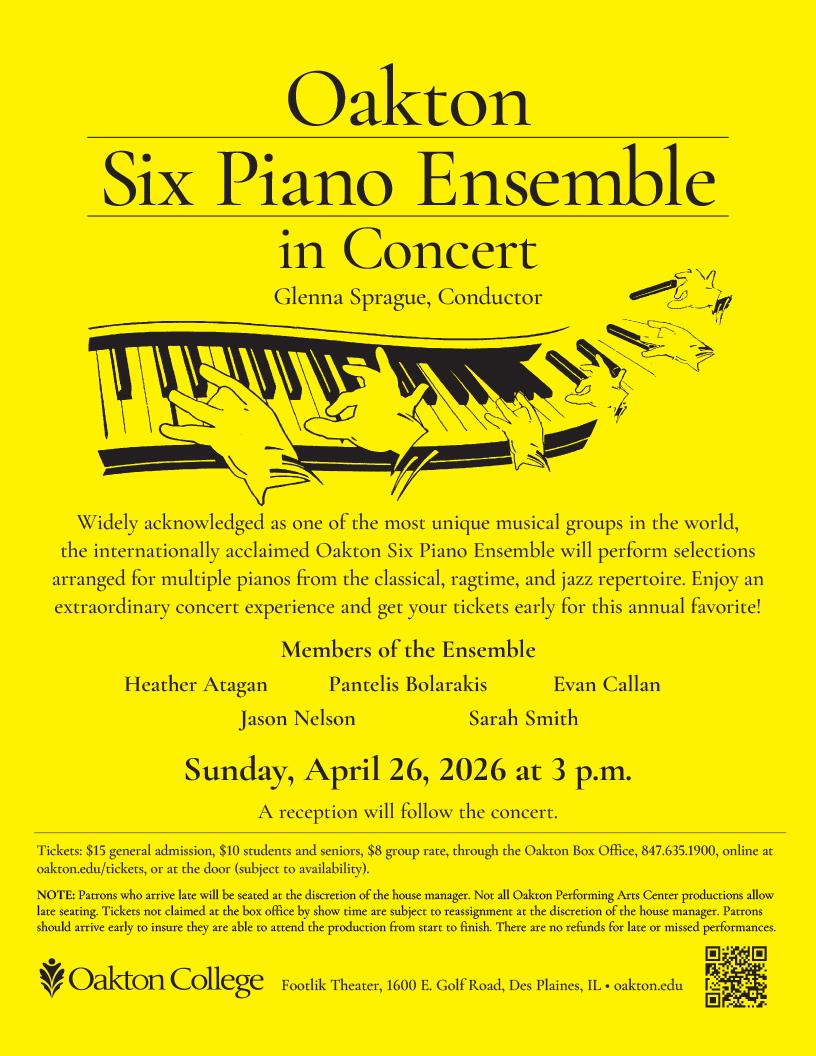
OAKTON SIX PIANO ENSEMBLE IN CONCERT

Oakton Six Piano Ensemble Concert April 26


The Oakton Six Piano Ensemble, conducted by Glenna Sprague, will present its annual concert on Sunday, April 26th at 3:00 p.m. in the Footlik Theater at Oakton College, 1600 East Golf Road, Des Plaines.


The group is founded by Glenna Sprague, Professor and Coordinator of Music at Oakton, where she also teaches piano.  Performing at multiple pianos, the group performs not only traditional classical piano music; but also, symphonic literature as well as ragtime, popular, and jazz music. Performing with a conductor, the rich, layered sound of the Six Piano Ensemble compares to that of an orchestra, with each member playing a different part of a composition as the melody transfers from pianist to pianist. This year’s concert features the following works: Samba triste from Four Piece Suite by Richard Rodney Bennett; Suite in C Minor for Two Keyboards by Handel; Sonata in D Major, K.381 by Mozart; Ain’t Misbehavin by Thomas Waller; The Strenuous Life Rag by Scott Joplin as well other selections.


Tickets are $15 for general admission; $10 for seniors and students; and $8 for groups. For ticket information, call the Oakton Box Office at 847-635-1900; order tickets online at www.oakton.edu/tickets or get tickets at the door (subject to availability).  A reception will follow the concert.


Widely acknowledged as one of the most unique music groups in the world, the Oakton Six Piano Ensemble has performed both internationally and throughout the United States, including the World Conference of the International Society for Music Education (ISME) at the Royal Conservatoire of Scotland in Glasgow; the College Music Society International Conference in Vienna, Austria; MTNA National Conferences in Atlanta and Spokane; numerous MTNA state conferences; National Conference on Keyboard Pedagogy in Chicago. Critics from Vienna to Glasgow hail the Ensemble as “extraordinary”, “technically superb”, and “musically innovative.”  

A NOTE FROM THE EDITOR

Dear NWSMTA members,


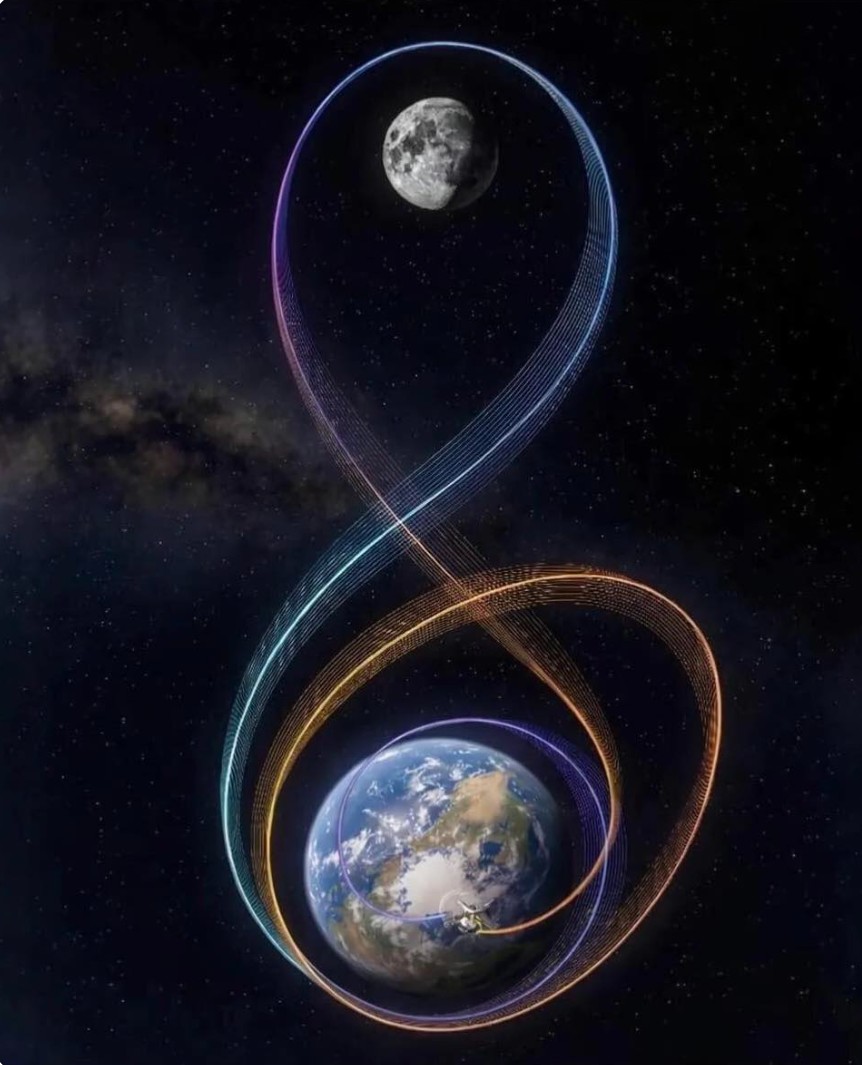
I saw Neil Armstrong take the first walk on the moon's surface. My grandchildren shared the opportunity to see the first Artemis 2 lunar flyby and the first close examination of the far side of the moon. When this picture was shared, I could not resist encouraging them to look closer for another, that they should recognize.... I was more than happy when they also saw an image that all musicians have recognized since before the first space flight. We have looked at it on our music scores everytime we play music that gives wings to allow our music to take flight.

Spring brings showers and flowers, sunny days, spring fever, and Spring Recitals. I took on six beginner students during a weak moment in January. I wanted to include them in my recitals, even though they dd not know what a recital is. I decided to have them come to a Meet and Greet class for first time performers. Since they are all beginners, their performance would be over in about ten minutes. I also realized they did not know each other, which would create an uncomfortable situation to perform in. My youngest student, who is four years old, asked if there would be treats at the Meet and Greet. She assured me she has no allergies. I remember when that was never an issue. A plan was starting to take shape. Parents would be included.


I needed an icebreaker, so I had each of the students introduce themselves starting with the youngest student. I then told the parents they also had a job to do. I had them practice their applause. It needed to be loud and long. It takes a bit longer for short students to get off the bench. I asked for a student volunteer to demonstrate a proper bow. The oldest student volunteered and gave a perfect bow.  Then I asked for another volunteer to demonstrate the wrong way to bow or get on the bench. That went over well. The ice was breaking. The order of performers was decided by drawing from a pouch containing the first seven letters of the alphabet. I used Scrabble letters. When in should have been E’s turn, no one moved to the piano. Since I had six participating, there was one extra letter. They had to try to figure out what happened. Finally, someone asked is there another letter in the bag?” The students were allowed to play whatever piece they wished to share. I arranged the piano bench and footrest for each child. This was so parents would see what the home situation should look like. After everyone had their chance to play, they were allowed to perform another selection. Anyone wishing to play a second piece could do so. The applause went on and on.


They seem excited for the real recital. 


P.S. Treats did indeed follow the performance.  


Deb Lynch

Newsletter Editor

Northwest Suburban Music Teachers Association | https://www.nwsmta.org
Facebook