Newsletter

March 14, 2026

Quick Links


Our Website

Our Facebook Page

ISMTA

MTNA

March General Meeting

Monday, March 16, 2026

Virtual Zoom Meeting

Mtg ID: 896 1963 3607

Passcode: 219505

Click here to join via Zoom

Click here for the February General Meeting Minutes

Upcoming Events

MARCH


VIRTUAL BUSINESS MEETING

Monday, March 16, 2026

Zoom

9:45 A.M. Meeting


MTNA NATIONAL CONFERENCE

Saturday-Wednesday, March 21-25, 2025

Chicago, IL


APRIL


AIM: LEVELS 1-2 COMPLETE AND LEVELS 10-12 PERFORMANCE EXAM JUDGE’S MEETING

Monday, April 6, 2026

Zoom

9:45 A.M.


Sunday, April 12, 2026

Deadline: Online Registration Spring Classical Recital


Sunday, April 12, 2026

Deadline: Online Registration Spring Pop & Jazz Recital


AIM: LEVELS 1-2 COMPLETE & 10-12 PERFORMANCE EXAMS

Sunday, April 12, 2026

Harper College


PROGRAM

Svetlana Belsky

"Shall We Dance? Teaching J.S. Bach’s French Suites"

Monday, April 20, 2026

Rolling Meadows Library and Zoom

9:45 A.M. Meeting


Monday, April 20, 2026

Deadline: Teachers Musicale


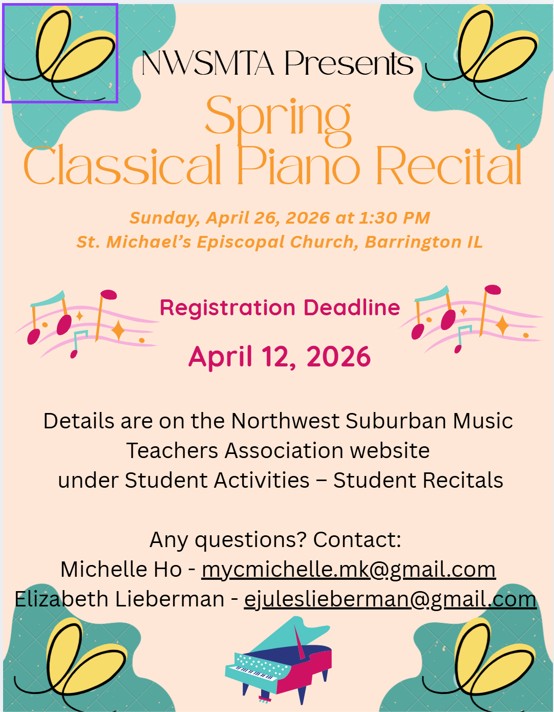
SPRING CLASSICAL RECITAL

Sunday, April 26, 2026

St. Michael’s Episcopal Church

647 Dundee Ave, Barrington

1:30 p.m.


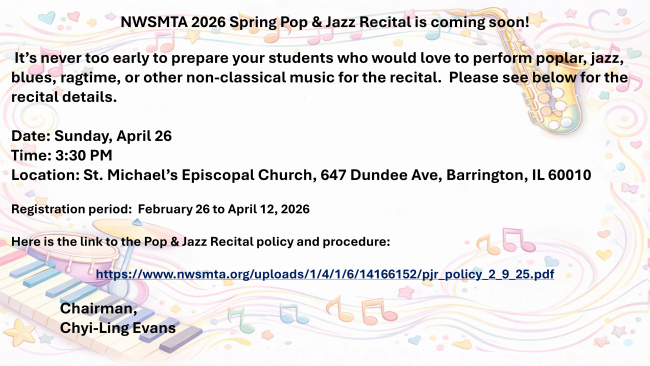
SPRING POP & JAZZ RECITAL

Sunday, April 26, 2026

St. Michael’s Episcopal Church

647 Dundee Ave, Barrington

3:30 p.m.


MAY


Friday, May 1, 2026

Deadline: Music Camp Scholarship

Send entries to Suyi Su, 313 Dundee Road, Barrington Hills, IL. 60010


Friday, May 1, 2026

Deadline: College Scholarship

Send entries to Suyi Su, 313 Dundee Road, Barrington Hills, IL. 60010


TEACHERS MUSICALE

Monday, May 4, 2026

Rolling Meadows Library

10:00 A.M.


Monday, May 4, 2026

Deadline: Annual Report/Budget Request Forms Due for 2026 events


LUNCHEON / BUSINESS MEETING

Monday, May 11, 2026

10:45 A.M. Followed by Lunch

Location TBA

PRESIDENT'S MESSAGE

Reflections on Theodor Leschetizky’s Legacy and Our Own Legacies


By Lois Veenhoven Guderian, President, NWSMTA


Recently, when I was reading from a biography on the American author Mark Twain (Samuel Clemens), I found it interesting to learn that one of Clemens’ daughters, singer Clara Clemens, had studied piano with Theodor Leschetizky (1830-1915). Since it is not so common to see or hear the name of the famous piano pedagogue in our current times, I found it doubly interesting that I would be exposed to information on Leschetizky twice in only a four-month period of time. In November 2025, I attended the ISMTA plenary session on Leschetizky that was given by the conference artist Petronel Malan. Before attending the session, I had not known very much about Leschetizky. I was surprised to learn that some of the individuals who had taught and/or influenced me were in the piano teacher-piano student genealogy of the man. I will use the term “piano teacher-piano student genealogy” to mean the knowledge that is passed to a student from a teacher, and that teacher’s teacher and the others in their ancestry of piano teachers. For example, Leschetizky was a student of Czerny who was a student of Beethoven. Leschetizky credited Czerny for much of his teaching-knowledge, and Czerny attributed his knowledge to Beethoven.

In this master-apprentice model of private teaching, it is clear that the teaching and influence of an individual can impact generations of students. This is wonderful when the teaching and influence is very beneficial to humankind. In regard to Leschetizky’s students who were contemporaries of Clara Clemens and her famous pianist husband, Ossip Gabrilowitsch, the comments on Leschetizky’s style of teaching by Twain, as reported by one of Samuel Clemens’ biographers, Ron Chernow (2025), was not altogether positive. Indeed, in reading the account, I was thankful to be living during a time period when such teaching practices would be regarded as questionable, strongly discouraged and potentially end in lawsuits. “Lecherous, terrifying yet exciting, having an elite social circle of students,” are a few of the comments Twain supposedly made in describing Leschetizky. Twain described his own experience when invited to a soiree given by Leschetizky where Leschetizky’s students performed and then Leschetizky performed. Friends, family, co-students and notable musicians were invited for these events. Similar to what we might call a studio class recital, using two-pianos, Leschetizky would have a student perform. According to the account by Twain’s biographer, “the selected student would perform their piece looking “ill with terror.” Then, Leschetizky would sit down and perform the piece showing the assembled audience and the student how it really should be played. During this process, he was known to tear up sheet music the student was playing, pour out wrath, criticism, sarcasm and humor to try to get the results in a student’s playing that he wanted.” (Chernow, 2025, p. 627-629). To me, who believes in nurturing individuals’ musical ability in ways that make the process enjoyable, this sounds more like a horror story than a studio class recital.

Although Clara reported that Leschetizky treated her beautifully at her lessons, when her opportunity arose to play a piano concerto at a soiree with Leschetizky playing the orchestral reduction of the score as a Piano II part, the experience was devastating for her. The words of her future husband, Ossip Gabrilowitsch, who was one of Leschetizky’s most famous students in his legacy, helped Clara to see the experience in perspective and not to allow the laughter to affect her. Clara was an extremely serious student who practiced 3-4 hours a day and became an accomplished pianist. In time, she toured as a singer-concert artist.

From the ISMTA conference session and Twain and his daughter’s account of Leschetizky, I was curious to find out more about the famous pedagogue and just how accurate was the account by Twain. After all, Leschetizky certainly seems to have had a positive influence on a number of individuals who were giants in piano performance – Schnabel and Paderewski among the listed.

I am happy to write here that I found additional information on Leschetizky that is much more positive in nature. For example, his holistic way of thinking about piano teaching and the excellent technique he passed on to his students that he had received from Czerny. There are many accounts of his love and devotion to his students and concern over their well-being. A marvelous performer and composer himself, after the first twenty-five years of his career, Leschetizky chose to devote the majority of his time and work to the teaching and development of the next generation pianists. Many regard him as among the greatest piano teachers of all time if not the greatest.  https://interlude.hk/theodor-leschetizky/; https://www.leschetizky.org/about/about-theodor-leschetizky/


 These positive accounts of Leschetizky and his philosophy of teaching more closely reflect our own time period and thoughts on how to treat students and how to nurture their potential talent. Leschetizky lived during a different time period – one whereby many educators’ were strict to the point of harming students’ well-being and even, in some ways responsible for performance-related injuries. Nadia Boulanger was also reported at times to be overly critical with students (a conversation with my own teacher who had studied with her). I was reminded as to how seriously negativity can affect students, even setting them up to become a high risk for injury. See also the AMT February-March 2026 edition of the journal for an informative article on “How Stress and Emotions Affect Injury Risk” by Jennie Morton. Clara Clemens, for one, suffered injury from her piano studies and practice.

Although Leschetizky’s legacy is for the most part outstanding, teaching practices of his time period that are perhaps not as stellar as we would hope they would be, as well as Leschetizky’s own established teaching practices that might have needed some adjustment also remain a part of his legacy. Fortunately, we live at a time in history where we have the opportunity to see an ongoing transformation in education. We are under the long arm of influence of past educators like Jean-Jacques Rousseau (1712-1778) the composer and philosopher who paved the way for child-centered teaching, Johann Heinrich Pestalozzi (1746-1827) (The Father of Modern Education) who was extremely child-centered in his approach to teaching and learning, 20th century education giants John Dewey, Jean Piaget, Maria Montessori, Lev Vygotsky, and Eunice Boardmen (music educator), and yes, famous pedagogues like Theodor Leschetizky (19th and 20th centuries) who besides their famous educational theories, were all in some way advocates of child-centered and people-centered teaching and learning. Leschetizky taught until his death. From the work of the 20th century educators, we realize the importance, in all areas of human teaching and learning, the need to differentiate teaching and learning according to individual need. In addition, the importance of social-emotional and culturally responsive aspects of teaching and learning, and many more practices of 21st-century education in all subjects, including private studio and school music are areas of education available to us and well-worth our ongoing study and professional development.

In learning how to play an instrument, the importance of one-on-one teaching and learning by a knowledgeable expert will likely always be a key factor in an individual’s success in learning how to play that instrument. How we teach is critical to a student’s ability to learning. As educators, we can look to the models of the past and present in helping us know what to avoid as teaching practices and how to continue to learn and grow as piano-teacher experts who influence the lives of our students in the most positive of ways.


Chernow, Ron (2025). Mark Twain. New York: Penguin Press. 


Leschetizky Association, The. Retrieved from https://www.leschetizky.org/about/about-theodor-leschetizky/


Morton, Jennie (2026). How stress and emotions affect injury risk. American Music Teacher, February-March 2026. 14-17.


Predota, Georg (2021). Theodor Leschetizky. Interlude. Retrieved from

https://interlude.hk/theodor-leschetizky/

NOTE: THE MARCH MEETING WILL BE VIRTUAL ONLINE ZOOM ONLY.

SPRING CLASSICAL PIANO RECITAL

Registration for the 2026 Spring Classical Student Recital is now open. Enrollment is accepted on a first-come, first-served basis, so early registration is strongly encouraged. Please note that only online registrations will be accepted.


Before registering your students, carefully review all rules and procedures. Complete details are available on the Northwest Suburban Music Teachers Association website under Student Activities – Student Recitals or click the links below.


1. Link to the online registration form:

https://www.nwsmta.org/classical-recital-entry-form.html


2. Link to the Rules and Procedures:

https://drive.google.com/file/d/1TB2xFtIPWByNqjbPJRWiJGw9_jyoWO9B/view


Any questions? Contact: 

Michelle Ho - mycmichelle.mk@gmail.com

Elizabeth Lieberman - ejuleslieberman@gmail.com

SPRING POP & JAZZ RECITAL

Here's the clickable link from the Pop & Jazz announcement above:

https://www.nwsmta.org/uploads/1/4/1/6/14166152/pjr_policy_2_9_25.pdf

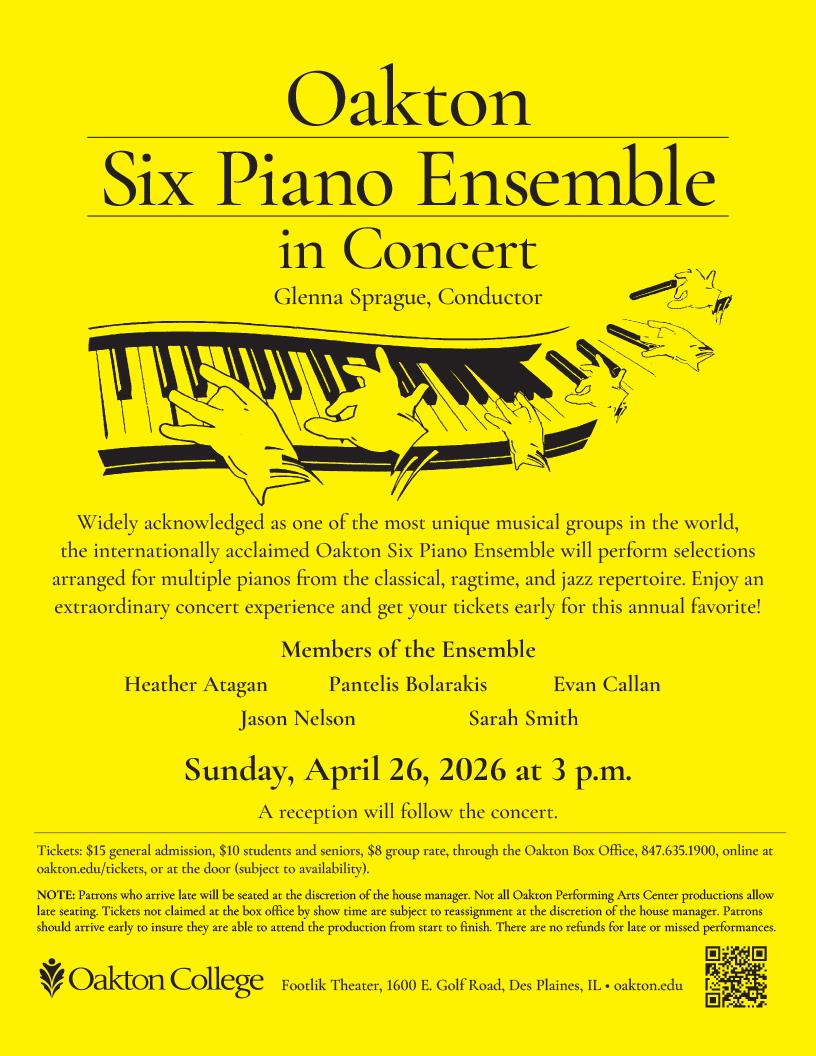
OAKTON SIX PIANO ENSEMBLE IN CONCERT

Oakton Six Piano Ensemble Concert April 26


The Oakton Six Piano Ensemble, conducted by Glenna Sprague, will present its annual concert on Sunday, April 26th at 3:00 p.m. in the Footlik Theater at Oakton College, 1600 East Golf Road, Des Plaines.


The group is founded by Glenna Sprague, Professor and Coordinator of Music at Oakton, where she also teaches piano.  Performing at multiple pianos, the group performs not only traditional classical piano music; but also, symphonic literature as well as ragtime, popular, and jazz music. Performing with a conductor, the rich, layered sound of the Six Piano Ensemble compares to that of an orchestra, with each member playing a different part of a composition as the melody transfers from pianist to pianist. This year’s concert features the following works: Samba triste from Four Piece Suite by Richard Rodney Bennett; Suite in C Minor for Two Keyboards by Handel; Sonata in D Major, K.381 by Mozart; Ain’t Misbehavin by Thomas Waller; The Strenuous Life Rag by Scott Joplin as well other selections.


Tickets are $15 for general admission; $10 for seniors and students; and $8 for groups. For ticket information, call the Oakton Box Office at 847-635-1900; order tickets online at www.oakton.edu/tickets or get tickets at the door (subject to availability).  A reception will follow the concert.


Widely acknowledged as one of the most unique music groups in the world, the Oakton Six Piano Ensemble has performed both internationally and throughout the United States, including the World Conference of the International Society for Music Education (ISME) at the Royal Conservatoire of Scotland in Glasgow; the College Music Society International Conference in Vienna, Austria; MTNA National Conferences in Atlanta and Spokane; numerous MTNA state conferences; National Conference on Keyboard Pedagogy in Chicago. Critics from Vienna to Glasgow hail the Ensemble as “extraordinary”, “technically superb”, and “musically innovative.”  

A NOTE FROM THE EDITOR

Dear NWSMTA members,


Have you heard the saying, “Grandchildren are God’s reward for allowing our children to survive.” That may be an exaggeration, but there were moments that my husband and I asked each other, “Can you remind me why we decided to have children?” Perhaps we were holding on for the grandchildren to arrive.


I no longer get up at 5:00 A.M. to go to my grandsons to practice piano. Now, I go to practice with them after school. I see the window for that getting smaller every year as they get closer to high school and college. I try to keep our music positive for all of us. I often bring healthy treats and reward them for playing for others without complaining. Most people are amazed by their eagerness to perform. Five dollars for each song goes a long way. I also reward them with money for working hard with a good attitude. We call Friday “payday”. One Friday, Seth was having an off day, so I felt we should wait a day to evaluate his past week and I left him to finish practicing on his own. The next day, I found out he had completed all his songs. I told him that was wonderful and showed he’s probably able to do more on his own. Being a Gramma, I asked if he missed me, or liked it better to practice without me. Seth said he definitely missed me. Then he added that should be worth an extra dollar. I agreed with him. I am not suggesting anyone try to follow this plan. I am just happy I do not have to tazer them. 


Seth, the child who called the fire department when he was four years old, while I was teaching his older brother, loves to suggest ways I should improve my teaching. He does not really mind practicing or would not if I would heed his advice. When Seth comes in the door, his face lights up, and he greets me with ”Hi Gramma.” Then he immediately has a snack, while I play the piano for him. I have noticed my playing shapes his playing. It’s like subliminal learning. Dynamics get more creative, the beat gets more even and I need to talk less. He does not like to be interrupted while playing. Seth says it is impolite to interrupt the student. His pieces can be four pages long at this stage, and I cannot remember everything I think he should be changing. I also feel overloaded. I have tried to have him start on different pieces, pages or phrases. Seth prefers doing the newest piece first and ending up with what he can play in his sleep. Negotiations can take even more time. Teaching Seth has taught me to be quick on the draw. Get your idea on the table fast. After he tries my idea’ he can suggest one of his own. There are a few times this actually works. He has also taught me “Tomorrow is another day.”


The difference between teaching a student and a grandchild is your grandchild has more invested in the outcome. Just last week, Seth and I had a disagreement between what notes the composer wrote and which notes were played incorrectly. After begging him to just listen to me play the example, I heard the music playing softly. I realized Seth had secretly recorded himself to prove he had it right. He said nothing but agreed to look at it again. We have a new goal of creating five new recordings a day. They can be very short, or quite long. We go over them and try to analyze if there is truly a problem. He seems willing to make the corrections if he can tell they are needed.


When I studied piano, I don’t remember ever asking my teachers a question. When I teach, I agree with Seth, it is important for the student to be able to speak up and question why or why not.


Deb Lynch

Newsletter Editor

Northwest Suburban Music Teachers Association | https://www.nwsmta.org
Facebook