|
Governor Kathy Hochul’s 2025 State of the State: Fighting for Your Family
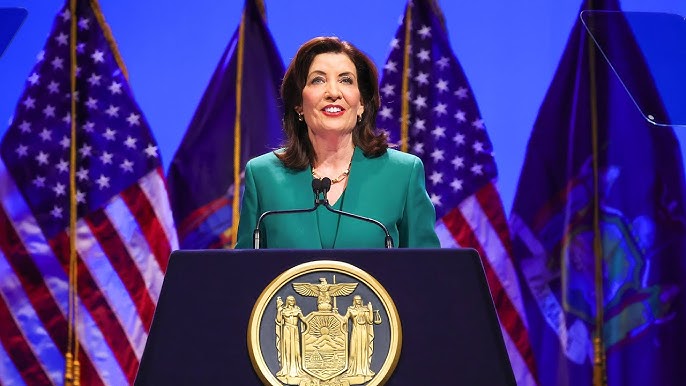
Governor Kathy Hochul on Tuesday delivered her 2025 State of the State address, including more than 200 initiatives that will put money back in people’s pockets, keep New Yorkers safe and ensure the future of New York is a place where all families can thrive. “Your family is my fight — and I will never stop fighting for the people of New York,” Governor Hochul said. “New Yorkers expect results and that’s why I fight day in and day out to make New York safer, healthier, cleaner, more affordable for you and your family — and that is what we’re doing with the initiatives announced as part of my 2025 State of the State.” Read more here.
Fighting Crime and Strengthening the Criminal Justice System
Protecting First Responders, Expanding Resources for Training and Recruitment and Supporting Victims of Crime
Safer Subways
Transforming and Improving New York’s Mental Health Care System
Promoting Kids’ Mental and Physical Health
Strengthening our Health Care System and Expanding Care for New Yorkers
Proposing New and Expanded Support for New Yorkers with Disabilities
| |
Governor Hochul Proposes Investments in Education and Youth Mental Health in Fireside Chat With Hundreds of High School and Community College Students
Governor Kathy Hochul on Monday proposed new investments in education and youth mental health at a fireside chat with hundreds of high school and community college students. The proposals build on the Governor’s commitment to making the State a place where residents of all ages have access to the resources they need to thrive. They include expanded access to youth mental health services, launching a college-in-high-school opportunity fund and providing funding for new apprenticeship programs in high demand occupations. Governor Hochul also announced that she will introduce legislation in her FY26 Executive Budget to restrict cell phone use in K-12 education, following on her historic legislative action to protect kids on social media. Read more here.
Related: NIH: Urban and Rural Differences in the Efficacy of a Mobile Health Depression Treatment for Young Adults
| |
DEA Releases Special Registration Framework, Telehealth Final Rule
Substance use disorder (SUD) treatment providers who prescribe medications for opioid use disorder (MOUD) via telehealth received some good news on Wednesday. The Drug Enforcement Administration (DEA) and the Department of Health and Human Services (HHS) announced a final rule that allows clinicians to prescribe buprenorphine via telehealth or audio-only telehealth visits for up to six months. This rule, called the Expansion of Buprenorphine Treatment via Telemedicine Encounter, is finalized and published in the Federal Register. While the new rule could make it easier for virtual prescribing, many providers are worried that ambiguity in the regulations would complicate the legal landscape for MOUD prescribing in the future. Read more here.
| |
Researchers Identify Public Policies that Work to Prevent Suicide
An analysis led by New York University researchers determines which public policies effectively prevent suicide deaths in the United States. But it’s not just policies that limit firearms and expand access to health care—many economic and social policies that are not explicitly focused on mental health can also prevent suicide, according to their article published in the Annual Review of Public Health. “Most of the policies that demonstrate evidence do not mention suicide and were not passed to prevent suicide. They are policies that are intended to address other issues—for instance, increasing minimum wage to promote economic security or reducing alcohol consumption—but they have spillover benefits in that they also prevent suicides,” said Jonathan Purtle, associate professor of public health policy and management at the NYU School of Global Public Health and the study’s lead author. Read more here.
Related: SAMHSA Issue Brief: Black Youth Suicide Prevention
NY Health Foundation Data Snapshot: Veteran Suicide in New York State (2022 Update)
Equity Focused Suicide Prevention, Intervention, and Postvention Resources for LGBTQ+ Populations
| |
Patients and Doctors Sound the Alarm About the Maternal Mental Health Crisis
“Becoming a new mother in May 2020 was really, really actually awful,” said Stephanie Wu. Wu and her husband welcomed their first child in the midst of the COVID-19 lockdowns. “My parents masked up and met our son on the sidewalk outside the apartment,” Wu said. The chaos of that time was especially hard for the new mom. “When my son turned one year old is kind of when I was just like, ‘Oh my God, what happened to my life?’” Five months later, Wu found out she was pregnant with her second child. Soon after giving birth to a healthy baby girl, she noticed signs that she was struggling. “I had periodic insomnia still,” she said. “I think all of that, it was sort of like the cascade.” She was overwhelmed by intrusive thoughts, one of the many symptoms of more serious perinatal mood and anxiety disorders, or PMADS. “I just kept having just such despair, just like the most profound despair of my life,” Wu explained. Read more here.
Related: Resources for Measuring Rurality in Research on Maternity Care
| |
Alcohol Carries New Risks in Middle Age
Americans are drinking more as they hit midlife — and suffering the consequences. People between the ages of 35 and 50 reported record-high levels of binge drinking in 2022. One recent study found that the greatest increase in heavy alcohol use between 2018 and 2022 was among people in their 40s. Doctors are particularly concerned about rising alcohol consumption among middle-aged women, as more of them develop alcohol-related liver and heart disease. Researchers are not entirely sure why middle-aged drinking is on the rise, though they noted that adults in this age range faced the pressures of caring for both children and aging parents, heightened demands at work and “historic” levels of loneliness. Read more here.
Related: U.S. surgeon general has warned about alcohol and cancer risk. What should providers do?
Assessing Links Between Alcohol Exposure and Firearm Violence: A Scoping Review Update
| |
Mental Health Advocates Aim to Dismantle Barriers to Care for Latinx Residents
Despite reporting high levels of mental illness, US Latinx community members often fail to receive adequate care. The 2022 National Survey on Drug Use and Health showed that just over a fifth of Hispanic adults (21.4%) reported having a mental illness—defined in the report as a diagnosed mental, emotional, or behavioral disorder that may have interfered with their lives. That’s less than the rate of White Americans (24.6%) but more than that of Black Americans (19.7%) and Asian Americans (16.8%). This gap is fueled by a series of barriers that include linguistic limitations, higher poverty rates, lack of insurance, the high cost of treatment, the lack of bilingual services, and the lack of training of many mental health professionals to understand Latin American cultures that often discourage accessing mental healthcare. Overcoming this stigma remains a central challenge. Read more here.
| |
New in 2025: Counties Should Prepare Now for the Upcoming HIPAA Security Rule Update
On December 27, 2024, the Office for Civil Rights (“OCR”) at the U.S. Department of Health and Human Services (“HHS”) filed a proposal to modify the Security Standards for the Protection of Electronic Protected Health Information (“Security Rule”) under the Health Insurance Portability and Accountability Act of 1996 (“HIPAA”) and the Health Information Technology for Economic and Clinical Health Act of 2009 (“HITECH”). This Security Rule was initially published in 2003 and most recently revised in 2013. Based on the dates shown in the proposal, HHS plans to publish the final rule in 2025, requiring regulated entities, including counties with access to Electronic Protected Health Information (“ePHI”), to establish and implement policies, procedures, and practices to achieve compliance within 180 days of the effective date. The proposed Security Rule would require regulated entities to perform and document an audit of compliance at least once every 12 months. Read more here.
| |
Applying Evidence to Address Social Needs in Health Care: Insights from Complex Care Experts
Factors outside the health care system — housing and food insecurity, lack of employment and transportation, and social isolation — significantly impact people’s health. Recognizing this, health care entities and policymakers are investing in interventions to address patients’ social needs. What does the evidence say about the effectiveness of these programs? How can research inform policy and decision-making? To explore these questions, last fall, the Better Care Playbook, in partnership with the Camden Coalition and UPMC Health Plan, co-hosted a symposium, Social Needs in Healthcare: Turning Evidence into Practice. The symposium featured panels of national complex care experts, including clinical leaders, policymakers, researchers, and people with lived experience. Speakers discussed community observations, highlighted research on the most effective strategies for addressing social needs in health care, and shared how they translate evidence into practice at the local, state, and national levels. Read more here.
| |
Study Examines Links Between Opioid Epidemic and Rural Homelessness
ATLANTA — A new study led by a Georgia State University researcher finds that the opioid epidemic and rural homelessness are exacerbating each other with devastating consequences. School of Public Health Assistant Professor April Ballard and her colleagues examined data from the Rural Opioid Initiative on more than 3,000 people who use drugs in eight rural areas across 10 states. They found that 54 percent of study participants reported experiencing homelessness in the past six months, a figure that suggests Point in Time Counts used to allocate state and federal funding significantly underestimate homeless populations in rural areas. The findings appear in the January edition of the journal Drug and Alcohol Dependence. Read more here.
Related: Building Thriving Communities: Focusing on Housing Solutions That Work
| |
|
SAMHSA Releases Updated National Behavioral Health Crisis Care Guidance
This week SAMHSA released updated National Behavioral Health Crisis Care Guidance (National Guidance), comprised of three documents:
- 2025 National Guidelines for a Behavioral Health Coordinated System of Crisis Care
- Model Definitions for Behavioral Health Emergency, Crisis, and Crisis-Related Services
-
Mobile Crisis Team Services: An Implementation Toolkit Draft (released for public comment)
The updated National Guidance reflects the U.S. transition to the 988 Suicide & Crisis Lifeline in 2022 and other progress and emerging needs related to behavioral health crisis care, and provides a framework for transforming behavioral health crisis care systems in communities throughout the United States, at a time when the U.S. continues to face record high rates of suicide and overdose. Read more here.
Related: SAMHSA Releases National Guidance for Substance Use Disorder Care
Official Launch of SAMHSA's Center for Addiction Recovery Support (CARS)!
| |
UPCOMING EVENTS & TRAININGS
Resources to Support the Behavioral Health Needs of the Military/Veteran Community
January 16, 1 - 3 pm, SAMHSA
Supporting Mental Health Through Culturally Responsive Community Engagement
January 16, 3 - 4 pm, UW Forefront Suicide Prevention
Accelerating Housing and Services Partnerships to Advance Housing Stability: National Webinar
January 16, 3 - 4 pm, SAMHSA
Accelerating Housing and Services Partnerships to Advance Housing Stability: National Webinar
January 16, 3 - 4:30 pm, HHS/HUD
How to Have the Conversation: Talking about SU and MH (in Rural Spaces)
January 17, 10 am - 12 pm, NCROTAC
Comprehensive Clinical Assessments with a Focus on Quality
January 19, 3 - 4:30 pm, NAADAC
Workforce Solutions Jam | Bridging the Gap: Advancing a Diverse and Resilient Workforce for SUD Treatment
January 21, 1 - 2 pm, National Council for Mental Wellbeing
The ROI of Resource Navigation: Findings from the Accountable Health Communities Model
January 21, 1 - 2 pm, Camden Coalition
Changing Pathways: How to leverage evidence-based practice to improve treatment outcomes for OUD
January 23, 12 - 1 pm, Behavioral Health Tech
The Interconnection between Health Equity, the Social Determinants of Health and the Impact of Intersectionality (in Rural Communities)
January 23, 2 - 4 pm, NCROTAC
Integrating Care: The Role of MOUD in Addressing Opioid Use Disorder and Infectious Disease
January 29, 1 - 2 pm, PCSS
Treating People who Use Meth or other Stimulants: Leveraging Contingency Management in Criminal Justice Settings
January 29, 2 - 3:30 pm, SAMHSA's GAINS Center
Healing Over Handcuffs: Advancing Deflection Strategies
January 29, 2 - 3 pm, National Council for Mental Wellbeing
Comprehensive Clinical Assessments with a Focus on Quality
January 29, 3 - 4:30 pm, NAADAC
When clinicians become family caregivers
February 5, 2 - 3 pm, Camden Coalition
FREE Getting the Grant Workshop - In-Person - Ithaca, NY
February 6, 8 am - 4 pm, Appalachian Regional Commission
Navigating Concerns on Youth Crime, Violence, and Behavioral Health: 3 Steps to Take Series
February 11, 2 - 3 pm, CSG Justice Center
The Power of Collaboration: Aligning Perspectives to Build with Purpose
February 11, 2 - 3 pm, Behavioral Health Business
Supporting African Americans in Treatment and Recovery: Medications for Alcohol Use Disorder (MAUD)
February 13, 3 - 4 pm, PCSS
Providing Quality Treatment Programming: What It Means to Ensure Fidelity to the Treatment Model
February 18, 2 - 3:30 pm, SAMSA's GAINS Center
Wellness and Resilience in Rural Communities: An Overview of Rural Minds
February 19, 12 - 1 pm, OMH/SPCNY
Conducting Cultural Assessments: Engaging and Providing Treatment for Justice-Involved Individuals from BIPOC and LGBTQIA+ Communities
February 26, 3 - 4:30 pm, NAADAC
Justice Center Code of Conduct Train-the-Trainer Session
February 26, 1 - 4 pm, Justice Center for the Protection of People with Special Needs
Youth and the Legalization of Marijuana
March 12, 3 - 4:30 pm, NAADAC
Justice Center Code of Conduct Train-the-Trainer Session
March 26, 1 - 4 pm, Justice Center for the Protection of People with Special Needs
Sequential Intercept Model (SIM) of Peer Support in Criminal Justice
March 26, 3 - 4:30 pm, NAADAC
| |
CLMHD CALENDAR
JANUARY
Office Closed - Martin Luther King, Jr. Day
January 20
Children & Families Committee Meeting
January 21: 11:30 am - 1 pm
FEBRUARY
CLMHD Executive Committee Meeting
February 5: 8 - 9 am
AOT Coordinators Call
February 7: 10 - 11:30 am
LGU Clinic Operators Call
February 11: 10 - 11 am
LGU Billing Staff Call
February 11: 11 am - 12 pm
Addiction Services & Supports (ASR) Committee Meeting
February 13: 11 am - 12 pm
Mental Health Committee Meeting
February 13: 3 - 4 pm
CLMHD Office Closed - Presidents' Day
February 17
Children & Families Committee Meeting
February 18: 11:30 am - 1 pm
Membership Call
February 19: 9 - 10:30 am
| |