|
CLMHD Celebrates 50 Years of Partnership, Advocacy, and Service to New York Communities
The New York State Conference of Local Mental Hygiene Directors (“the Conference”) is proud to celebrate a milestone 50 years of service with an evening of education and networking on May 12, 2026. This invitation-only special event will bring together leaders from across the state to honor five decades of partnership, advocacy, and commitment to our members and their role in the community. Founded in 1976, the Conference was born from a simple but powerful idea: that local leaders in the mental hygiene sector could accomplish more by speaking with one voice. What started as a small group of Directors of Community Services (DCSs) collectively testifying at a Legislative hearing — the first time local governments in the field had done so — grew into a statewide organization representing all 57 county mental hygiene departments and the City of New York. Over five decades, as the behavioral health landscape has been transformed again and again, the Conference and its members have been there every step of the way. Read more here.
Many thanks to our planning committee, partners, sponsors, and supporters for helping to make this event happen!
| |
State Policies Can Help Address the Mental Health Care Workforce Shortages
Hospitals and health systems are a critical point of intervention for individuals experiencing suicidal thoughts and behaviors. In just five years, the share of emergency department visits because of suicide attempts or intentional self-harm more than tripled—climbing from 0.6% in 2015 to over 2% in 2020. The effective delivery of evidence-based suicide screening and care in hospital settings relies heavily on a sufficiently staffed, knowledgeable, and supported workforce. However, workforce shortages continue to strain health system staff and affect consistent, quality health services for people in crisis. In fact, according to a nationally representative survey conducted by The Pew Charitable Trusts and the Joint Commission—an independent nonprofit organization that accredits 70% of hospitals in the U.S.—examining the implementation of universal suicide screening in accredited hospitals, about half of hospitals reported challenges stemming from insufficient staffing that affected their ability to provide suicide care interventions. Read more here.
Related: Workforce and Staffing at 988 Suicide & Crisis Lifeline Centers
School psychologists push for licensure expansion to fill gaps in mental health services
The Behavioral Health Workforce Crisis: Administrative Burden Is Breaking Your Nursing Team
Enhancing the Behavioral Health of Rural Workers: Solutions for Service Gaps
| |
Trump’s Drug Strategy Aims To Bolster Addiction Services — Despite Gutting of Government Support
The White House’s newly released strategy for tackling the nation’s drug and addiction crisis calls for a number of ambitious public health approaches that some experts say are laudable but will be hampered by the administration’s own actions. The sweeping 195-page National Drug Control Strategy, published May 4, advocates for making access to treatment easier than getting drugs, preventing young people from developing addictions in the first place, increasing support for people in recovery, and reducing overdose deaths. Those broad goals are widely supported by public health researchers, addiction treatment clinicians, and recovery advocates. But accomplishing such goals will be difficult in the face of the administration’s mass layoffs of federal employees, cancellation of research and community grants, attacks on organizations and practices that serve people who use drugs, and cuts to Medicaid, the state-federal health insurance program for low-income people that is the largest payer for addiction and mental health care nationwide. Read more here.
Related: Community-Initiated Care in Behavioral Health: Exploring Funding Mechanisms for Substance Use Disorders
What to Know About Orphines, a New Class of Deadly Opioids
| |
Her Self-Experiment with Drug Detox Almost Broke Her
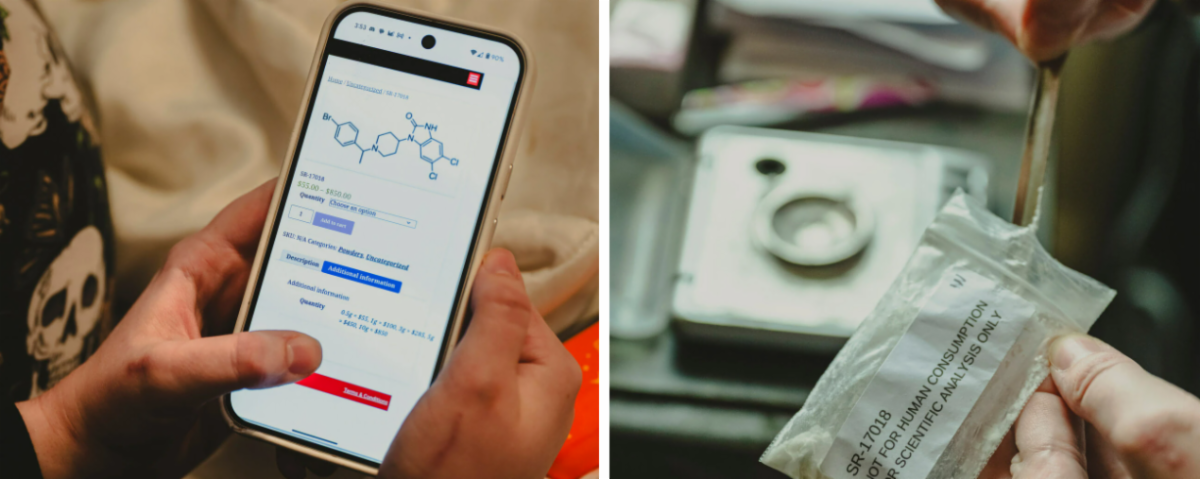
A 27-year-old woman began an experiment on herself early one morning in December 2024. Her laboratory was her childhood bedroom, tucked into a second-floor corner of a pale yellow house in the Boston suburbs. On a bookshelf behind her sat a small stuffed sloth and some favorite books, including “Siddhartha” by Hermann Hesse. Her parents were asleep in the room next door. Her name is Rebecca, but she goes by Becks. Sitting at her desk in a gray T-shirt, she opened a small plastic bag filled with white powder. The bag was stamped “SR-17018,” and “NOT FOR HUMAN CONSUMPTION.” She extracted some powder with a red microscooper, poured it onto a digital scale and carefully weighed out 25 milligrams. She gathered this into a blue and white pill capsule and sealed it, and then swallowed the capsule with water. It was 4:27 a.m. “It’s my turn to be a guinea pig,” Becks wrote in the online diary she was keeping of her experience. Becks had joined the vanguard of a dangerous, highly speculative do-it-yourself approach to getting sober. For a decade, on and off, she had been addicted to various drugs, most recently kratom, an opiate-like substance, which cleared her head and covered up her pain but required constant dosing. She feared the call of fentanyl, which she’d tried a few times. Read more here.
| |
When the Helpers ‘Feel Helpless’: First Responders Get a Boost in Mental Health Support
Ty Wooten didn’t realize the weight of answering his first 911 call — until more than a decade later. A woman had dialed 911 to report that her husband had shot himself in front of her and their 7-year-old son, on the family’s living room couch. It was Wooten’s first call as a dispatcher. “I wasn’t prepared for that, and I didn’t quite realize how difficult that call was for me for several years,” said Wooten, who has worked in the 911 industry for more than 30 years, both taking calls and managing dispatch centers. He is now director of government affairs for the International Academies of Emergency Dispatch, an industry group that helps set standards for emergency dispatch centers. Wooten pushed the experience aside. It wasn’t until about 15 years later, while swapping stories with colleagues, that the details came rushing back — triggering a spiral of anxiety, panic attacks and depression that would take time to fully confront. “I had taken that experience and kind of put it in the corner of my mind, and built a wall around it so I wouldn’t think about it again,” Wooten said. Wooten’s experience reflects a broader reality for first responders, who are routinely exposed to traumatic events but often lack the space — or support — to process them. Read more here.
| |
How 13 High Schoolers Are Fighting the Bullying Crisis Facing Students With Disabilities
SPRINGFIELD, Mass. — Students with disabilities are bullied and socially excluded more than their peers. But a group of Massachusetts high school students is trying to change that. “I learned that disabilities are more common than you think,” said Isabelle Ogutt, who is part of the Hampden County District Attorney Youth Advisory Board. About 20% of the population has dyslexia, 15.5 million U.S. adults have been diagnosed
with ADHD, about 1.4 million people in the U.S. have Tourette syndrome, about 5.5 million Americans use a wheelchair and about 1 million people are blind. The group of 13 students created videos and a children’s book after talking to people- with disabilities about how they want to be treated and how they navigate the world. The district attorney’s Youth Advisory Board includes more than 70 students from schools across the region who participate in the year-long program. The first meeting was on Oct. 1 and started with Hampden District Attorney Anthony Gulluni giving a speech and encouraging the students. Read more here.
| |
Nearly Every State Raised Medicaid Mental Health Rates. Now What?
Medicaid is the largest payer for mental health services in the US, yet access to these services remains limited. As of 2023, 40 percent of adult Medicaid beneficiaries with any mental illness reported unmet needs. Workforce shortages, geographic maldistribution of mental health clinicians, and growing demand for services continue to constrain access to services. A central factor underlying them is payment: Medicaid reimbursement for mental health services remains substantially below Medicare and commercial rates, with wide variation across states. These payment differentials influence where clinicians practice, whether they participate in Medicaid, and how much care they provide—making reimbursement a key lever for shaping access. In response, states have increasingly turned to reimbursement increases as a central policy tool. Understanding the landscape of these approaches matters for several reasons. Read more here.
| | |
UPCOMING EVENTS & TRAININGS
Responding to High Acuity Challenges in Supportive Housing (Part 2)
May 7, 1:30 - 2:30 pm, CSH
Beyond the Court Order: New Long-Term Evidence from Mobile County’s AOT Program
May 7, 2 - 3 pm, Policy Research Associates
Responding to Serious Behavioral Health Symptoms in the Courtroom: The Role of Each Court Partner
May 7, 3 - 4:30 pm, SAMHSA's GAINS Center
Innovations in Prevention
May 11, 2:30 - 4 pm, SAMHSA
Beyond the Screen: Creating Healthy, Engaged Elementary School Classrooms
May 12, 2 - 3 pm, SAMHSA
Update from the Field: Crisis Response and Co-response to Support Individuals Experiencing Mental and Substance Use Disorders
May 13, 12 - 1:30 pm, SAMHSA's GAINS Center
Supporting Individuals Engaged in Opioid Use Disorder Treatment for Peers
May 13, 12 - 1:30 pm, NAADAC
Revised Regulations for Opioid Treatment Programs: Establishing a Baseline to Measure Progress Over Time
May 14, 1 - 2 pm, SAMHSA CFRI
Storytelling for Impact
May 14, 2 - 3 pm, SAMHSA
Train Your AI for Your Future: How Behavioral Health Organizations Are Teaching AI Their Operational DNA
May 18, 1 - 2 pm, Clinically AI
Best Practices to Provide Integrated Care for Children with Serious Emotional Disturbance (SED) & Neurodevelopmental Needs
May 18, 1 - 2:30 pm, National Council for Mental Wellbeing
Brain Injury: Practical Strategies for Engagement
May 19, 10 - 11 am, DOH/OMH/OASAS
Navigating Schizophrenia in Black & Hispanic Communities (Rompiendo el Silencio)
May 19, 3 - 4 pm, NAMI
Developing Leaders, Delivering Results: The ROI of Strong Managers
May 21, 1 - 2 pm, National Council for Mental Wellbeing
Improving Access to Specialty Care in Rural Communities Through Project ECHO
May 21, 2 - 3 pm, Center for Health Care Strategies
Case-Based Discussion: Gambling and Alcohol Use Disorder
May 21, 3:30 - 4:30 pm, PCSS-MOUD
Integrated Care in MHOTRS Webinar
May 28, 2 - 3 pm, MCTAC
State Peer-to-Peer Learning Session: Innovative Post-Crisis Follow-Up Procedures
June 9, 3 - 4 pm, SAMHSA
Beyond Dual Diagnosis: Understanding the Relationship Between Personality Disorders and Substance Use Disorders Among Adults
June 10, 12 - 1:30 pm, CTAC
Balancing Public Meeting and Records Transparency Amid Rising Threats and Public Pressure
June 11, 2 - 3 pm, NACo
Essential Clinical and Peer Supervision Practices in Substance Use Disorder Services
June 17, 12 - 1:30 pm, NAADAC
| |
CLMHD CALENDAR
May
CLMHD Spring Full Membership Meeting
May 11 - 13, Albany, NY
Children & Families Committee Meeting
May 19: 12 - 1:30 pm
Membership Call
May 20: 9 - 10:30 am
June
Executive Committee Meeting
June 3: 8 - 9 am
Mental Hygiene Planning Committee Meeting
June 4: 1 - 3 pm
Quarterly AOT Coordinators Call
June 5, 10 - 11:30 am
LGU Clinic Operators Call
June 9, 10 - 11 am
Addiction Services & Recovery Committee Meeting
June 11: 11 am - 12 pm
Mental Health Committee Meeting
June 11: 3 - 4 pm
Children & Families Committee Meeting
June 16: 12 - 1:30 pm
Membership Call
June 17: 9 - 10:30 am
Developmental Disabilities Committee Meeting
June 18: 1 - 2 pm
CLMHD Offices Closed - Juneteenth
June 19
| |