|
HHS Awards Over $96 Million to Strengthen Mental Health, Suicide Prevention, and Substance Use Disorder Services
The U.S. Department of Health and Human Services (HHS), through the Substance Abuse and Mental Health Services Administration (SAMHSA), today announced $96.7 million in grants and cooperative agreements to strengthen behavioral health services and supports across the country. The awards provide funding for a range of behavioral health services and initiatives, including services for people with serious mental illness who are homeless, suicide prevention and early intervention, substance use disorder treatment, training and technical assistance, peer support, and disaster-related emotional support. “Every American deserves the opportunity to recover and live with dignity,” said HHS Secretary Robert F. Kennedy, Jr. “These investments will expand access to treatment, strengthen behavioral health services, and help more people move from crisis to recovery. That is how we restore health, rebuild lives, and strengthen our communities.” Read more here.
| |
CMS Launches New State Toolkit to Protect Children with Autism, Strengthen Oversight of Applied Behavior Analysis Services
Children with autism deserve care that is individualized, effective, and free from fraud and financial exploitation. To help states meet that standard, the Centers for Medicare & Medicaid Services (CMS) released the State Medicaid and Children’s Health Insurance Program (CHIP) Applied Behavior Analysis (ABA) Toolkit, a comprehensive resource to help state Medicaid and CHIP agencies address growing concerns about increasing expenditures, inconsistent clinical practices, and fraud schemes targeting autism services. CMS data shows that between 2021 and 2025, ABA spending in Medicaid and CHIP increased 421%, far outpacing the 67% growth in the number of children with an autism spectrum disorder (ASD) diagnosis receiving services. That disparity is not just a fiscal concern. It raises important questions about whether Medicaid resources are consistently supporting medically appropriate care. It also signals that rapid program growth requires stronger oversight to ensure children receive services based on medical need rather than financial incentives. Read more here.
| |
States Seek $200 Billion From Meta Over Child Social Media Addiction Claims
Meta on Tuesday again defended itself over claims it addicted young people to social media, this time in a federal trial brought by states seeking roughly $200 billion in penalties and changes to the company’s platforms. In opening statements, California, Colorado, Kentucky and New Jersey accused the social media giant, which owns Instagram and Facebook, of harming children with technology designed to be addictive like cigarettes. Meta helped fuel a national youth mental health crisis and deceived users by promoting its apps as safe, the states argued in the first bellwether trial in the U.S. District Court for the Northern District of California in Oakland. The suit charges the company with violating federal child privacy laws and state consumer protection laws. Read more here.
| |
New York State Encourages Individuals Living with Mental Illness to Visit State Parks, Historic Sites, and Recreational Sites
The New York State Office of Mental Health announced an initiative to encourage more New Yorkers living with a mental illness to enjoy the state’s many parks, historical sites, and outdoor recreational facilities, which can have a positive impact on mental well-being. As part of this push, the agency has made it easier for individuals living with mental illness and receiving services through an OMH program to apply for the state Office of Parks, Recreation and Historical Preservation’s Access Pass, which allows free or discounted access to state sites for individuals with a qualifying disability. Read more here.
| |
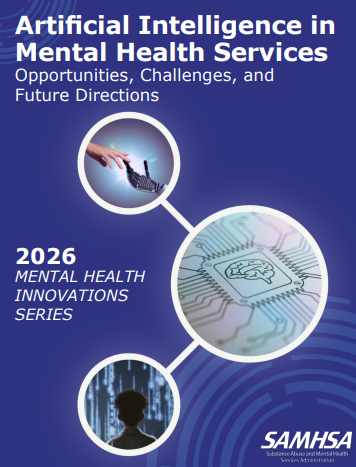
Artificial Intelligence in Mental Health Services: Opportunities, Challenges, and Future Directions
This policy paper presents current evidence on AI and mental health services, and examines what is known or proposed in a rapidly evolving AI enterprise. Based on this information, the paper provides considerations for policymakers as they govern responsibly advancing AI into mental health and substance use disorder services.
Related: She told no one about her agony except ChatGPT. What her death reveals about AI risks
| |
Can Social Determinants Deliver ROI? North Carolina's Medicaid Pilot Says Yes
Healthcare can't seem to decide whether Social Determinants of Health (SDOH) deserve a permanent place in the spotlight. North Carolina, however, has recently signaled that—for now, at least—the answer is yes. An evaluation of the state's Healthy Opportunities Pilots found that Medicaid beneficiaries who received non-medical services addressing food insecurity, housing instability, transportation barriers and interpersonal safety needs generated average savings of $164 per member per month while experiencing fewer emergency department visits and hospitalizations. Now, with $25 million in newly approved state funding, the program—which had been paused—is back with more work ahead, according to Impact Health CEO Laurie Stradley. Impact Health serves as the lead network organization managing Medicaid funding for non-medical drivers of health such as food, housing and transportation. The next challenge, she said, is ensuring the program becomes permanent. As the effects of HR-1 begin to reshape Medicaid financing, programs like Healthy Opportunities offer CFOs a real-world example of where population health investments may help offset reimbursement pressures while improving outcomes. Read more here.
Related: The Missing Piece in Healthcare's SDOH Strategy
| |
OpenAI Introduces ‘ChatGPT for Teens’ as Safety Concerns Grow
OpenAI announced on Tuesday “ChatGPT for Teens,” a new mode in which the chatbot automatically limits some conversations to better protect young users, as scrutiny grows over the harmful effects of artificial intelligence. Many features of the new mode deal with safety, the company said in a blog post. The chatbot will limit high-risk conversations that involve self-harm, violence, eating disorders, and explicit sexual and graphic content. In some cases, ChatGPT will alert adults who have opted in to parental controls and notifications. And the mode will strengthen protections that prevent the chatbot from suggesting it has personal feelings. ChatGPT’s teen mode also contains new studying tools and guardrails for students, OpenAI said. If the chatbot detects that a teenager is working on homework, it should respond to prompts with further questions instead of just providing the answer, for example. Read more here.
| |
How to Save a Life: Lessons From 2 Bridges, 15 Years Apart
Fifteen years ago this month, David Bartley walked onto the tallest bridge in California, planning to jump 730 feet to his death. Last month, another man climbed onto the Victory Memorial Bridge in Nashville with the same intention. In both cases, law enforcement officers engaged the men in deep, earnest conversation, and used the power of connection to light a spark of hope and inspire both men to live another day. A passerby’s 911 call alerted a sheriff’s deputy that Bartley needed help walking back from the precipice of his pain. Approaching with patience and caution, the deputy allowed him to “hurt out loud,” Bartley told MindSite News by asking curious yet counterintuitive questions and really listening to his answers. “The first was, ‘David, what does it feel like to be depressed?’ At that point, everything decelerated — and the key to keeping people safe is to slow things down,” Bartley explained. In the years since, he has become a suicide-prevention advocate, sharing with adults and children the lessons that he’s learned to save lives. Read more here.
| |
Mental Healthcare Provider Gaps, by State
Access to mental healthcare remains out of reach for millions of Americans, with some states facing more severe shortages of mental health professionals than others, new federal data shows. The Health Resources and Services Administration’s Bureau of Health Workforce published its latest quarterly report of Designated Health Professional Shortage Area Statistics on Aug. 13, reflecting data updated July 1. For mental health, an area generally qualifies as a shortage area when the population-to-psychiatrist ratio is at least 30,000 to 1, or 20,000 to 1 in communities with unusually high need. Compared with the 2024 snapshot, the latest HRSA figures suggest shortages have worsened. The number of designated mental health professional shortage areas rose from 6,418 to 6,807 as of Dec. 31, and the population covered by those designations grew from about 122 million to 137 million. Over the same period, the percentage of Americans’ mental health needs met improved only slightly — from 26.4% to 27.3% — while the estimated number of additional practitioners needed to remove the designations increased from roughly 6,200 to 6,800. The figures suggest workforce growth has not kept pace with demand. Read more here.
| | |
UPCOMING EVENTS & TRAININGS
Doing More With Less: How Counties Can Successfully Address Behavioral Health Crisis Response Needs
August 20, 2 - 3 pm, NACo
Metabolic Psychiatry: A Nutrition Based Approach to Treating Mental Illness
August 20, 2 - 3:30 pm, SAMHSA
Leveraging the Certified Community Behavioral Health Clinics Model to Strengthen Reentry and Homelessness Response
August 20, 2:30 - 4 pm, SAMHSA's GAINS Center
Addressing Nicotine Use in Patients with Opioid Use Disorder (OUD)
August 20, 3 - 4 pm, PCSS-MOUD
Mobile Crisis Foundations & Capacity Building
August 25, 2 - 3 pm, SAMHSA
Building Integrated Care Teams for Co Occurring Behavioral Health and Substance Use Conditions
August 25, 4 - 5:30 pm, MPATTC
Using PSYCKES for ACT Teams
August 26, 10 - 11:30 am, OMH
Opioid Use Disorder in the Perinatal Period: Screening and Treatment
August 26, 12 - 1 pm, Project TEACH
De-escalation in behavioral health: What it takes to protect staff and patients
August 26, 1 - 2 pm, Becker's Hospital Review
Bridging the Gap – Workforce Collaboration in CCBHCs
August 26, 2:30 - 3:30 pm, National Council for Mental Wellbeing
From Hire to Licensed: Accelerating Your Workforce Pipeline
August 27, 3 - 3:45 pm, National Council for Mental Wellbeing
Restoring Black Men’s Wellbeing Through Nature and Community (Part II)
September 2, 3 - 4 pm, NAMI
Exploring the Intersection of Housing and Civil Commitment: Civil Commitment for Substance Use Disorders and Mental Illness
September 3, 1 - 2:30 pm, SAMHSA's GAINS Center
Elevating Peers and Community Health Workers within Integrated Care Teams
September 10, 1 - 2 pm, National Council for Mental Wellbeing
Suicide Attempt survivor and Adolescent Support groups-Examples and opportunities
September 14, 12 - 1 pm, SPCNY
National Recovery Month Virtual Event: Recognizing Addiction Transfer in Recovery
September 15, 12:30 - 1:30 pm, National Council for Mental Wellbeing
Using PSYCKES for FQHCs
September 15, 1 - 2 pm, OMH
Workforce Solutions Jams: HR1 & the Behavioral Health Workforce
September 15, 1 - 2 pm, National Council for Mental Wellbeing
A Guide to Responsible Use of AI for Behavioral Health Settings
September 15, 12 - 1 pm, Becker's Hospital Review
Chasing Other Dragons – Atypical Intoxicants
September 16, 12 - 1:30 pm, NAADAC
Beyond Recruitment: Building a Workforce That Lasts
September 17, 2 - 3 pm, Behavioral Health Business
Final Coaching Call: Integrated Systems Care for Opioid Use and Co-Occurring/Co-Morbid Disorders
September 21, 12 - 1 pm, National Council for Mental Wellbeing
Creating a Trauma-Informed, Recovery-Oriented System of Care Series
September 24, 3 - 4 pm, National Council for Mental Wellbeing
REGISTRATION OPEN - The 2026 New York State Suicide Prevention Conference
September 29 - 30, Ithaca, NY
Transforming Documentation: From Pitfalls to Best Practices
September 30, 12 - 1:30 pm, NAADAC
Cross-Agency Data-Sharing: What Corrections Can Learn from Montana
September 30, 3 - 4:30 pm, CSG Justice Center
| |
CLMHD CALENDAR
August
Developmental Disabilities Committee Meeting
August 20: 1 - 2 pm
September
Executive Committee Meeting
September 2: 8 - 9 am
CLMHD Office Closed - Labor Day
September 7
LGU Clinic Operators Call
September 8:10 - 11 am
Addiction Services & Recovery Committee Meeting
September 10: 11 am - 12 pm
Mental Health Committee Meeting
September 10: 3 - 4 pm
Membership Call
September 16: 9 - 10:30 am
| |