DCJS Victims Services

National Crime Victims' Rights Week

April 19–25, 2026

Manager's Message


This short message from our Victims Services Manager, Kristina Vadas, highlights the 2026 National Crime Victims’ Rights Week theme and reflects on its meaning for our communities. It emphasizes the importance of victim‑centered work and recognizes the dedication of the professionals who support crime victims every day. It offers a moment to reflect on the impact of your efforts and the vital services you provide.


Serve for Awareness

Patricia Foster, DCJS Victim Witness Grant Program Coordinator


The Virginia Crime Victim and Witness Rights Act (“Rights Act”) turned 30 years old in 2025. To continue honoring the legacy of those who came before us, and to serve those now and in the future, a comprehensive emphasis is being placed on the services provided under the Rights Act by DCJS-funded local and state victim services programs. Over the years, the service definitions have morphed to more accurately describe the changes in advocacy trends and demographics, in addition to federal and state legislative updates. Throughout the implementation of these changes, the foremost constant is that we get to serve others better each year, increasing knowledge and awareness of victims’ rights and cultivating a sense of empowerment for crime victims to make informed decisions.


The six areas of the Rights Act are primarily coordinated by local and state victim/witness programs, with support from allied professionals. The collaborative efforts of many contribute to strengthening the criminal justice system's response to victims of crime, and to overcoming a lack of knowledge of available services and rights. Serving others in our communities and increasing awareness encourage connections that can transform and reinvent lives, including our own.

Victims' Rights Resources

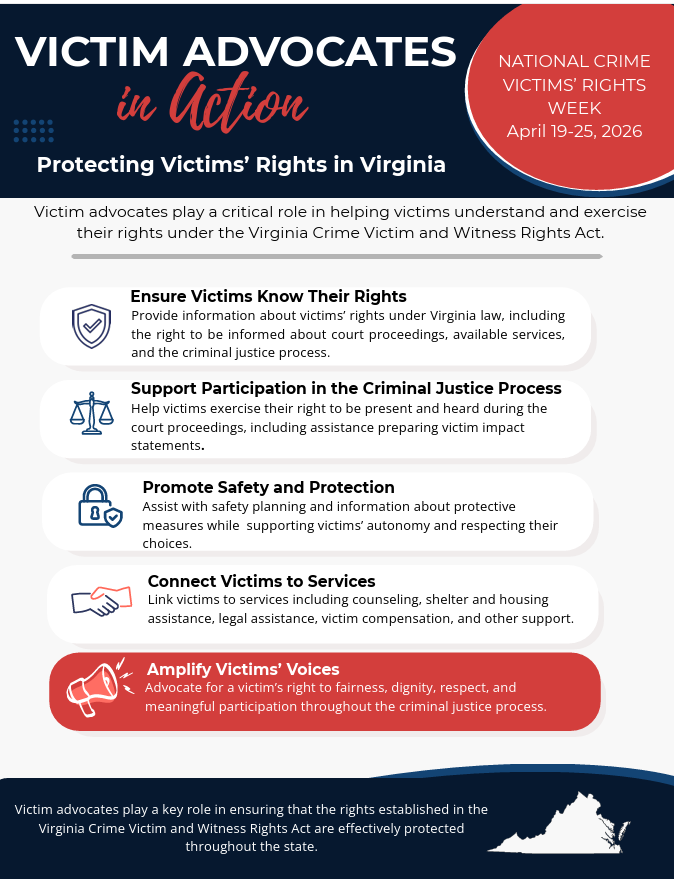
This handout highlights the 2026 National Crime Victims’ Rights Week theme and outlines the key ways advocates support victims, including informing them of their rights, assisting with court participation, promoting safety, and connecting them to essential services. It also includes statewide helplines and a QR code for accessing downloadable victim‑rights materials.


Download here

DCJS Victims Services also offers several brochures you may download to share with victims. They include:

Additional Rights for Human Trafficking Victims in Virginia

McKayla Burnett, State Trafficking Response Coordinator


The Virginia Crime Victim and Witness Rights Act guarantees victims important rights, including protection, financial assistance, court notifications, participation in the justice process, and access to support services.

In addition to these protections, Virginia law provides further rights specifically supporting victims of human trafficking. Survivors who are injured as a result of labor or sex trafficking may pursue civil action to recover damages and attorney fees under Code of Virginia § 8.01-42.4. Victims of family abuse, sexual assault, stalking, or human trafficking who are renting a home may also have the right to terminate their lease under Code of Virginia § 55.1-1236. Additionally, non-Virginia students who are in the Commonwealth as a result of being trafficked may qualify for in-state tuition under Code of Virginia § 23.1-506.

Vacatur Rights and Human Trafficking Survivors

Kimberly Hill, State Trafficking Services Specialist


Code of Virginia § 19.2-327.16 states that “upon a petition of a person who was convicted or adjudicated delinquent of a qualifying offense [prostitution or certain related offenses], the circuit court of the county or city in which the conviction or adjudication of delinquency was entered shall have the authority to issue writs of vacatur under this chapter.” During the 2025 General Assembly session, legislation was passed that expanded vacatur eligibility from only two misdemeanors to felony drug possession and over 30 misdemeanor offenses.


This means that human trafficking survivors may be able to have certain charges that were a result of their exploitation vacated from their record. Regent University’s Center for Global Justice offers pro bono legal services through their Human Trafficking Clinic to help survivors of human trafficking obtain record relief. Click to learn more here about eligibility requirements for record relief in Virginia.

The Contagion Effect: Mass Violence Increases Over Time

Julia Fuller-Wilson, State Victims Crisis Assistance and Response Team Program Coordinator


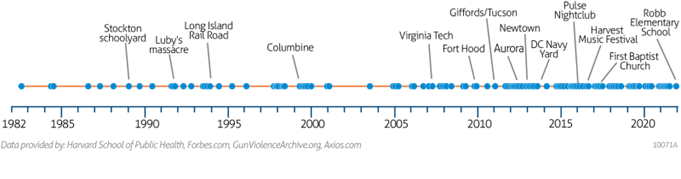
Research has shown an increase in mass violence over time, as demonstrated by these national statistics:[1]

  • From 1982 to 2011, there was an average of one mass murder every 172 days.
  • In 2011, that average changed to one mass murder every 64 days.
  •  During the first half of 2022, there were eight mass murders and 56 fatalities.
  •  After media coverage of a mass shooting, studies have found an average of three mass shootings occur within the following two weeks.


[1] Fox, J. A., Sanders, N. E., Fridel, E. E., Duwe, G., & Rocque, M. (2021). The Contagion of Mass Shootings: The Interdependence of Large-Scale Massacres and Mass Media Coverage. Statistics and Public Policy8(1), 53–66. https://doi.org/10.1080/2330443X.2021.1932645

training_worldcloud.jpg


National Crime Victims' Rights Week Training

In observance of National Crime Victims’ Rights Week, DCJS Victims Services is pleased to offer the following training opportunities:


Advancing Victims’ Rights: Past, Present, and Practice

This two-part live webinar training series, presented by Meg Garvin, MD, JD, MsT, Executive Director of the National Crime Victim Law Institute, will feature the two sessions described below. You can register here for either or both sessions.


Session 1:The History and Current Landscape of Victims’ Rights

April 20, 2026, 12:00 pm–1:30 pm

The history of victim involvement in criminal justice is an important foundation for understanding the current landscape of victims' rights and for strategically choosing a path forward. This session will describe the evolution of the modern victims' rights movement, including analyzing its goal of empowering victims. Despite this, many victims continue to experience re-victimization when they interact with the criminal justice system. This session will discuss what we can do to ensure victims' rights are meaningful and identify ways that each of us can empower victims to help them become survivors and thrivers.


Session 2: Confidentiality & Information Sharing When Collaborating: Focus on Ethics and Survivor Agency

April 24, 2026, 12:00 pm–1:30 pm

Crime victims encounter a maze of well-meaning service providers in the aftermath of their victimization. In this session the presenter will provide an overview of the fundamentals of privacy law, including privilege and confidentiality, as well as the unlawful practice of law. With these foundations in place, we will identify the different obligations and norms to which various victim service professionals are bound, looking at how those can align and conflict. We will then discuss how we can effectively and ethically collaborate across professional roles in support of victim survivor agencies. Case examples may be used.


Pause, Breathe, Continue: Mindfulness Skills for the Advocacy Journey

April 23, 2026, 2:00 pm–4:00 pm

This two-hour, practice-centered workshop supports advocates who devote significant emotional energy to others and may experience the cumulative impact of that work. While advocacy is meaningful, it can also lead to secondary trauma and burnout. This session offers space to slow down, reconnect with your own well-being, and build skills that help you remain steady, grounded, and present in challenging environments.

Through guided exercises, participants will learn to recognize how stress, secondary trauma, and burnout show up in the body and mind. The workshop includes accessible, experiential practices such as brief meditation, gentle movement, grounding techniques, and moments for personal reflection. Throughout the session, participants will engage directly with mindfulness and compassion-based tools that support emotional regulation and resilience.

By the end of the workshop, participants will have practiced multiple techniques they can immediately apply in their advocacy work and will walk away with a personalized plan for integrating short, sustainable well-being practices into their daily routine. You may register here.


*New* Virginia Crime Victim and Witness Rights Act E-learning Module

The DCJS Victims Services team is pleased to announce the launch of the Virginia Crime Victim and Witness Rights Act e-learning module, now available through our Benchmark Learning Management System (LMS). This module provides an overview of the rights afforded to crime victims and witnesses in Virginia and highlights the essential role of victim/witness program staff in helping individuals understand and exercise those rights.


To access this course, you must first be logged into your LMS account. Don’t have an account yet? You can register for one here. Once you are registered you can search for the course, or follow this link. For more information, or help creating an account, you can access the user guide here.