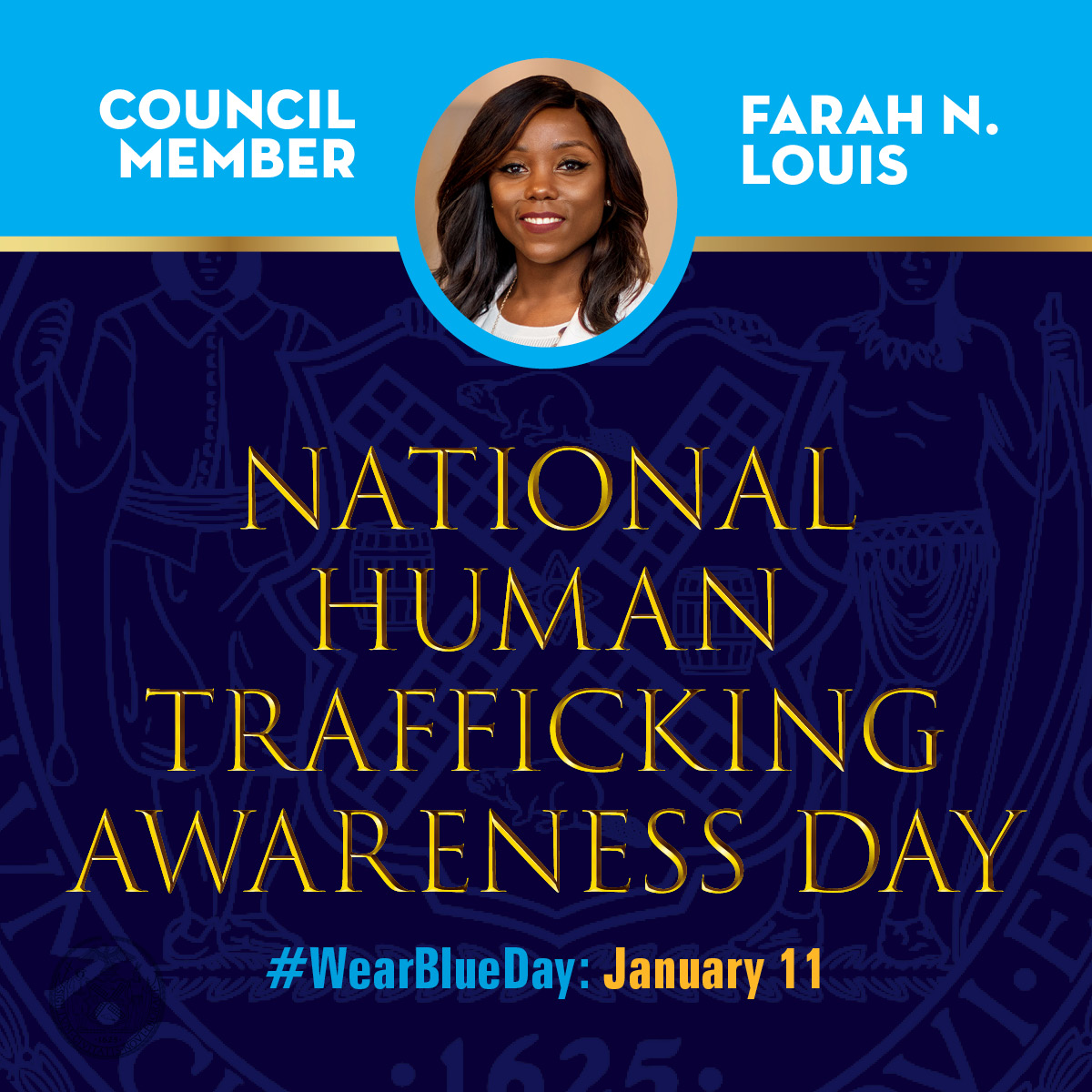
Blue and gold National Human Trafficking Awareness Day graphic with CM Farah Louis' picture on top.
Human Trafficking:
Is Closer Thank You Think
Dear Neighbor,

On National Human Trafficking Awareness Day, recognized annually on January 11, we heighten the importance of education and advocacy to help end labor and sexual exploitation.

Additionally, we wear blue in support of survivors and victims unknown but not forgotten.  

Our communities are in a state of crisis. Yet, the outrage that one would expect has never surfaced because the data that would help us understand the gravity of the situation is non-existent. Our daughters are not expendable, yet many missing persons of color mainly Black and brown people have been dismissed as runaways and garnered little or no media coverage. 

  • 64,000-75,000 Black women and girls are missing in the U.S.
  • Over 40% of domestic sex-trafficking victims in the U.S. are Black girls.
  • Approximately 60% of Black girls are sexually assaulted before turning 18. 
  • At least 40% of Black girls are sexually victimized before their eighteenth birthdays.

Until this crisis hits too close to home, no one can ever understand the anguish of families desperately searching for their loved ones, retracing their steps, exhausting all resources, yet unsure of whether they will ever be reunited. 

The lack of reporting data has hindered our ability to identify trends and hot spots, inform the public, or bolster resources that will help the NYPD prevent and pursue any perpetrators responsible for the disappearance of our loved ones. 

Girls and young women of color are being targeted, followed, harassed, or abducted on their way to school, work, home, and especially in the shopping centers. The few who manage to escape are traumatized yet courageous enough to share their dangerous encounters with strange men and vans in the hopes that the information could help protect another potential victim. 
More needs to be done in communities of color to make our streets safer for all. I introduced two pieces of legislation, which I am pushing to be heard by the Committee on Public Safety:
INTRO 1929 would create a public alert system to be used in missing persons cases where the person is believed to be in imminent danger.
Although we have Amber and Silver Alert systems in place, no such alert exists for missing people over 18 who are not elderly and suffer from a cognitive disorder or mental disability. There is a chronic issue with a lack of urgency in exploring any potential leads during the crucial 24 to 48-hour window when adults are reported missing, even with substantial indicators that the person may be in danger. People cannot merely be dismissed as “runaways”— there is a larger story to tell.
INTRO 1928 would require the NYPD to compile, send, and post a yearly missing persons report, disaggregated by race, age, gender, police precinct, percent of cases solved, and proportion of which cases involved human trafficking.
This data would provide valuable insight that would shed some light on the REAL threats such as human traffickers that exist right in our backyard and inform how we as a City can do better to eradicate this problem and keep families whole.

Often, people hear the terms “sex trafficking” or “labor trafficking” and think these problems are far away, but this could not be any further from the truth. These issues are taking place in each borough across New York City— right in our backyards. 
Before the COVID-19 crisis, my office was contacted on numerous occasions by families whose daughters had disappeared. Young women themselves shared traumatic accounts with me of vans circling their blocks and following them home. I will not stand by idle while women who look like me disappear without a trace, without a care.

Human traffickers move among us. They live in our communities and are careful to hide their intentions— but all it takes is one vigilant individual with enough information to offer a helping hand, contact proper authorities, and potentially save a life.  

Enclosed are helpful resources from The Brooklyn Human Trafficking Task Force, co-chaired by Safe Horizon and the Kings County District Attorney’s Office. If you need assistance, please call Safe Horizon’s Anti-Trafficking Program at (718) 943-8631 or the Human Trafficking Hotline at (718) 250-2770.

Sincerely,
Farah N. Louis
Council Member, District 45
Co-Chair, Women’s Caucus
More Resources
Available Mon. – Fri., 9 a.m. – 5 p.m. T (718) 943-8631
If you cannot talk during their hours of operation, leave a message, and someone can arrange to speak at a later time. When leaving a message, please indicate when it is safe to call you back.
Human Trafficking Hotline T (718) 259-2720
