NATIVE CONNECTIONS WEEKLY DIGEST
The Native Connections (NC) Weekly Digest provides your tribe, community, or organization with resources to assist in your grant activities and other prevention efforts. It will also help keep you connected to other communities to share the good work that is happening throughout Indian Country and Alaska. Please do not reply to this email but direct any questions or comments to the contact information provided for the organization or individual associated with that particular news item.
| |
|
In a Good Way
Webinars and Events
- Native Connections Topic Suggestions
Resources:
- Native Connections Resource Center (NCRC)
- TSLGBTQ 2023 Calendar
- 988 Implementation Guidance Playbooks
Funding Opportunities
- Youth Engagement, Education, and Employment - due September 15, 2022
- Tribal Transportation Program Safety Fund - due September 15, 2022
- Preventing Outages and Enhancing the Resilience of the Electric Grid Program - due September 30, 2022
| |
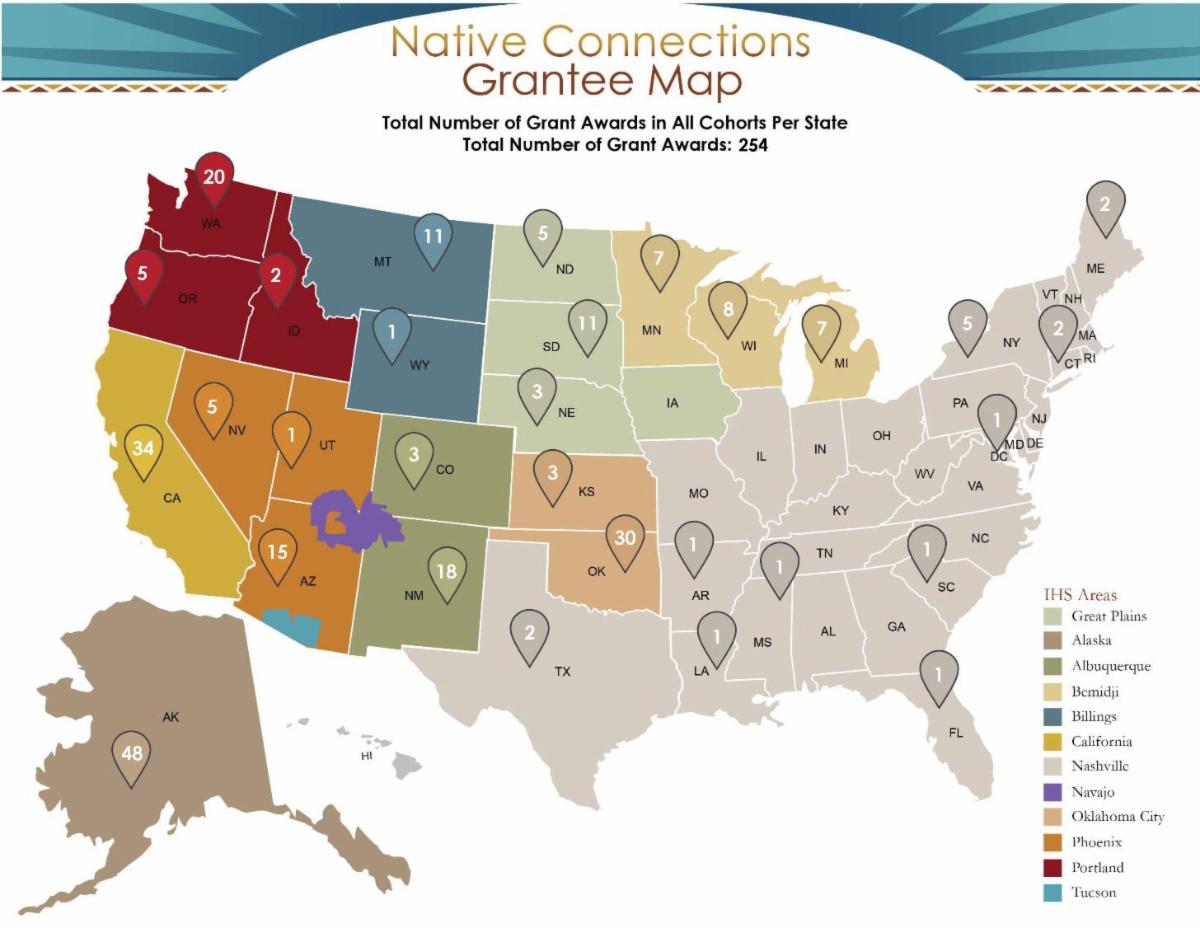
In the last NC podcast, grantee Aron Wahkinney discussed partnerships and collaborating with other resources in the community. If your program is looking for partnerships to serve your community better, another NC program is a great place to start. Other NC programs share similar goals and can provide insight for issues in your program, or vice versa. The NCRC contains a map of all NC programs in the country. Review the map to see what other programs are in your area and what networking opportunities are available to you. Each grantee is also paired up with a "buddy" in their area, which is another NC grantee. You can find out your buddy by looking at your one-pager or through you Grantee Technical Assistant. | |
As the summer ends, we are already planning for the year ahead. To best serve our NC grantees, we want to hear from you on what topics you would like to see for our upcoming Webinars, National Learning Communities, and Podcasts. To submit topic suggestions, click the button below. | |
While the topics for the upcoming webinars, podcasts, and learning communities are being submitted, you can go back and watch previous webinars, podcasts, and learning communities on the NCRC. These resources are always available to review and can all be found in the resources link below. | |
Native Connections Resource Center | |
Webinars
NC Approach
NC Podcasts
Youth Engagement
LGBTQ2S Resources
Trauma Resources
| |  |
Culture
Evaluation
Sustainability
Procedure, Protocol, and Policy
Resilience
Crisis Response
| |
In addition to the NCRC, we encourage grantees to visit the Native Connections website for various resources and information. Here, grantees will have access to resources not found on the NCRC including webinars, publications and resources, and information about Training and Technical Assistance. Visitors to the website can also access related SAMHSA resources, including info about alcohol, tobacco, and other drugs, mental and substance use disorders, prevention of substance abuse and mental illness, suicide prevention, and tribal affairs. | |
988 Implementation Guidance Playbooks | |
|
In 2020, Congress designated the new 988 dialing code to be operated through the existing National Suicide Prevention Lifeline. SAMHSA sees 988 as a first step towards a transformed crisis care system in America. SAMHSA, in co-sponsorship with NASMHPD, worked with partners across critical working sectors involved with 988 to develop 988 Implementation Guidance Playbooks (e.g., “playbooks”) for States, Territories, and Tribes; Mental Health and Substance Use Disorder Providers; Lifeline Contact Centers; and Public Safety Answering Points. The following are the links to these playbooks:
| |
Youth Engagement, Education, and Employment | |
|
The U.S. Fish and Wildlife Service (FWS) is the premier government agency dedicated to the conservation, protection, and enhancement of fish, wildlife, plants, and their habitats. We are the only agency in the federal government whose primary responsibility is the conservation and management of these important natural resources for the American public. The Service's origins date back to 1871 when Congress established the U.S. Fish Commission to study the decrease in the nation’s food fishes and recommend ways to reverse that decline. Today, we are a diverse and largely decentralized organization, employing about 8,000 dedicated professionals working out of facilities across the country, including a headquarters office in Falls Church, Virginia, and eight regional offices representing the 12 Unified Interior Regions. A variety of programs within the U.S. Fish and Wildlife Service and the National Wildlife Refuge System are focused on engaging diverse youth in wildlife conservation and public land management. The Service enters into cooperative agreements with member organizations of the FWS Youth Corps to engage with youth and veterans in projects under the Authority of the Public Lands Corps Act (PLC).
| | |
|
Due Date: September 15, 2022
Funds Available: $1500,000
Cost Sharing/Match: Yes
| | |
Eligible Applicants: Public and State controlled institutions of higher education, Native American tribal organizations (other than Federally recognized tribal governments), Special district governments, County governments, and Nonprofits that do not have a 501(c)(3) status with the IRS, other than institutions of higher education, City or township governments, Nonprofits having a 501(c)(3) status with the IRS, other than institutions of higher education, state governments, private institutions of higher education, Native American tribal governments (Federally recognized) | |
Tribal Transportation Program Safety Fund | |
|
Eligible projects described in section 148(a)(4) are strategies, activities, and projects on a public road that are consistent with a transportation safety plan and that (i) correct or improve a hazardous road location or feature, or (ii) address a highway safety problem. Tribal Transportation Program Safety Funds emphasizes the development of strategic transportation safety plans using a data-driven process as a means for Tribes to identify transportation safety needs and determine how those needs will be addressed in Tribal communities. Federal Highway Administration has identified four eligibility categories: transportation safety plans; data assessment, improvement, and analysis activities; systemic roadway departure countermeasures; and infrastructure improvements and other eligible activities as listed in 23 U.S.C. § 148(a)(4).
| | |
|
Due Date: September 15, 2022
Funds Available: $22,000,000
Number of Awards: 75
Cost Sharing/Match: No
| | |
Eligible Applicants: Native American tribal governments (Federally recognized) | |
Preventing Outages and Enhancing the Resilience of the Electric Grid Program | |
|
The U.S. Department of Energy (DOE) today opened the application period for States, Tribal Nations, and territories to apply for the $2.3 billion formula grant program designed to strengthen and modernize America’s power grid against wildfires, extreme weather, and other natural disasters exacerbated by the climate crisis. The Preventing Outages and Enhancing the Resilience of the Electric Grid program is established by President Biden’s Bipartisan Infrastructure Law and administered through DOE’s new Building a Better Grid Initiative. The program will assist with projects that create good-paying jobs to deliver clean, affordable, and reliable energy to more Americans when needed — getting the nation closer to the Biden-Harris Administration’s goal of a national grid run on 100% clean electricity by 2035.
“Every community deserves a strong and reliable energy grid that can deploy cleaner, cheaper power to homes and businesses,” said U.S. Secretary of Energy Jennifer M. Granholm. “Thanks to the transformative investments in grid infrastructure from President Biden’s Bipartisan Infrastructure Law, we can help protect our neighborhoods, main streets, and downtowns from grid shutdowns during extreme weather events, while creating good-paying jobs in the process.”
Power outages from severe weather have doubled over the past two decades across the U.S. and the frequency and length of time for power failures has reached their highest levels since reliability tracking began in 2013 — with U.S. customers on average experiencing more than eight hours of outages in 2020.
The Preventing Outages and Enhancing the Resilience of the Electric Grid formula grant program will provide $459 million annually to States and Tribal nations over an anticipated five-year period to improve the resilience of the electric grid against disruptive events. Grid resilience activities could include:
- Utility pole upkeep and removal of trees and other vegetation affecting grid performance
- Undergrounding electrical equipment
- Relocating or reconductoring powerlines
- Improvements to make the grid resistant to extreme weather
- Increasing fire resistant components
- Implementing monitoring, controls, and advanced modeling for real-time situational awareness
- Integrating distributed energy resources like microgrids and energy storage
Applicants will be asked to describe the concrete outcomes they intend to seek and commit to specific progress metrics, such as reducing or shortening outages from severe events or by reducing risks to health and safety from such outages. The funding program will make awards to states, territories, or tribes representing diverse sets of populations, including underserved and disadvantaged communities, following through on the Biden Administration’s Justice40 commitment to provide 40% of the benefits from climate investments to frontline communities.
Under this program, priority will be given to projects that will generate the greatest community benefit, whether rural or urban, in reducing the likelihood and consequences of blackouts and power shutdowns because of extreme weather or other disruptive events like cyberattacks. Projects should also drive the creation of good-paying union jobs with a focus on high labor standards and the free and fair chance for workers to join a union.
The application deadline is September 30, 2022 by 11:59 PM ET. Application forms and instructions are available in Section 40101(d) Formula Grants to States & Indian Tribes.
| |
If you would like to highlight and share your NC journey, have an article, resources, or other information to share with our NC team, please email Communication Coordinator Sarah Lake at s.lake@3stargov.com. The deadline for submissions is 3:00 PM (Eastern) every Monday. | | | | | |