October 2026 Newsletter


TuffCut® XT9 Family

9-flute Solid Carbide End Mills for High-Speed Machining

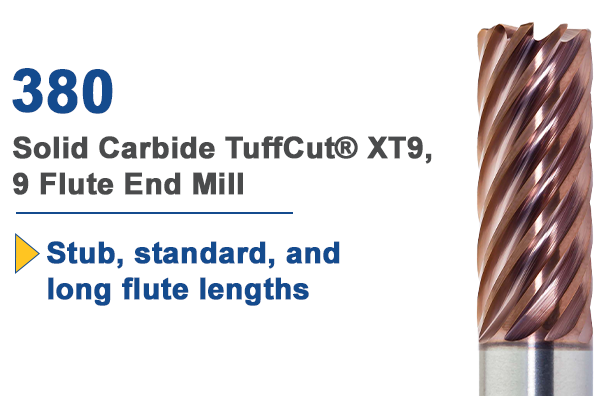
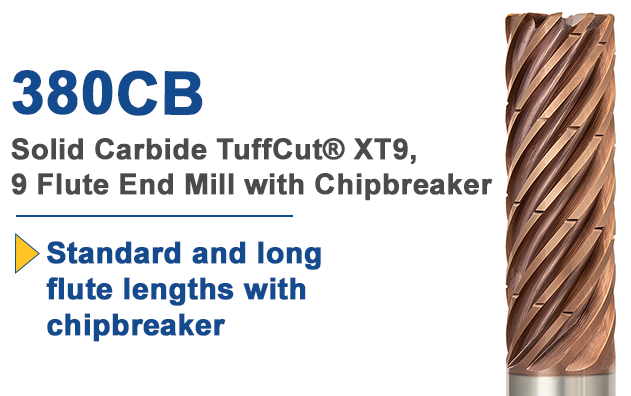
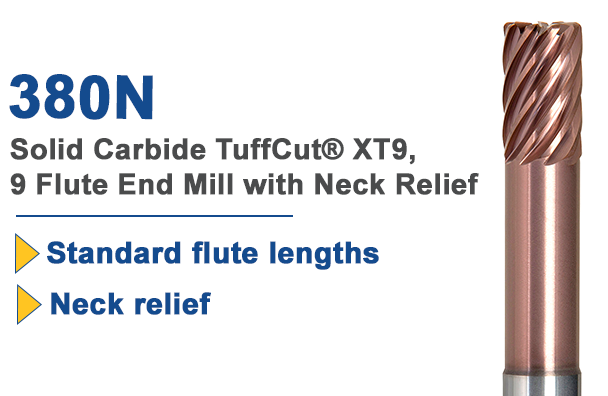
The TuffCut® XT9 family integrates a 9-flute design and our ALtima® Xtreme coating into three distinct series—the 380, 380 CB, and 380N—for high-speed and finish machining of titanium, Inconel, and similar materials, with each distinguishing itself by flute length, chipbreaker feature, and neck relief.

Shared Feature

Product specifications

Flute Count

9 Flute

Construction

Solid Carbide

Coating

ALtima® Xtreme

Helix Angle

37° Helix Angle

Machining Suitability

Suitable for high-speed and

finish machining

Flute Count Benefit

Uneven flute count reduces harmonics for stable machining zones

Designed for the Job you Need Done

Need high performance with versatility? The 380 series is designed for HEM roughing & finishing applications specifically where the tool is engaged radially rather than taking a full slot cut.

Need chip control, especially the long, continuous, or difficult-to-evacuate chips? The 380CB has the versatility of the 380 as well as the added feature of the chipbreakers.


Need a longer reach end mill with the versatility of the 380? The 380N with its 4xD and 5xD neck lengths allow for an extended reach into the workpiece.

Technical Expertise, Optimized Results

How Tool Size Affects Machine Speed

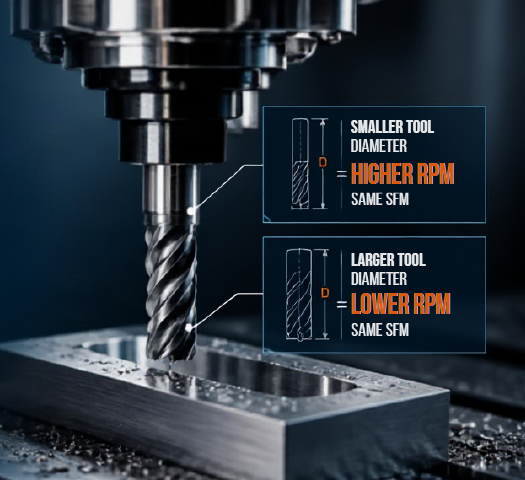
Machining uses two common ways to talk about speed, and they are easy to mix up. SFM (surface feet per minute) and RPM (revolutions per minute) both describe motion, but they describe different kinds of motion. The difference becomes much clearer when you focus on what is moving: SFM describes how quickly the cutting edge moves across the material, while RPM describes how quickly the machine rotates the tool.


These measurements are connected, but they are not interchangeable. A tool can rotate at a certain RPM while its cutting edge travels a different distance depending on the tool’s size.


Think of it this way: A large wheel covers more distance per rotation, so it spins more slowly. A small wheel covers less distance per rotation, so it must spin faster. Machining works the same way: larger tools need lower RPM, while smaller tools need higher RPM.


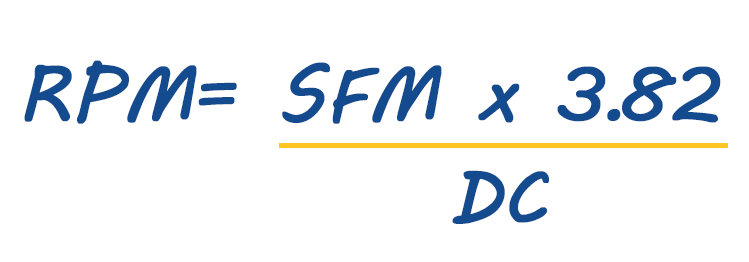
The Formula Behind Speed

DC = Cutting Diameter

Unlock the full potential of your M.A. Ford® tools. For expert guidance on speeds, feeds, application optimization, and more, contact the M.A. Ford technical team at maftech@maford.com.

Upcoming Holiday Closing


Connect with us!

Facebook  Instagram  X  Linkedin  Youtube  
M.A. Ford | www.maford.com | sales@maford.com