Dear Colleagues,
This issue of the HBCU STEM-US Research Center newsletter contains stories and briefs aligned with the Center’s mission to tell the stories of excellence in STEM education at HBCUs.
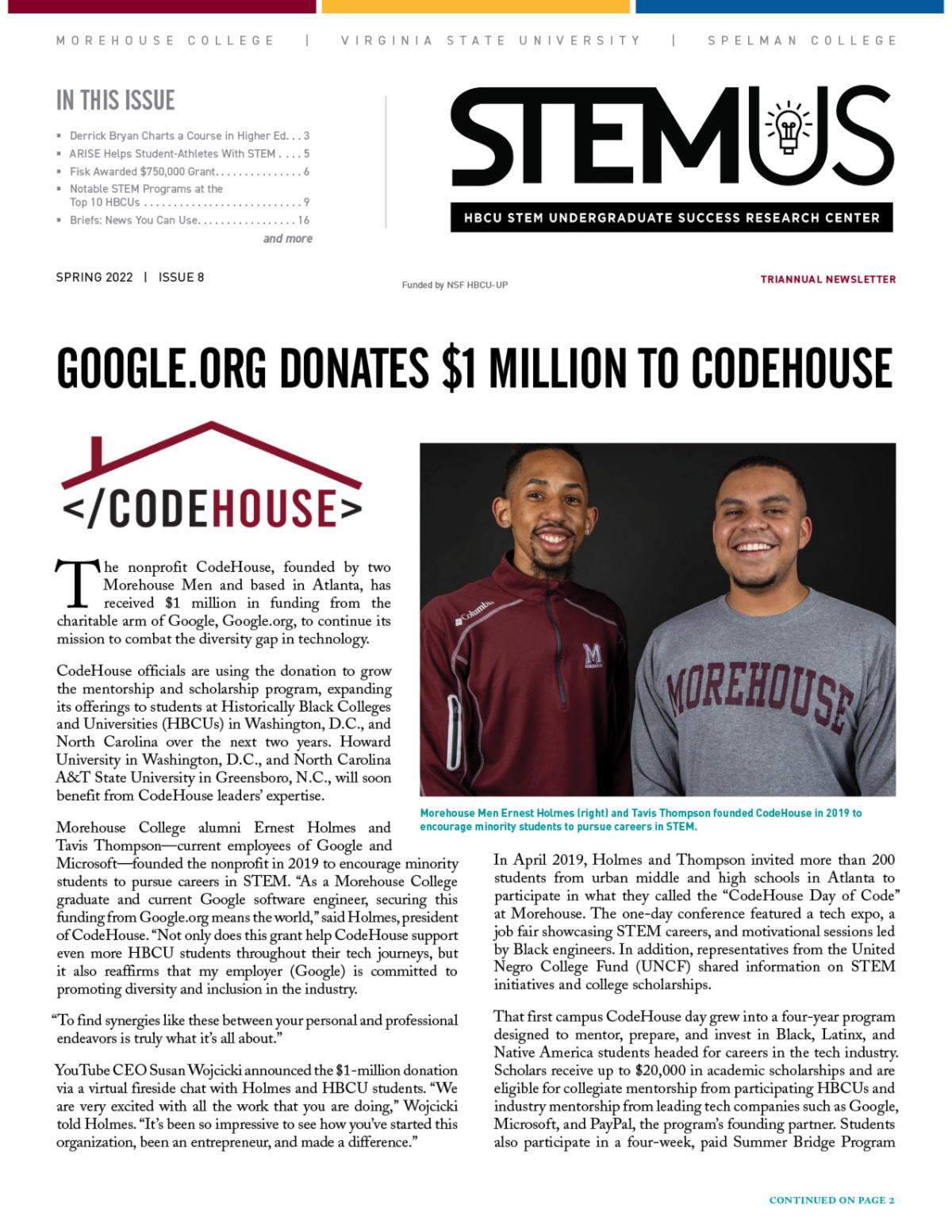
CodeHouse, a nonprofit founded by two Morehouse Men and based in Atlanta, has received $1 million in funding from the charitable arm of Google, Google.org, to continue its mission to combat the diversity gap in technology. CodeHouse officials are using the donation to grow the mentorship and scholarship program, expanding its offerings to students at HBCUs in Washington, D.C., and North Carolina.
|
|
Research Center Newsletter!
|
|
|
Virginia State University has created its first, four-year, fully online undergraduate degree in hospitality management. And Fisk University in Nashville is in the news for establishing three fellowships to support the university’s John Lewis Center for Social Justice, as well as for being awarded a three-year, $750,000 federal grant for its STEM through Rocketry, Electronics, Engagement and Coding program.
MSNBC President Rashida Jones is giving back to her alma mater, Hampton University, by providing scholarships to students in the university’s Scripps Howard School of Journalism and Communications. Spelman College, with its Center of Excellence for Minority Women in STEM— designed to nurture students' critical thinking about issues such as human rights, healthcare, and leadership development—has topped the list of HBCUs in U.S. News & World Report’s 2022 edition. (Enjoy our rundown of the rest of the Top 10, which includes STEM highlights from each school.)
Derrick M. Bryan, Ph.D., executive director of the HBCU STEM-US Research Center and an associate professor of sociology at Morehouse, is profiled as this issue’s outstanding STEM faculty member. And the student spotlight is on Jaylen Lowe, a 2021 graduate of Morehouse, with a bachelor’s degree in psychology, who heads to Los Angeles soon to pursue a doctorate in urban schooling at UCLA.
Also in this issue: two HBCU STEM leaders have been presented with the nation’s highest U.S. award for science, mathematics and engineering mentoring; and vet-tech students at FAMU are taking care of shelter dogs in Tallahassee, while getting much-needed, hands-on experience.
I hope this issue serves as a helpful resource for learning about the positive contributions HBCUs are making in STEM education.
Sincerely,
Derrick M. Bryan, Ph.D.
Executive Director, HBCU STEM Undergraduate Success (STEM-US) Research Center
|
|
Director, Frederick Douglass Academic Success Center (FDASC)
Associate Professor of Sociology
Morehouse College | 830 Westview Drive, S.W. | Atlanta, GA 30314
|
|
About the STEM-US Research Center
Investigating the formation of a resilient, science identity for STEM majors remains a strong part of the STEM-US mission.
“STEM-US's mission is important because, despite the extremely positive contributions HBCUs have made in STEM education, a deficit-oriented discourse concerning HBCUs’ contributions to society still exists,” former Center Executive Director Lycurgus Muldrow said. “To combat this narrative, there needed to be a center-based, systematic, investigation to elucidate how HBCUs with diverse academic cultures successfully graduate African American students at a higher rate than other institutions, produce a higher rate of African American STEM students receiving doctorates, and instill in students a greater sense of self-efficacy.”
The STEM-US Research Center’s comprehensive work includes: a holistic strategy integrating research, education, outreach, and knowledge transfer. This approach is needed to effectively disseminate, at local, state, and national levels, the contributions, impact, and positive legacy of HBCUs in broadening participation; a common theoretical framework that helps to identify student vulnerabilities while developing the necessary support for promoting resilience, success, and retention; and research-based protocols and analytical findings that will inform mainstream education reform, as well as contribute to the larger goal of overcoming race-related educational disparity in the United States.
|
|
HBCU STEM Undergraduate Success Research Center |
|
|
|
|
|
|