The N.C. Politics Center has a new logo!

Statement on Recent Political Violence in North Carolina


Last week, a Mecklenburg County Republican candidate for county commission announced he is withdrawing from the election and relocating after a shooting into his home—an incident that underscores growing concerns about political violence.


On this, North Carolinians are clear: political violence against candidates is unacceptable.


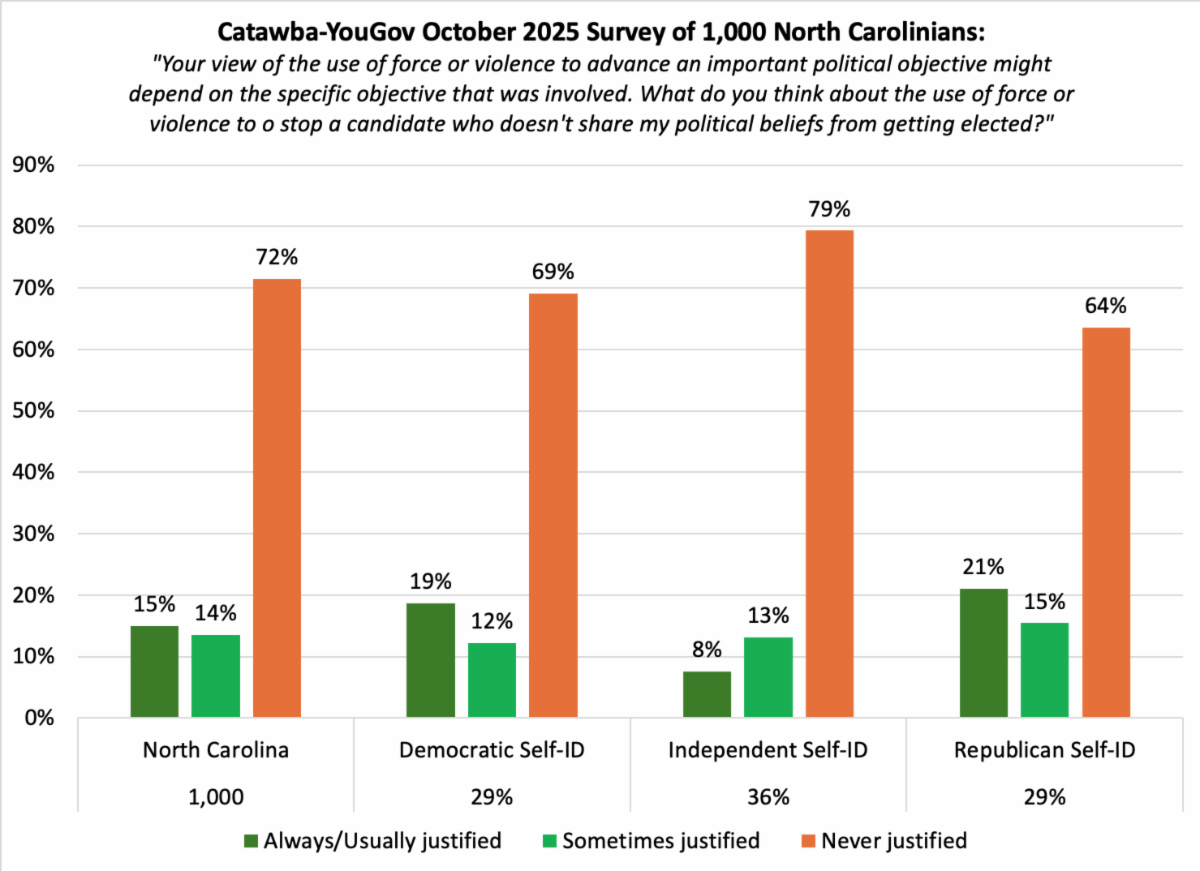
In the October 2025 Catawba-YouGov Survey of 1,000 North Carolinians, 72 percent said that using violence to stop a candidate from getting elected is never justified.


This was the highest rated 'never justified' situation in the survey. And notably, this view holds across the partisan spectrum, reflecting a broad consensus that violence has no place in democratic competition.

The Center for North Carolina Politics & Public Service affirms that all citizens and candidates must be able to participate safely in civic life. Acts intended to intimidate candidates, voters, or election workers violate this fundamental value. We support continued law enforcement efforts to investigate this incident and ensure accountability.


As North Carolina enters another competitive general election season, we remain committed to a fundamental principle: elections must be conducted in a safe, secure environment where citizens, candidates, and communities can trust in the integrity and credibility of this democratic process.

April Lunch & Learn Webinar on

"Spot the Bot"


Next Wednesday, April 8, beginning at 12 PM, we will host another Lunch & Learn Webinar on "Spot the Bot: How to spot fake accounts and sort fact from fiction in social media" with Torry Crass.


As the former Chief Information Security Officer (CISO) for NC and for the NC State Board of Elections, Torry will explain how to recognize fake accounts, foreign interference, and misinformation in various forms during this hour-long lunch and learn.


He will focus on NC vulnerabilities, noting that our US Senate race will likely bring a lot of misleading campaign ads and interference over the summer, but will also look more broadly at threats and the tools the average person can use to recognize and avoid being manipulated by bots or even drawn into fraudulent schemes.

NEW CATAWBA-YOUGOV SURVEY:

Trump Approval Drops as North Carolinians Oppose Iran Escalation; Cooper Leads Senate Race


The March 2026 Catawba-YouGov survey of 1,000 North Carolinians points to a three-part story: Donald Trump remains underwater with voters, the public is wary of deeper U.S. military involvement in Iran, and Roy Cooper begins the Senate contest with a significant advantage. Taken together, the findings suggest a political environment that is looking like a classic mid-term election: uneasy about escalation abroad, voters are not currently giving Republicans a strong tailwind at home.


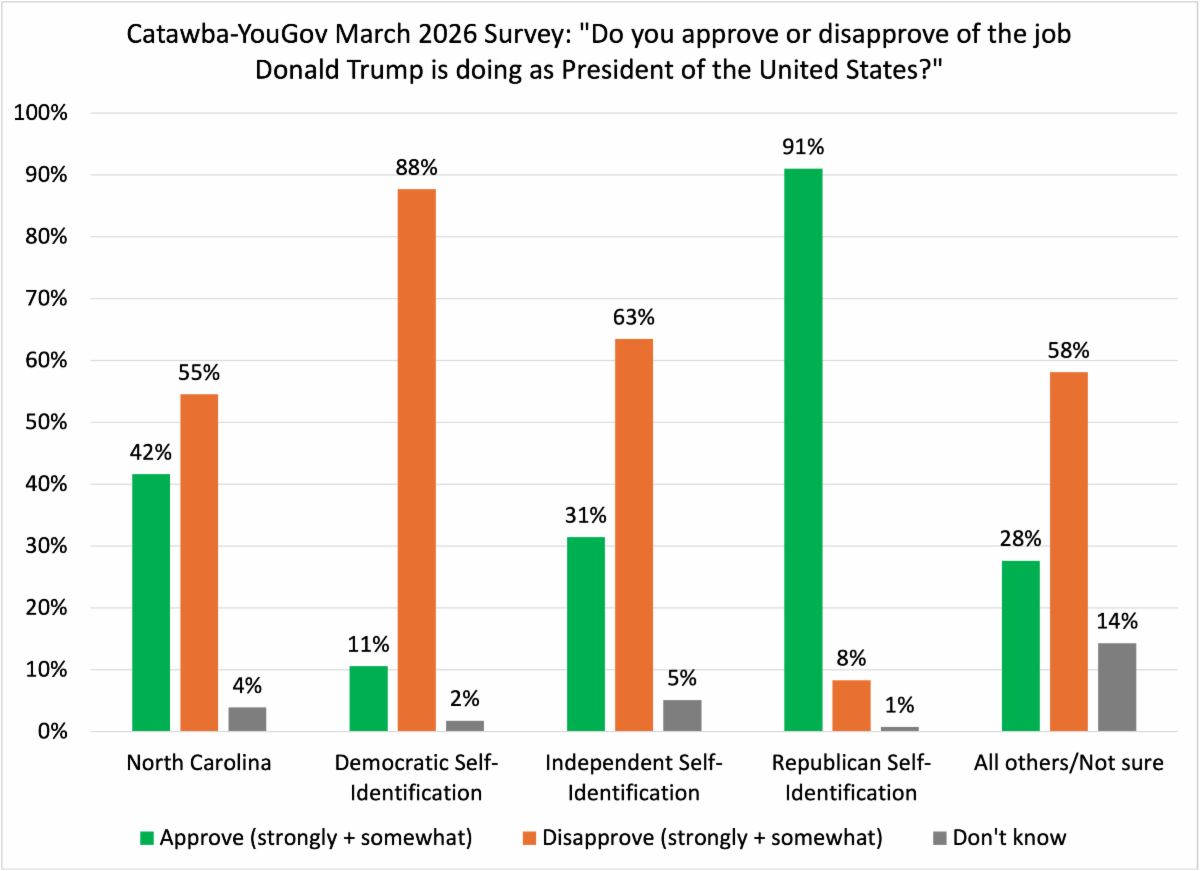
On Trump’s standing, the numbers are straightforward: 42% approve of the job he is doing, while 55% disapprove. That places him in negative territory, outside the survey's +/- 3.59% margin of error, and reflects a trend shown in his national numbers.

Among several topics asked of North Carolinians, the Iran findings show even more caution. When voters are asked whether the United States should intervene militarily in Iran, only about 34% agree, while roughly 44% disagree, and about 21% are neutral.


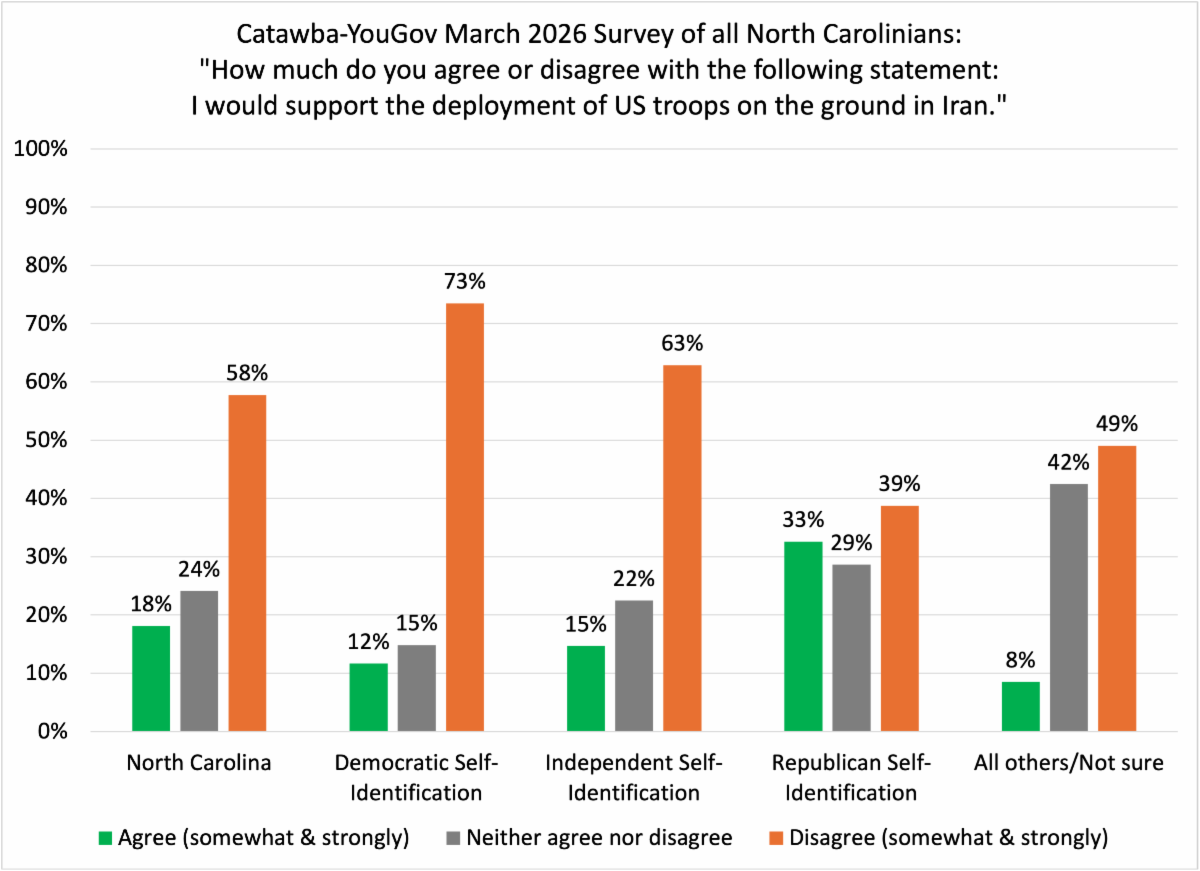
The resistance becomes stronger when the question turns to sending U.S. troops into Iran: just 18% agree, while nearly 58% of North Carolinians disagree.

That is one of the clearest public opinion signals in the survey: North Carolinians may support toughness in principle, but they are notably reluctant to endorse direct military escalation, especially if American troops are involved.


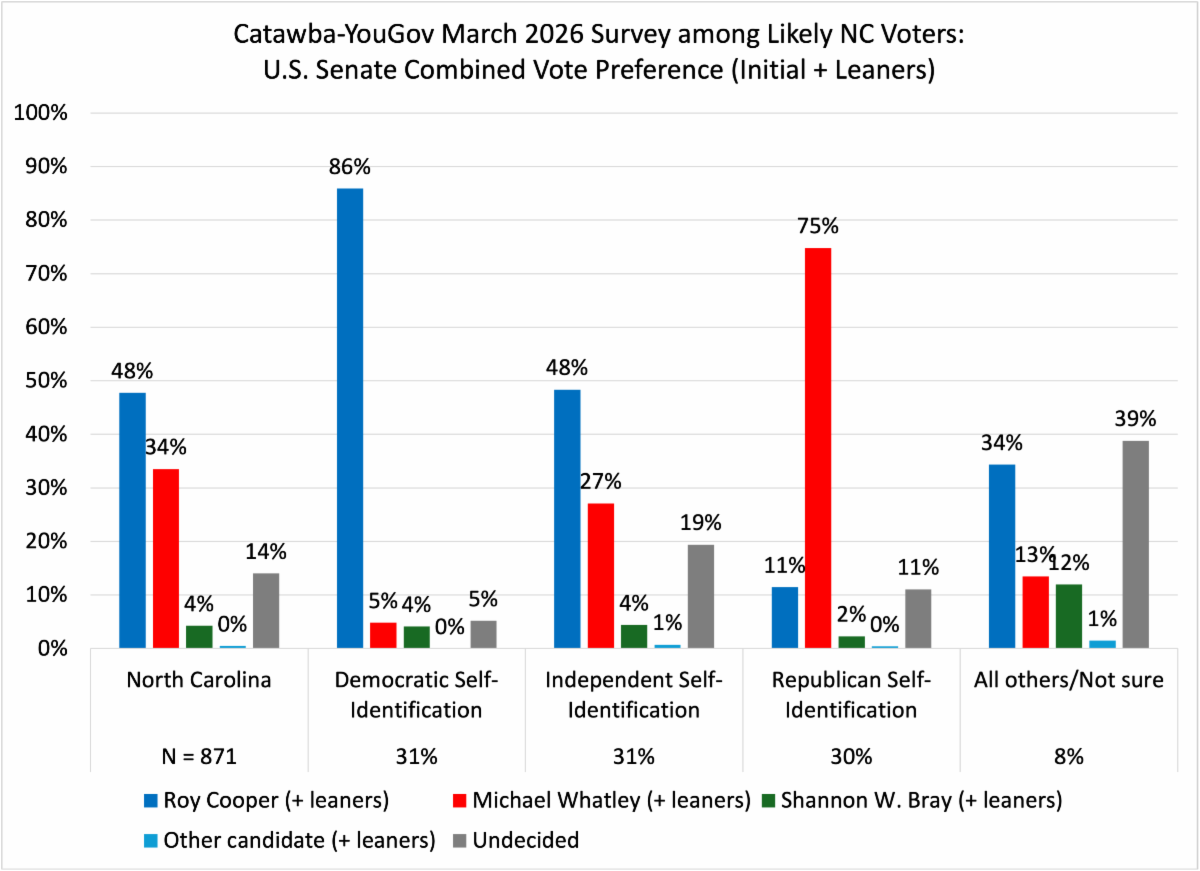
Against this backdrop, the U.S. Senate race starts with Democratic candidate Roy Cooper in a strong horserace position. In the initial ballot test, Cooper leads Republican Michael Whatley 47% to 31%, with about 18% undecided.


When voters who initially say they are undecided are pressed to lean, Cooper still leads, 48% to 34%. Cooper begins the general campaign’s horserace with a clear edge, while a meaningful share of North Carolina's electorate remains available to be won over.

The broader political meaning of these findings is fairly clear. Voters are uneasy with Trump, skeptical of deeper military action in Iran, and currently more open to Cooper than to Whatley. If these attitudes hold over the next several months, Democrats enter the fall general campaign with a favorable starting point for the 2026 mid-term elections in North Carolina.


The survey has other topics, including:


  • Generic Ballot findings for NC's U.S. House, state legislative, and state supreme court contests
  • NCians' support for financial & military aid to Ukraine & Israel
  • Approval/Disapproval for Governor Josh Stein and U.S. Senator Thom Tillis


There will be more findings released in the future, including opinions on ICE, voting locations, and more.


Read this survey's findings at:

Facebook  Instagram  LinkedIn  TikTok  Web  YouTube

You can find the N.C. Politics Center on various social media platforms:


Please join the N.C. Politics Center on your favorite social media platform for more information. Thanks for your interest in the Center for N.C. Politics & Public Service.


Dr. Michael Bitzer

Director, Center for N.C. Politics & Public Service

Professor of Politics & History

Catawba College


The Hon. Jennifer Roberts

Senior Advisor


The Hon. Robert (Bob) Orr

Senior Consultant