Quick, Timely Reads
On the Waterfront
|
|
Horsing Around
William Scott’s Racetrack in the Wilderness
|
|
By David Frew
February 2022
|
|
Dr. David Frew, a prolific writer, author, and speaker grew up on Erie's lower west side as a proud "Bay Rat," joining neighborhood kids playing and marauding along the west bayfront. He has written for years about his beloved Presque Isle and his adventures on the Great Lakes. In this series, the JES Scholar-in-Residence takes note of life in and around the water.
|
|
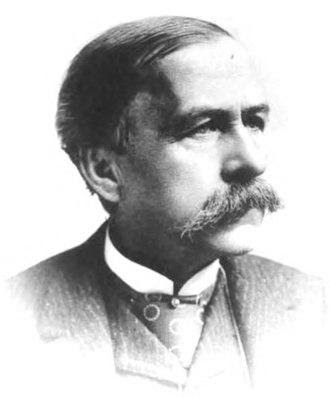
William Lawrence Scott (1828 to 1891) |
|
Bay Rat adventures. On days when we had lots of time, we often hiked west into Erie’s wilderness areas. Unlike the bluffs to the north of us or the docks, these wild spots were not “industrial.” There were trees, bushes, and running water plus an occasional path through the woods. The first of the adventure lands was Frontier Park, an undeveloped spot just on the other side of the West Sixth Street viaduct. Frontier Park was interesting, but it was surrounded by residential neighborhoods and not quite as wild as our second wilderness, which was farther west. Beginning at Sommerheim Drive, there was an enormous tract of land between West Sixth Street and Presque Isle Bay, which extended all the way to Presque Isle Drive (just east of present-day Peninsula Drive). There were rumors about this wilderness. Vague stories about a millionaire who died suddenly after beginning to develop the property, leaving it abandoned. He had passed away in the late 1800s, an imaginably long time from the perspective of 10-year-olds. Who was the mysterious millionaire and why did he own so much property?
As we explored the western wilderness, our questions went unanswered. There were old fields surrounded by woods and a network of paths. The pathways led us to the bluffs overlooking the west end of the bay. One of the trails continued down to the water where we found the remains of an old building, rotting in the sand. And most mysterious of all, there was an overgrown, oval track in the center. We were not sure if it was a running track or the border of an athletic field like the one that was adjacent to Strong Vincent High School.
Astonishingly, the man who had created both of these wilderness areas, which were still in existence long after the Erie metropolitan area had grown well beyond them was a quiet, gentle person who never considered Erie to be his hometown. William Scott was born in Washington, D.C. in 1828 and fell in love with the Delmarva Peninsula as a boy. The Eastern Shore and Chesapeake Bay were his family’s favorite vacation sites. Scott had completed the equivalent of a high school education by age 13 and since he seemed small, frail, and too young to go off into the “big world,” his well-to-do family helped him to earn an appointment to the United States House of Representatives as a page boy. While he worked as a congressional page, he took college classes in Washington.
Scott’s intelligence, work ethic, and interpersonal skills captured the attention of Erie’s Charles Reed while he was serving in Congress. At the end of his term, Reed convinced the young page to leave Washington and come to Erie. From age 17 to 23, William Scott served as Reed’s administrative assistant and chief “deal maker.” Scott’s time with Reed was during a period when his mentor was rapidly becoming the area’s wealthiest and most successful businessman.
Even though he was Reed’s assistant and learning the shipping and raw materials transfer business, Scott had a much broader worldview than his mentor. He had grown up in Washington and witnessed the world of business, both domestic and international. But Scott patiently served Charles Reed for almost five years, after which he suddenly disappeared from the local shipping and pier infrastructure businesses to go off “on his own.” During the years when he was establishing himself, Scott spent time in and around Washington, Philadelphia, and New York City as well as Erie. He had missed the Eastern Shore and old family connections with the Delmarva Peninsula so he traveled there often during his first years in business for himself. Scott’s instincts, upon leaving the Reed organization, were to look for business opportunities in both his adopted home of Erie and the Delmarva area where he had been raised.
Meanwhile in Erie, the Reeds and other locals were hoping to keep William Scott and his enormous business talent anchored to their city. In typical small-town style, Reed and his associates began by conspiring to encourage young William Scott to court Mary Tracy, daughter of one of Reed’s business associates, John A. Tracy. Mary’s father had moved to Erie from New York City and was hyper involved in railroading. His interests were complimentary to those of Reed since his holdings were primarily west of Erie and extending to Chicago. The arranged romance worked and, in 1853 when he was 25 years old, William Scott and Mary Tracy were married. Instantly, Scott was connected to Erie royalty since his new wife was the granddaughter of Daniel Dobbins, local War of 1812 hero. Scott’s new father-in-law was as instrumental in his business development as Charles Reed had been since one of his sons was a charter member of the New York Stock Exchange, and he, himself, was a land speculator. These were two skills that Scott was to add to his portfolio of investing skills.
William Scott made an astonishing amount of money from railroad, coal, and land deals between the time of his wedding and the end of the Civil War. He did it by diversifying his investments geographically, splitting them between Erie and Virginia, and especially the Delmarva Peninsula. In 1866, influential Erie colleagues, including John A. Tracy and his son and business partner John F. Tracy, convinced Scott to run for Mayor of Erie, another thinly veiled attempt to make him commit to the area. Scott had played an important role as an original member of Erie’s powerful Water Commission, which along with Erie’s first progressive mayor, Orange Noble, built Erie’s waterworks that still stand on Erie’s west bayfront. Scott agreed to challenge Noble for Mayor in 1871 and won by 64 votes. Scott later served a second term as mayor.
A year earlier, in 1870, Scott leveraged profits from coal and railroading into a single New York Stock Exchange deal in which he made $2 million. That stock deal launched a major post-Civil War campaign of land acquisitions both in Erie and Virginia. Scott’s father-in-law and brother-in-law had been investing profits from their railroad holdings into land on the outskirts of Erie for years and encouraged Scott to follow their lead. Scott did but he approached land speculation in a different manner. The Tracys were buying and holding vacant land, largely west of Erie. John A. Tracy and John F. Tracy had managed to acquire much of the land between today’s Beverly Drive and Sommerheim Drive. Scott decided that it would be better to purchase working farms and continue to operate them for a profit. Between 1872 and 1875, Scott purchased five farms, which featured every imaginable crop as well as livestock, including cattle, dairy cows, chickens and pigs. Typical William Scott diversity! Using economies of scale, Scott created three central farm organizations and hired managers for each of them. The first set of two farms was immediately west of the early city limits (Cranberry Street) and included Cascade Farm near the bay and Frontier Farm (today’s L.E.A.F. and Frontier Park). His second complex consisted of two farms on the west side. The largest was located along West Lake Road (Eighth Street) between today’s Sommerheim Drive and Presque Isle Drive. The other was in Girard. His fifth farm was on the lakeshore in Harborcreek, east of the city. Scott’s managers operated the three farm complexes.
William Scott’s persona was essentially the opposite of the contemporary image of a leader. He was a small, quiet, and unassuming man, quite the opposite of charismatic. As he told friends, he had no idea how to run coal mines, railroads, or farms so he preferred to trust the people that he hired and give them the autonomy needed to do a good job. According to a memoir by William Reed and other historical accounts, Scott was a good judge of character, however, and had a track record of hiring quality individuals. William Scott was a rare, early example of a “participative leader” who rewarded subordinates with shares of the profits. Those who worked for him were loyal and hardworking, often reporting that their boss was a wonderful man that they would “follow to the ends of the earth.”
Scott’s west farm manager contacted him in 1877 to suggest that he purchase an adjoining property, the Laird Farm, which was located at the head of Presque Isle Bay in the area that now contains Sara’s southern campground. The Laird farm had been the site of an earlier iron ore bog. Once Scott added the new shoreline property, his site-manager suggested building an excursion hotel on the beach below the west farm. Since everything was going well on the west farm, the property manager suggested that adding a hotel at the back of the newly combined property would increase profits without adding much labor. The adjacent beach below the farm already had two waterside clubs and both were doing well. Scott approved the plan, a local architect was hired, and a huge 200-room hotel, Massassauga Point, opened in 1879. Scott contracted the manager of the Downtown Reed House to operate his new hotel and the opening was a grand success.
During the following winter, Scott traveled to Virginia with his wife to enjoy the mild weather near the ocean. A horseracing enthusiast, William Scott had enjoyed racetracks since he was a boy and he had become a successful better. Scott had made a large amount of money on one particular horse and on that 1880 trip he learned that his favorite horse, Algerine, had been retired and was living on a farm south of Washington, D.C. On a whim, Scott visited the farm and offered to purchase it. It was the beginning of a new career: horse breeding. Scott hired a professional manager to operate his new Virginia horse farm and when he returned to Erie, he decided to add a breeding stable at his western farm. A new stable was completed in 1881 and Scott moved his prized new stud horse from Virginia to Erie with four brood mares.
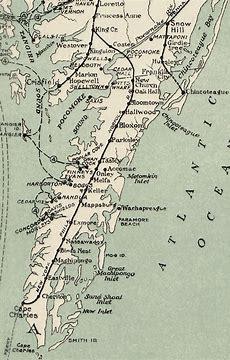
In 1882, Scott continued to shift his business focus toward Virginia and the Delmarva Peninsula. That year he became the owner and president of a new railroad line, the New York, Philadelphia and Norfolk Line. His new railroad was intended to open the otherwise hard-to-visit Delmarva Peninsula both to tourism and to the coal business. Scott was looking for a more efficient route for transporting his Pennsylvania coal to the Norfolk-Hampton docks.
|
|
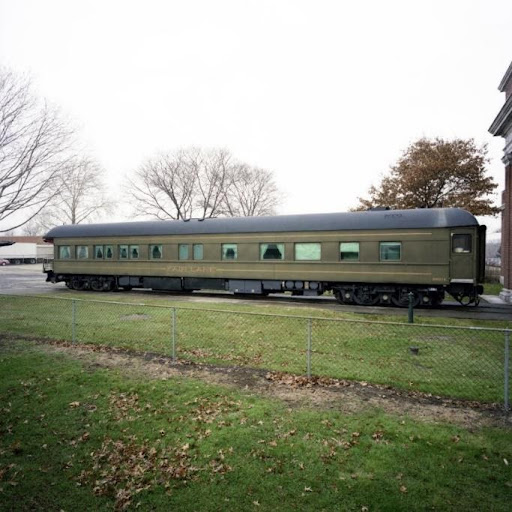
A typical private train car like the one used by William Scott |
|
Like other wealthy industrialists of the era, Scott owned his own railroad car, which had living quarters, a full-time chef, and an office where he entertained business clients. He traveled in it with his wife to Washington and then down the Delmarva that summer as he surveyed and laid tracks for his new railroad. The Delmarva Peninsula is a beautiful natural area blessed with seacoast, lovely southern style foliage, and sensational views of both the Chesapeake Bay and the Atlantic Ocean. Scott recognized the obvious shortcoming of the 19th century Delmarva, however. It ended abruptly and had no transportation connections to the busy Norfolk or Newport regions. Scott’s plan was to connect the southern end of his railroad to Norfolk via railroad car ferry from the tip of the peninsula. |
|
A map of the Delmarva Peninsula, including the new railroad route |
|
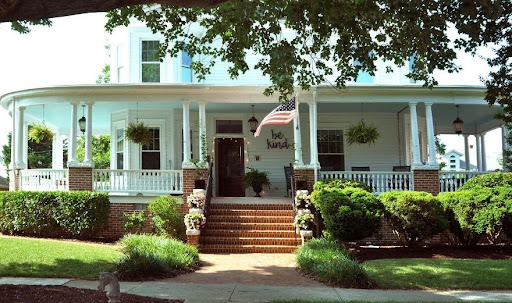
The Scott House in Cape Charles, Virginia became William Scott’s winter home.
|
|
Near the southern end of the Delmarva that year, Scott encountered a pastoral horse farm at Cape Charles that was being sold by the family of the former state governor. He purchased the 3,500-acre spread complete with both racehorses and trotters as well as a stately, southern style home. Scott bought the farm, partially because he wanted to own a winter home to get away from the cold northern winters, and also because of his growing interest in horse breeding. To punctuate his ability to make successful land deals, he cordoned off the farmhouse and horse breeding areas and then developed the rest of the property. Scott’s waterfront property was to become the new city of Cape Charles, Virginia. With a new railroad as well as regular ferry service to the Norfolk region he knew that land values would explode at Cape Charles. And he was correct. When the railroad and ferry service opened in 1884 the new city of Cape Charles, Virginia became the fastest growing area on the coast and William Scott made a fortune on the land development as the city grew exponentially. Also, and quite suddenly, William Scott was the owner of two horse breeding farms. |
|
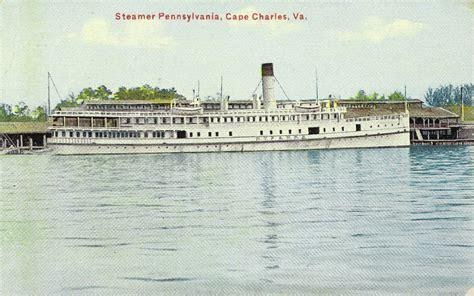
Scott’s railroad-car ferry connected the southerly end of his new railroad with Norfolk. |
|
While he was busy in Virginia, Scott received word that his new hotel had burned to the ground and his farm manager wanted to know if he should begin the process of rebuilding. Scott uncharacteristically said no, that he wanted to consider other options. The hotel business had never seemed comfortable to Scott and now that he had two successful horse farms in Virginia, he decided to shift the focus of his western farm in Erie. Upon his return in 1883, he officially named his west farm “Algeria” in honor of his favorite horse. From 1883 to 1885, he focused all of his attention upon the Algeria Stud Farm, adding new stables and developing grazing fields as well as a three-quarter mile “demonstration track.” He never planned to open a thoroughbred racetrack in Erie. Rather, he would use the track to show off the horses that were to be sold.
If there was to be a new hotel his preference was to place it on the bluff overlooking Presque Isle Bay, where it could serve as a retreat for high-end horse farm visitors from the East. William Scott now had three horse farms, Algeria where he would breed racehorses, and the two Virginia farms where he would stable and race them.
With Erie friends becoming increasingly concerned that Scott would move away and live full-time in his old hometown area of Virginia, he was persuaded to run for the United States House of Representatives. Once more, he agreed to be a candidate but did not campaign. He won easily, serving Congress for two terms from 1885 to 1889. One of his motivations for serving was to be closer to his primary horse breeding operations and new home in Virginia. Another was the network of business connections that he knew that he would be making, especially with respect to the horse breeding and racing operations. Deteriorating health persuaded him not to run for a third term. He also made powerful political allies, such as President Grover Cleveland, whom he counseled. Cleveland, between presidential terms, later attended Scott’s funeral in Erie.
In Erie, Scott reluctantly agreed to let his Algeria Farm manager proceed with rebuilding a replacement excursion hotel below the bluffs and behind his stud farm. The replacement hotel, which opened in 1885 was not as opulent as its predecessor but it was popular and a success for a short time. At the time, the southwestern corner of Presque Isle Bay (Massassauga Point and the Head) was the center for sunbathing and recreation in the area. Presque Isle’s popularity followed much later. Scott, given the time that he was spending away from town, did not think that many of his equestrian connections would be traveling to Erie to stay in a hotel at the upper farm, so he settled for a less-than-perfect replacement.
In 1891, William Scott died suddenly of heart failure while visiting with friends in Rhode Island. Scott’s family insisted that he be returned to Erie and buried, although there was a movement in Cape Charles to have him interred at the new city that he had founded on the Delmarva. Many people in Cape Charles are still convinced that William Scott was from there and not Erie.
The disposition of Scott’s many holdings fell to his daughter, Annie Scott Strong, and her husband, Charles Strong. Scott’s two Virginia horse farms and his winter home in Cape Charles were sold almost immediately. But Annie, who had inherited her father’s proclivity for investing in and holding property, held on to most of the Erie property. Frontier Farm was split in half after West Sixth Street was extended to Lincoln Avenue. Annie’s husband used the area north of the new street for a summer place and the remainder of the Frontier Farm was donated to the city of Erie after the town border was extended to Pittsburgh Avenue. One of the west farm managers, James Whipple, was hired later to change the stud farm to a riding academy and the Girard farm was sold. Annie retained the Harborcreek property and later used it to develop a summer retreat for herself.
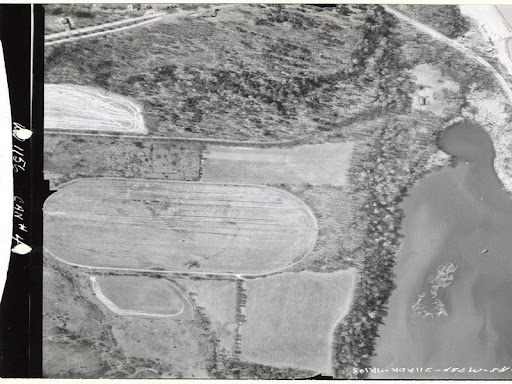
A fuzzy 1923 aerial photograph of the west end of Presque Isle Bay, including the land along the south shore of the water, reveals the mysterious manmade mark in the landscape that we encountered in the 1950s. The photograph was taken 32 years after Scott’s death while Algeria was still operating as a riding academy and stable where ordinary people could board or rent horses. The overgrown track that we had discovered during the 1950s was not quite as obvious 30 years after the photograph (below) had been taken but it was still there; the interrupted dream of a multimillionaire.
|
|
Here is a 1923 aerial photograph taken to help determine where to place the new road
to Presque Isle. (From the Jerry Skrypzak Collection)
|
|
Several still-familiar landmarks can be seen in the photograph. The racetrack that dominates the center of the image has become a baseball field. Also evident were several cleared fields where horses were allowed to graze when they were not exercising. Immediately above (west of) the track there is a path that connected the stables near West Lake Road to the area where the old hotels had once operated (the Head) and eventually became the “Bridle Trail” that led to Presque Isle. That is the first of two visible roadways above the circular track and today’s Presque Isle Boulevard (not Peninsula Drive). Scott had developed that road to deliver patrons to his hotel(s) at the Head.
Above that pathway is a gravel road that once led to the iron ore bogs that were at the Head. That road is almost exactly where today’s Presque Isle Drive is, but in the image above it ended at the Head. The remains of the second (1885) hotel are there but not visible. The small building that can be seen at the end of all three pathways is a caretaker’s cottage.
|
|
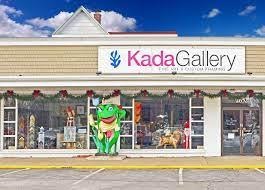
The original Algeria farmhouse has been converted to a gallery at the Colony Plaza.
Note the peaked roof behind the storefront.
|
|
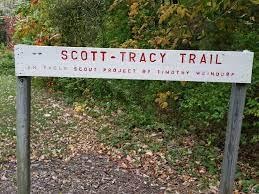
The “wilderness” of our 1950s days has become a lovely park, where it is still possible to observe many of the historic features that once graced the area. While the land to the south of West Sixth Street has been carved into housing developments as well as the contemporary Colony Plaza, the original Algeria farmhouse can still be seen (behind Kada Gallery) rising above the row of stores on West Eighth Street. Until a few years ago when it was destroyed by an arson fire, the original barn was still located behind today’s Brew Ha Ha in the Colony Plaza. The concrete foundation is still there. As a memorial to the Scott and Tracy families there is now a park complete with a BMX racetrack, baseball field, playground, and network of trails on the north side of West Sixth Street. The Tracys – the Scott family friends – have been honored there by the creation of a new school in the Millcreek School District that was built on the southeast corner of the property. |
|
One of the trailheads at the former Algeria Farm memorializes the families of Erie’s enormously successful business leaders of the 19th century, William L. Scott, his brother-in-law John F. Tracy, and Tracy’s father John A. Tracy. |
|
Accidental Paradise Available at TRECF!
Accidental Paradise
by Dr. David Frew and Jerry Skrypzak
|
|
The beautiful book on Presque Isle published by authors David Frew and Jerry Skrypzak – “Accidental Paradise: 13,000-Year History of Presque Isle” – is on sale at the Tom Ridge Environmental Center’s gift shop and through a special website, AccidentalParadise.com.
The book, priced at $35 plus tax and shipping, can be ordered now through the website sponsored by the TREC Foundation, AccidentalParadise.com.
Presque Isle Gallery and Gifts on the main floor of TREC, located at 301 Peninsula Drive, Suite #2, Erie, PA 16505 will also handle sales daily from 10 a.m. to 4 p.m.
For more information, send an email to aperino@TRECF.org.
To watch "Accidental Paradise: Stories Behind The Stories" click here.
|
|
ABOUT THE AUTHOR
Historian and author David Frew, Ph.D., is a Scholar-in-Residence at the JES. An emeritus professor at Gannon University, he held a variety of administrative positions during a 33-year career. He is also emeritus director of the Erie County Historical Society/Hagen History Center and is president of his own management consulting business. Frew has written or co-written 35 books and more than 100 articles, cases, and papers.
|
|
|
|
|
|
|