Quick, Timely Reads
On the Waterfront
|
|
Power of Storytelling: A Grandmother’s Gift |
|
Dr. David Frew, a prolific writer, author, and speaker grew up on Erie's lower west side as a proud "Bay Rat," joining neighborhood kids playing and marauding along the west bayfront. He has written for years about his beloved Presque Isle and his adventures on the Great Lakes. In this series, the JES Scholar-in-Residence takes note of life in and around the water.
|
|
Marc Brown’s drawing of the stables at Algeria Farms |
|
I absolutely love “research rabbit holes.” The more confusing and circuitous the better. Finding weird and esoteric tangents has been the hallmark of my research endeavors since I began doing literature searches in the 1960s. Often the tangents have been more instructive than the primary search objectives. As a rookie researcher, I was often criticized for my seeming proclivity to get lost and take too much time in the obscure. But being a longtime sufferer of ODD (oppositional defiance disorder), I continued, sometimes amusing mentors with “important stuff” that was serendipitously identified.
Writing the “On the Waterfront” series has been no exception. Topics that I originally imagined to be shallow and easy to cover have led in wild and crazy directions, leading to unanticipated and wonderful places. Of all the topics that I have explored, the life, times, and historic markers of William L. Scott may have been the most expansive. And little wonder. Erie’s one-time wealthiest person was involved in land development, coal mining, railroading, hotels, and horse breeding. His daughter Annie and son-in-law Charles Strong continued in Erie for decades after he passed away, shaping the development of Presque Isle State Park, providing fledgling Gannon University with its most important early building, and important philanthropy.
One of my connections to Scott was Algeria Farms, a riding academy that I often passed on the west side of town. My parents and others had described the joys of renting horses at Algeria. Riders could cross West Sixth Street, wind their way along a path that passed today’s Scott Park and continue down the bluffs to the area that is now Sara’s Campground. From there they could continue along the bayside of Presque Isle to Waterworks and circle back. During the first years of the state park there were signs proclaiming that “Horses had the Right of Way.” As kids exploring the remains of this once-venerable local institution, we were able to find traces, but by the 1950s the old farm was being broken up into modern components, including housing developments.
As I hunted for historic Algeria Farms vestiges, I did google word searches and one of the most interesting things that popped up was the cartoon image of Algeria Farms above. I chased the image to a relatively modern television cartoon, which was part of the popular kids show “Arthur.” As I was exploring the Arthur series (books and television), it dawned on me that the creator-author was originally from Erie. Marc Brown, who was born in 1946, is a near contemporary so he would not personally have experienced Algeria Farms. But he grew up on the west side of town near old Algeria and graduated from McDowell High School. He must have had parents or grandparents who had directly experienced Algeria. His reference to Algeria Farms in the cartoon was clearly not an accident. I watched the cartoon on YouTube and, true to the general approach that Brown has taken to his children’s writing, the essence of the story was a sibling controversy.
|
|
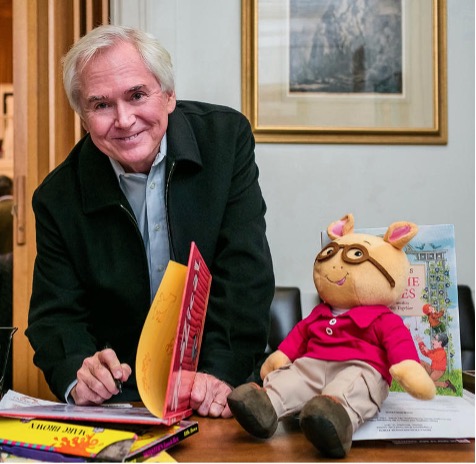
Marc Brown poses at a book signing with his famous character, Arthur. |
|
I was a huge fan of PBS children’s programming during the early 1970s when my children were loyal audience members. I loved Sesame Street, the Electric Company, and Mr. Rogers’ Neighborhood, especially after I had the good fortune to meet Fred Rogers and speak with him. But my three children had moved on before Arthur became regular television fare and I did not know much about the highly successful series. Arthur found his way to television in 1996 and has continued for an astonishing 249 episodes – almost as long as the Simpsons. The television series, which features several anthropomorphic characters, is based upon Marc Brown’s earlier children’s book series. It was developed for television in Boston by Kathy Waugh and is now jointly produced by her and Brown.
No stranger to social controversy, Marc Brown has boldly written about such matters as same-sex marriage families, autism, bullying, and other issues that face modern children. And his style of presentation is not pedantic or authoritarian. He skillfully wraps problems and solutions is comforting stories. In the Algeria Farms story, for example, central character Francine has saved her own money to pay for riding lessons. Her dream is to become an Olympic equestrian. But she has a big sister, Catherine, who has always been better at everything than Francine. A primary difficulty arises when their parents will only allow Francine to go to Algeria Farms to take lessons if her sister accompanies her. Francine is terrified that Catherine will be better than her at horseback riding.
When Marc Brown, consummate storyteller, was interviewed after winning an Emmy Award, he credited his grandmother for his skills. As a child, he was regularly treated to her stories and now realizes that those old narratives from his grandmother are still rumbling about his brain, after decades. She had obviously told him stories about Algeria Farms. As he was thinking about a career, his grandmother encouraged him and helped with the tuition needed to attend art school in Cleveland, Ohio.
|
|
The cartoon Algeria Farms sign |
|
If there are lessons here, they clearly revolve around the power of storytelling. Not everyone will become a successful author or develop the artistic skills of Marc Brown, but we all have the ability to tell stories. And grandchildren need them. Stories and their imbedded lessons allow all of us to understand and solve all kinds of problems. |
|
Does Catherine, Francine’s older and highly successful sister, represent a piece of Marc Brown’s past? Do his children’s stories emanate from old Brown family dynamics? Were they absolutely true? Is it not important? |
|
Accidental Paradise Available at TRECF!
Accidental Paradise
by Dr. David Frew and Jerry Skrypzak
|
|
The beautiful book on Presque Isle published by authors David Frew and Jerry Skrypzak – “Accidental Paradise: 13,000-Year History of Presque Isle” – is on sale at the Tom Ridge Environmental Center’s gift shop and through a special website, AccidentalParadise.com.
The book, priced at $35 plus tax and shipping, can be ordered now through the website sponsored by the TREC Foundation, AccidentalParadise.com.
Presque Isle Gallery and Gifts on the main floor of TREC, located at 301 Peninsula Drive, Suite #2, Erie, PA 16505 will also handle sales daily from 10 a.m. to 4 p.m.
For more information, send an email to aperino@TRECF.org.
To watch "Accidental Paradise: Stories Behind The Stories" click here.
|
|
ABOUT THE AUTHOR
Historian and author David Frew, Ph.D., is a Scholar-in-Residence at the JES. An emeritus professor at Gannon University, he held a variety of administrative positions during a 33-year career. He is also emeritus director of the Erie County Historical Society/Hagen History Center and is president of his own management consulting business. Frew has written or co-written 35 books and more than 100 articles, cases, and papers.
|
|
|
|
|
|
|