|
2026 GENERAL ASSEMBLY LEGISLATION OVERVIEW
I am pleased to share with you an overview of the legislation passed this session by the General Assembly. These measures have a direct impact on our community and the state.
CHILDCARE & EDUCATION
🚩CO-SPONSORED Higher Education (SB007) repeals language preventing the Maryland Higher Education Commission (MHEC) from issuing an initial Douglas J.J. Peters Veterans of the Afghanistan and Iraq Conflicts Scholarship award after June 30, 2030.
Child Care Scholarship Program - Freeze in Enrollment - Exceptions and Waitlist (HB 849) ensures that during any Child Care Scholarship enrollment freeze, vulnerable families—including those receiving public assistance, children experiencing homelessness, and siblings of enrolled children—can still access the program, while requiring the State to maintain a prioritized waitlist.
Education - The Blueprint for Maryland's Future - Revisions (SB311) Increases State investment in public education—particularly for low-income students—reducing the need for families to pay out of pocket for academic supports and enrichment. By expanding school-based services and career readiness pathways, it also helps lower long-term education and workforce costs for students.
Student Electronic Communication Device Use Policy - Establishment (Joanne C. Benson Maryland Phone-Free Schools Act) (SB928/HB525) The Maryland Phone-Free Schools Act ensures students can focus on learning by requiring schools to limit cell phone and social media use during the school day, while still allowing reasonable exceptions for health, accessibility, and educational needs.
Comprehensive Outcomes and Measures of Progress for Supporting Schools (COMPASS Act) (HB1582)
The COMPASS Act modernizes Maryland’s school accountability system by updating how school performance is measured, placing greater emphasis on student growth, school quality, and equitable outcomes rather than overreliance on standardized testing.
CRIMINAL JUSTICE & CIVIL RIGHTS
🚩CO-SPONSORED Police Training Autism and Dementia (LEAD Act of 2026) (SB745) requires all entrance-level and in-service police training to include certain training regarding individuals with intellectual and developmental disabilities, dementia and autism.
🚩CO-SPONSORED Commission on the House of Reformation and Instruction for Colored Children (SB776) will research the history, operations, and resident deaths at the House of Reformation and Instruction for Colored Children and provide a complete and public accounting of the children who died and were buried on the grounds in a report to the Governor and General Assembly by December 31, 2029.
🚩CO-SPONSORED Criminal Procedures – Victims of Sexually Assaultive Behavior (SB531) Prohibits police from asking victims of sexual assault to verbally agree to give up their legal rights during an interaction.
🚩CO-SPONSORED Criminal Law-Identity Fraud-Artificial Intelligence and Deepfake Representations (SB009) strengthens Maryland’s identity fraud laws by banning the use of stolen or fake identities—including fictional ones—and the use of AI or deepfake technology to harm, harass, intimidate, threaten, or defraud others. It also allows victims to go to court for help, such as stopping the behavior, and clarifies existing penalties.
Criminal Law - Third-Degree Assault (SB514) Creates a new, lower-level offense for minor, non-injurious “offensive contact,” separating it from more serious assault charges. It reduces penalties for these minor offenses and allows individuals to seek expungement after a period of time.
Criminal Procedure – Protection of Identity of Victim of Sexual Assault or Stalking (SB 294) strengthens privacy protections for victims of sexual assault and stalking by requiring courts to redact identifying information from case records unless disclosure is justified by clear and convincing evidence.
Criminal Law - Sexual Offense by a Person in a Position of Authority (SB407/HB501) Creates a new felony offense for sexual misconduct by individuals in positions of authority (i.e. teacher, coach, tutor), increasing penalties for repeat offenders, and requiring more serious offenders to register as Tier III sex offenders.
Criminal Law - Firearm Crimes - Machine Gun Convertible Pistols (SB334) Prohibits the manufacture or sale of Glocks and other similarly manufactured semi-automatic pistols that can easily be converted into machine guns with common household tools including glock switches.
Voting Rights Act of 2026 - Counties and Municipal Corporations (SB255) Prohibits local election systems that dilute the voting power of racial or language minority groups and ensures they can elect candidates of their choice.
Juvenile Court - Jurisdiction, Detention, and Confinement (Youth Charging Reform Act) (SB323) Limits the automatic charging of youth as adults and restricts the placement of youth in adult facilities, ensuring age-appropriate treatment within the justice system.
ECONOMIC DEVELOPMENT & ACCOUNTABILITY
🚩CO-SPONSORED Economic Dev – Rural Readiness Program and Rural MD Capacity Building Fund (SB300/HB461) creates a Rural Readiness Program to help rural communities prepare for economic development. It also sets up a grant fund that offers up to $50,000 to eligible participants who complete the program to support local planning and capacity‑building projects.
🚩CO-SPONSORED Dept of Budget & Management – Audit and Finance Compliance Unit (SB858) requires the Governor to establish oversight systems; directs the Unit to monitor and assist departments in correcting audit findings; authorizes preventive measures; and permits direct assistance to departments with four or more repeat audit findings.
🚩CO-SPONSORED State Finance – Delinquent Federal Funds (SB828) authorizes the Department of Budget and Management’s Central Collection Unit, working with the Attorney General, to recover federal funds owed to the State by the federal government.
🚩CO-SPONSORED Anne Arundel County Residential Property Tax Payment Deferrals (SB109) - expands eligibility for a property tax deferral program in Anne Arundel County.
Family Investment Program - Temporary Cash Assistance - Good Cause and Adequate Reason Exceptions (HB1490) Ensures that families receiving Temporary Cash Assistance are not denied, reduced, or terminated from benefits if they have valid reasons for not cooperating with child support requirements like domestic violence, safety risks, or family crises, while simplifying the process to claim “good cause.”
Economic Development - Small, Minority, and Women-Owned Business Accounts - Management Fees (Small Business Increased Access to Capital Act) (SB920) Ensures more funding in State investment programs goes directly to small, minority-, and women-owned businesses rather than excessive fees. This is important because it expands access to capital and helps create a more equitable and inclusive economy.
Food Retailers and Third-Party Food Delivery Service Providers - Dynamic Pricing and Personal Data (Protection From Predatory Pricing Act) (SB387/HB895) Prohibits food retailers and third-party delivery services from using “dynamic pricing” or personal data to charge different prices to different consumers for the same goods, and bars discriminatory pricing based on protected characteristics.
Business Regulation - Cemeteries - Requirements for Sale or Transfer or Government Acquisition (SB233) Strengthens protections for cemeteries by requiring state approval and public notice before a cemetery can be sold or repurposed, ensuring input from descendants and the community.
Commercial Law - Earned Wage Access - Revisions (SB094) Prohibits payday loan apps from charging hidden fees and abusive interest rates.
FAMILY LAW
🚩CO-SPONSORED Family Law - Temporary and Final Protective Orders - Duration (SB433/HB497) Strengthens protections for survivors by extending temporary protective orders from 7 to 14 days and requiring final protective order hearings to occur within 14 days of issuance.
Public Information Act - Divorce Records (SB426) protects privacy in divorce proceedings by requiring public records custodians to deny access to most divorce-related records, including financial filings and custody orders, while still allowing access to final divorce decrees. Records remain available to parties involved, their attorneys, or others authorized by a court.
HEALTHCARE
Hospitals - Emergency Pregnancy-Related Medical Conditions – Procedures (SB169) Closes a gap in federal enforcement created by the rollback of guidance under EMTALA, ensuring Maryland hospitals are still required to provide emergency screening, treatment, and stabilization for all patients, including those experiencing pregnancy-related emergencies and guarantees access to lifesaving care— including medically necessary abortion services—while protecting providers who act in the best interest of patient safety.
Health Insurance - Scalp Cooling Systems - Required Coverage (SB272) Requires certain health insurance plans to cover scalp cooling systems for cancer patients undergoing chemotherapy to help prevent hair loss.
Health Occupations, Public Health, and Insurance - Menopause - Provider Training Coverage Requirements, Policy Initiatives, and Access to Care (SB892) Expands access to menopause care by requiring insurance coverage for evaluation and treatment of menopause-related conditions, while also improving provider training and increasing access through statewide policy and reporting initiatives.
Public Health - Recommendations for Immunizations, Screenings, and Preventive Services - Pharmacist Administration and Required Health Insurance Coverage (The Vax Act) (SB385) Requires Maryland’s Health Secretary to issue statewide recommendations for immunizations and preventive services and allows pharmacists to administer certain vaccines to individuals age 7 and older.
HOUSING/REAL PROPERTY
🚩CO-SPONSORED Landlord and Tenant - Discrimination in Housing for Income-Based Housing Subsidies and Positive Rental History Reporting (SB335) Strengthens housing protections by prohibiting landlords from denying applicants simply because they use housing vouchers or have limited or imperfect credit tied to periods without assistance. It also gives tenants the option to build credit through positive rent payment reporting.
Land Use - Permitting - Development Rights (Maryland Housing Certainty Act) (SB325) Provides predictability for housing development by ensuring projects are reviewed under the laws in place when an application is submitted and granting developers vested rights for approved projects for at least five years. It also delays the collection of development impact fees until construction is complete, helping reduce upfront costs and support housing production.
Criminal Law - Counterfeiting and Possession of Counterfeit Lease of Real Property - Penalty (SB082) Expands Maryland’s counterfeiting law to include fake leases and rental agreements, making it a felony to create or use or possess a phony lease and carries up to 10 years in prison.
UTILITIES
Utility RELIEF Act (HB1532) Reduces energy costs for Maryland families by increasing oversight of utility spending, limiting excessive cost recovery, and requiring large energy users to pay a fairer share. Specifically, the Utility RELIEF Act:
- Reduces annual bills by more than $150 per year on average from the limited portion of costs within Maryland’s control;
- Holds utility companies accountable, requiring greater State oversight of federally approved projects totaling $3.5 billion in actual and projected spending, and capping what utilities can recover for supervisor pay;
- Builds on the Next Generation Energy Act from last Session to further force data centers to pay an increased price for the energy they consume and infrastructure upgrades their construction requires;
- Invests $100 million to bring new in-state clean generation online as quickly and efficiently as possible to fight back against Trump policies driving up electric bills by attacking renewable projects; and
- Streamlines existing energy assistance programs while supporting the State’s new Limited Income Mechanism program, which could save eligible low-income households up to $1,400 annually.
AN OVERVIEW OF MARYLAND’S FY2027 BUDGET
This year, we passed a balanced $70.8 billion state budget despite a $1.4 billion projected shortfall and growing economic uncertainty. We closed that gap through a combination of targeted spending reductions, fund transfers, and disciplined budgeting—without broad-based tax increases. While overall general fund spending was constrained, we continued to prioritize critical investments in education, public safety, healthcare, and energy assistance. We also maintained strong state reserves, helping ensure Maryland remains prepared for future economic uncertainty. Every decision was guided by a focus on affordability and fiscal responsibility, ensuring Maryland families are supported during a challenging economic moment, even as we continue to navigate long-term structural budget pressures.
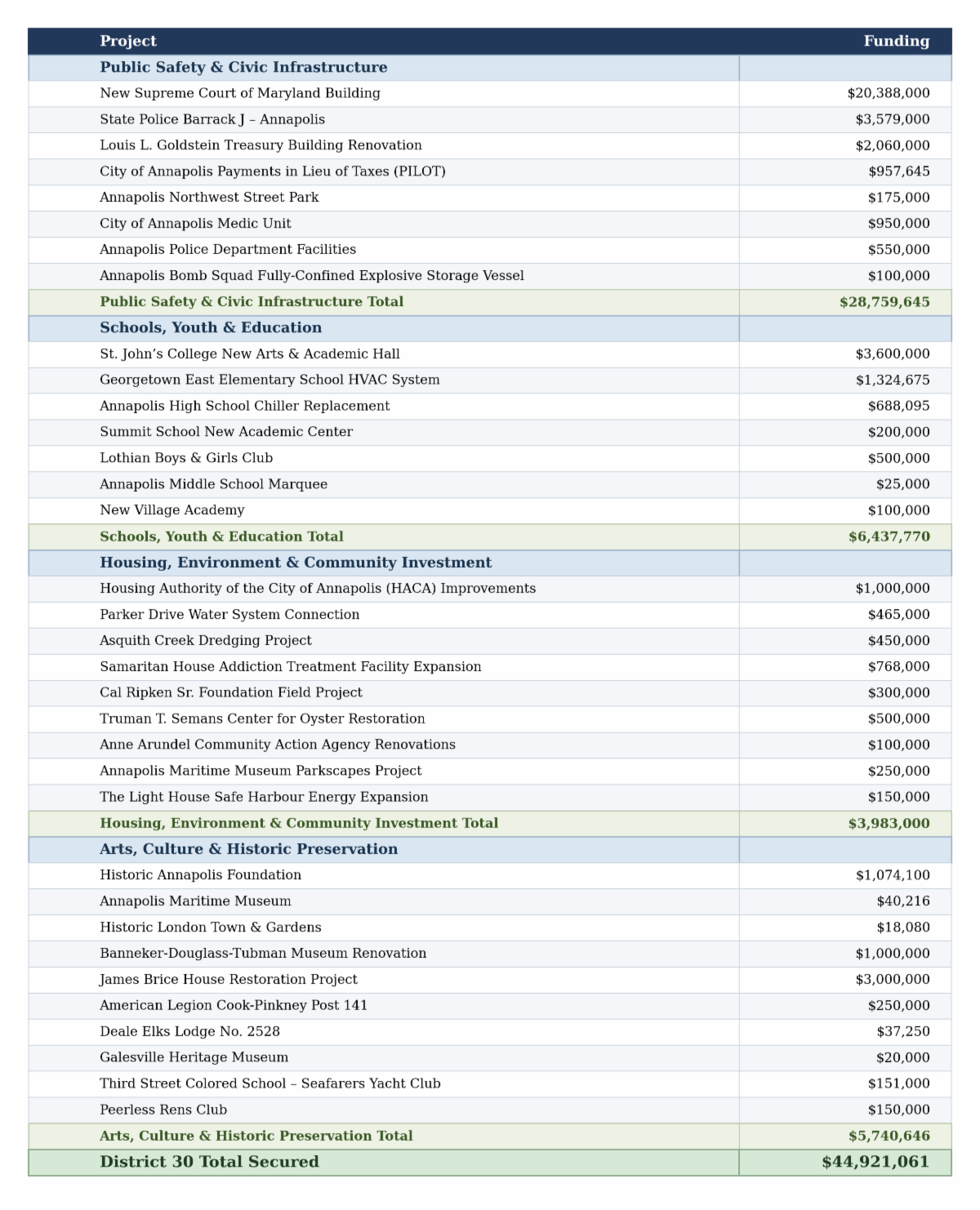
In this year’s budget, we secured more than $44.9 million in state funding for District 30—supporting critical investments in public safety, schools, housing, environmental infrastructure, and cultural preservation across our communities.
|