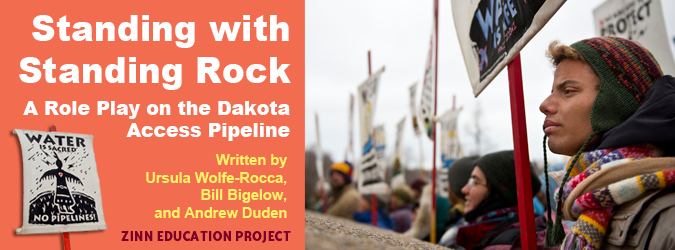
The election of Donald Trump has left many people asking where can we find hope. But it's the wrong question.
We don't find hope, we make it.
One shining example is
the struggle of the Standing Rock Sioux water protectors to prevent the Dakota Access Pipeline
----the "black snake"
----from destroying sacred sites and threatening their source of clean water. The outpouring of solidarity from other Indigenous people, climate activists, clergy, labor activists, veterans
----and teachers
----has been remarkable. And pushed by this activism, the Army Corps of Engineers has blocked the pipeline's completion
----at least for now.
The teaching activities
help students grasp the issues at stake in the historic struggle of the Standing Rock Sioux for recognition of their treaty rights and for clean water for all. Please download these and share them widely.
Article by Ursula Wolfe-Rocca
The more I read and learned about the Standing Rock resistance to the Dakota Access Pipeline, the more obvious it became that
this story must make its way into my curriculum. Here was a fascinating and important story
----a story that literally cannot be told without recognizing Native peoples as full participants in their own, and U.S., history.
I put out a call to other teachers, educators, and activists who might be interested in collaborating on some curriculum.
Our first and most important goal was to create a context for students to confront the complex social reality of the Dakota Access Pipeline and the resistance movement to which it has given rise. That social reality includes the history and contemporary status of Indigenous rights, the power of the fossil fuel industry, the support for pipeline infrastructure from segments of organized labor, and the extent to which our government is protecting----or failing to protect----the land, water, and air
.
|