|
Spring lake fishing is finally here! The fishing starts a bit slow with cold water temps (March), then accelerates rapidly through April into May & early June. April fishing can be excellent, but May into early June is the peak opportunity. As the water warms, trout and aquatic insects become more active. As hatches occur the fishing can be incredible. When you find an area where trout are actively feeding you can expect a strike on every cast.
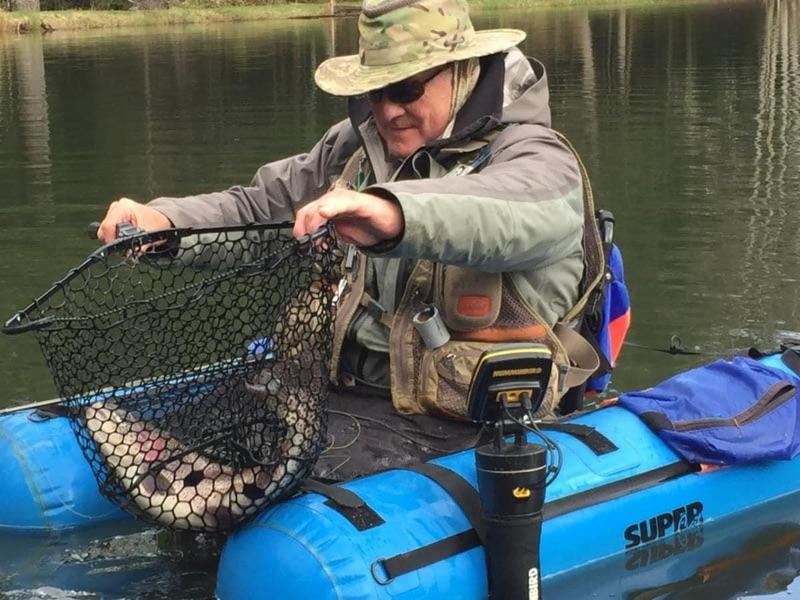
The following all relates to fishing from a float tube/pontoon or regular boats. If bank fishing – your options are really limited.
Where will you find the trout in spring? The shallow areas! The areas that by June will see weed beds up to the surface. Why? The shallows are where the largest concentration aquatic insects are. By shallow, I mean from five feet of depth all the way into one foot of depth.
You will need to move your float tube/pontoon slowly and cast. I fished Mundo Lake in late March. Water was 47 degrees at the surface. The wind was up a bit with a good chop on the water. Caught six trout at twenty inches: ALL hit the fly in two to three feet of water! (Several more slipped the hook.) Also caught many
smaller trout.
How can you measure the depth without a depth finder? Your rod tip. With a nine-foot rod held tip down, slowly push the rod tip down until you feel the bottom. You’ll know when you’re at five feet of depth just by looking at the rod in the
water. Of course – buy a depth finder and you won’t have to clean the crud off your rod!
Another way to know you are “in the zone” as far as a shallow feeding area is the water surface. Trout feeding in the shallows disturb the water surface. Not talking about rises here. The water surface will bulge and reflect light differently
from a wind chop or calm water. You’ll also see flashes from trout moving around. We’ve all seen this is rivers.
Just get a depth finder and accelerate your fish catching. This device is important for knowing the bottom depth and depth variations. (More on this in the future.) A good basic finder is the Hawkeye Electronics FishTrax 1C model, with the Kayak Mount. Another one is the Huminbird 140C model – only available used, and, it will cost as much as new. (Don’t get me started on Humminbird.)
General tips for spring lake fishing:
Weather: If high winds are forecast – just don’t go. I’ve been in enough high wind situations to know. If caught in a high wind – get shallow and use your feet on the bottom to move. Yes, this does work, but it sucks.
Wind: Other than trying to flip you over, wind is your best friend out fishing. A wind chop provides cover for you and the trout. Makes it so much easier to catch them in shallow water.
Retrieves: Remember to slow down your trolling and your casting retrieves. If you are not getting hits, go slower.
Retrieve types: My basic retrieve after casting is three hand twists or three, 4-6 inch pulls, followed by a pause. Vary the pause first before changing the pull speed.
Presentation: Cast across the wind so that your fly is presented broadside to the trout. Trout almost always face into the wind. The trout like to see their prey in full profile. The windward side of the lake is generally best for fishing. The wind blows spent and hatching bugs to the trout. Also, the bottom gets stirred up and the fish like that.
Fly size: In Spring, you fish large buggers (size 8 and 6). The trout are hungry and want to eat….now! My normal bugger size is a ten. In Fall, I go twelve and fourteen. In Spring – go big!
The bite: In April, the activity starts around 10 AM and goes to about 2-3 PM. This “window” expands through Spring, starting earlier and finishing later. In May to June, count on a 9 AM start and a 4 -5 PM finish. The exception is first and last light minnow pattern fishing in the shallows.
That’s it for now.
Dave Klosterman
|