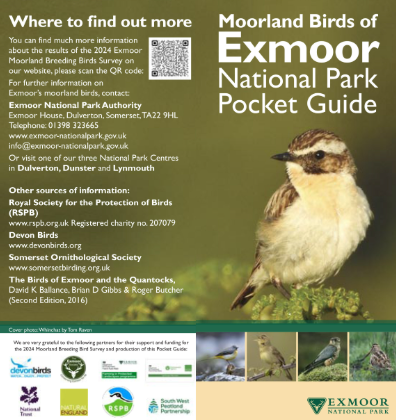
A new Moorland Bird report and pocket guide has been launched by Exmoor National Park Authority, (ENPA) to provide valuable information for nature lovers, farmers applying for new support schemes and to contribute to Natural England’s SSSI condition monitoring.
The report is based on an extensive survey covering all of Exmoor’s moorland (c17,000 hectares), with support from partners such as the RSPB, during the breeding season of last Spring and Summer. The full results have been collated and released, along with a complete bird map for moorland landowners and a free pocket guide for enthusiasts that can be picked up at any one of our National Park Centres.
Although Exmoor has seen some species losses, which may be at least partly due to changes in climate, there have been some real winners particularly in response to the work of the Southwest Peatland Partnership, of which the National Park Authority is part. Restored peatlands on Exmoor help it remain a stronghold for important species like Grasshopper Warbler, Reed Bunting and Snipe. Other moorland birds that have increased in Exmoor are Whinchat, Linnet, Stonechat, Tree Pipit, Willow Warbler, Grey Wagtail and Kestrel.
Read the full report and get more info on these birds here
Senior conservation officer for ENPA Ali Hawkins said:
“We were very excited to lead the Moorland Breeding Survey and it’s an essential baseline for landscape scale projects across Exmoor moorland. Exmoor’s moorland provides vital habitats for the upland and farmland birds that have suffered considerable declines in other parts of the UK. There’s been some fantastic work carried out by our brilliant moorland bird survey team (led by Juan Castello), who were out every day before dawn, tirelessly surveying every corner of moorland on Exmoor.
They recorded over 35,000 birds and over 9,000 environmental variables, providing us with useful habitat data to create an invaluable picture of how our moorland birds are faring and the state of the moorland itself. We’d particularly like to thank landowners who have been working with our rangers on access for survey work to take place. It provides valuable information for farmers entering new support schemes and it will also contribute to Natural England’s SSSI condition monitoring.”
Species data was recorded and the condition of moorland vegetation assessed, as this can affect breeding birds. The survey area included all the moorland Sites of Special Scientific Interest (SSSI) and the Exmoor Heaths ‘Special Area of Conservation’. Funding for the survey, together with data analysis and reporting has been secured from partners including the Exmoor Society, Natural England, South West Peatland Partnership, the National Trust, Devon Birds and from the Exmoor Heartlands Landscape Recovery Project.
|