|
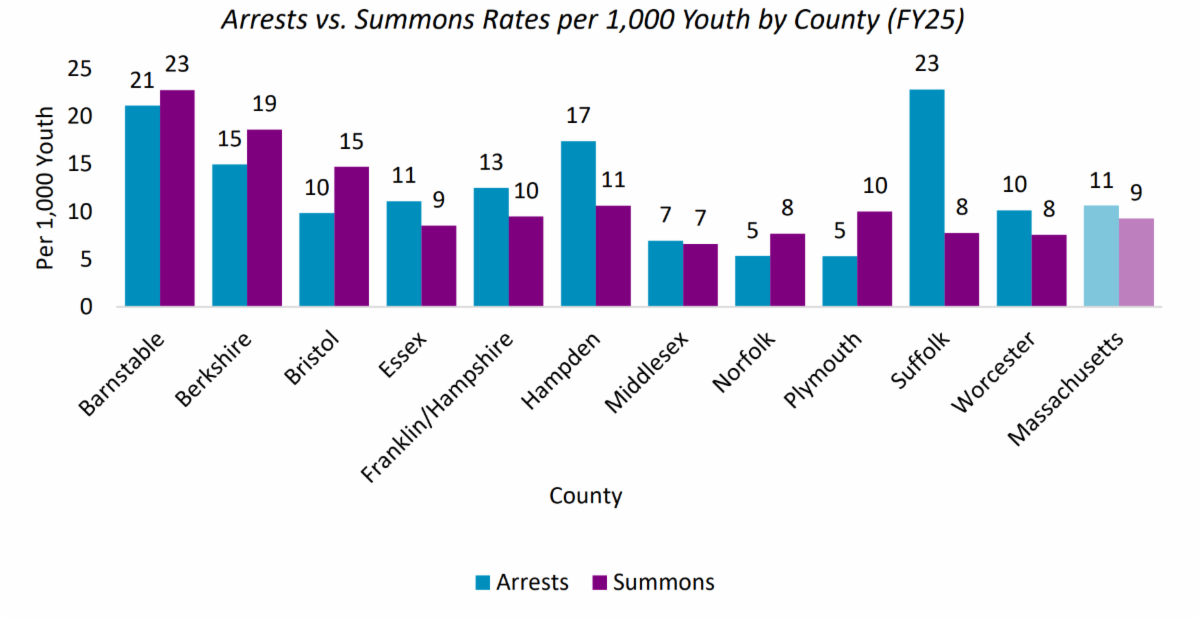
Source: OCA Juvenile Justice Data Brief County Level Breakdowns
Suffolk County had the highest arrest rate in the Commonwealth, with 23 per 1,000 youth arrested vs. only 8 per 1,000 summonsed. Suffolk is followed by Hampden and Franklin/Hampshire Counties, with 17 arrests per 1,000 vs. 11 summonses per 1,000 and 13 arrests per 1,000 and 10 summonses per 1,000 respectively. Research cited by the OCA shows that youth who are arrested can continue to feel long-term negative effects such as school disengagement, psychological harm, and mental health concerns.
Because cases initiated by arrest typically cannot be diverted by clerk-magistrates, high arrest rates also most likely drove higher rates of delinquency filings. Suffolk and Hampden counties had the second and third highest rates of delinquency filings in the state, behind Essex County. Lowering arrest rates would allow more youth to be diverted from the Juvenile Justice system entirely and be held accountable at the community level.
Uneven Detention Practices
After arraignment, Suffolk and Worcester counties had the highest rates of placing youth in pretrial detention, with 41 youth and 36 youth out of every 100 arraignments experiencing detention at some point in the process for each county respectively. These high detention rates cannot be fully explained by the seriousness of alleged offenses. While Suffolk County had a higher percentage of arraignments for felonies than the state average, there are counties with similar rates that had lower pretrial detention rates, such as Bristol and Norfolk Counties. This may be because youth were more likely to be held on a cash bail in Suffolk than in any other county, with 37% of detentions resulting from being held on bail.
A young person being arrested instead of summonsed, or held on bail, can mean spending weeks in detention and missing out on school and other pro-social activities before their case is even resolved. Counties with lower rates of pretrial detention and greater utilization of summons permit young people to avoid traumatic arrest and detention experiences, prove to the court that they can abide by conditions in the community and remain connected to important, beneficial activities while their cases are pending.
Different Dismissal Rates
Suffolk, Middlesex, Essex, and Norfolk counties had higher judicial dismissal rates than the state average (68%), with 88%, 78%, 72%, and 72% of cases dismissed in each county respectively. Plymouth and Hampden counties had the lowest rates of dismissal, both at 49%. High dismissal rates point to opportunities to increase the use of diversion, which has proven to be highly successful over the past few years.
|