New Study: Anti-Discrimination Clauses in Higher Education Collective Bargaining Agreements

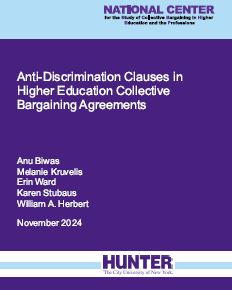
The National Center for the Study of Collective Bargaining in Higher Education and the Professions at Hunter College is pleased to announce its latest publication: Anti-Discrimination Clauses in Higher Education Collective Bargaining Agreements. Download the study here.


The study is based on research that led to the publication in September of our 2024 Directory of Bargaining Agents and Contracts in Higher Education.


The purpose of this study is to assist negotiators, labor representatives, and administrators in developing, amending, and implementing anti-bias contract provisions.


The study includes excerpted anti-discrimination text from 30 collective bargaining agreements negotiated by different nationally-affiliated unions and institutions at all levels of higher education from across the country involving tenured and tenure track faculty, non-tenure track faculty, postdoctoral scholars and academic researchers, and graduate student employees.


For each contract, the monograph includes the contract's anti-discrimination clause and the relevant negotiated procedure concerning enforcement when the contract does not permit, limits, or modifies the use of the standard grievance-arbitration procedure to enforce the anti-discrimination clause. In addition, the monograph includes a hyperlink to each contract to permit the contextualization of the excerpted provisions within the terms of the entire agreement.


KEY FINDINGS


  • While most anti-discrimination clauses explicitly prohibit discrimination based on race, religion, color, national origin, sex, sexual orientation, age, disability, and union activity, there are wide differences with respect to other protected categories.


  • Over the course of time, anti-discrimination clauses have changed, reflecting the historical context during which they were negotiated. Examples of those changes over the years are prohibitions against discrimination based on civil union status, HIV status, and Vietnam-era veteran status.


  • Recent contract clauses have expanded protections against discrimination to include caste; citizenship status; immigration status; ancestry; marital or parental status; status as a victim of domestic violence, sexual assault or stalking; gender expression; gender identity; genetic information; height; weight; arrest record; military status; veteran status; or unfavorably discharged from military service. Only one contract has an anti-discrimination clause limited to prohibiting discrimination based on union activity.


  • Certain contracts expand upon sex as a protected category to explicitly address sexual harassment and sexual misconduct, as well as faculty-student relationships. The most detailed definitions of sexual harassment, with special procedures for investigating and remedying sexual harassment complaints under Title IX and anti-discrimination clauses, are in contracts involving postdoctoral scholars and graduate student employees.


  • A significant difference among the contracts is the agreed-upon means of enforcement. Some contracts permit discrimination claims to be processed under the regular grievance-arbitration procedure. Others modify those procedures for handling discrimination issues and some agreements exclude alleged violations of the anti-discrimination clause from the grievance process. Lastly, some parties have opted to condition the arbitration of a discrimination grievance on the employee waiving her or his rights to pursue statutory discrimination claims in court or other external forums.

Advance Praise for Anti-Discrimination Clauses in Higher Education Collective Bargaining Agreements


"Collective bargaining offers unions and institutions of higher education a mechanism for establishing comprehensive, legally binding anti-discrimination provisions. In contrast to aspirational declarations, negotiated contracts can manifest concrete commitments to equitable practices and equal opportunity. This important new study by the National Center provides valuable insights into this domain. The research highlights exemplary and innovative contractual language addressing discrimination, as well as other collaborative approaches undertaken by unions and administrators to combat discriminatory practices in academic settings. The study's findings are particularly relevant in the current sociopolitical climate, where diversity, equity, and inclusion initiatives on college campuses face increasing scrutiny and opposition. By codifying anti-discrimination measures within collective bargaining agreements, institutions and unions can establish a robust framework for maintaining equitable practices, even in the face of external pressures."


Ana Avendaño, Visiting Associate Professor of Law, City University of New York School of Law


"Anti-Discrimination Clauses in Higher Education Collective Bargaining Agreements will be an extremely powerful bargaining tool in pursuit of well-tailored examples of anti-discrimination contract provisions relevant to particular workplaces. The contractual anti-discrimination provisions concretely and efficiently presented in this work will carve out joint union-employer commitments to rid workplaces of arbitrary and pernicious discrimination. Picking up where legislatures leave off, these clauses will help unions and institutions build upon state and federal legislative foundations of justice. I cannot recommend this work highly enough."


Michael C. Duff, Professor of Law, Saint Louis University School of Law and co-director of the Wefel Center for Employment Law


"Drawing on the treasure trove of the National Center’s 2024 repository of collective bargaining agreements, this monograph provides tools for both unions and employers in higher education. It is an excellent resource for negotiating provisions aimed at preventing, eliminating, and remedying employment discrimination in colleges and universities. With its many examples of contract provisions, the monograph can be used by negotiators to go above and beyond statutory minimums to create a collective bargaining agreement that advances towards the goal of inclusive, fair, and just institutions of higher education."


Risa L. Lieberwitz, Professor of Labor and Employment Law, School of Industrial and Labor Relations, Cornell University

National Center for the Study of Collective Bargaining in

Higher Education and the Professions

 Hunter College, CUNY

www.hunter.cuny.edu/ncscbhep

msavares@hunter.cuny.edu