|
NEMWI Weekly
Update
December 15th, 2025
| |
| |
NEMWI To Host Event on
Great Lakes Marine Sanctuaries
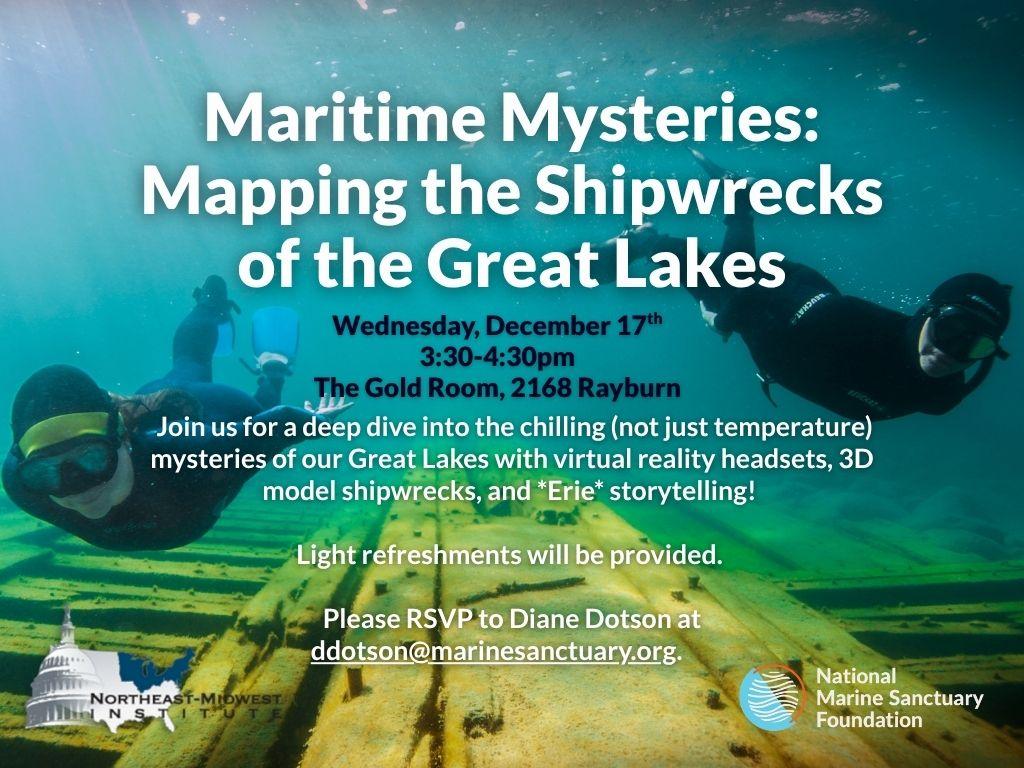
The Northeast-Midwest Institute and the National Marine Sanctuary Foundation will co-host a Congressional briefing on Great Lakes marine sanctuaries on Wednesday, December 17th, from 3:30-4:30 p.m. in Rayburn 2168. The briefing is a session of NEMWI’s Great Lakes Primer and Orientation Program, sponsored by the Erb Family Foundation.
Join us for a deep dive into the chilling mysteries of the Great Lakes with virtual reality headsets, 3-D shipwreck models, and *Erie* storytelling!
Covering about 10,000 miles of coastline, America’s Great Lakes serve as gateways for trade and tourism, centers for biodiversity and science innovation, and underwater museums for national maritime heritage. Only about 15% of these lakebeds are mapped to modern standards, leaving huge gaps in the data needed to create updated nautical charts, discover untold stories and shipwrecks, and manage the region’s extraordinary natural and cultural resources. The recent designations of national marine sanctuaries in the Great Lakes have led to intensive mapping efforts and new discoveries by NOAA and its commercial, academic, and federal partners.
The answers to many maritime mysteries lie in the depths of these largely unexplored waters, preserving evidence and glimpses into the past, for those who dare to discover. The briefing will focus on the network of America’s premier marine places in the Great Lakes and the new discoveries, innovative technologies, and immersive experiences benefiting their communities.
Light refreshments will be provided.
Please RSVP to Diane Dotson at ddotson@marinesanctuary.org.
| | |
House Passes Great Lakes Fishery Reauthorization Act
The House of Representatives passed the Great Lakes Fishery Research Reauthorization Act today under suspension of the rules, sending the bill to the President to sign.
The bill seeks to reauthorize the U.S. Geological Survey’s Great Lakes Fishery Research program, which would otherwise expire at the end of this fiscal year, for five years until 2030. This program supports the USGS’ Great Lakes Science Center, which conducts research to inform fishery management across the Great Lakes Basin, with $15 million yearly. The Great Lakes Science Center performs research critical to the region’s $5 billion fishery.
Continued investment is necessary to safeguard the health of the lakes and protect the industries that depend on them, especially as the Great Lakes face growing pressures from climate change, pollution, and shifting ecosystem dynamics. Reauthorization is especially critical given proposed reduction-in-force notices at the Department of the Interior that would have cut the Great Lakes Science Center’s workforce by 79%. Because of the continuing resolution passed last month, those RIFs have been halted at least through January.
For these updates and more, see NEMWI’s Great Lakes and Water Policy Legislative Tracker here.
| | | |
Lamprey Populations Down to Pre-Pandemic Levels, GLFC Finds
The Great Lakes Fishery Commission (GLFC) released their 2025 Status of Sea Lamprey Control report today, finding decreases in 3-year average adult sea lamprey abundances in four of the five Great Lakes from 2024 to 2025. In total, 37,800 lampreys were captured, just below the average of 38,167 from 2017-19. This indicates that lamprey populations, which spiked when the Covid-19 pandemic limited the GLFC’s lamprey control program, are returning to pre-pandemic levels as the normal control program has resumed. Lake Ontario estimates are emblematic of the success of the program in driving lamprey populations back down. In 2023, the GLFC estimated adult lamprey abundance at 56,000. In 2024, it was 22,374, and in 2025 it numbered 11,584, just above the target of 10,000.
These results highlight the need for a full program; in the absence of lampricide treatment, even for a brief period, lamprey populations will rebound. “As we saw in 2022 and 2023, sea lamprey populations easily skyrocket when control efforts are relaxed,” GLFC vice chair Earl Provost said. “We are just now getting back to a semblance of what it was like before the COVID-19 pandemic, but there is still much work to do.” Earlier this year, potential funding and staffing disruptions threatened the lamprey control program. Ultimately, reversals of staffing cuts and a hiring freeze at the U.S. Fish and Wildlife Service allowed the continuation of critical work to protect the Great Lakes fishery.
“The Great Lakes mean a great deal to the millions of people living, working, and recreating in the basin,” said Ethan Baker, chair of the GLFC. "This $5.1 billion industry will crash if sea lamprey populations get out of control again. No one wants to have a repeat of the early days when it was hard to find a fish without a sea lamprey wound. So, we are going to continue working hard—in collaboration with federal, state, provincial, and Indigenous partners—to make sure sea lamprey control will continue without pause."
| | | |
Research Presented on Plastic Pollution in the
Great Lakes
Professor Matthew J. Hoffman on December 4 presented research from the Rochester Institute of Technology aimed at better understanding the transport and circulation of plastic pollution in the Great Lakes. The event was part of the Cooperative Institute of Great Lakes Research’s (CIGLR) Great Lakes Seminar Series. Researchers used NOAA’s operational hydrodynamic models and custom-built code to simulate the plastic particle properties, including variables such as differentiating densities, beaching, deposition, and biofouling particles.
Major population centers along the coastal Great Lakes, such as Chicago, Toronto, Cleveland, and Detroit, serve as the primary sources of plastic pollution. The researchers found that nearly 10,000 metric tons of plastic debris enter the Great Lakes every year from both Canadian and United States coastlines. Furthermore, they hypothesized the existence of a garbage patch in the middle of the Great Lakes, based on gyrocirculation trends and previous oceanic research. However, using current data from 2009 to 2014 provided by NOAA Great Lakes Coastal Forecasting System, the simulation model showed no evidence of such a garbage patch. This raised the question: where is the plastic in the lakes going?
In an experiment conducted in Kenora, Ontario, Hoffman and a collaborative research team released three different types of microplastics, each with distinct densities, into a lake. The scale of the experiment was equivalent to adding just over one cup of microplastics to an Olympic-sized swimming pool. The amount of plastic in the water column decreased very rapidly, as the small pellets dispersed. Ultimately, the researchers collected less plastic than they initially released. The investigation remains ongoing, but they hypothesize the missing plastics may reside in ice, burials, surfaces, biota, and shoreline environments.
Reported by NEMWI Intern Christina Uytingco, University of Michigan
| | | |
Connect With the Northeast-Midwest Institute
on Social Media
The Northeast-Midwest Institute is on social media with new updates and information on its regional research and policy education program and with announcements for upcoming briefings and events. NEMWI is posting our research reports on current regional issues and ongoing policy education on the page to make keeping up with our policy work easier than ever. The Institute also is updating the page with announcements of upcoming policy briefings and webinars. NEMWI is excited for the opportunity to connect with as many people as possible.
Please check out our LinkedIn here, our Twitter/X here, our Facebook here, and our Bluesky here. Be sure to like and follow us to keep up to date with NEMWI!
On Bluesky, also check out our Great Lakes feed at "NEMW Great Lakes Feed" and if you are a Great Lakes organization on Bluesky, contact Great Lakes Program Manager Alex Eastman at aeastman@nemw.org so that we can add your posts to the feed!
| | | |
|
Great Lakes Events
(all times eastern)
| | | | | |