|
NEMWI Weekly
Update
July 21st, 2025
| |
| |
NEMWI Hosts Briefing on Great Lakes Compact
On Thursday, July 17, NEMWI hosted the fourth session of the Great Lakes Primer and Orientation Program, made possible with the support of the Erb Family Foundation, on the topic of the Great Lakes Compact. The briefing highlighted the pivotal role of the Great Lakes St. Lawrence River Basin Sustainable Water Resources Compact (“Great Lakes Compact”), a legally binding agreement that protects Great Lakes water from out-of-basin diversions and helps develop and implement water management and water conservation and efficiency goals and programs. Panelists included Peter Johnson and David Naftzger, Deputy Director and Executive Director, respectively, of the Great Lakes St. Lawrence Governors & Premiers, and two of the architects of the Compact.
In order to ensure an equal playing field of understanding in the audience, Naftzger and Johnson gave a comprehensive overview of the scope and justification of the Great Lakes Compact. The presentation began with an overview of the Great Lakes St. Lawrence Governors and Premiers, an organization rooted in economic and environmental collaboration between the region's American and Canadian chief executives.
Naftzger and Johnson described how the Compact was drafted, and what makes it so successful. Through a process including 5 years of talks, 60 public meetings, 13,000 comments, and the legislative procedures of 8 states and Congress, the Great Lakes Compact became state and federal law with over 95% of legislators voting in favor.
Central to this success was the collaborative and inclusive process that shaped the Compact itself. Tribes and First Nations were welcomed as participants at the discussion table, contributing to a stronger, more comprehensive agreement. Naftzger and Johnson noted that a shared understanding of the cultural importance of water and responsible water management brought these groups together.
Building on this theme, Johnson added that while the Compact sets shared, clearly defined goals, “each of the states has taken a different approach” to implementation. The decentralized yet cooperative structure of the Compact allows flexibility and functionality across varied geographic and political landscapes, essential to its success.
Looking ahead, Naftzger and Johnson acknowledged the ever-changing nature of water demand. Especially given the changing electricity production landscape as well as the rise of data centers, the panelists indicated their intent to commission comprehensive water demand forecasts to ensure preparedness.
To conclude their presentation, Naftzger and Johnson highlighted the important role of the Great Lakes Compact in ensuring our water resources are protected. “Our water is arguably our greatest competitive advantage aside from our people,” Naftzger said. Continuing to communicate and work together on agreements like the Great Lakes Compact, is “critical for the region and for our country.”
Reported by NEMWI interns Megan O’Neil and Bennet Roman, University of Michigan
| | | |
Appropriations Committees Advance FY26 Bills
The House and Senate Appropriations Committees voted last week to advance several appropriations bills, giving more insight into what FY26 government funding could look like.
In the Senate, the Commerce, Justice, and Science bill was advanced 19-10 in a bipartisan vote that was complicated by language about the relocation of the FBI headquarters. Most notably, the bill pushes back against proposed cuts to NOAA. It would fund NOAA at $6.1 billion, a reduction from FY24 levels of $6.7 billion, but an increase over the President’s Budget request of just $4.5 billion. NOAA’s National Ocean Service would be funded at $673 million, a slight increase over FY24 levels, and vastly more than the $434 million requested in the President’s Budget. NOAA’s Office of Oceanic and Atmospheric Research, which the President’s Budget would have eliminated, would be funded at $657 million, $1 million above FY24 levels.
The bill rejects the proposed elimination of a number of Great Lakes programs. The Great Lakes Environmental Research Laboratory, Integrated Ocean Observing System, Sea Grant College Program, Sea Grant Aquaculture Program, Harmful Algal Bloom Competitive Research Account, and the Center of Excellence for Ocean and Great Lakes Mapping, all of which were slated for termination in the President’s Budget, would be restored, funded at or (in the case of IOOS) slightly above their FY24 enacted levels.
The committee reports for the bills also included language pushing back against proposed cuts. In response to the proposal to eliminate the Ocean Laboratories and Collaborative Institutes account, which contains GLERL, the report reads: “The Committee expects NOAA to request funding these cooperative institutes at appropriate levels in future years, including well-established institutes focused on... fisheries management; long-term monitoring of oil spill impacts on marine and freshwater ecosystem health; coastal resilience; ...hypoxia and HABs."
The report also responded to staffing cuts. “The Committee is concerned that staffing losses will affect the agency’s [NOAA’s] ability to fulfill its statutory responsibilities, including the delivery of timely and accurate weather forecasts vital to public safety,” it states. “The Committee notes that sufficient staff funding has been provided and encourages NOAA to expedite efforts to address mission critical vacancies," it continues.
The House Appropriations Committee passed the Energy and Water and Transportation, Housing and Urban Development bills in party-line votes. The THUD bill would fund the Port Infrastructure Development Program at $123.5 million, slightly above current levels, but far below the $550 million request in the President’s Budget. The Energy and Water would provide $12.9 for the Brandon Road Lock and Dam project and $176.6 for the new Soo Locks. It would also restore funding for the Great Lakes Authority at a reduced level of $3.75 million.
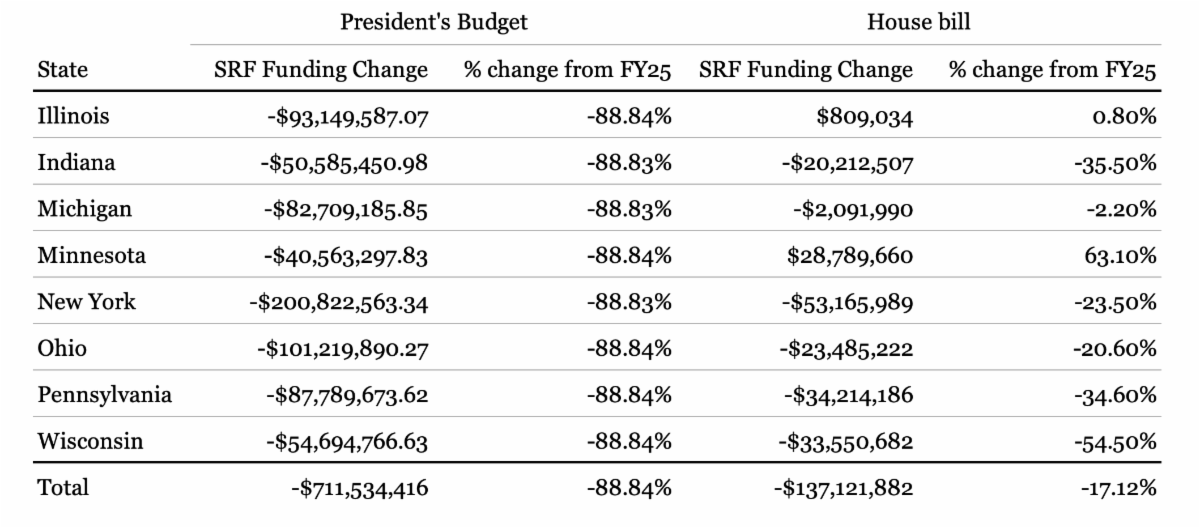
The Alliance for the Great Lakes has also conducted a state-by-state analysis of the House Interior-Environment Appropriations Bill’s funding for the Clean Water and Drinking Water State Revolving Funds. Because of broad disparities in funding for earmarks, Great Lakes states would see a wide range of outcomes. Minnesota, which would receive more than three times as much money through earmarks as through base SRF funding, would see a 63% boost in funding over FY25. Wisconsin, on the other end of the spectrum, would see its SRF funding decline by 54.5%. And while the cuts in the House bill, at 24%, would be far less than the proposed 90% cut in the President’s Budget, Great Lakes states would still see their water infrastructure funding fall significantly, by 17% in total.
| |
Source: Alliance for the Great Lakes analysis of State Revolving Fund cuts in the House Interior-Environment bill and the President’s Budget
Looking ahead, the House Appropriations Committee is scheduled to markup the Interior-Environment, State and Foreign Operations, and Commerce, Justice and Science bills this week, while the Senate looks to tackle the Interior-Environment and Transportation, Housing and Urban Development bills. NEMWI will provide analysis of those bills as they advance, and you can find the House and Senate bill reports as they stand here.
| |
House Appropriations Subcommittee Advances Commerce, Justice, and Science Bill
The House Subcommittee on Commerce, Justice, Science, and Related Agencies held a hearing on Tuesday, July 15, to discuss the appropriations bill for fiscal year 2026. A major topic of discussion in this hearing was funding for the National Oceanic and Atmospheric Administration (NOAA), particularly its weather forecasting infrastructure and workforce.
Democratic members of the Subcommittee raised strong concerns about many of the proposed reductions to the budget, including its cut to NOAA, which it would fund at $5.8 billion, below the Senate level of $6.1 billion. Ranking Member Grace Meng (D-CA) criticized the bill’s $2.1 billion in cuts, warning that they could undermine the ability to provide timely care and disaster prevention across the country. “These cuts,” she said, “will betray our fundamental responsibility to keep Americans safe and our economy strong.”
Rep. Rosa DeLauro (D-CT) also expressed alarm over the long-term impact of repeated funding constraints. She pointed to previous freezes in funding, which she said have delayed NOAA’s ability to procure vital forecasting tools such as weather radars and satellites. She noted that recent staffing reductions have affected scientists responsible for tracking extreme weather events. “These cuts are not numbers on a page,” she said. “At NOAA, the Trump Administration has dismissed several weather service forecasters and other critical employees, endangering American communities.” Concerns were also raised about how reduced funding has already resulted in fewer weather balloon launches and less consistent data collection – all of which impair early warning systems and disrupt emergency planning at the state and local level.
Republican members supporting the bill emphasized broader fiscal goals, including reducing discretionary spending across federal agencies, though it is also notable that the bill rejects most of the cuts proposed by the Trump administration. While debate continues over final appropriations levels, the hearing underscored the divide between those seeking to scale back federal investment and those calling for robust support of scientific infrastructure and public safety systems. The bill has now advanced to the full House Appropriations Committee, which will mark up the bill this week.
Reported by NEMWI Intern Anhat Makkar, Brown University
| |
House SST Hearing Takes a Look at AI Weather Models, Highlights Support for NOAA
The House Committee on Science, Space, and Technology’s Subcommittee on the Environment convened a hearing on Wednesday, July 16, titled “Protecting Lives and Property: Harnessing Innovative Technologies to Enhance Weather Forecasting.” The session brought together experts in atmospheric science, artificial intelligence, and public-private forecasting partnerships to examine how innovative tools can improve weather prediction and community safety.
Subcommittee Chair Scott Franklin (R-FL) and Committee Chair Brian Babin (R-TX) opened the hearing by emphasizing the critical role of accurate forecasting in saving lives, particularly in light of recent deadly flash floods in Central Texas. Citing both agricultural dependence and growing climate threats, members of Congress and expert witnesses reinforced the urgent need to modernize forecasting infrastructure. Testimony was provided by: Mr. Thomas Cavett, Tomorrow.io; Dr. John Nielsen-Gammon, Texas State Climatologist; Dr. Waleed Abdalati, University of Colorado Boulder; and Dr. Jayesh Kumar Gupta, Silurian AI. The witnesses detailed advances in AI-powered weather models, commercial satellite constellations, and new data assimilation methods. Tomorrow.io’s Cavett discussed the importance of private investment in accelerating forecasting capabilities and describing how commercial technology can complement and enhance public weather services. Dr. Gupta noted that while physics-based modeling still plays a role, the future of forecasting lies increasingly in AI-driven approaches.
Both Dr. Nielsen-Gammon and Dr. Abdalati spoke to the importance of federal funding in science. Dr. Nielsen-Gammon advocated for increasing the number of NOAA radars, especially for rural areas. Dr. Abdalati discussed newly emerging drone technologies and spoke to their value and potential in complementing current practices.
Lawmakers broadly supported NOAA’s efforts to integrate commercial data and expand forecasting capabilities through partnerships with the private sector. However, multiple members, including Reps. Zoe Lofgren (D-CA), Suzanne Bonamici (D-OR), and Deborah Ross (D-NC), raised concerns about recent proposals to reduce NOAA’s workforce and budget, potentially threatening the agency’s core mission. In advocating for NOAA’s work, Rep. Bill Foster (D-IL) cited a tornado in Naperville, Illinois, where close coordination between local officials and the National Weather Service directly saved lives. Rep. April McClain Delaney (D-MD) cited the hundreds of lives saved at Western Point Elementary School during a flood in Maryland.
Rep. Gabe Amo (D-RI) and others highlighted the risk of a "brain drain" from federal expertise if staffing shortages persist Multiple lawmakers referenced the 27% cut to NOAA in the President’s Budget and a 17% workforce reduction. “I do not believe in finger-pointing, but I do believe in using data…” Rep. McClain Delaney said. “We need to make sure that before we start to defund and break things, that we are staffed up and really understand the impact.”
Reported by NEMWI Intern Eloise Wyatt, Bates College
| |
Energy and Commerce Subcommittee Holds Hearing on Chemical Recycling
The Subcommittee on Environment held a hearing last week evaluating next steps to promote the growth of U.S. domestic recycling operations. The Subcommittee heard from the following witnesses: Ross Eisenberg, President, America’s Plastic Makers, American Chemistry Council; Matt Bedingfield, Executive Vice President of Commercial Strategy and Growth, Mint Innovation; Dan Felton, President and CEO, Flexible Packaging Association; and Keefe Harrison, Founder and CEO, The Recycling Partnership.
In their opening statements, committee members and witnesses asserted the need to expand the capacity and effectiveness of the recycling system, with a special focus on e-waste. In his opening statement, Chairman Gary Palmer (R-AL) reflected on the increasing accumulation of e-waste, citing “billions of dollars of losses” due to the lack of a circular economy. Ranking Member Paul Tonko (D-NY) cited the need for foundational improvements to the American recycling system, including improved data, accessibility, education, and transparency.
Though the hearing included a comprehensive review of the domestic recycling landscape, committee members paid extensive attention to chemical/advanced recycling. Committee members underscored the potential for recycling to feed the domestic supply chains of the growing manufacturing sector. Witnesses echoed these sentiments, but highlighted the current limited capacity of chemical recycling in the United States. Notably, in his opening statement, Rep. Bedingfield emphasized the impacts of America’s lack of e-waste recycling infrastructure. America, he said, either exports or landfills the vast majority of our e-waste, which accounts for 70% of the hazardous materials and heavy metals in our landfills. In order to expand the domestic chemical recycling industry, witnesses Eisenberg, Bedingfield, and Felton advocated for federal government classification as a manufacturing activity, which would loosen regulation of the industry.
Committee members and witnesses alike acknowledged the environmental and human health benefits of recycling. Notably, Rep. Schakowsky (D-IL) expressed concern for plastics pollution in Lake Michigan, and Rep. Griffith (R-VA) sought clarity regarding the dangers of microplastics. In response to Rep. Schakowsky, Harrison highlighted the unique ability of the federal government to promote better environmental stewardship. Specifically, she advocated for the passage of the CIRCLE Act, which creates a federal recycling infrastructure investment tax credit and the STEWARD Act, which supports recycling infrastructure in rural communities. Both of these are bipartisan pieces of legislation. She also supported EPR legislation, which would hold businesses accountable for the recycling of their products. In response to Rep. Griffith, Eisenberg emphasized the need for more research regarding the causes and effects of microplastic pollution.
In addition, representatives from the Northeast and the Midwest advocated for causes close to home. Rep. Miller-Meeks (R-IA) discussed the lack of access to recycling services in Iowa. She highlighted her recently introduced bill, the Recycling Infrastructure and Accessibility Act, which would establish a pilot grant program targeting communities without a recycling plant within 75 miles. Also, Rep. Menendez (D-NJ) highlighted a first of its kind EPR law for EV batteries passed in New Jersey, although Bedingfield noted that while the U.S. does engage in chemical recycling for e-waste, regarding EV batteries, “we don’t have the processes here in many instances to recover it back to the cobalt, nickel, lithium… to be reused. That’s what’s being exported.”
Reported by NEMWI Intern Ben Roman, University of Michigan
| |
NEMWI Releases Updated Great Lakes and Water Legislative Tracker
Key provisions of H.R. 4192, the Military PFAS Transparency Act, introduced by Reps. Kristen McDonald Rivet (D-MI) and Jack Bergman (R-MI) and cosponsored by Reps. Debbie Dingell (D-MI), Brian Fitzpatrick (R-PA), and Jen Kiggans (R-VA), Co-Chairs of the bipartisan Congressional PFAS Task Force, have been incorporated into the House and Senate versions of the National Defense Authorization Act (NDAA), a major step forward for the bill.
The Military PFAS Transparency Act would require the Department of Defense (DoD) to submit annual reports detailing remediation efforts at each contaminated site, including the funds spent, the progress made, and the timelines for completion. Furthermore, the bill requires the DoD to “submit… a remediation acceleration strategy,” which will make cleanup more efficient by prioritizing certain sites based on risk, establishing timelines for cleanup, and increasing PFAS testing capacity. The bill also requires the DoD to create a public online dashboard with PFAS cleanup data, funding, timelines, and community points of contact for each contaminated site.
Elsewhere, three new bipartisan bills with significant implications for the Great Lakes and surrounding Northeast and Midwest regions have recently been introduced and added to the NEMWI’s Great Lakes and Water Legislative Tracker. Of particular regional importance is H.R. 4375, introduced by Rep. Kristen McDonald Rivet (D-MI) with cosponsors Reps. Tony Wied (R-WI) and Max Miller (R-OH). This bill directs the U.S. Coast Guard to submit a comprehensive strategy to Congress for completing the design and construction of a new Great Lakes icebreaker. The icebreaker is critical for maritime commerce, emergency response, and national security on the often-icy Great Lakes.
In addition, H.R. 4256, introduced by Rep. Dave Min (D-CA), would reauthorize the Digital Coast Act, enhancing coastal data accessibility and resilience planning tools which are vital for shoreline communities in the Great Lakes region facing increasing flood risks and erosion due to climate change. H.R. 4294, introduced by Rep. Sarah Elfreth (D-MD), establishes a pilot program to support the sale of blue catfish harvested from the Chesapeake Bay Watershed. This initiative has potential benefits for invasive species management models applicable to aquatic ecosystems in the Great Lakes. These bills reflect a continued federal focus on supporting infrastructure, sustainability, and economic resilience in water-centered communities across the northeast and midwest.
Discussed in previous tracker updates, the Protecting Firefighters and Advancing State-of-the-Art Alternatives Act (PFAS Alternatives Act) introduced by Rep. Debbie Dingell (D-MI-6) has been gaining support in Congress, with a total of 54 co-sponsors as of July 16, 2025. The full tracker is available here, and the Institute will continue to track newly introduced legislation as it emerges.
| |
Connect With the Northeast-Midwest Institute
on Social Media
The Northeast-Midwest Institute is on social media with new updates and information on its regional research and policy education program and with announcements for upcoming briefings and events. NEMWI is posting our research reports on current regional issues and ongoing policy education on the page to make keeping up with our policy work easier than ever. The Institute also is updating the page with announcements of upcoming policy briefings and webinars. NEMWI is excited for the opportunity to connect with as many people as possible.
Please check out our LinkedIn here, our Twitter/X here, our Facebook here, and our Bluesky here. Be sure to like and follow us to keep up to date with NEMWI!
On Bluesky, also check out our Great Lakes feed at "NEMW Great Lakes Feed" and if you are a Great Lakes organization on Bluesky, contact Great Lakes Program Manager Alex Eastman at aeastman@nemw.org so that we can add your posts to the feed!
| | | |
|
Great Lakes Events
(all times eastern)
| | | |
In the House:
Hearing: Oversight hearing titled Permitting Purgatory: Restoring Common Sense to NEPA Reviews.
Tuesday, July 22nd | 10:15 AM | 1324HR Longworth HOB
Host: Committee on Natural Resources
Hearing: Strengthening American Energy: A Review of Pipeline Safety Policy.
Tuesday, July 22nd | 10:30 AM | 2322 Rayburn HOB
Host: Committee on Energy and Commerce | Subcommittee on Energy
Markup: Fiscal Year 2026 Interior Environment and Related Agencies Bill
Tuesday, July 22nd | 10:30 AM | 2359 Rayburn HOB
Host: Committee on Appropriations
Markup: Weather Act reauthorization Full Committee Markup
Wednesday, July 23rd | 10:00 AM | 2318 Rayburn HOB
Host: Committee on Science, Space, and Technology
Markup: Fiscal Year 2026 National Security Department of State and Related Programs Bill
Wednesday, July 23rd | 10:00 AM | 2359 Rayburn HOB
Host: Committee on Appropriations
Markup: Fiscal Year 2026 Commerce Justice Science and Related Agencies Bill
Thursday, July 24th | 10:00 AM | 2359 Rayburn HOB
Host: Committee on Appropriations
In the Senate:
Hearings to examine the road ahead, focusing on proposals to improve America's transportation infrastructure.
Wednesday, July 23rd | 3:00 PM | SD-562
Host: Committee on Environment and Public Works | Subcommittee on Transportation and Infrastructure
Markup: Interior, Environment, and Related Agencies Appropriations Act, 2026 and Transportation, Housing and Urban Development, and Related Agencies Appropriations Act, 2026
Thursday, Jul 24, 2025 | 9:30 AM | SD-106
Host: Committee on Appropriations
| | | | |