|
NEMWI Weekly
Update
March 9th, 2026
| |
| |
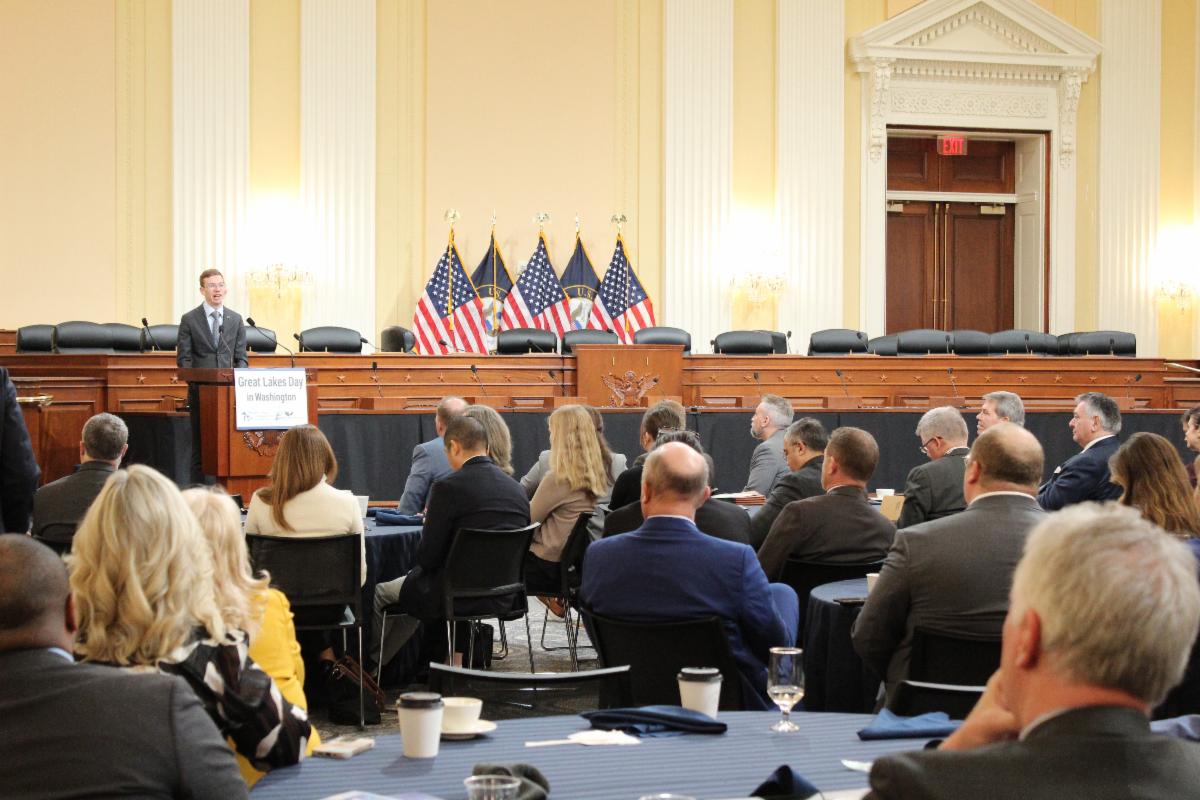
NEMWI and GLC Co-Host 2026 Great Lakes Congressional Breakfast
The Northeast-Midwest Institute and the Great Lakes Commission co-hosted the annual Great Lakes Congressional Breakfast Reception on Thursday, March 5th, on Capitol Hill. The Breakfast is an opportunity for Great Lakes stakeholders to hear from their Representatives and Senators about critical Great Lakes issues, and it leads into the outreach and advocacy efforts on Great Lakes Day. This year, nine Representatives, six Senators, and two Canadian Members of Parliament addressed the Breakfast. Speakers represented both parties and communities from all across the Great Lakes basin.
Many speakers at the Summit highlighted the importance of multinational cooperation in protecting the Great Lakes. United States and Canadian speakers alike told stories of cross-border partnerships that contribute to a flourishing environment and economy in both countries around the lakes. Speakers also talked about the need to reauthorize the GLRI to build on recent successes in restoration such as the delisting of Muskegon Lake. Shipping and ship building were also major topics of discussion.
Speakers at this year’s Congressional Breakfast, listed in order of their remarks, included: Sen. Bernie Moreno (R-OH), Rep. Debbie Dingell (D-MI), MP Terry Duguid, Canadian Sen. Jim Quinn, Sen. Elissa Slotkin (D-MI), Rep. Pete Stauber (R-MN), Sen. Dick Durbin (D-IL), Rep. Bill Huizenga (R-MI), Rep. Frank Mrvan (D-IN), Rep. Tim Walberg (R-MI), Rep. Jack Bergman (R-MI), Rep. Hillary Scholten (D-MI), Sen. Gary Peters (D-MI), Rep. Marcy Kaptur (D-OH), Rep. Nick Langworthy (R-NY), Rep. Brad Schneider (D-IL), Sen. Tammy Baldwin (D-WI), and Sen. Jon Husted (R-OH).
Alongside Great Lakes Week events, the Great Lakes Commission along with other Great Lakes organizations released their 2026 Federal Joint Priorities. They include appropriating no less than $500 million for the GLRI, funding the Drinking Water and Clean Water State Revolving Funds at the fully authorized level, and supporting measures to address contaminants like PFAS, microplastics, nutrient pollution, and other toxic substances that threaten Great Lakes water quality.
| |
| | |
Help Us To Improve the NEMWI Weekly Update!
Thank you for reading NEMWI's Weekly Update newsletter! We’re always looking to make it a better product, and we want to ask for your help! We would appreciate you taking the time to fill out this quick survey to tell us how you use the newsletter, what you like and what you don’t, and how we could improve it going forward. It shouldn’t take more than three minutes. Thank you!
| | | |
Subcommittee on Environment Holds Hearing
on Reauthorization of EPA’s Brownfields Program
The House Energy and Commerce Subcommittee on Environment held a hearing on Wednesday, March 4th, to discuss four draft bills for reauthorizing the EPA’s Brownfields Program through FY2031. Providing witness testimony were Chris Wells, Executive Director of the Mississippi Department of Environmental Quality; Gerald Pouncey, Senior Counsel for Taft Stettinius & Hollister; Alan Tomson, Mayor of Davis, West Virginia; and David Robinson, Executive Vice President of Strategic Development for Aligned Data Centers.
At the opening of the hearing it was noted that since the program’s inception, more than 42,000 sites have been assessed and 12,000 made ready for redevelopment through projects that have leveraged $44 billion and nearly 230,000 jobs. Through FY2025, each dollar the federal government awarded through multipurpose, assessment, revolving loan fund, and cleanup cooperative agreements leveraged approximately $20 in additional investment. During the hearing, lawmakers across the aisle highlighted the program’s success as a tool for restoring blighted, contaminated properties to productive uses that stimulate local revenue enhancement and job creation while preserving greenfields. In his opening statement, Chairman of the Subcommittee on Environment Rep. Gary Palmer (R-AL) urged his fellow legislators to “[look] for opportunities to accomplish the compatible goals of siting crucial infrastructure…and encouraging remediation and reuse of idle or underutilized properties.”
Bipartisan consensus has been reached in the legislative proposals for increasing CERCLA Section 104(k) funding for multipurpose, assessment, revolving loan fund, and cleanup grants, waiving cost-share requirements for small and disadvantaged communities, and raising the cap on brownfields awards from $500,000 to $1 million. Rep. Frank Pallone (D-NJ), Ranking Member of the Energy and Commerce Committee, however, remarked that certain provisions in the majority’ proposals “unnecessarily imperil this bipartisan program” and would “create backward incentives that prioritize polluting interests over local control.” For instance, the Brownfields Revitalization for a Better Tomorrow Act would expand eligibility for grants to certain for-profit limited liability companies and update the EPA’s grant application ranking criteria to promote brownfield remediation for “nationally significant infrastructure facilities” supporting artificial intelligence, critical mineral refining, semiconductor manufacturing, and energy generation from all power resources. Rep. Paul Tonko (D-NY), Ranking Member of the Subcommittee, noted that this provision would replace the existing prioritization for renewable energy and energy efficiency projects. He also expressed concern that the majority’s proposals would strain “limited, over-subscribed assessment and remediation grants” and siphon resources away from the projects communities most desire, like parks and affordable housing.
Tomson, representing the National Brownfields Coalition to testify to the impact of the program in local communities, noted that “any increase in grant awards is welcome” but argued that making LLCs eligible for brownfields funding would dilute the resources available to public sector entities. “The program in its current construct works very well,” he stressed. “If we open it up to the private sector, that makes it more difficult for local governments and municipalities and nonprofits to seek the scarce dollars in the program.”
According to Robinson, sites historically purposed for industrial use are particularly attractive for data center development, owing to the existing power generation and transmission infrastructure and favorable industrial zoning. Tomson, however, stressed that municipal redevelopment projects should not have to compete with multibillion-dollar private sector developments for the same funding. For municipalities, “it’s all or nothing,” he said. “We can’t do it without the Brownfields Program. But a data center complex or a power plant—those entities can build those with the existing resources that they already have.” He emphasized the need to “put those facilities in an appropriate location that doesn’t have secondary effects that are detrimental to people or to other factors supportive of jobs revenue.”
Rep. Rob Menendez (D-NJ) pressed on the public health, environmental, and quality of life impacts of data centers for nearby residents. According to Tomson, a Harvard and MIT study found that a natural gas power plant proposed on a site within his town to support a nearby data center complex would incur an added $19-35 million a year in medical costs. Rep. Greg Landsman (D-OH) also expressed concern about whether such data center projects risked recontaminating the water and soil of remediated brownfield sites, though Robinson denied the leakage of chemicals from Aligned’s facilities.
Regarding the discussion about EPA grant eligibility, Wells urged legislators to consider an “all of the above” approach that would empower communities to “recruit whatever type of economic development is best suited for them,” cautioning against any solution that would “categorically exclude” private sector entities. Multiple legislators inquired how the EPA’s program could better support public-private partnerships, especially in rural and manufacturing-heavy districts that “often face difficulty recruiting private industry.” Pouncey described that high upfront cleanup costs, regulatory hurdles, and CERCLA liability exposure hinder private developers. For smaller developments, environmental due diligence “is often prohibitive,” costing five to ten times more than what it would on a comparable greenfield site. He endorsed the creation of a database identifying brownfield sites and their key characteristics, like proximity to utilities and transportation corridors—a proposal reflected in the Brownfields Inventory and Permitting Efficiency Act. This law would direct the EPA and states to compile a publicly-available repository of sites suitable for nationally significant infrastructure facilities, as well as mandate states to allocate at least five percent of the awards they receive for brownfields assessment, cleanup, and redevelopment to developing this inventory.
Reps. John Joyce (R-PA), Earl Carter (R-GA), Gabe Evans (R-CO), and Scott Peters (D-CA) questioned the witnesses about expediting the permitting process to accelerate brownfields remediation. While Pouncey asserted that such reform would have a “tremendous impact,” Tomson warned that communities like his “need protection. We can’t…forget about the human cost trade-off.” The Brownfields Inventory and Permitting Efficiency Act would provide a NEPA exemption for federal authorizations concerning nationally significant infrastructure facilities located on a brownfield site.
A key theme throughout the witness testimony was the crucial role state brownfields response programs play in providing technical and financial assistance to localities with limited staffing to navigate cleanup and redevelopment on their own. Wells urged legislators to ensure robust support at the state and Tribal level by increasing Section 128(a) grant funding, which he cited as “among the most effective state-federal partnership programs that we have” and “the most efficient way to provide non-competitive brownfields…assistance to small, rural, and low-capacity public entities and nonprofits.” Pouncey likewise commented that the “biggest return on investment is when these [federal] dollars have gone to support state brownfield programs doing the work on the ground.” Tomson echoed the importance of these programs, as well as EPA regional technical assistance centers: “it’s leveraging their knowledge, their expertise, that allows [rural communities] to be successful.” It was noted that the Brownfields Reauthorization for an Affordable and Revitalized America, offered by the minority, would substantially increase the authorization of appropriations for the EPA Brownfields Program and state response programs through FY2031.
Find the full hearing here.
Reported by NEMWI Intern Samantha Malcolm, University of Michigan
| |
| | |
House Natural Resources Subcommittee Holds Hearing on Migratory Bird Treaty Act
The House Natural Resources Subcommittee on Water, Wildlife, and Fisheries held an oversight hearing on Wednesday, March 4, on the Migratory Bird Treaty Act, which implements 20th-century conservation treaties that the United States entered into with Canada, Mexico, Japan, and Russia to protect migratory bird populations.
Subcommittee Chair Rep. Harriet Hageman (R-WY) in her opening statement spoke to the importance of migratory birds to the hunting and bird watching industries. The Migratory Bird Treaty Act, she said, has helped address historical threats such as DDT contamination. She views the intersection of bird habitat and power generation to be an emerging issue. “I look forward to discussing how we can better protect migratory birds from power generation and ensure utility providers have the tools necessary to safely and responsibly deliver power to our ratepayers,” she said.
In her opening statement, subcommittee Ranking Member Rep. Val Hoyle said that 100 million Americans partake in some kind of bird-related activity, such as bird watching, and that these activities generate $279 billion in economic output, support 1.4 million jobs, and contribute $108 billion in direct spending on birding-related expeditions and supplies. Furthermore, she said, bird conservation is woven deeply into our national fabric. “President Teddy Roosevelt established the first federal bird reservation pelican island in 1903,” she said. “Over the course of his presidency, he established 51 bird reservations and four game reserves, laying the foundation for the creation of the National Wildlife Refuge System, and building a network of land, waters, and wetlands for migratory bird habitat across North America.” Not long after, in 1916, the United States signed the first migratory bird treaty with both Great Britain and Canada, which subsequently led to Congress passing the Migratory Bird Treaty Act. But now, she said, North American bird populations are in a rapid decline. “Now is not the time to take away the tools that local land managers rely on to assess how and whether to protect additional bird habitat, especially without any clear replacement plan,” she concluded.
Witnesses included Mike McCormick, President of the Mississippi Farm Bureau Federation; Lesly Swanson, Senior Environmental Scientist for Salt River Project; Paul Schmidt, a retired U.S. Fish and Wildlife Services Official who served as the Assistant Director of Migratory Birds; and Davy Hite, co-host of Bassmaster Television.
Ms. Swanson explained the issue of utility infrastructure as it relates to birds. Birds often perch, hunt, roost, and nest on infrastructure, often causing issues. When asked by Rep. Hageman about that problem, she responded that there is no one-size-fits-all solution. Unfortunately, she said, there are smaller co-operatives that do not have the capacity that larger investor-owned utilities have. However, she does look forward to continuing to work with the agencies to create more effective solutions.
Mr. Schmidt talked about the need for strong legislation to both understand and reverse declines in bird populations. Rep. Debbie Dingell (D-MI) asked Mr. Schmidt about those declines, noting: “How can the Migratory Bird Treaty Act help address these concerning trends?” Mr. Schmidt responded that the Migratory Bird Treaty Act strengthens the ability to collaborate and build partnerships. He specifically highlighted Road to Recovery, which is an independently-funded initiative whose mission is to stop the decline in bird populations. He also advocated that the Migratory Bird Treaty Act should better emphasize stewardship in the conservation process.
Mr. McCormick detailed the conflict between agriculture and the bird species protected by the Migratory Bird Treaty Act, and implored the Committee to balance protecting these species with the interests of private landowners and farmers. Rep. Mike Ezell (R-MS) asked Mr. McCormick about Ezell’s Cormorant Relief Act of 2025, which would require the U.S. Fish and Wildlife Service to reissue the 1974 depredation order to protect catfish aquaculture by killing cormorants “when they are found committing or about to commit depredations to aquaculture stocks.” He asked, “Can you explain how reissuing the depredation order as proposed in the Cormorant Relief Act would provide timely relief to catfish farmers and why current harassment and permitting tools just aren’t enough?” Mr. McCormick responded that the tools are not enough for the intelligent birds, which know when they are not in danger, and will repopulate an area after dispersal techniques, such as the playing of loud noises, conclude.
Reported by NEMWI Intern John Cole, Moravian University
| |
| | |
Senate Committee Completes Mark-Up of NOAA Weather Bill
The Senate Committee on Commerce, Science, and Transportation, held a full committee mark-up on Wednesday, March 4, of S. 933, NASA Transition Authorization Act of 2025 and S. 3923, the Weather Research and Forecasting Innovation Reauthorization Act of 2026. The Weather Research and Forecasting Innovation Reauthorization Act of 2026 is a package of 17 bipartisan bills aimed at strengthening the National Oceanic and Atmospheric Administration’s (NOAA) forecasting, warning, and hazard communication capabilities.
Committee Chairman Senator Cruz in his opening statement described the Weather Research and Forecasting Innovation Reauthorization Act of 2026 as a bill that is “aimed at improving the accuracy and actionability of forecasts and weather warnings, as well as modernizing weather systems.” The bill will “go a long way towards modernizing radars and satellites, leveraging commercial data, and integrating artificial intelligence capabilities into NOAA programming.” Senator Cruz closed his statement by saying that “the weather act packaged multiple bipartisan pieces of legislation, many of which have previously passed out of this committee and five of which passed the Senate last session.”
One bill in the package is the Harmful Algal Bloom and Hypoxia Research and Control Amendments Act of 2025, which would reauthorize the HABHRCA program, continuing federal investment in harmful algal bloom research, monitoring, and mitigation in the Great Lakes region and around the country.
Senator Maria Cantwell (D-WA), began her opening statement stressing that “we should not underestimate how important this is to our nation’s continued success in letting our citizens know how important science is in determining where we put resources and how we help our citizenry.” She said that “too many other natural disasters have shown us that providing Americans with more timely and accurate weather information can avoid billions of dollars in property losses and save lives.” Senator Cantwell added that the bill “establishes an atmospheric river forecast improvement program, modernizes hazardous weather alerts, radio infrastructure, as the chairman mentioned, strengthens landslide preparedness, and helps rural farmers plan for drought and bring new tools to better forecast wildfires, hurricanes, and heat waves.”
With no further remarks, the motion was agreed to, and S. 3923, Weather Research and Forecasting Innovation Reauthorization Act of 2026, was ordered to be reported favorably.
Reported by NEMWI Intern Asia Simms, Northeastern University graduate
| |
| | |
Connect With the Northeast-Midwest Institute
on Social Media
The Northeast-Midwest Institute is on social media with new updates and information on its regional research and policy education program and with announcements for upcoming briefings and events. NEMWI is posting our research reports on current regional issues and ongoing policy education on the page to make keeping up with our policy work easier than ever. The Institute also is updating the page with announcements of upcoming policy briefings and webinars. NEMWI is excited for the opportunity to connect with as many people as possible.
Please check out our LinkedIn here, our Twitter/X here, our Facebook here, and our Bluesky here. Be sure to like and follow us to keep up to date with NEMWI!
On Bluesky, also check out our Great Lakes feed at "NEMW Great Lakes Feed" and if you are a Great Lakes organization on Bluesky, contact Great Lakes Program Manager Alex Eastman at aeastman@nemw.org so that we can add your posts to the feed!
| | | |
|
Great Lakes Events
(all times eastern)
| | | | | |