|
NEMWI Weekly
Update
June 2nd, 2025
| |
| |
NEMWI and GLFC to Host Sea Lamprey Event on Capitol Hill
This Thursday, June 5th, from 2:00-3:00 pm in Cannon House Office Building 156, NEMWI and the Great Lakes Fishery Commission will host a sea lamprey event. Join us to see live sea lamprey, enjoy refreshments including sea lamprey cookies, and learn more about this invasive species!
This event is being held in cooperation with Rep. Marcy Kaptur and the Great Lakes Task Force.
| | | |
President’s Budget Slashes EPA, NOAA Funding,
But Preserves GLRI
The Trump Administration released its more detailed budget proposals late last week, giving more insight into the administration’s priorities after the “skinny budget” was released last month. The budget would significantly reduce clean water, science, and environmental investments across the Great Lakes region.
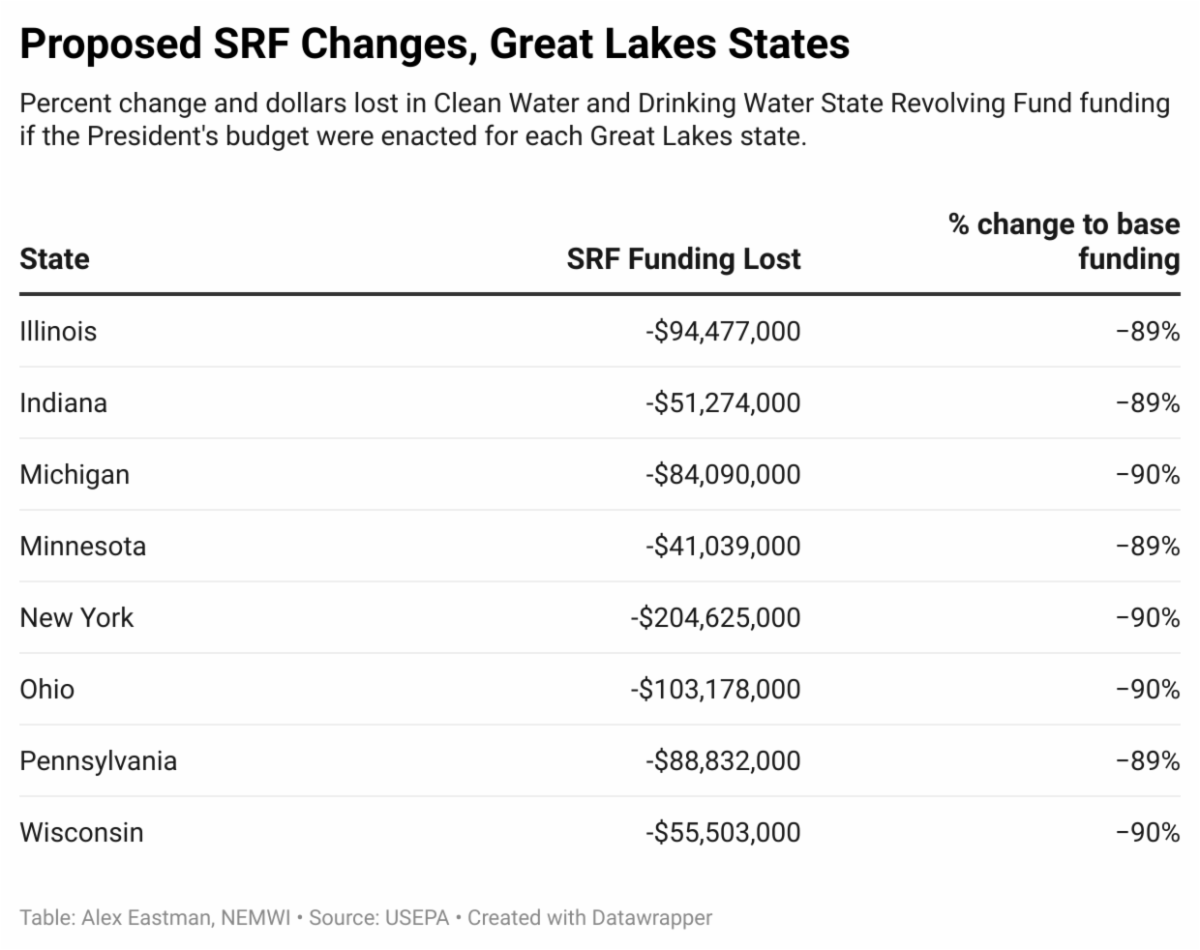
The EPA would see its budget cut by over 50%. A major casualty would be the Clean Water and Drinking Water State Revolving Funds, EPA programs that fund water infrastructure across the nation. The CWSRF was funded at $1.639 billion and the DWSRF at $1.126 billion in FY25, but the budget would cut funding by 90%, to $155 million and $150 million, respectively. In the skinny budget, the administration justified these cuts by saying that WIFIA, a distinct water infrastructure program, could help fund these projects. This notion was already misguided, as WIFIA is a smaller program that complements the SRFs and is not intended or well-suited to replace them. Yet the budget seeks to cut WIFIA, too. The program, currently funded at $72.9 million, would be cut to just $8 million. See how SRF cuts would impact each Great Lakes state below.
| | | |
The budget would also reduce and eliminate several critical grant programs. Within the State and Tribal Assistance Grants, the budget calls for cuts to the Reducing Lead in Drinking Water Grant (from $22 million to $20 million), Technical Assistance for Wastewater Treatment Works (from $25.5 million to $10 million), and Brownfields Projects (from $98 million to $80 million). The budget also seeks to eliminate 16 EPA categorical grants totaling about $1 billion. Among these are several critical Great Lakes accounts: Beach grants, which fund water quality monitoring and communication with the public in the event of unsafe conditions, section 319 non-point source grants, which provide funding to states and tribes to combat non-point source pollution and improve water quality, and the Brownfields Grant Program. The one bright spot in the EPA budget is the request of $368 million, equal to FY25 levels, for the Great Lakes Restoration Initiative.
Additionally, the Transportation Department budget requests $550 million for the Maritime Administration’s (MARAD) Port Infrastructure Development Program (PIDP), up from just $120 million in FY24 and $212 million in FY23. The PIDP will also receive $450 million from the Infrastructure Investment and Jobs Act (IIJA) in FY26, which would bring the total appropriation to $1 billion. This is especially critical to the Great Lakes region given that the PIDP has begun to give a more equitable share of funds to Great Lakes ports. Last year, Great Lakes ports received 13% of PIDP funding, up from just 2% the year prior.
NOAA has not yet published details on its budget. NOAA’s budget would be cut by $1.5 billion, about one-quarter of its $6.7 billion budget. The budget eliminates the Office of Oceanic and Atmospheric Research (OAR), which could lead to severe cuts to harmful algal bloom research and would zero out funding for the Great Lakes Observing System and the Cooperative Institute for Great Lakes Research, among other programs. The budget would also slash the budgets of the National Ocean Service by over 30% and NOAA Fisheries by 27%. Commerce Secretary Howard Lutnick will be on Capitol Hill Wednesday and Thursday of this week to defend these cuts to Congress (see below).
Once NOAA releases its Congressional Justification, NEMWI will analyze the impact of Trump Administration cuts on these and other critical Great Lakes programs.
| | | |
NEMWI Hosts GLPOP Session on PFAS
The Northeast-Midwest Institute hosted the second session of its Great Lakes Primer and Orientation Program on Wednesday, May 28th. The briefing concerned PFAS, a “forever chemical” ubiquitous in everyday products that poses dangers to human health, especially in drinking water. The Primer program is made possible with the generous support of the Erb Family Foundation.
Marta Venier, from the O’Neill School of Public and Environmental Affairs at Indiana University, gave an overview of PFAS and their properties, uses, and impacts. Dr. Venier also discussed how PFAS exposure can happen, including in drinking water, food and food packaging, and dust inhalation. One worrying exposure pathway is through contaminated fish. PFAS bio-accumulate and bio-magnify in animals, meaning that concentrations are higher as an individual grows and higher toward the top of the food chain. An older fish will have a higher concentration of PFAS than a younger fish, and an apex predator will have a higher concentration of PFAS than a primary consumer. Studies have shown both bio-accumulation and bio-magnification in Great Lakes organisms, and have shown a higher level of PFAS than other “legacy” contaminants like PCBs or pesticides. Fortunately, however, PFAS levels are lower in the fillet than other parts of the fish. Still, there are places in the Great Lakes where consuming certain fish could increase an individual’s PFAS exposure. “PFAS are one of the top compounds driving fish consumption advisories... they represent now one of the major reasons for concern for these advisories,” Dr. Venier said.
Cathy Martin, Senior Coordinator of Drinking Water Policy at the National Wildlife Federation’s Great Lakes Regional Center, presented on PFAS in agriculture. Particularly, PFAS are present in bio-solids, a byproduct of wastewater treatment commonly used to fertilize farm fields. When these bio-solids are contaminated with PFAS, they can render farmland unusable. PFAS are also found in commercially-available fertilizer. Martin gave an example of what happened in Maine after the state tested farmland and found that 80 sites were impacted. “Some farms were able to alter what they produced or where they produced to continue production... others had to close permanently,” she said. Potential policy solutions could include relief funds for impacted farmers and providing funding and technical assistance for testing and remediation, as included in Susan Collins’ Relief for Farmers Hit With PFAS Act. Bio-solids testing a regulation may also be necessary. States across the country have funded testing and imposed limits for PFAS in bio-solids, and states also have required pretreatment of industrial discharges to limit the amount of PFAS entering sewers in the first place.
Erica Bloom from the Great Lakes PFAS Action Network addressed federal policy around PFAS and recent EPA actions. In 2024, the EPA announced the first-ever drinking water standards for PFAS, setting Maximum Contaminant Levels for PFOS, PFOA, HPFO-DA (Gen-X), PFNA, and PFHxS, as well as a Hazard Index that would regulate combinations of these PFAS even if none of them were over the threshold individually. Water treatment plants would be required to complete testing by 2027 and the standards would go into effect in 2029. The Trump EPA has kept the MCLs for PFOA and PFOS, the two largest PFAS, but delayed enforcement until 2031, and rolled back the other standards entirely. “The announcement ensures that Americans will be drinking PFAS for another decade,” Bloom said. “The PFAS contamination crisis is much more than just two PFAS chemicals – PFOS and PFOA,” she added. “The cost of PFAS pollution will fall on ordinary people, who will pay in the form of polluted water, and more sickness.”
Finally, Tony Spaniola, also of the Great Lakes PFAS Action Network, spoke on contaminated sites, especially military bases. Spaniola has long been involved in PFAS advocacy in his hometown of Oscoda, MI, which faces PFAS contamination from an Air Force base. “The Department of Defense is the largest PFAS polluter in the United States, with more than 700 contaminated military sites across the country,” Spaniola said. This is primarily because of the use of PFAS in firefighting foam. The Defense Department was slow to react and limit PFAS use and runoff. “As a result of the inaction, Oscoda is subject to five separate public health warnings due to the Air Force’s PFAS contamination,” he said. Residents cannot eat fish in the Au Sable River, drink water from many residential wells, or consume venison and other game. “These problems devastated our way of life, our health, and our economy, and have placed a tremendous financial burden on our local governments and our taxpayers,” Spaniola stated. Oscoda developed a roadmap to limit PFAS exposure and uplift community voices which developed into a Defense Department directive which aims to speed up cleanup in collaboration with experts on the ground. Spaniola also mentioned the PFAS Task Force, a bipartisan group of Congresspeople working toward solutions on PFAS. “I am proud that the bipartisan Congressional PFAS Task Force was born out of advocacy in Oscoda... those Members have been key champions in this fight.” Spaniola said. “This is not a partisan issue; it is a public health emergency, and our response must be rooted in cooperation and urgency.”
If you missed the briefing, watch the recording here. View a collection of NEMWI’s recent briefings here.
| | | |
Connect With the Northeast-Midwest Institute
on Social Media
The Northeast-Midwest Institute is on social media with new updates and information on its regional research and policy education program and with announcements for upcoming briefings and events. NEMWI is posting our research reports on current regional issues and ongoing policy education on the page to make keeping up with our policy work easier than ever. The Institute also is updating the page with announcements of upcoming policy briefings and webinars. NEMWI is excited for the opportunity to connect with as many people as possible.
Please check out our LinkedIn here, our Twitter/X here, our Facebook here, and our Bluesky here. Be sure to like and follow us to keep up to date with NEMWI!
On Bluesky, also check out our Great Lakes feed at "NEMW Great Lakes Feed" and if you are a Great Lakes organization on Bluesky, contact Great Lakes Program Manager Alex Eastman at aeastman@nemw.org so that we can add your posts to the feed!
| | | |
|
Great Lakes Events
(all times eastern)
| | | |
Capitol Hill Ocean Week
Tuesday, June 3rd - Thursday June 5th | Ronald Reagan Building and International Trade Center
1300 Pennsylvania Avenue NW, 20004, Washington, DC, United States | Register here
Host: National Marine Sanctuary Foundation
Sandy Shorelines and Seiches: Information Workshop for Waterfront Landowners
Friday, June 13th | 1:00-4:00 pm | Sunset Bay Volunteer Fire Station 1, 12798 Allegany Road, Irving, NY 14081 | Register here
Host: New York Sea Grant, NYSDEC
|
| |
In the House:
Hearing: Oversight Hearing titled Restoring American Seafood Competitiveness.
Wednesday, June 4th | 10:15 AM | 1324 Longworth HOB
Host: Committee on Natural Resources | Subcommittee on Water, Wildlife and Fisheries
Hearing: "The Future of the Coast Guard: Review of Coast Guard Programs and Structure"
Thursday, June 5th | 10:00 AM | 2167 Rayburn HOB
Host: Committee on Transportation and Infrastructure | Subcommittee on Coast Guard and Maritime Transportation
Hearing: Budget Hearing Fiscal Year 2026 Request for the Department of Commerce
Thursday, June 5th | 11:00 AM | 2359 Rayburn HOB
Host: Committee on Appropriations | Subcommittee on Commerce, Justice, Science, and Related Agencies
In the Senate:
Hearings to examine proposed budget estimates for fiscal year 2026 for the Department of Commerce.
Wednesday, June 4th | 10:00 AM | SD-192
Host: Committee on Appropriations | Subcommittee on Commerce, Justice, Science, and Related Agencies
| | | | |