|
NEMWI Weekly
Update
September 29th, 2025
| |
| |
NEMWI To Host Briefing on State Revolving Funds
The Northeast-Midwest Institute will host the fifth session of the Great Lakes Primer and Orientation Program on the Clean Water and Drinking Water state revolving funds. The session will be held virtually on the GoToMeeting platform Thursday, October 9th, from 1:00-2:00 p.m. (EDT). NEMWI’s Great Lakes Primer and Orientation Program is sponsored by the Erb Family Foundation.
The Clean Water and Drinking Water State Revolving Funds (SRFs) are a critical avenue for water infrastructure funding for the country, and especially for the Great Lakes region. Annual appropriations from Congress sustain this revolving loan program, which provides low-interest loans for water infrastructure investments. State agencies develop intended use plans in consultation with the federal government to direct those dollars to the most urgent and high-impact projects throughout each state.
Recently, federal SRF appropriations have included Congressionally-directed projects, often in the form of grants, which when taken out of the SRF capitalization grants, could threaten the fiscal sustainability of the revolving loan funds in future years.
This briefing will feature speakers from the Great Lakes Commission as well as state SRF managers to give insight into the perspective on the ground and the outlook for the region. Speakers will include:
- Eric Brown, Director of Policy and Government Affairs, Great Lakes Commission;
- James Polidori, Senior Program Specialist, Great Lakes Commission;
- Becky Scott, Environmental Loans Section Manager, Wisconsin Department of Natural Resources;
- Matt Marcum, Environmental Loans Section Manager, Wisconsin Department of Natural Resources;
- Pam Foster, Clean Water Revolving Fund Coordinator, Minnesota Pollution Control Agency;
- Karin Berkholtz, Deputy Director, Minnesota Public Facilities Authority.
| | | |
NEMWI To Host Event on Great Lakes Marine Sanctuaries
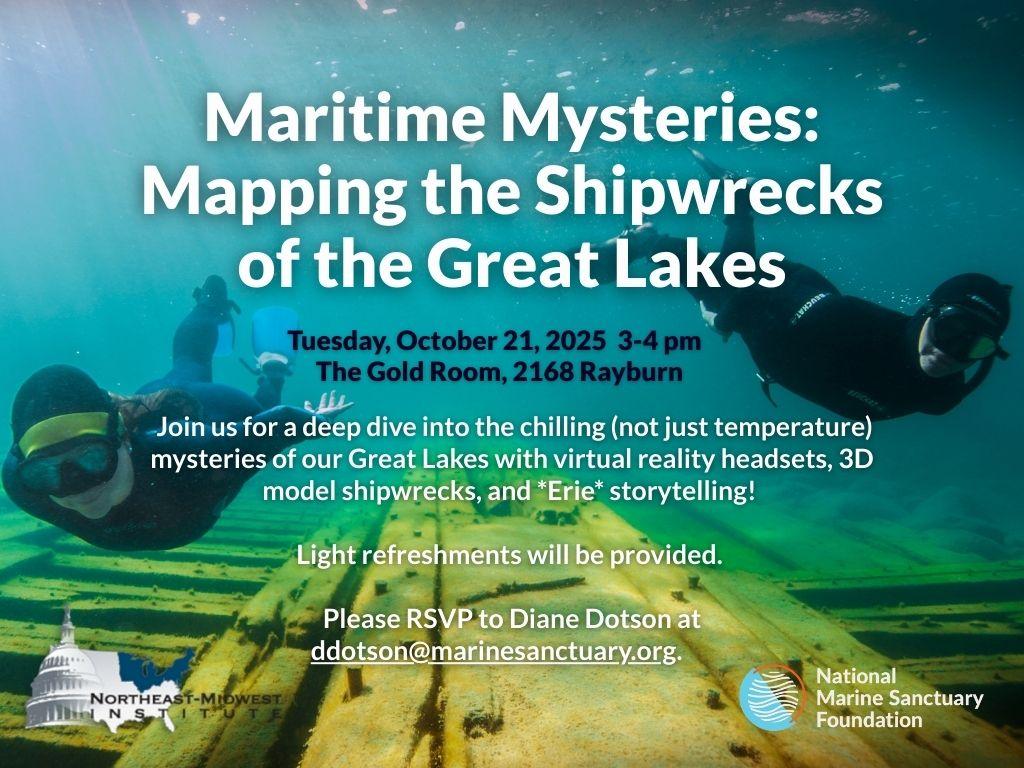
The Northeast-Midwest Institute and the National Marine Sanctuary Foundation will co-host a Congressional briefing on Great Lakes marine sanctuaries on Tuesday, October 21st from 3:00-4:00 p.m. in Rayburn 2168. The briefing is a session of NEMWI’s Great Lakes Primer and Orientation Program, sponsored by the Erb Family Foundation.
Join us for a deep dive into the chilling mysteries of the Great Lakes with virtual reality headsets, 3-D shipwreck models, and *Erie* storytelling!
Covering about 10,000 miles of coastline, America’s Great Lakes serve as gateways for trade and tourism, centers for biodiversity and science innovation, and underwater museums for national maritime heritage. Only about 15% of these lakebeds are mapped to modern standards, leaving huge gaps in the data needed to create updated nautical charts, discover untold stories and shipwrecks, and manage the region’s extraordinary natural and cultural resources. The recent designations of national marine sanctuaries in the Great Lakes have led to intensive mapping efforts and new discoveries by NOAA and its commercial, academic, and federal partners. The answers to many maritime mysteries lie in the depths of these largely unexplored waters, preserving evidence and glimpses into the past, for those who dare to discover. The briefing will focus on the network of America’s premier marine places in the Great Lakes and the new discoveries, innovative technologies, and immersive experiences benefiting their communities.
Light refreshments will be provided.
Please RSVP to Diane Dotson at ddotson@marinesanctuary.org.
| | |
|
OMB Makes RIF Threat Amid Looming Government Shutdown
Congress appears to be careening toward a government shutdown on October 1 as Republicans and Democrats remain at an impasse on federal funding. The federal fiscal year ends on Tuesday at midnight, and if appropriations are not signed into law by then, the government will shut down. The House last week passed a generally clean continuing resolution (CR) although with new security funding that would extend current spending levels through November 21st, but it failed to pass the Senate, which would require a filibuster-proof 60-vote majority, and therefore, Democratic votes. The Senate plans to vote on the House proposal again on Tuesday, while the House is scheduled to continue to be out of session all week. The government is already operating under a full-year CR after an agreement on passing spending bills could not be reached last year.
The implications of a shutdown could be massive. The executive branch has wide discretion over what stays open during a shutdown and what does not, and the Trump administration is widely expected to take a narrow view of what constitutes “essential” work. The Office of Management and Budget last week sent out a memo instructing agency heads to “explore reduction in force (RIF) notices” for all employees working on programs that would run out of funding under a shutdown, did not receive additional funding under the Big Beautiful Bill Act that passed earlier this year, and are “not consistent with the President’s priorities.” Typically, during a shutdown, employees deemed non-essential would be furloughed but rehired after the shutdown ends. The OMB memo opens the door to laying off large swaths of federal workers permanently. At the Environmental Protection Agency, for example, upwards of 15,440 employees – 92% of the EPA’s workforce – would be vulnerable to a RIF if the threat is carried out.
Democratic negotiators have approached the memo as an intimidation tactic. “Donald Trump has been firing federal workers since day one—not to govern, but to scare. This is nothing new and has nothing to do with funding the government,” Senate Majority Leader Chuck Schumer (D-NY) said.
Leadership at many agencies are also reportedly playing down the threat to their workers, according to the Government Executive. By and large, the article says, “agency officials are telling employees they will face their normal shutdown furloughs, but not reduction-in-force notices.” Such dramatic layoffs would also surely invite court challenges, and the administration could also face pressure to rehire workers, especially at agencies which already have rehired many workers fired earlier this year.
During any shutdown, even federal workers deemed essential and required to work would be working without pay until an eventual resolution to the shutdown is reached with new Congressional funding.
| |
NEMWI Updates Manufacturing Legislative Tracker
The Northeast-Midwest Institute has updated its Manufacturing Legislative Tracker to reflect recent Congressional activity, including the Standardizing Permitting and Expediting Economic Development (SPEED) Act. The SPEED Act is a bipartisan bill put forth by Natural Resources Chairman Bruce Westerman (R-AK) and Representative Jared Golden (D-ME) which recently received a hearing in the House Natural Resources Committee.
The bill aims to streamline the permitting process by targeting the National Environmental Protection Act (NEPA), a procedural statute established in 1969 that requires certain environmental standards be met by all federal projects (including private projects that receive any form of federal funding). The proposed NEPA reforms include relaxing agencies’ parameters for analysis, limiting the definition of “Major Federal Action” so as not to include projects that receive a small portion federal funding, and limiting judicial review, especially by setting a 150-day statute of limitations from when a project begins building to make NEPA claims. The bill goes hand in hand with the e-Permit Act, which would digitize and consolidate permitting across agencies.
Rep. Westerman argued in the hearing that SPEED will treat every project as “blind” and cites the fact that partisan weaponization of NEPA has limited productive projects in both the clean energy and fossil fuel industries.
In the first panel of the hearing, there were three witnesses supporting the SPEED Act and one environmental law professor against. Those in support made the case for permitting reform. They decried “frivolous litigation” which they claimed usually only serves to delay projects—for an average of four years—and rarely actually changes outcomes. Thomas Hochman of the Foundation for American Innovation argued that NEPA delays actually hurt low carbon projects the most. Witnesses also advocated permitting reform as necessary to keep up with China, a point echoed by many representatives.
Opponents of the bill expressed a wish that it address the Trump administration’s recent cancellations of various wind and solar projects. Ranking Member Jared Huffman (D-CA) argued that the entire meeting was a “sham” without a discussion of Trump’s rollback of clean energy. Others worried that the bill would hollow out NEPA and disincentivize federal agencies from taking a hard and fair look at upcoming projects. They also expressed concern that the SPEED Act may force NEPA to align more with private projects’ goals as opposed to its intended function as an independent analysis.
Overall, those in favor of the SPEED Act believe it a necessary action to take towards permitting and judicial reform, allowing the U.S. to secure a competitive advantage in critical mineral and other projects, and offset the recent rise in energy prices. However, those opposed believe that litigation by citizens is crucial to NEPA’s structure, and the SPEED Act removes many of the environmental precautions that NEPA currently protects. Opponents did leave the door open for a compromise. Seth Magaziner (D-RI) wanted to find “a balance between making it easier to build and protecting our environment,” he said.
View the latest Manufacturing Legislative Tracker here.
Reported by NEMWI Intern Roxie Gosfield, Dartmouth College
| | | |
GLC Holds Webinar on Approaches to Great Lakes Resiliency
The Great Lakes Commission hosted the third and final webinar of their Realizing Resilience series on September 23 to share various organizations’ approaches to resilience implementation efforts for the Great Lakes Basin. Speakers referred to the goals of the GLC Action Plan for a Resilient Great Lakes Basin, which helps prioritize basin-wide efforts and forms a roadmap to advance climate resilience in the region. Community, infrastructural, economic, and ecosystem resiliency are critical for the basin to withstand and adapt to climate-related stressors and changing conditions.
State Senator Laura Ellman (D-IL) shared the climate-resilient efforts of the Great Lakes St. Lawrence Legislative Caucus (GLLC). The GLLC has five main focuses: water consumption, aquatic invasive species, coastal resiliency, nutrient management, and toxic substances. The GLLC emphasizes the role of state and provincial legislators in regional studies within the Great Lakes. Their 2025 action items include ongoing education on adapting to changing weather patterns, maintaining partnerships with organizations such as the GLC, growing and maintaining the U.S. Great Lakes Waterfront Trail, and continuing to track 33 pieces of pending legislation from 2024 and 2025.
From the Detroit/Wayne County Port Authority, Executive Director Mark Schrupp and Sustainability Manager Taylor Mitchell discussed the advancement of decarbonizing the maritime industry in Detroit, MI. The port oversees 8 million tons of cargo annually, including international and domestic commodities such as steel, aluminum, and cement. In October 2024, the port authority received two grants from the EPA’s Clean Ports Program to aid in its green transition. These initiatives included a $21.9 million grant to implement zero-emission equipment, including items like forklift trucks, railcar movers, and patrol boats. They also received a $3 million grant for port-wide zero emission fuel. This EPA grant initiated research for the use of hydrogen fuel and the implementation of a zero-emission power barge system.
Finally, Acting Director Mark Burrows and Physical Scientist Rajesh Bejankiwar spoke on behalf of the International Joint Commission (IJC). The IJC compiled their Great Lakes Climate Adaptation Resource Guide in hopes of helping local and regional communities. This guide begins with Volume Ⅰ, an overview of the Great Lakes and the framework to determine a community’s role in climate adaptation. This includes understanding risks, investigating options, assessing vulnerability to climate change, and strategy planning. Volume Ⅱ provides hundreds of sources to help educate and empower small to medium-sized communities.
Reported by NEMWI Intern Christina Uytingco, University of Michigan
| |
Connect With the Northeast-Midwest Institute
on Social Media
The Northeast-Midwest Institute is on social media with new updates and information on its regional research and policy education program and with announcements for upcoming briefings and events. NEMWI is posting our research reports on current regional issues and ongoing policy education on the page to make keeping up with our policy work easier than ever. The Institute also is updating the page with announcements of upcoming policy briefings and webinars. NEMWI is excited for the opportunity to connect with as many people as possible.
Please check out our LinkedIn here, our Twitter/X here, our Facebook here, and our Bluesky here. Be sure to like and follow us to keep up to date with NEMWI!
On Bluesky, also check out our Great Lakes feed at "NEMW Great Lakes Feed" and if you are a Great Lakes organization on Bluesky, contact Great Lakes Program Manager Alex Eastman at aeastman@nemw.org so that we can add your posts to the feed!
| | | |
|
Great Lakes Events
(all times eastern)
| | | |
In the House:
The House has district work periods this week.
In the Senate:
No relevant hearings this week.
| | | | |