|
NEMWI Weekly
Update
October 6th, 2025
| |
| |
NEMWI To Host Briefing on State Revolving Funds
The Northeast-Midwest Institute will host the fifth session of the Great Lakes Primer and Orientation Program on the Clean Water and Drinking Water state revolving funds. The session will be held virtually on the GoToMeeting platform this Thursday, October 9th, from 1:00-2:00 p.m. (EDT). NEMWI’s Great Lakes Primer and Orientation Program is sponsored by the Erb Family Foundation.
The Clean Water and Drinking Water State Revolving Funds (SRFs) are a critical avenue for water infrastructure funding for the country, and especially for the Great Lakes region. Annual appropriations from Congress sustain this revolving loan program, which provides low-interest loans for water infrastructure investments. State agencies develop intended use plans in consultation with the federal government to direct those dollars to the most urgent and high-impact projects throughout each state.
Recently, federal SRF appropriations have included Congressionally-directed projects, often in the form of grants, which when taken out of the SRF capitalization grants, could threaten the fiscal sustainability of the revolving loan funds in future years.
This briefing will feature speakers from the Great Lakes Commission as well as state SRF managers to give insight into the perspective on the ground and the outlook for the region. Speakers will include:
- Eric Brown, Director of Policy and Government Affairs, Great Lakes Commission;
- James Polidori, Senior Program Specialist, Great Lakes Commission;
- Becky Scott, Environmental Loans Section Manager, Wisconsin Department of Natural Resources;
- Matt Marcum, Environmental Loans Section Manager, Wisconsin Department of Natural Resources;
- Pam Foster, Clean Water Revolving Fund Coordinator, Minnesota Pollution Control Agency;
- Karin Berkholtz, Deputy Director, Minnesota Public Facilities Authority.
| | | |
NEMWI To Host Event on Great Lakes Marine Sanctuaries
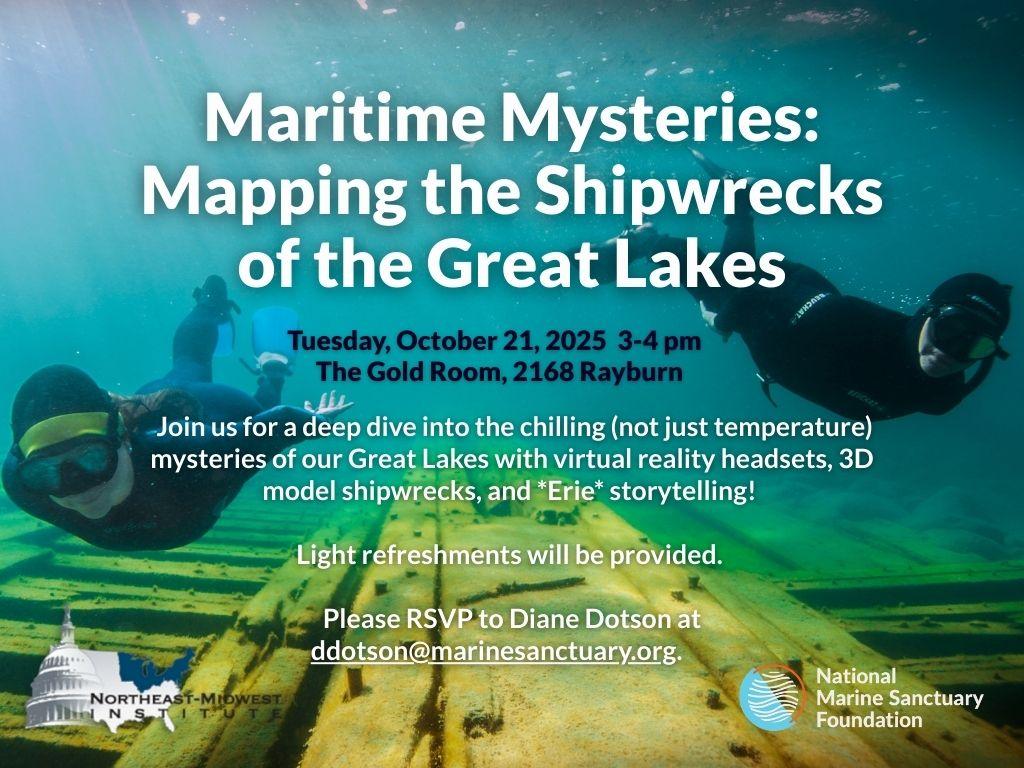
The Northeast-Midwest Institute and the National Marine Sanctuary Foundation will co-host a Congressional briefing on Great Lakes marine sanctuaries on Tuesday, October 21st from 3:00-4:00 p.m. in Rayburn 2168. The briefing is a session of NEMWI’s Great Lakes Primer and Orientation Program, sponsored by the Erb Family Foundation.
Join us for a deep dive into the chilling mysteries of the Great Lakes with virtual reality headsets, 3-D shipwreck models, and *Erie* storytelling!
Covering about 10,000 miles of coastline, America’s Great Lakes serve as gateways for trade and tourism, centers for biodiversity and science innovation, and underwater museums for national maritime heritage. Only about 15% of these lakebeds are mapped to modern standards, leaving huge gaps in the data needed to create updated nautical charts, discover untold stories and shipwrecks, and manage the region’s extraordinary natural and cultural resources. The recent designations of national marine sanctuaries in the Great Lakes have led to intensive mapping efforts and new discoveries by NOAA and its commercial, academic, and federal partners. The answers to many maritime mysteries lie in the depths of these largely unexplored waters, preserving evidence and glimpses into the past, for those who dare to discover. The briefing will focus on the network of America’s premier marine places in the Great Lakes and the new discoveries, innovative technologies, and immersive experiences benefiting their communities.
Light refreshments will be provided.
Please RSVP to Diane Dotson at ddotson@marinesanctuary.org.
| | |
|
Costs Mount As Government Shutdown Continues
The government shutdown continues to drag on with no end in sight. The Senate has held multiple votes on a House-passed clean continuing resolution (CR) that would extend current spending levels through November 21st and a Democratic-led bill that includes a flat CR plus reversals of the One Big Beautiful Bill Act’s Medicaid cuts, extension of Obamacare subsidies, reversals of recissions passed by Congress last month to public radio and foreign aid, and restrictions on the Trump Administration’s ability to freeze federal funds. Neither bill has garnered the 60 votes needed to override a filibuster. The Senate will continue to hold votes on both proposals throughout the week. The House remains out of session this week despite having been scheduled to return, aiming to pressure the Senate to accept the clean CR. Though things can change, it is hard to see a quick resolution. Most observers expect the shutdown to last at least another week.
The impacts of the shutdown, meanwhile, are being felt more and more acutely. National parks have thus far stayed open, albeit with reduced personnel. Flight delays, which sometimes occur during shutdowns, have reportedly been limited. But the Trump administration has used the shutdown as an excuse to continue slashing federal funding. The Department of Energy last week cut 223 clean energy projects totaling $7.6 billion, all in states that voted for Kamala Harris in the 2024 election. The administration also cut $18 billion in infrastructure projects in New York, the home state of Democratic leaders Sen. Chuck Schumer (D-NY) and Rep. Hakeem Jefferies (D-NY), and $2.1 billion for transit projects in Chicago, Illinois. The cuts, apparently politically targeted, were hinted at by the President ahead of the shutdown. “We can get rid of a lot of things that we didn’t want, and they’d be Democrat things,” he said. Legal challenges are expected, and more cuts may be announced this week.
While many workers have been furloughed, the mass layoffs threatened by the Office of Management and Budget so far have not come to pass, despite OMB director Russell Vought telling Congressional Republicans on Wednesday to expect such layoffs in “one or two” days. Kevin Hassett, Director of the National Economic Council, repeated the threat today, however. "If the president decides that the negotiations are absolutely going nowhere, then there will start to be layoffs,” Hassett said. “But I think that everybody is still hopeful that when we get a fresh start at the beginning of the week, that we can get the Democrats to see that it's just common sense to avoid layoffs like that." This New York Times analysis of federal furloughs (workers who are labeled “non-essential,” but will return to work after the shutdown) provides insight into the power of the executive branch to use a shutdown to advance their priorities. At the Environmental Protection Agency (89% of workers furloughed); Department of Education (87%); and Department of Commerce (81%), which includes the National Oceanic and Atmospheric Administration; the vast majority of workers have been deemed “non-essential,” and are not coming in to work. The opposite is true at the Department of Transportation (23%); Department of Homeland Security (5%), which includes Immigration and Customs Enforcement; and the Office of Management and Budget (10%). Both essential and non-essential workers will go without pay but will receive back pay after the shutdown is over under the Government Employee Fair Treatment Act of 2019.
| |
Muskegon Lake Removed from Great Lakes Areas of Concern List
The U.S. Environmental Protection Agency (EPA) and the Michigan Department of Environment, Great Lakes, and Energy (EGLE) announced that Muskegon Lake has been officially removed from the list of Great Lakes Areas of Concern (AOCs), marking the successful cleanup and restoration of one of the region’s most historically degraded waterways.
Spanning more than 4,000 acres and flowing into Lake Michigan, Muskegon Lake was designated an AOC in 1985 due to decades of industrial pollution, habitat loss, and contaminated sediment. Its delisting represents the culmination of decades of collaboration among federal, state, local, and tribal partners working to restore water quality, fish and wildlife habitat, and recreational use. Muskegon Lake is now the eighth U.S. Area of Concern to be delisted, and the seventh since the beginning of the Great Lakes Restoration Initiative (GLRI) in 2010.
“The successful cleanup and restoration of the Muskegon Lake Area of Concern, achieved through decades of dedicated effort, marks a significant milestone in our ongoing work to restore and protect the Great Lakes,” said EPA Region 5 Administrator and Great Lakes National Program Manager Anne Vogel. “This accomplishment showcases the commitment and collaborative spirit of our partners in restoring not just the lake, but also the habitats and recreational opportunities that had been lost for so long.”
Federal, state, and local project partners remediated more than 190,000 cubic yards of contaminated sediment through projects totaling approximately $47 million. EPA provided $21 million from the GLRI and $9.2 million through its predecessor, the Great Lakes Legacy Act. These investments leveraged an additional $16.3 million in state and local contributions.
Seven major habitat restoration projects, supported by $38 million in GLRI funding, restored approximately 134 acres of habitat and more than 6,000 feet of shoreline. These projects reestablished nearly 100 acres of open water and wetlands and removed more than 110,000 tons of sawmill debris from the lakebed, improving conditions for fish, wildlife, and invertebrates.
According to a study by Grand Valley State University, the restoration of Muskegon Lake is projected to increase local home values by nearly $8 million and generate $28 million annually in recreation-related economic activity. The community already has seen a 19% increase in marina visitors and a 45% rise in county hotel tax revenue, translating to an estimated 6-to-1 return on investment.
“Muskegon Lake’s recovery demonstrates what is possible when communities come together to restore and protect their natural resources,” said EGLE Director Phil Roos. “This achievement represents a tremendous local and regional success story—and a foundation for continued stewardship in the years ahead,” he said.
The delisting of Muskegon Lake marks another step forward in the long-term restoration of the Great Lakes. Of the 31 U.S. Areas of Concern originally designated under the 1987 Great Lakes Water Quality Agreement, eight have now been delisted following extensive cleanup and restoration work supported through the Great Lakes Restoration Initiative and partner investments.
Reported by NEMWI Intern Rachael Stein, University of Colorado at Boulder Graduate Student
| | | |
STRATEGIC Minerals Act Reintroduced in the Senate
U.S. Senators Todd Young (R-IN), Chris Coons (D-DE), John Cornyn (R-TX), and John Hickenlooper (D-CO) have reintroduced the Securing Trade and Resources for Advanced Technology, Economic Growth, and International Commerce (STRATEGIC) Minerals Act, aimed at strengthening the United States’ critical minerals and rare earth elements (REEs) supply chains. The bill addresses growing national and economic security concerns stemming from U.S. dependence on adversarial nations for these vital resources.
“Negotiating more trade agreements specific to critical minerals with trusted partners will help shore up our supply of these resources, protect American interests, and strengthen our national security,” Senator Young said in a press release.
The STRATEGIC Minerals Act seeks to: secure reliable access to critical minerals and REEs essential for U.S. industries such as defense, clean energy, and advanced technology; reduce U.S. reliance on China, which currently dominates global supply chains in this sector; and promote economic and national security by fostering strategic trade partnerships focused solely on critical minerals.
The reintroduction of this bill signals an increasing prioritization of national security, and push for reduced dependency on adversarial nations, especially China. This bipartisan bill aims to position the U.S. for long-term leadership in key strategic industries. The STRATEGIC Minerals Act was referred to the Committee on Finance, and currently awaits further action.
For more information on this bill and others impacting this sector, see NEMWI’s Critical Minerals Legislation Tracker here.
Reported by NEMWI Intern Christina Mina, University of Texas at Dallas
| |
Great Lakes and St. Lawrence Cities Initiative Holds Webinar on Resilient Great Lakes Coasts
The Great Lakes and St. Lawrence Cities Initiative hosted an introductory webinar last Wednesday on the Initiative for Resilient Great Lakes Coasts. The initiative is a collaborative program between the Great Lakes and St. Lawrence Cities Initiative and the National Oceanic and Atmospheric Administration (NOAA), which also includes engineering consultants Dewberry and LimnoTech. The initiative supports locally-driven efforts to restore, protect, and enhance fish and wildlife habitat while building resilience in vulnerable coastal areas. With the Great Lakes region facing growing challenges such as flooding, shoreline erosion, limited staff capacity, and insufficient funding, the Initiative for Resilient Great Lakes Coasts provides communities with a sustainable plan for healthy ecosystems, economies, and environments.
Zoë Kuntze, Senior Coastal Programs Manager at the Great Lakes and St. Lawrence Cities Initiative, discussed the project implementation process for interested communities along the Great Lakes. In the first phase of the program, the initiative provides training, technical assistance, and workshops on habitat restoration and resilience to communities interested in the program. Next, the technical consultants at Dewberry and LimnoTech offer one-on-one support to the communities for project conception and development. During the third phase, projects are prioritized and selected for engineering and design planning support.
To showcase projects in the program, the panel conducted an overview of two of them. The first project examined was the planning and implementation of flood solutions at East River Van Beaver Park in Green Bay, Wisconsin. Melissa Schmitz, Resiliency Coordinator for the City of Green Bay, explained that the park site and areas along the East River experience numerous challenges, including a long history of riverine flooding, invasive species, coastal erosion, and stormwater runoff. These issues greatly affect the communities nearby, harming local ecosystems, infrastructure, and economies. Through assistance from the initiative, solutions have begun to take shape, including flood storage increases, wetland restoration and creation, shoreline stabilization, and community engagement. In her conclusion, Schmitz emphasized that the program is key for project advancement, especially for communities with funding and staffing constraints.
The second project pertained to dune restoration and stormwater runoff at Oscoda Beach Park in Oscoda, Michigan. Township Engineer Rick Freeman discussed the ongoing issues at the park, stating that the area had undergone coastal erosion, coastal flooding, boardwalk deterioration, and sand build-up. However, the combination of a Michigan Natural Resources Trust Fund grant and the Initiative for Resilient Great Lakes Coasts generated necessary solutions for the park. These included the installations of sand fencing, native dune grass, an elevated boardwalk, native trees, and rain garden detention ponds for improved stormwater management and dune restoration. These renovations, Freeman said, would enhance natural habitat, park amenities, and restoration efforts in the area.
Phase 1 of the program will run from November 2025 through March 2026 and will include training, technical support, and workshops. Phase II will continue from spring 2026 through summer 2027 and will entail project prioritization and selection followed by engineering and design planning support. Communities interested in participating in the program should fill out a brief expression of interest form by Friday, October 24th, available online here.
Two upcoming training webinars are being held: Nature-based Solutions for Coastal Hazards, Nov. 5 from 1-3 p.m. CT / 2-4 p.m. ET; and Diving into the Digital Coast, Nov. 19 from 1-2:30 p.m. CT / 2-3:30 p.m. ET. The registration form for these webinars will be sent to those who submit the expression of interest form.
For more information on the Initiative for Resilient Great Lakes Coasts contact Zoë Kuntze at the Great Lakes and St. Lawrence Cities Initiative (zoe.kuntze@glslcities.org) or Becky Nicodemus at NOAA (rebecca.nicodemus@noaa.gov).
Reported by NEMWI Intern Logan Rau, University of Michigan Graduate
| |
UCLA Hosts Webinar on Climate Policy and Overturning Endangerment Finding
The UCLA School of Law's Emmett Institute on Climate Change and the Environment hosted a webinar on September 29th titled "Up in the Air: Climate Policy Without the Endangerment Finding." The webinar, moderated by Cara Horowitz, Executive Director of the Emmett Institute on Climate Change and the Environment at UCLA School of Law, featured three panelists: Ann Carlson, Professor of Environmental Law at UCLA, founding Faculty Director of the Emmett Institute, and former Acting Administrator of NHTSA; Joseph Goffman, Former Assistant Administrator, Office of Air and Radiation at US EPA; and Karen McKinnon, Associate Professor at UCLA, who spoke about the long-term impacts of the current administration's mission in overturning the endangerment finding.
The endangerment finding is a scientific and regulatory determination by the EPA that six greenhouse gases, including carbon dioxide and methane, among others, are a threat to public health and welfare, based on scientific evidence of their role in causing climate change. This 2009 finding set the legal groundwork for the EPA to regulate these pollutants under the Clean Air Act.
On his first day in office, President Donald Trump issued an executive order requiring the EPA to conduct an investigation on the "legality and continued applicability" of the Endangerment Finding. Then, EPA Administrator Lee Zeldin released plans to repeal the finding.
The speakers discussed the administration's potential routes to overturn the endangerment finding, including prompting the Supreme Court to explicitly overturn Massachusetts v. EPA – the court case that became the legal justification for the EPA’s determination – or limit its original findings. This could pose long-term ramifications, as any change in Supreme Court precedent would require future administrations to go through the courts once again to issue changes, and opens the door for states to challenge future greenhouse gas regulations.
Goffman stated that "If the administration's ambitions are entirely fulfilled [...] it'll take the Clean Air Act off the board as a toolbox for climate policy. What the administration is assembling is what it hopes will be an impregnable wall against any future action to regulate greenhouse gases under the Clean Air Act”.
In July, the Department of Energy released a report titled "A Critical Review of Impacts of Greenhouse Gas Emissions on the U.S. Climate" that minimized the impact of greenhouse gases on the environment and public health. Dr. McKinnon described the misleading use of scientific research, including her own in that report.
"If you think about this being, in theory, what should be a trustworthy report from the federal government [...] we should not be having false or misleading claims about science coming in one of these government reports," McKinnon said.
Watch the full webinar here.
Reported by NEMWI Intern Christina Mina, University of Texas at Dallas.
| | |
|
Connect With the Northeast-Midwest Institute
on Social Media
The Northeast-Midwest Institute is on social media with new updates and information on its regional research and policy education program and with announcements for upcoming briefings and events. NEMWI is posting our research reports on current regional issues and ongoing policy education on the page to make keeping up with our policy work easier than ever. The Institute also is updating the page with announcements of upcoming policy briefings and webinars. NEMWI is excited for the opportunity to connect with as many people as possible.
Please check out our LinkedIn here, our Twitter/X here, our Facebook here, and our Bluesky here. Be sure to like and follow us to keep up to date with NEMWI!
On Bluesky, also check out our Great Lakes feed at "NEMW Great Lakes Feed" and if you are a Great Lakes organization on Bluesky, contact Great Lakes Program Manager Alex Eastman at aeastman@nemw.org so that we can add your posts to the feed!
| | | |
|
Great Lakes Events
(all times eastern)
| | | | | |